CELPIP Listening Error Analysis System: Fix Mistakes & Boost Score to CLB 9+
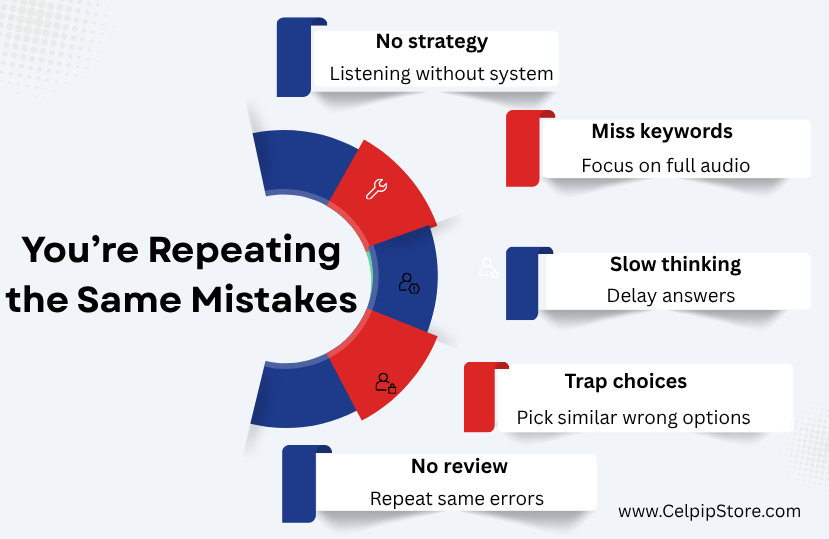
Most students do not fail CELPIP Listening because they “don’t understand English.” They lose marks because they repeat the same mistakes without realizing it.
If your score is stuck at CLB 6–8, the issue is not listening ability. It is error blindness the inability to identify why you are wrong.
High scorers don’t just practice more. They analyze better.
This lesson gives you a complete Error Analysis & Recovery System to systematically fix listening mistakes and improve accuracy step by step. To understand how error analysis fits into your overall CELPIP Listening preparation, explore CELPIP Listening Mastery: Complete Strategy for CLB 9.
Learning Objectives
By the end of this lesson, you will be able to:
- Identify your personal listening error patterns
- Categorize mistakes into clear types
- Fix weak areas using structured review methods
- Convert wrong answers into learning improvements
- Build a CLB 9+ improvement loop
- Reduce repeated mistakes in real exams
Overview: Why Most Students Don’t Improve
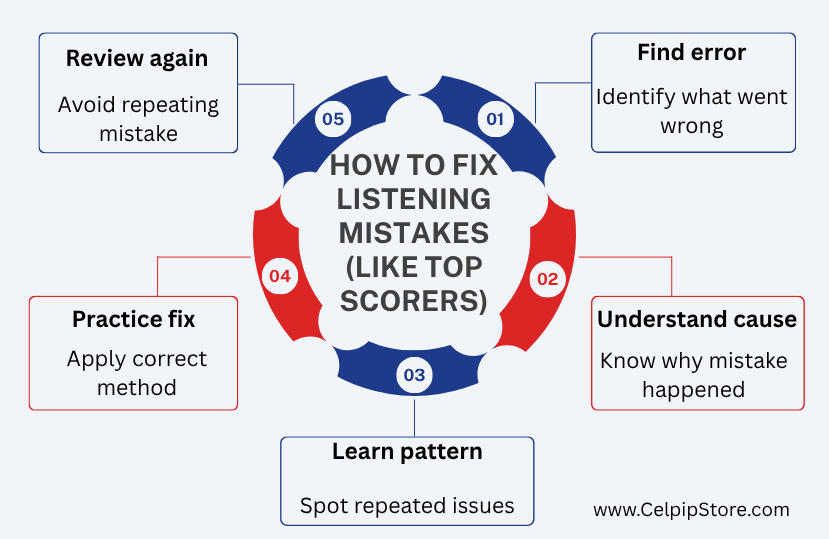
Many students practice listening daily but still don’t improve.
This happens because they:
- Only do practice tests
- Do not review mistakes deeply
- Ignore patterns in wrong answers
- Repeat the same thinking habits
Without analysis, practice becomes repetition not improvement.
The Core Idea of This System
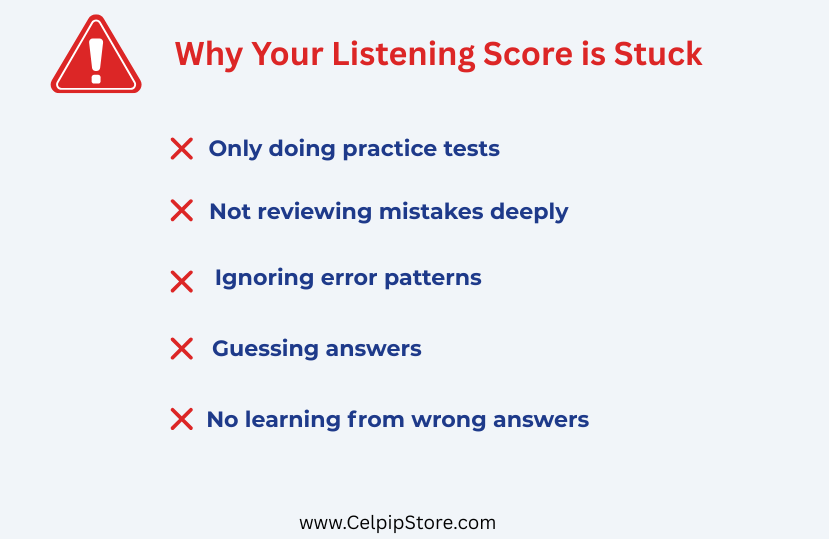
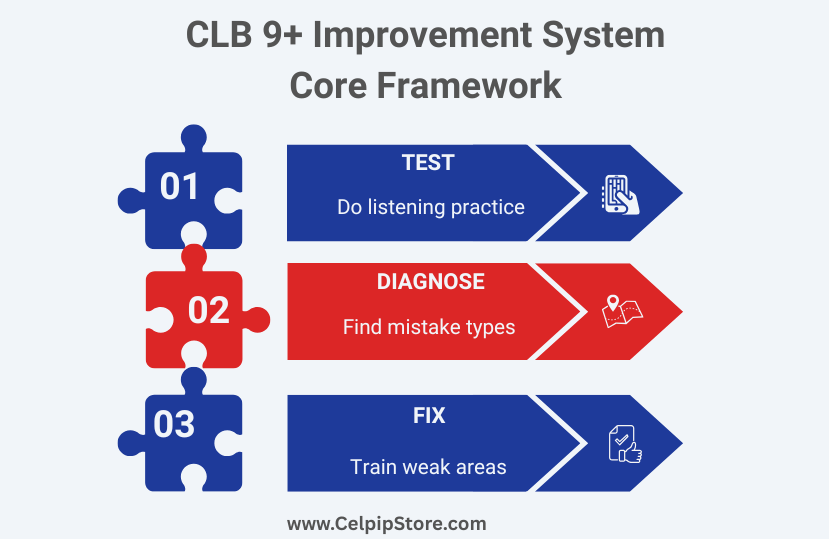
To improve Listening, you must follow a 3-Step Improvement Loop:
- Step 1: Test (Practice Listening)
- Step 2: Diagnose (Find Mistakes)
- Step 3: Fix (Train Weak Areas)
This loop transforms average learners into high scorers.
Common Mistakes (Why Students Keep Losing Marks)
Mistake 1: No Error Review
Students finish a test and move on.
Result: Same mistakes repeat again.
Mistake 2: Guess-Based Answers
Students choose answers without understanding why.
Result: No learning happens.
Mistake 3: Ignoring Audio Replays
They never check where understanding broke down.
Mistake 4: Confusing Words with Meaning
They match words instead of understanding full meaning.
Mistake 5: No Mistake Categories
All errors are treated as “just wrong.”
This blocks improvement. Identifying mistakes is an important step toward improvement, but you also need a complete listening framework. Learn more in CELPIP Listening Mastery: Complete Strategy for CLB 9.
The Truth About CELPIP Listening Improvement
Improvement does NOT come from doing more tests.
It comes from understanding your mistakes deeply.
1. The Core Error Analysis Framework (CLB 9 Recovery System)
To improve CELPIP Listening effectively, you must stop treating mistakes as random.
Instead, classify every mistake using a structured system.
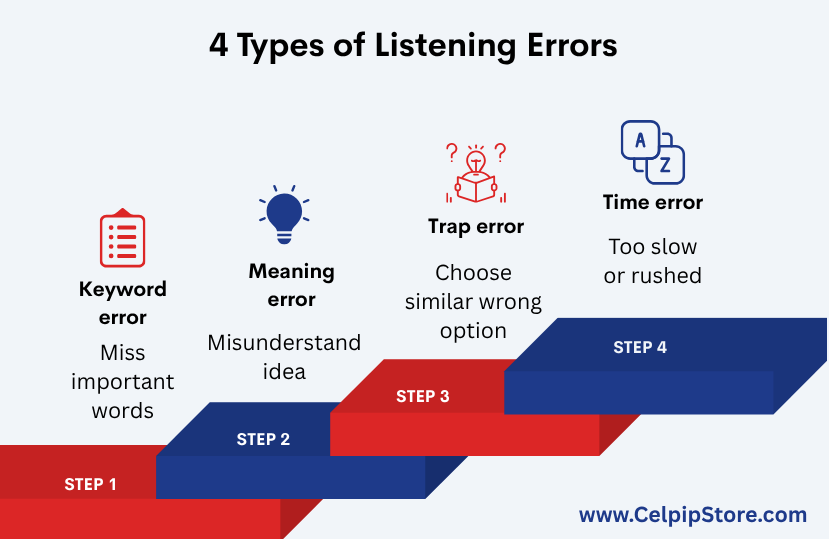
We use the 4-Category Error Model:
STEP 1: Keyword Error
You missed or misunderstood important words.
Examples:
- Names
- Numbers
- Dates
- Action verbs
This happens when focus is too weak or scattered.
STEP 2: Meaning Error
You understood words but not the full idea.
Example:
- Audio: “I can’t attend the meeting today.”
- You think: “He is busy” (partially correct but incomplete understanding)
Problem is interpretation, not listening.
STEP 3: Trap Error
You selected the wrong option due to similarity.
Common causes:
- Word matching traps
- Distractor options
- Partial truth answers
This is the most common CELPIP mistake type.
STEP 4: Attention Error
You missed information due to distraction or loss of focus.
Causes:
- Thinking about previous question
- Panic during audio
- Not reading question properly
2. The Recovery System (How to Fix Each Error Type)
Recovery for Keyword Errors
- Practice focused listening for numbers and names
- Slow down mental processing
- Underline keywords before listening
Train selective attention.
Recovery for Meaning Errors
- Practice paraphrasing sentences
- Learn synonyms and rephrasing patterns
- Ask: “What is the speaker really saying?”
Recovery for Trap Errors
- Always eliminate options first
- Compare full meaning, not words
- Train awareness of CELPIP distractors
This improves accuracy fastest.
Recovery for Attention Errors
- Practice full mock tests daily
- Improve concentration endurance
- Use “reset mindset” after every question
Train mental stability.
3. Error Mapping System (Advanced Technique)
After every practice test, create an error map:
- Write each wrong question number
- Identify error category
- Note why you chose wrong answer
- Rewrite correct logic
This creates pattern awareness.
4. High-Scorer Behavior Pattern
High scorers do NOT:
- Guess randomly
- Ignore mistakes
- Repeat the same practice blindly
Instead, they:
- Track every mistake
- Categorize errors
- Fix one weakness at a time
- Re-test after correction
1. Advanced Fixing Techniques (CLB 9+ Level Recovery)
At this stage, improvement is not about doing more tests. To strengthen your listening skills across different question types and reduce recurring errors, follow CELPIP Listening Mastery: Complete Strategy for CLB 9.
It is about fixing thinking patterns behind mistakes.
Technique 1: Reverse Answer Analysis
Take every wrong answer and ask:
- Why did this option look correct?
- What part of my thinking was wrong?
This builds awareness of trap patterns.
Technique 2: Audio Breakdown Method
Replay the section and divide it into:
- What I heard
- What I missed
- What I misunderstood
This isolates exact failure points.
Technique 3: Paraphrase Correction Drill
Convert wrong understanding into correct meaning.
Example:
- Wrong: “He is not going.”
- Correct: “He cancelled his plan today.”
This strengthens meaning-based listening.
Technique 4: Focus Reset Training
After every question:
- Reset mentally in 2 seconds
- Forget previous question
- Focus only on current audio
Prevents attention loss errors.
2. Examiner Insights (How Mistakes Are Designed in CELPIP)
CELPIP Listening is designed to test thinking under pressure, not just hearing.
Insight 1: Misleading Confidence Options
Correct-looking answers are often:
- grammatically perfect
- familiar vocabulary
- partially true
But missing full meaning.
Insight 2: Emotional Distraction Design
Audio may include emotional phrases to distract:
- “I guess…”
- “Maybe…”
- “I’m not sure…”
These reduce clarity if not handled properly. Improve your ability to recognize key information, evaluate answer choices, and avoid distractors with the strategies in CELPIP Listening Mastery: Complete Strategy for CLB 9.
Insight 3: Information Layering
Important information is often:
- spread across sentences
- not repeated directly
- given in indirect form
3. Practice System (Error Correction Training Plan)
To fix listening errors permanently, use this 3-layer practice model:
Layer 1: Practice Test (Exposure Stage)
- Do full listening tests
- Do NOT pause audio
- Simulate exam pressure
Layer 2: Deep Review (Analysis Stage)
After test:
- Review all wrong answers
- Categorize errors (Keyword / Meaning / Trap / Attention)
- Write correct logic
Layer 3: Fix Training (Correction Stage)
Focus only on weak areas:
- paraphrasing practice
- keyword listening drills
- tone identification practice
Do NOT repeat full test immediately.
4. Vocabulary Upgrade for Error Reduction
Better vocabulary improves understanding accuracy.
Paraphrase Vocabulary
- cancel -> call off
- delay -> postpone
- attend -> show up
- decide -> make a decision
Opinion Vocabulary
- I believe
- I suppose
- I’m convinced
- It seems
Problem Vocabulary
- issue
- difficulty
- concern
- setback
Solution Vocabulary
- resolve
- handle
- improve
- fix
These help reduce misunderstanding errors. Turn your error-review sessions into a more structured preparation routine by applying the methods in CELPIP Listening Mastery: Complete Strategy for CLB 9.
Summary
CELPIP Listening improvement is not about doing more tests.
It is about building a structured error correction system.
To reach CLB 9+, you must:
- Identify your exact mistake types
- Understand why each mistake happens
- Fix errors using targeted practice
- Track improvement over time
- Avoid repeating the same patterns
You don’t rise in score by practicing more. You rise by correcting smarter. To address weaknesses across all listening parts and improve your overall performance, use the complete framework in CELPIP Listening Mastery: Complete Strategy for CLB 9.
CLB 9 Listening Error Checklist
Use this checklist after every practice test:
Step 1: Identify Mistakes
- Did I choose based on keywords only?
- Did I misunderstand meaning?
- Did I fall into trap options?
- Did I lose focus during audio?
Step 2: Categorize Errors
- Keyword Error
- Meaning Error
- Trap Error
- Attention Error
Step 3: Fix the Problem
- Rewrite correct meaning
- Replay audio section
- Identify trigger words
- Learn correct paraphrase
Step 4: Confirm Learning
- Can I explain why my answer was wrong?
- Can I identify the correct logic now?
Frequently Asked Questions (FAQs)
Q1: Why do I keep repeating the same mistakes?
Because you are practicing without analyzing your errors deeply.
Q2: How do I improve CELPIP Listening quickly?
Use the test -> analyze -> fix -> retest system instead of only practice tests.
Q3: What is the biggest listening mistake?
Choosing answers based on word matching instead of meaning.
Q4: Should I replay audio during practice?
Yes, but only for analysis not during real exam simulation.
Q5: Can I reach CLB 9 with weak listening skills?
Yes, if you fix error patterns systematically and consistently. Combine error analysis with a comprehensive approach to every listening task by revisiting CELPIP Listening Mastery: Complete Strategy for CLB 9.
7-Day Practice Plan (Error Fixing System)
Day 1–2: Awareness Stage
- Take 1 full listening test daily
- Identify all wrong answers
- Categorize errors
Day 3–4: Deep Analysis Stage
- Replay wrong questions
- Write correct meanings
- Identify traps and keywords
Day 5–6: Fixing Stage
- Practice paraphrasing
- Focus on weak error type
- Do short listening drills
Day 7: Simulation Test
- Full test under exam conditions
- No pauses, no repetition
- Apply improved strategies
Final Conclusion
CELPIP Listening success is not about intelligence or memory.
It is about awareness and correction discipline.
If you apply this system:
- Your mistakes will reduce systematically
- Your accuracy will improve steadily
- Your confidence will increase under pressure
- Your score will move toward CLB 9+