
CELPIP Listening Mastery: Complete Strategy for All Parts (Score CLB 9+)
Introduction
CELPIP Listening is not just about hearing English.
It is about understanding meaning, catching key details, and making fast decisions under pressure.
Many test-takers believe they need perfect English to score high.
That is not true.
High scorers follow a clear system.
They know what to listen for, what to ignore, and how to select answers quickly. To improve your performance in everyday conversations and challenging listening situations, learn the CELPIP Listening Part 1 Problem-Solving Strategy.
Without a system, you will feel:
• Lost during audio
• Overloaded with information
• Confused between similar options
• Pressured by time
This lesson will give you a complete Listening Mastery System the same structured approach used by CLB 9+ scorers. To strengthen your understanding of everyday conversations in the CELPIP Listening test, explore the CELPIP Listening Part 2 Daily Conversation Strategy.
To improve your ability to identify important details and extract relevant information during the test, explore the CELPIP Listening Part 3 Information Extraction Strategy.
To improve your ability to understand news reports and identify important information, explore the CELPIP Listening Part 4 News Strategy System.
To improve your ability to understand different viewpoints and identify speakers’ opinions, explore the CELPIP Listening Part 5 Discussion & Opinion Strategy.
To strengthen your overall listening preparation with a structured CLB 9+ approach, explore CELPIP Listening Mastery: CLB 9 Strategy for All Parts.
To understand why your listening score may remain stuck despite regular practice, explore the CELPIP Listening Error Analysis & Recovery System.
Learning Objectives
By the end of this lesson, you will be able to:
• Understand the complete CELPIP Listening structure
• Apply a step-by-step listening system for all parts
• Take effective notes without missing audio
• Identify keywords, tone, and speaker intention
• Eliminate wrong answers with confidence and speed
• Handle fast speech and unfamiliar topics
• Improve accuracy under real exam pressure
A complete listening system requires a different approach to each task. Learn how to handle everyday conversations with the CELPIP Listening Part 2 Daily Conversation Strategy.
A complete CELPIP Listening system requires a targeted approach to each task. Learn how to identify and organize key details with the CELPIP Listening Part 3 Information Extraction Strategy.
Each CELPIP Listening task requires a targeted approach. Learn how to process news reports and recognize key details with the CELPIP Listening Part 4 News Strategy System.
A complete CELPIP Listening system requires a targeted approach to each task. Learn how to analyze discussions and recognize opinions with the CELPIP Listening Part 5 Discussion & Opinion Strategy.
A strong listening strategy is only effective when you identify and correct repeated mistakes. Learn how with the CELPIP Listening Error Analysis & Recovery System.
Overview of CELPIP Listening
CELPIP Listening tests your ability to understand real-life English in Canada.
You will hear:
• Conversations
• Problem-solving discussions
• Daily life situations
• News reports
• Opinions and viewpoints
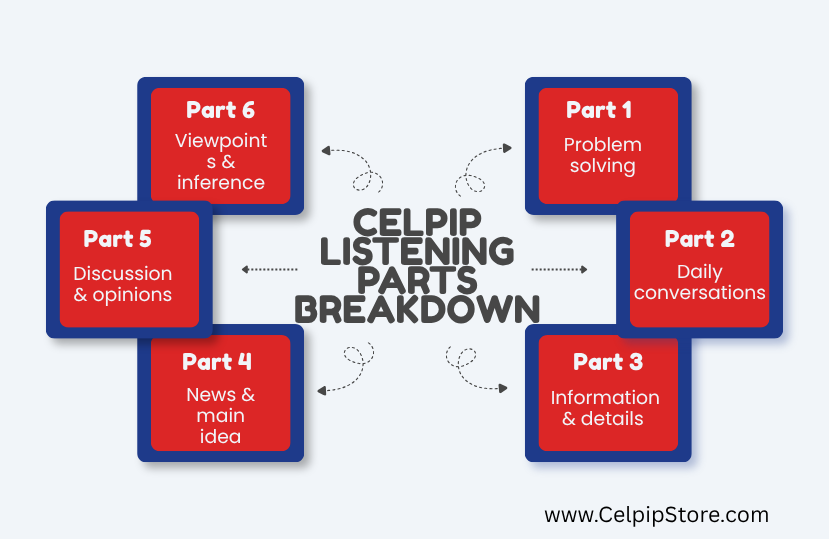
The test is divided into multiple parts, and each part checks a different skill:
| Part | Focus Skill |
|---|---|
| Part 1 | Problem-solving & detail understanding |
| Part 2 | Daily conversation comprehension |
| Part 3 | Information extraction |
| Part 4 | News listening & main idea |
| Part 5 | Discussion & opinion |
| Part 6 | Viewpoints & inference |
To succeed, you need more than listening. A strong CELPIP Listening system requires a clear approach to each task explore the CELPIP Listening Part 1 Problem-Solving Strategy to understand how to handle problem-solving conversations.
Identifying the speakers' relationship, situation, and purpose is essential for accurate answers. Master these skills with the CELPIP Listening Part 2 Daily Conversation Strategy.
Accurate answers depend on recognizing essential facts while ignoring irrelevant details. Strengthen this skill with the CELPIP Listening Part 3 Information Extraction Strategy.
Success in discussion-based listening depends on recognizing speakers’ opinions, attitudes, and supporting reasons. Develop these skills with the CELPIP Listening Part 5 Discussion & Opinion Strategy.
Once you understand the fundamentals of CELPIP Listening, take your preparation further with the advanced techniques in CELPIP Listening Mastery: CLB 9 Strategy for All Parts.
If you repeatedly choose incorrect answers without understanding why, use the CELPIP Listening Error Analysis & Recovery System to identify the root causes of your errors.
You need:
• Prediction skills (before audio starts)
• Selective listening (focus on key info)
• Answer strategy (not guessing blindly)
• Time control (no panic, no delay)
Success in news-based listening depends on recognizing the main message and separating it from supporting details. Master this skill with the CELPIP Listening Part 4 News Strategy System.
The Core Listening Mastery System (Preview)
Throughout this lesson, you will learn a powerful 4-step system:
Step 1 — Predict
Understand the situation before the audio begins
Step 2 — Capture
Write only keywords, not full sentences
Step 3 — Interpret
Understand meaning, tone, and intention
Step 4 — Eliminate
Remove wrong options and choose the best answer
This system works for all parts of the test. Identifying the speaker’s main problem is essential for choosing the correct answer. Master this skill with the CELPIP Listening Part 1 Problem-Solving Strategy.
To understand what speakers really mean, identify their intentions, attitudes, and key messages using the CELPIP Listening Part 2 Daily Conversation Strategy.
If you struggle to distinguish important news information from distracting details, strengthen your approach with the CELPIP Listening Part 4 News Strategy System.
Common Mistakes (Why Most Students Lose Marks)
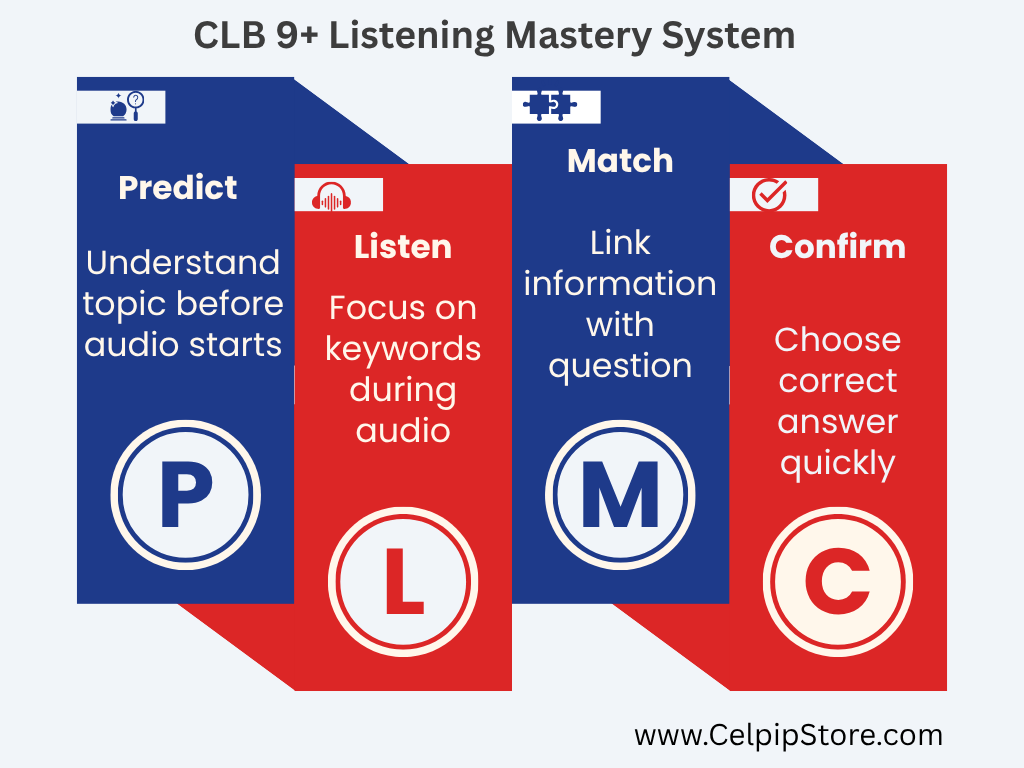
1. Trying to Understand Every Word
Many students panic when they miss a word.
Reality:
You do NOT need every word.
You need the main idea + key details.
2. Writing Too Much Notes
Students try to write full sentences.
Problem:
You miss the next important information.
Correct approach:
Write short keywords only.
3. Not Reading Questions Before Audio
If you don’t read questions first:
You don’t know what to listen for.
Result:
Everything sounds important -> confusion. If you struggle to remember names, numbers, locations, or other important details, use the techniques explained in the CELPIP Listening Part 3 Information Extraction Strategy.
To recognize how news reports present events, explanations, and relevant facts, follow the techniques in the CELPIP Listening Part 4 News Strategy System.
To understand why distractors lead you to the wrong answer and how to avoid similar mistakes in future tests, follow the CELPIP Listening Error Analysis & Recovery System.
4. Getting Stuck on One Question
Missing one answer -> thinking about it -> missing next answers.
High scorers:
Move on instantly.
When speakers express different perspectives, you need to distinguish their positions and understand their reasoning. Practice this skill with the CELPIP Listening Part 5 Discussion & Opinion Strategy.
5. Ignoring Tone and Intention
Listening is not just words.
Example:
“Yeah, that’s great…” (sarcastic tone)
Meaning changes completely.
6. No Strategy for Similar Options
Many answers look almost the same.
Without elimination skills:
You guess -> lose marks.
Each listening part requires specific skills, but success also depends on connecting them through one consistent system. Learn how with CELPIP Listening Mastery: CLB 9 Strategy for All Parts.
7. No Practice Under Real Conditions
Practicing casually? real exam performance.
You must train with:
• Time pressure
• One-time listening
• No pauses
What Makes a CLB 9+ Listener Different?
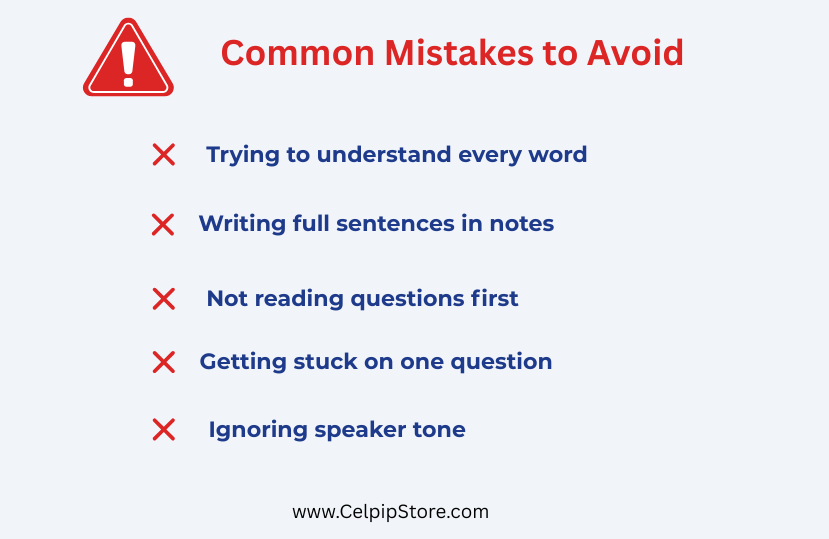
A high scorer:
• Listens for purpose, not words
• Focuses on important information only
• Uses prediction before listening
• Writes minimal but useful notes
• Quickly eliminates wrong answers
• Stays calm under pressure
To recognize problems, evaluate possible solutions, and identify the speaker’s intended outcome, follow the CELPIP Listening Part 1 Problem-Solving Strategy.
If you struggle with unfamiliar expressions, distracting details, or implied meanings, improve your approach with the CELPIP Listening Part 2 Daily Conversation Strategy.
To avoid missing critical information and choosing distractor answers, develop a systematic listening approach with the CELPIP Listening Part 3 Information Extraction Strategy.
The Complete Listening Framework (CLB 9 System)
To score CLB 9+, you need a repeatable system not random tips.
Here is the Listening Mastery Framework you will use for every part:
4-Step Listening System
1. Predict -> Before audio
2. Capture -> During audio
3. Interpret -> Understand meaning
4. Eliminate -> Choose correct answer
This system works across all listening sections. Make your listening practice more focused by training with news-based questions and structured analysis in the CELPIP Listening Part 4 News Strategy System.
Step 1 — Predict (Before Audio Starts)
This is where most students lose easy marks.
Before the audio begins, you usually get time to read questions. If you confuse a speaker’s opinion with supporting details or another speaker’s viewpoint, improve your approach with the CELPIP Listening Part 5 Discussion & Opinion Strategy.
What to Do
• Read the questions quickly
• Identify the situation
• Underline keywords mentally
• Guess possible answers
What to Predict
Ask yourself:
• Who is speaking?
• Where is the situation?
• What is the topic?
• What kind of information is needed?
Example
Question:
What problem is the man facing?
Prediction:
You will hear:
• A complaint
• A difficulty
• A situation with a solution
Now your brain is ready. If you often confuse the speaker’s problem with the proposed solution, use the techniques in the CELPIP Listening Part 1 Problem-Solving Strategy to improve your accuracy.
Turn your general listening practice into focused information-extraction training with the CELPIP Listening Part 3 Information Extraction Strategy.
To strengthen your CLB 9+ preparation, combine your overall listening framework with the targeted techniques in the CELPIP Listening Part 4 News Strategy System.
Make your listening practice more effective by analyzing viewpoints, comparing arguments, and identifying key messages through the CELPIP Listening Part 5 Discussion & Opinion Strategy.
To improve your accuracy across different question types and avoid recurring mistakes, apply the methods explained in CELPIP Listening Mastery: CLB 9 Strategy for All Parts.
Why This Works
Prediction helps you:
• Focus on relevant information
• Ignore unnecessary details
• Reduce confusion during fast speech
Step 2 — Capture (Smart Note-Taking)
You cannot remember everything.
So you must capture only what matters. Effective listening practice requires more than completing questions; it also requires reviewing mistakes and learning from them through the CELPIP Listening Error Analysis & Recovery System.
Golden Rule
- Don’t write sentences
- Write keywords only
What to Write
• Names
• Numbers
• Dates
• Problems
• Solutions
• Opinions
• Changes
Example Notes
Audio says:
“The meeting was moved from Monday to Wednesday at 3 PM because the manager is unavailable.”
Your notes:
Meeting -> Wed 3 PM (not Mon) -> manager busy
Symbols You Can Use
- change
- increase
- decrease
- problem
- solution
Big Mistake to Avoid
Writing too much = missing next answer.
Always remember:
Listening is more important than writing.
Step 3 — Interpret (Understand Meaning, Not Words)
This is the most important skill.
You must understand:
• What the speaker means
• Why they are saying it
• How they feel
Focus on These 3 Things
1. Main Idea
What is the overall message?
2. Key Details
What specific information supports it?
3. Tone & Intention
Is the speaker happy, annoyed, unsure, sarcastic?
Example
Speaker says:
“Well… I guess it could work, but I’m not fully convinced.”
Meaning:
Not confident / slightly negative
Correct answer will reflect:
Uncertain opinion
Important Tip
Same idea? same words
CELPIP uses paraphrasing.
Example
Audio:
“He postponed the trip.”
Answer:
“He delayed his travel.”
Same meaning -> correct answer. Apply your overall listening techniques to task-specific practice with the CELPIP Listening Part 1 Problem-Solving Strategy and build a more systematic approach to answering questions.
Step 4 — Eliminate (Smart Answer Selection)
This is where high scorers win.
Instead of finding the perfect answer,
they remove wrong ones first.
Elimination Strategy
Remove options that are:
• Too extreme (always, never)
• Not mentioned
• Opposite meaning
• Partially correct but incomplete
• Misleading details
Example
Question:
Why did the woman cancel the event?
Options:
A. She was sick
B. The venue was unavailable
C. She forgot the event
D. She didn’t like the plan
Audio:
“The hall we booked is no longer available.”
Correct approach:
- Eliminate A, C, D
- Choose B confidently
Apply your overall listening techniques to realistic everyday conversations with the CELPIP Listening Part 2 Daily Conversation Strategy.
To strengthen your CLB 9+ preparation, combine your overall listening framework with the targeted techniques in the CELPIP Listening Part 3 Information Extraction Strategy.
To strengthen your CLB 9+ preparation, combine your overall listening framework with the targeted techniques in the CELPIP Listening Part 5 Discussion & Opinion Strategy.
Build a more systematic practice routine by combining task-specific exercises with the complete framework in CELPIP Listening Mastery: CLB 9 Strategy for All Parts.
Part-Specific Strategy Overview
Each listening part tests a slightly different skill.
Part 1 — Problem Solving
Focus on:
• Problem
• Cause
• Solution
Part 2 — Daily Conversations
Focus on:
• Relationship between speakers
• Context
• Everyday language
Part 3 — Information
Focus on:
• Details
• Instructions
• Specific facts
Part 4 — News Item
Focus on:
• Main idea
• Supporting details
• Sequence of events
Part 5 — Discussion
Focus on:
• Opinions
• Agreement / disagreement
• Reasons
Part 6 — Viewpoints
Focus on:
• Different perspectives
• Comparison
• Author’s attitude
If your CELPIP Listening score is not improving, develop a structured method for analyzing errors and correcting weaknesses with the CELPIP Listening Error Analysis & Recovery System.
Time Management Strategy
You cannot control the audio.
But you can control your reaction.
Golden Rules
• Don’t panic if you miss one point
• Stay focused on the current question
• Move forward quickly
• Trust your first logical answer
Mental Rule
Missed something? -> Forget -> Continue -> Recover next answer
Complete Example (Putting It All Together)
Before Audio:
You read:
“What is the main reason for the delay?”
Prediction:
Look for cause/reason
During Audio:
You hear:
“The shipment was delayed because of bad weather conditions.”
Notes:
Delay -> weather
After Audio:
Options:
A. Staff shortage
B. Weather issues
C. Technical problem
D. Transportation strike
Eliminate:
A, C, D -> incorrect
Answer:
- B
To build stronger listening comprehension and work toward CLB 9+, combine your overall preparation with the targeted techniques in the CELPIP Listening Part 2 Daily Conversation Strategy.
Advanced Listening Techniques (CLB 9+ Level)
Once you understand the basic system, you need to upgrade your skills to handle real exam difficulty.
These techniques separate average scorers from high scorers.
1. Listening for Signal Words (Exam Triggers)
Signal words tell you that important information is coming.
Common Signal Words
Contrast:
but, however, although, instead
Cause/Reason:
because, since, due to
Result:
so, therefore, as a result
Change/Correction:
actually, in fact, I mean
Example
“I thought the meeting was today, but it’s actually tomorrow.”
Correct meaning:
The meeting is tomorrow (not today)
Exam Insight
Important answers often come after signal words, not before. To strengthen your CLB 9+ preparation, combine your overall listening framework with the targeted techniques in the CELPIP Listening Part 1 Problem-Solving Strategy.
2. Handling Fast Speech & Accents
In CELPIP, speakers may talk quickly or naturally.
What High Scorers Do
• Focus on keywords, not speed
• Ignore filler words (uh, um, you know)
• Stay calm and follow meaning
Key Tip
If you miss one phrase:
Don’t panic
Catch the next key idea
3. Understanding Distractors (Trap Answers)
CELPIP includes trap options to confuse you. To manage your time, process information efficiently, and prepare for different listening challenges, follow CELPIP Listening Mastery: CLB 9 Strategy for All Parts.
Common Trap Types
1. Same words, different meaning
Audio: “He considered moving.”
Trap: “He moved.”
2. Partial information
Only half the idea is correct
3. Opposite meaning
Audio: “She didn’t like it.”
Option: “She liked it.”
4. Early mention trap
First idea is changed later
Golden Rule
Final meaning > first information
4. Tone & Emotion Detection (High-Level Skill)
Many questions test speaker attitude.
Common Tones
• Positive -> happy, satisfied
• Negative -> annoyed, disappointed
• Neutral -> factual
• Uncertain -> unsure, hesitant
• Sarcastic -> opposite meaning
Example
“Great… just what I needed.” (flat tone)
Real meaning:
Not positive
Slightly negative / sarcastic
5. Paraphrasing Mastery (Score Booster)
You will rarely hear the exact words from the answer.
Examples
| Audio | Answer |
|---|---|
| cancel | call off |
| delay | postpone |
| problem | issue |
| improve | enhance |
| cheap | affordable |
Strategy
Always ask:
“Does this option mean the same thing?”
Examiner Insights (What They Are Testing)
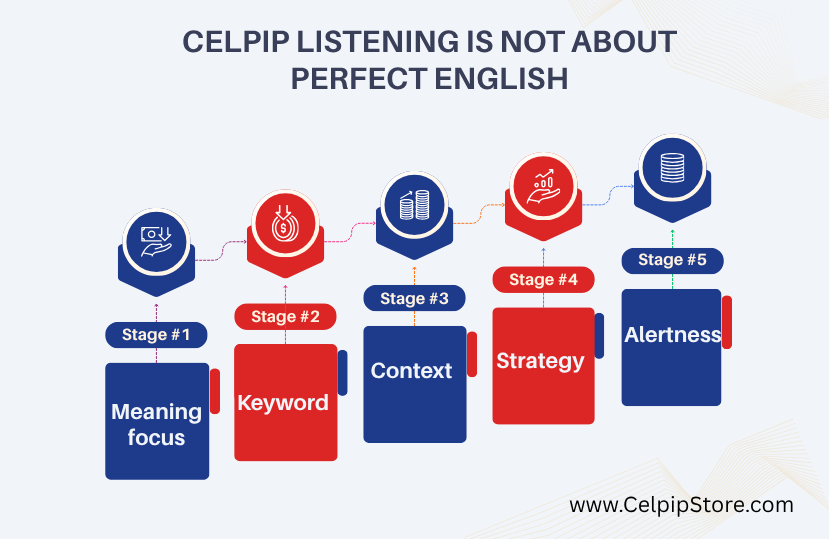
CELPIP examiners are not testing your memory.
They are testing your understanding ability.
They Want to See If You Can:
• Identify main ideas quickly
• Understand real-life conversations
• Handle different speaking styles
• Recognize intentions and emotions
• Make accurate decisions under pressure
Important Insight
Even if you miss some words,
you can still get the correct answer.
High-Impact Vocabulary for Listening
You don’t need advanced vocabulary.
You need common paraphrasing words.
Daily Life Vocabulary
• appointment -> meeting
• purchase -> buy
• assist -> help
• require -> need
Problem & Solution
• issue -> problem
• fix -> solve
• delay -> postpone
Opinion Language
• believe -> think
• suggest -> recommend
• prefer -> like more
Learning these helps you recognize answers faster. To turn your listening practice into measurable progress toward CLB 9+, combine your overall strategy with the CELPIP Listening Error Analysis & Recovery System.
Practice Section (Apply the System)
Practice Example 1
Audio Idea:
“The restaurant was too crowded, so we decided to leave.”
Question:
Why did they leave?
Options:
A. Food was bad
B. Too many people
C. Expensive menu
D. No reservation
Correct Answer: B
Practice Example 2
Audio Idea:
“I wanted to join the course, but the timing doesn’t work for me.” If your goal is CLB 9 or higher, connect your current listening skills with a complete preparation framework through CELPIP Listening Mastery: CLB 9 Strategy for All Parts.
Question:
Why didn’t the speaker join?
Answer: Schedule conflict
Practice Example 3 (Trap Focus)
Audio:
“He planned to travel, but later changed his mind.”
Trap Option:
“He traveled”
Correct Answer:
“He decided not to travel”
Real Exam Simulation Tip
To improve faster, practice like the real exam:
• Listen only once
• Do NOT pause
• Follow time limits
• Review mistakes after
Error Correction System (Very Important)
After practice, always analyze mistakes:
Ask Yourself
• Did I miss a keyword?
• Did I misunderstand meaning?
• Did I fall for a trap?
• Did I panic?
Improve Faster
Fixing mistakes = faster improvement than more practice.
Summary (What You Must Remember)
CELPIP Listening is not a memory test.
It is a strategy-based comprehension test.
To score CLB 9+, you must apply a clear system:
4-Step Master System
- Predict -> Understand the situation before audio
- Capture -> Write only keywords
- Interpret -> Understand meaning, tone, intention
- Eliminate -> Remove wrong options quickly
Core Idea
You don’t need perfect English.
You need smart listening habits.
Final Checklist (Before Exam Day)
Before Listening Starts
- Read questions quickly
- Identify topic and situation
- Predict possible answers
During Listening
- Focus on keywords only
- Do not write full sentences
- Track signal words (but, because, however)
- Stay calm if you miss something
Answering Strategy
- Use elimination method
- Compare meaning, not exact words
- Trust first logical answer
- Avoid overthinking
After Each Question
- Move on immediately
- Do not replay mentally
- Focus on next question
FAQs (Common Student Questions)
1. How can I improve CELPIP Listening fast?
Use the Predict–Capture–Interpret–Eliminate system and practice under real exam timing.
2. Is note-taking necessary in CELPIP Listening?
Yes, but only keywords. Writing full sentences reduces your performance.
3. What is the hardest part of CELPIP Listening?
Usually Part 5 and Part 6 because they test opinions and inference.
4. How many times can I listen in CELPIP?
You hear audio only once. That’s why prediction is important.
5. What causes most mistakes?
Overthinking, missing keywords, and choosing trap answers.
6. How do I reach CLB 9?
Focus on accuracy, not speed. Use elimination strategy and understand paraphrasing.
Practice Plan (7-Day Listening Improvement System)
Day 1–2
• Learn question patterns
• Practice prediction only
Day 3–4
• Focus on note-taking keywords
• Practice short conversations
Day 5
• Full listening tests (timed)
• Apply elimination strategy
Day 6
• Review mistakes
• Focus on weak areas
Day 7
• Full simulation test
• No pauses, no repetition
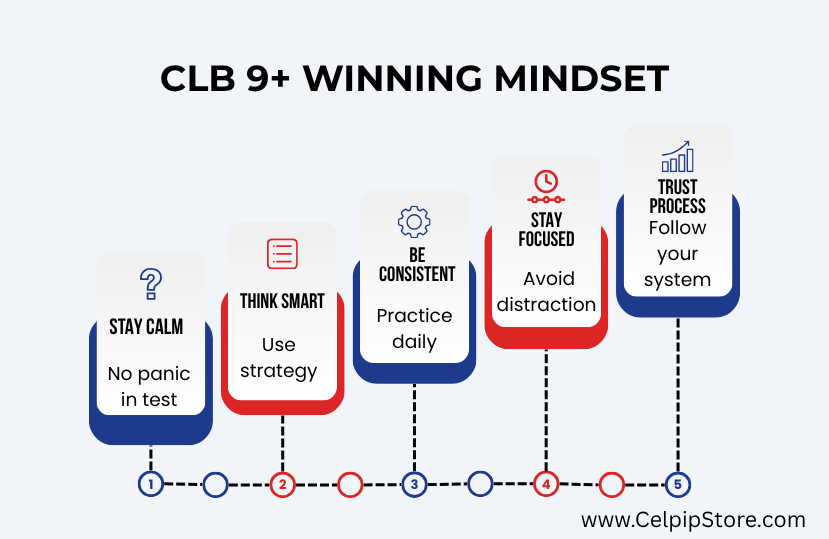
Final Exam Mindset
• Stay calm even if you miss answers
• Focus on next question immediately
• Trust your preparation system
• Don’t chase perfection
Conclusion
CELPIP Listening success depends on system + discipline, not just English ability.
If you consistently apply:
Predict -> Capture -> Interpret -> Eliminate
You will naturally improve your score toward CLB 9+ level.