CELPIP Listening Part 1 Strategy: Problem Solving System for CLB 9 Success
Introduction
CELPIP Listening Part 1 is one of the most important sections because it tests your ability to understand real-life problem-solving conversations.
These conversations are not simple.
They include confusion, changes, decisions, and solutions happening quickly.
Most students lose marks here because they:
• Try to understand every word
• Miss the main problem
• Get confused between options
• Panic when speakers change information
But high scorers follow a clear problem-solving system. To understand how Part 1 fits into the complete listening test, explore the CELPIP Listening Mastery: Complete Strategy for CLB 9
In this lesson, you will learn how to identify:
• The problem
• The cause
• The solution
• The final decision
Learning Objectives
By the end of this lesson, you will be able to:
• Understand the structure of CELPIP Listening Part 1
• Identify the main problem quickly in a conversation
• Track changes in information accurately
• Recognize solution keywords
• Avoid trap answers and distractions
• Apply a step-by-step problem-solving listening system
Overview of CELPIP Listening Part 1
This section is based on daily life problem-solving situations such as:
• Booking appointments
• Travel changes
• Service issues
• Scheduling conflicts
• Customer support conversations
What You Will Hear
Usually two speakers discussing:
• A problem or issue
• Possible solutions
• Final decision or outcome
What You Must Find
You are NOT just listening for details.
You must identify:
• What is the problem?
• Why did it happen?
• What solution is chosen?
Mastering problem-solving conversations is just one part of CELPIP Listening. Learn how to improve your overall performance with CELPIP Listening Mastery: Complete Strategy for CLB 9.
The Core Problem-Solving System (Preview)
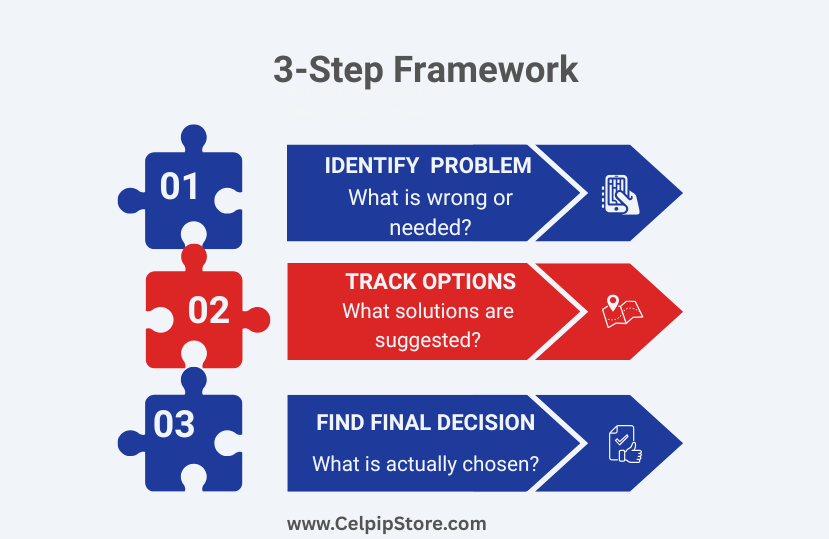
To succeed in Part 1, you must use this system:
Step 1 — Identify the Problem
Understand what is wrong or needed
Step 2 — Track the Options
Listen for possible solutions
Step 3 — Find the Final Decision
Choose what actually happens
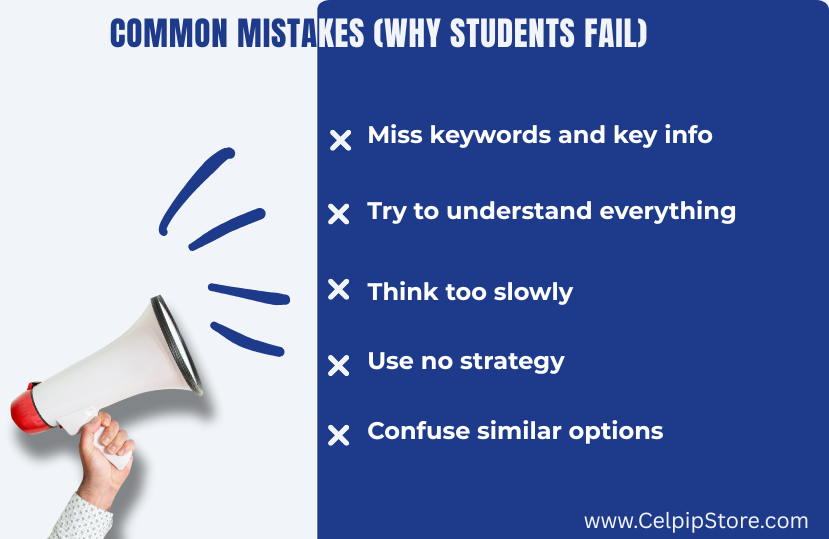
Common Mistakes (Why Students Lose Marks)
1. Confusing Details with the Main Problem
Students focus on small details and miss the main issue.
Example mistake:
Remembering names instead of understanding the problem.
2. Not Recognizing Changes in Information
Speakers often change plans.
If you miss the change, you choose the wrong answer.
3. Getting Distracted by Extra Information
Not everything in the conversation is important.
High scorers ignore unnecessary details.
4. Choosing First Mention Instead of Final Answer
Often the first idea is changed later.
Final decision is always correct.
5. Overthinking Options
Students compare too much instead of trusting logic.
Result: confusion and time loss.
6. Missing Problem Keywords
Words like:
• issue
• problem
• can’t
• not working
• unavailable
These are very important signals. To strengthen your ability to identify key information, understand speaker intentions, and select accurate answers, follow the complete CELPIP Listening Mastery: Complete Strategy for CLB 9.
Core Framework: Problem -> Options -> Decision System
In CELPIP Listening Part 1, every conversation follows a hidden structure:
1. Problem (What is wrong?)
2. Options (What can be done?)
3. Decision (What is finally chosen?)
If you track this flow correctly, you can answer most questions accurately even if you miss some words.
Step 1 — Identify the Problem Clearly
The first 10–20 seconds usually introduce the issue.
Common Problem Signals
Listen for words like:
• “I have a problem…”
• “There’s an issue…”
• “I can’t…”
• “It’s not working…”
• “Unfortunately…”
• “I’m having trouble…”
Example
“I booked a flight, but the date is wrong.”
Problem: Incorrect flight date
Exam Tip
Do NOT focus on background details.
Focus only on:
What is NOT working? Avoiding mistakes in Part 1 becomes easier when you understand broader listening strategies and answer-selection techniques explained in CELPIP Listening Mastery: Complete Strategy for CLB 9.
Step 2 — Track All Possible Options
After the problem is stated, speakers suggest solutions.
What Options Look Like
• Changing time
• Rescheduling
• Refund
• Replacement
• Alternative service
Example
“We can either change your booking or cancel it.”
Your notes:
• Option 1 -> change booking
• Option 2 -> cancel booking
Key Strategy
Do NOT decide early.
Just record options.
Step 3 — Find the Final Decision
This is the MOST IMPORTANT step.
CELPIP often includes:
- first idea (not final)
- final decision (correct answer)
Decision Signals
Listen for:
• “So we will…”
• “Let’s go with…”
• “In that case…”
• “I think I’ll…”
• “We decided to…”
Example
“I thought about rescheduling, but I’ll just cancel it.”
Final answer: cancel
Trap Pattern (Very Important)
CELPIP often uses this structure:
First Option (Trap)
“I can reschedule it…”
Final Decision (Answer)
“But I’ll cancel it instead.”
Many students choose the first option and lose marks.
Step-by-Step Answer Strategy
When listening, follow this process:
Step 1: Listen for Problem
Write: issue keyword only
Example: wrong date
Step 2: Note Options
Write short form:
• change
• cancel
Step 3: Wait for Final Decision
Circle or mark final choice
Example: cancel
Step 4: Match With Options
Eliminate incorrect answers quickly. For a structured practice system that goes beyond individual questions, use the methods in CELPIP Listening Mastery: Complete Strategy for CLB 9.
Mini Practice Example
Audio Idea:
“I booked a doctor appointment, but I can’t attend it. I might move it to next week, or maybe cancel it. Actually, I’ll just cancel it.”
Your Notes:
• Problem -> can’t attend
• Options -> move / cancel
• Final -> cancel
Correct Answer:
Cancel appointment
Examiner Insight
CELPIP is testing:
• Can you follow real conversation flow?
• Can you identify decision-making changes?
• Can you ignore distractions and focus on final meaning?
Common Student Mistake in Part 1
- Choosing first solution
- Missing “but / actually / instead”
- Writing full sentences
- Not tracking final decision
High-Scorer Behavior
- Focus on problem first
- Track options silently
- Wait for final decision
- Answer based on outcome, not discussion
Advanced Listening Techniques (CLB 9+ Level)
Now you understand the basic structure:
Problem -> Options -> Decision
In this section, we upgrade your performance to exam-level accuracy.
1. Recognizing “Hidden Problem Statements”
In CELPIP, the problem is not always direct.
Sometimes it is implied.
Example (Indirect Problem)
“I tried to submit the form, but it keeps freezing.”
Problem: system not working / form not submitting
Advanced Tip
Problem may appear after the conversation starts, not at the beginning.
So stay alert for:
• frustration
• complaints
• repeated attempts
• negative expressions
2. Multi-Step Decisions (Very Important)
Sometimes speakers change decisions more than once.
Example
“I’ll reschedule it… no actually, I might cancel it… wait, I’ll just reschedule it for next week.”
What You Must Do
Ignore confusion.
Focus ONLY on final statement:
Final answer = reschedule
Exam Insight
CELPIP often tests your ability to ignore hesitation.
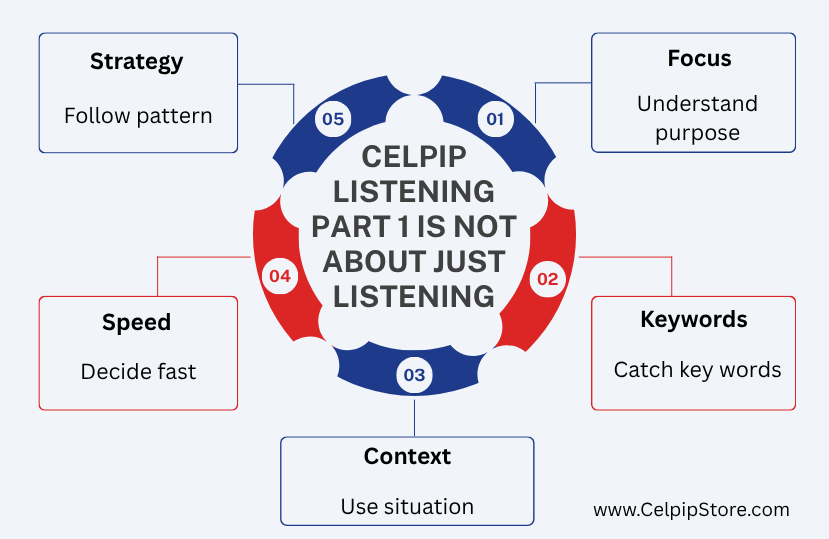
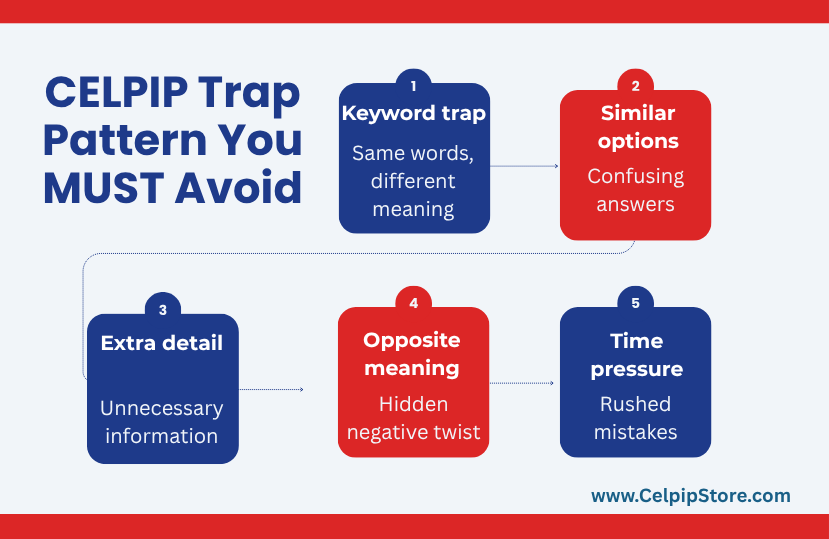
3. Distractor Strategy (Trap Detection System)
CELPIP uses intentionally misleading information.
Trap Types
Trap 1: Early Answer Trap
First option is NOT correct.
Trap 2: Partial Match Trap
Option sounds correct but incomplete.
Trap 3: Keyword Trap
Same words, different meaning.
Example
Audio:
“We can’t fix it today.”
Trap option:
“They fixed it today.”
Rule
Never match words.
Match meaning only.
Improve your listening accuracy and manage the test more effectively by applying the techniques from CELPIP Listening Mastery: Complete Strategy for CLB 9.
4. Signal Phrase Mastery (Decision Language)
These phrases show FINAL answers:
Final Decision Signals
• “Let’s go with…”
• “I’ve decided…”
• “In the end…”
• “Actually…”
• “So I’ll…”
• “We agreed to…”
Example
“I thought about replacing it, but in the end I’ll just repair it.”
Final: repair
5. Fast Listening Recovery Technique
What if you miss something?
Wrong Student Behavior
- Panic
- Try to remember
- Stop listening
Correct Strategy
- Skip mentally
- Focus on next sentence
- Reconnect with keywords
Golden Rule
One missed detail? lost question
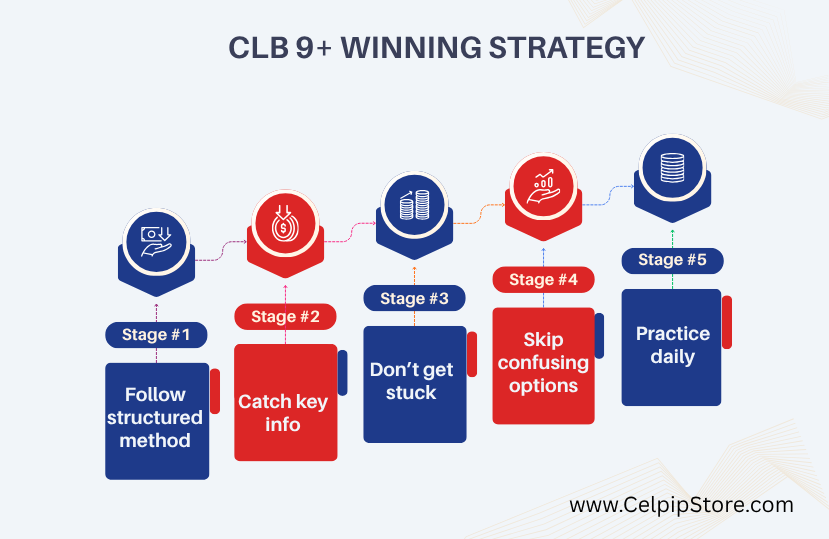
Examiner Insights (What CELPIP Really Tests)
In Part 1, examiners are checking:
• Can you track decision changes?
• Can you ignore extra conversation noise?
• Can you identify final outcome correctly?
• Can you handle real-life confusion situations?
High-Value Vocabulary for Part 1
These words frequently appear in problems:
Problem Words
• issue
• trouble
• delay
• error
• unavailable
• missing
Solution Words
• fix
• replace
• reschedule
• refund
• upgrade
• cancel
Decision Words
• decide
• choose
• agree
• finalize
• go with
Practice Drills (Exam Simulation Style)
Practice 1
“I ordered a product, but it arrived damaged. I could return it or ask for replacement. I think I’ll get a replacement.”
- Answer: replacement
Practice 2
“I missed my appointment. I might reschedule it, but actually I’ll cancel it.”
- Answer: cancel
Practice 3
“They offered repair or refund. At first I thought refund, but I’ll take repair.”
- Answer: repair
To connect your Part 1 problem-solving skills with a complete CLB 9 preparation plan, review CELPIP Listening Mastery: Complete Strategy for CLB 9.
Performance Booster Rule
To reach CLB 9+, follow this mindset:
- Ignore confusion
- Trust final statement
- Focus on meaning, not words
Summary
CELPIP Listening Part 1 is built around a simple structure:
Problem -> Options -> Final Decision
Your success depends on how well you track this flow, not on understanding every word.
High scorers do 3 things consistently:
• Identify the problem quickly
• Track all possible solutions
• Choose the final decision (not early ideas)
Final Checklist (Exam-Day System)
Before Listening
- Read question quickly
- Predict possible problem type
- Identify keywords (issue, delay, change)
During Listening
- Listen for the main problem first
- Note down short keywords only
- Track all options (don’t decide early)
- Focus on signal words (but, actually, so)
Final Answer Stage
- Choose the final decision only
- Ignore first suggestions if they change
- Eliminate trap options
- Trust meaning, not exact words
Quick Problem-Solving Formula
Problem -> Options -> Change -> Final Decision = Answer
Common Mistakes to Avoid
- Choosing first option
- Getting confused by multiple ideas
- Writing full sentences
- Missing “but / actually / instead”
- Overthinking options
FAQs (CELPIP Listening Part 1)
1. Why is Listening Part 1 difficult?
Because speakers often change decisions and include extra information.
2. What is the most important skill in Part 1?
Tracking the final decision, not the first idea.
3. Should I write full sentences in notes?
No. Only keywords help you keep up with audio.
4. How do I avoid trap answers?
Always wait for the final statement and ignore early options.
5. What type of language is used in Part 1?
Everyday problem-solving conversations (booking, services, changes).
Practice Plan (3-Day Focus Drill)
Day 1
• Practice identifying problems only
• Listen without answering
Day 2
• Track options in conversations
• Write keyword notes
Day 3
• Full practice test
• Focus only on final decisions
Final Exam Mindset
- Stay calm during confusion
- Trust final statement
- Do not overthink options
- Move forward quickly
Conclusion
CELPIP Listening Part 1 is not about difficulty it is about decision tracking skill.
If you consistently apply:
Problem -> Options -> Final Decision
Your accuracy will improve significantly.