CELPIP Listening Part 2 Strategy: Daily Conversation System for CLB 9 Success
Introduction
CELPIP Listening Part 2 is based on everyday, natural conversations between people in real-life situations. Unlike formal listening tasks, this section includes casual speech where speakers may change topics quickly, use informal language, and include filler words.
Many students struggle here because they try to understand every single word. However, success in Part 2 does not come from word-by-word understanding. It comes from understanding context, relationship, and intention. To understand how everyday conversations fit into the complete CELPIP Listening test, explore CELPIP Listening Mastery: Complete Strategy for CLB 9.
In this lesson, you will learn how to quickly decode daily conversations using a structured system so you can answer questions accurately even when the speech feels fast or informal.
Learning Objectives
By the end of this lesson, you will be able to:
- Identify speaker relationships quickly (friend, colleague, customer, etc.)
- Understand the situation and context of the conversation
- Recognize speaker tone and intention
- Extract key information from informal speech
- Ignore unnecessary filler words and distractions
- Apply a structured listening approach for Part 2
Overview of CELPIP Listening Part 2
CELPIP Listening Part 2 uses natural conversational English, similar to what you hear in daily life in Canada. The language is informal, and speakers often talk in a relaxed and unstructured way.
Typical situations include:
- Friends making plans or discussing activities
- Customer and service interactions
- Workplace conversations between colleagues
- Family discussions about daily life
- Informal problem-solving situations
In these conversations, the focus is not on grammar or academic language, but on understanding meaning in real context. Mastering daily conversations is only one part of listening success. Learn how to improve your performance across all listening tasks with CELPIP Listening Mastery: Complete Strategy for CLB 9.
What You Must Identify in Every Conversation
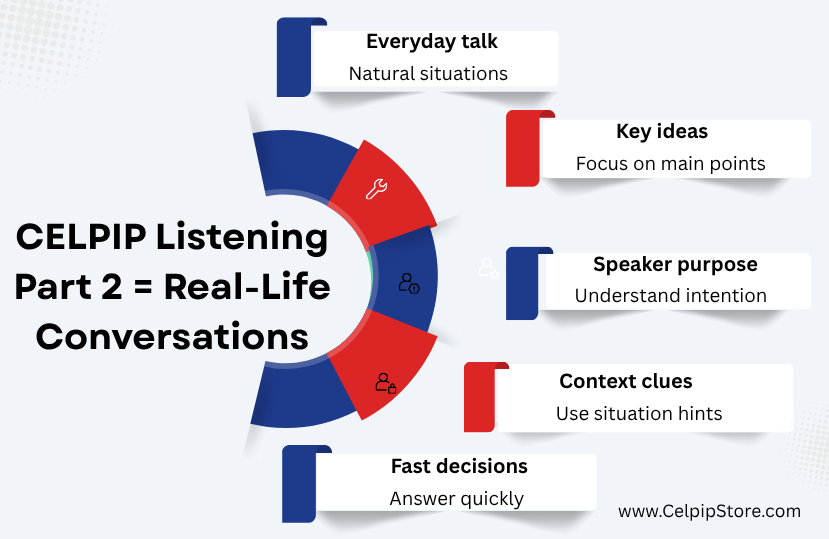
To perform well, you need to quickly understand:
- Who is speaking and their relationship
- What situation they are in
- Why they are talking (purpose of conversation)
- What decision or outcome is being discussed
What CELPIP Questions Usually Test
Questions in this section typically focus on:
- The main idea of the conversation
- The relationship between speakers
- Specific details mentioned
- Speaker intentions or decisions
The Core Daily Conversation System (Preview Framework)
To handle Part 2 effectively, you should always follow this simple system:
Step 1 — Identify Relationship
Understand who the speakers are (friends, coworkers, service staff, etc.). This helps you interpret meaning correctly.
Step 2 — Understand Context
Identify the situation quickly (planning, complaint, request, discussion, etc.).
Step 3 — Track Purpose
Focus on why the conversation is happening and what the speakers want to achieve.
Identifying relationships and intentions becomes more effective when combined with broader listening techniques explained in CELPIP Listening Mastery: Complete Strategy for CLB 9.
Common Mistakes (Why Students Lose Marks)
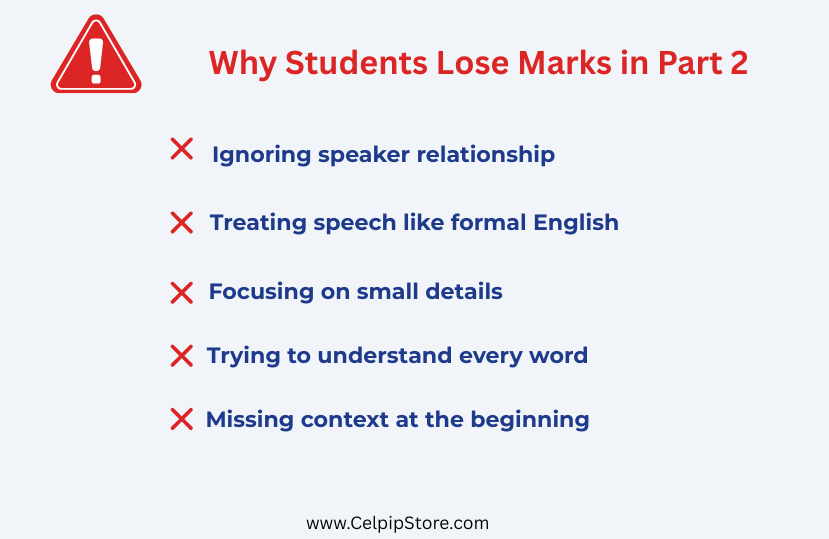
Many students lose marks in Part 2 due to avoidable errors.
- Ignoring speaker relationship
Meaning changes depending on who is speaking (boss vs friend vs customer). - Treating conversation like formal speech
Students expect structured English, but Part 2 is informal and natural. - Focusing on small details instead of main idea
Minor words distract from the real meaning of the conversation. - Misunderstanding tone
Tone often carries more meaning than words (e.g., hesitation, sarcasm, reluctance). - Trying to understand every word
Filler words like “um,” “you know,” and “like” are not important for answers. - Missing context at the beginning
If you don’t understand the situation early, the rest of the conversation becomes confusing.
What Makes Part 2 Different
CELPIP Listening Part 2 is designed to test your ability to understand real-life communication, not academic English.
It evaluates whether you can:
- Understand natural spoken English
- Recognize social relationships and roles
- Follow informal conversation flow
- Interpret meaning beyond words
Core Framework: Relationship -> Context -> Purpose System
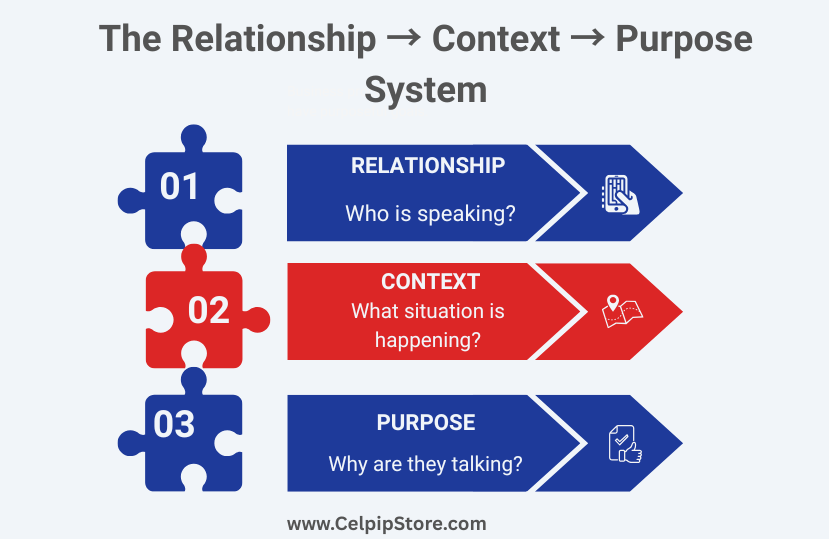
In CELPIP Listening Part 2, every conversation becomes easy if you follow one clear structure:
1. Relationship (Who is speaking?)
2. Context (What situation is happening?)
3. Purpose (Why are they talking?)
Instead of listening randomly, you must constantly track this flow. It helps you understand meaning even when speech is fast or informal.
Step 1 — Identify Speaker Relationship
The first and most important step is to understand who the speakers are to each other.
Common Relationships in Part 2
You will usually hear:
- Friends talking casually
- Customer and service staff
- Colleagues at work
- Family members
- Student and teacher (informal guidance)
Example
“I’m so glad you could help me with this order.”
Relationship: Customer -> Service staff
Exam Tip
Do NOT focus only on words.
Focus on how they speak to each other.
Tone + word choice = relationship clue.
Step 2 — Understand Context (Situation Recognition)
After identifying who is speaking, you must understand what situation they are in.
Common Context Types
- Making plans
- Solving a small problem
- Asking for help
- Giving suggestions
- Discussing daily routine
- Making changes
Example
“I can’t make it to the meeting tomorrow. Can we reschedule?”
Context: Scheduling problem
Key Strategy
Ask yourself:
“What is happening right now?”
Step 3 — Track Purpose (Why are they talking?)
This is where many students lose marks.
You must understand the goal of conversation.
Purpose Types
- Requesting something
- Offering help
- Making a decision
- Solving a problem
- Giving information
Example
“I was wondering if you could help me move this appointment.”
Purpose: Requesting help
Exam Insight
Purpose is often hidden in polite or indirect language. To improve your ability to identify key information, interpret meaning, and select accurate answers, follow CELPIP Listening Mastery: Complete Strategy for CLB 9.
Complete Example (Step-by-Step Application)
Conversation:
“Hey, I missed my bus this morning. Can you tell me if there’s another one later?”
Step 1 — Relationship
Two friends or casual interaction
Step 2 — Context
Transportation / bus timing issue
Step 3 — Purpose
Asking for information (next bus timing)
Correct Understanding:
The speaker wants help finding another bus option.
Trap Patterns in Part 2
CELPIP often uses distractions.
Trap 1: Extra Story Detail
Students focus on background instead of purpose.
- Wrong focus: missed bus
- Correct focus: asking for next bus
Trap 2: Polite Language Confusion
“Could you maybe…” does NOT mean uncertainty.
It still means a clear request.
Trap 3: Emotional Words
“Oh no, that’s terrible!”
- Emotion is not the answer
- Situation is important
Fast Listening Strategy (Real Exam Technique)
While listening, do this:
Step 1: Identify relationship in first 5–10 seconds
Step 2: Quickly label situation
(e.g., “appointment issue”, “help request”, “plan change”)
Step 3: Follow purpose until end
Ignore extra talk, focus on goal.
High-Scorer Behavior Pattern
- Think in roles, not words
- Identify situation early
- Focus on intention, not details
- Ignore filler and emotion noise
Advanced Listening Techniques (CLB 9+ Level)
Now that you understand Relationship -> Context -> Purpose, we will upgrade your skills to handle real exam complexity.
CELPIP Part 2 becomes difficult not because of vocabulary, but because of natural speech, hidden meaning, and distractions. If you repeatedly miss important details in everyday conversations, use the complete listening framework in CELPIP Listening Mastery: Complete Strategy for CLB 9 to strengthen your approach.
1. Hidden Relationship Signals
Sometimes the relationship is NOT stated directly. You must infer it.
Clues to Identify Relationships
- Polite formal language -> customer/service or professional
- Casual tone + slang -> friends or peers
- Giving instructions -> authority figure
- Asking permission -> lower role speaker
Example
“Hi, I was wondering if you could check my order status.”
Likely relationship: Customer -> service staff
Exam Insight
Even without titles, tone reveals relationship.
2. Context Switching (Very Common Trap)
In Part 2, conversations often shift topics.
Example
“We need to reschedule the meeting… also, did you get the email I sent yesterday?”
What Happens
Students get stuck on email part
But main question is about meeting
Rule
Focus on main problem topic, ignore side mentions.
3. Polite Language vs Real Meaning
CELPIP uses polite expressions that hide real intention.
Examples
- “Could you possibly…” -> direct request
- “I was thinking maybe…” -> suggestion
- “Would it be okay if…” -> permission request
Trap
Students think speaker is unsure.
But actually:
They are making a clear request. Build a consistent listening practice routine with the techniques outlined in CELPIP Listening Mastery: Complete Strategy for CLB 9.
4. Distractor Information (Noise Strategy)
Part 2 often includes extra information that is NOT needed.
Types of Noise
- Personal stories
- Emotional reactions
- Extra background details
- Repeated statements
Example
“I missed the bus, and it was raining heavily, and I was already late…”
Only important idea: missed bus
5. Tone-Based Answer Detection
Tone often changes meaning completely.
Common Tones
- Friendly -> casual conversation
- Frustrated -> problem exists
- Hesitant -> unsure decision
- Positive -> agreement
Example
“Yeah… I guess that’s fine.”
Meaning: reluctant agreement
6. Paraphrasing in Conversations
CELPIP rarely repeats exact words.
Examples
| Audio | Meaning |
|---|---|
| postpone | move to later date |
| cancel | call off |
| fix | repair |
| request | ask for |
Rule
Never match words.
Match meaning.
Examiner Insights (What is Tested in Part 2)
CELPIP is checking your ability to:
- Understand real-life spoken English
- Identify relationships without labels
- Track conversation flow with distractions
- Interpret tone and intention correctly
- Ignore unnecessary information
High-Value Vocabulary for Part 2
Daily Life Actions
- arrange -> plan
- reschedule -> change time
- confirm -> make sure
- cancel -> stop
Conversation Language
- actually
- by the way
- I mean
- you know
- kind of
Decision Words
- decide
- agree
- prefer
- suggest
Practice Drills (Exam Simulation Style)
Practice 1
“I was thinking we could meet tomorrow, but I’m not sure if I’m free.”
- Meaning: uncertain plan
Practice 2
“I can’t find my package. Can you help me track it?”
- Meaning: help request
Practice 3
“The appointment is still scheduled, right? I just want to confirm.”
Meaning: confirmation request. To connect your Part 2 skills with a complete CLB 9+ preparation strategy, review CELPIP Listening Mastery: Complete Strategy for CLB 9.
Performance Upgrade Rule
To reach CLB 9+, always:
- Focus on intention
- Ignore extra details
- Trust tone + context
- Avoid word-by-word translation
Summary
CELPIP Listening Part 2 is about understanding real-life conversations, not academic English.
Every conversation can be solved using one simple framework:
Relationship -> Context -> Purpose
If you can correctly identify these thre elements, you can answer most questions even when speech is fast or informal.
Final Checklist (Exam-Day Strategy)
Before Listening
- Quickly read the question
- Predict situation type (plan, problem, request)
- Expect informal spoken English
During Listening
- Identify speaker relationship early
- Focus on main situation, not side details
- Track purpose of conversation
- Ignore fillers like “you know”, “actually”, “like”
Answering Strategy
- Choose answers based on meaning, not exact words
- Use tone + context to confirm intention
- Avoid overthinking options
- Trust first logical understanding
Common Pitfall Reminder
- Don’t get distracted by emotional or extra details
- Don’t assume formal structure in casual speech
- Don’t translate word-by-word
FAQs (CELPIP Listening Part 2)
1. Why is Listening Part 2 confusing for students?
Because it uses natural, informal conversations with fast topic changes and filler words.
2. What is the most important skill in Part 2?
Understanding speaker relationship and conversation purpose.
3. Do I need to understand every word?
No. Focus only on meaning and intention.
4. How do I identify speaker relationship quickly?
Use tone, politeness level, and language style.
5. What causes most mistakes in Part 2?
Focusing on small details instead of main idea and purpose.
Practice Plan (3-Day Focus Training)
Day 1 — Relationship Training
- Listen to conversations
- Identify speaker roles only
Day 2 — Context Training
- Focus on situation types (plan, problem, request)
- Ignore details
Day 3 — Full Simulation
- Practice full listening sets
- Apply Relationship -> Context -> Purpose system
Final Mindset for Part 2
- Think in real-life situations
- Focus on intention, not words
- Stay calm during fast speech
- Ignore fillers and distractions
- Trust context over vocabulary
Conclusion
CELPIP Listening Part 2 is not difficult when you understand the system. It becomes predictable when you apply:
Relationship -> Context -> Purpose
This is the foundation of all high scores in conversational listening.