CELPIP Listening Part 4 Strategy: News Listening System for Main Idea & Detail Accuracy
Introduction
CELPIP Listening Part 4 is based on news-style audio passages that are more structured and formal compared to conversations.
You will hear a speaker reporting information such as events, updates, or announcements. The content is usually organized, but the challenge is that multiple details are presented quickly.
Many students struggle because they try to remember every sentence. However, success in this section depends on identifying the main idea first, then tracking key supporting details. To understand how news-based listening fits into the complete test, explore CELPIP Listening Mastery: Complete Strategy for CLB 9.
In this lesson, you will learn how to break down news listening into a simple and effective system so you can answer accurately without confusion.
Learning Objectives
By the end of this lesson, you will be able to:
- Understand the structure of news-style listening passages
- Identify the main idea quickly
- Track key details such as who, what, when, and where
- Avoid confusion from extra background information
- Improve accuracy in structured listening tasks
- Apply a clear news listening strategy system
Overview of CELPIP Listening Part 4
This section presents formal informational audio, similar to news reports or announcements.
Common topics include:
- Local events or community updates
- Public announcements
- Weather or traffic updates
- Incident reports
- Organizational or official news
Mastering news reports is only one part of listening success. Learn how to improve your performance across all listening tasks with CELPIP Listening Mastery: Complete Strategy for CLB 9.
What You Will Hear
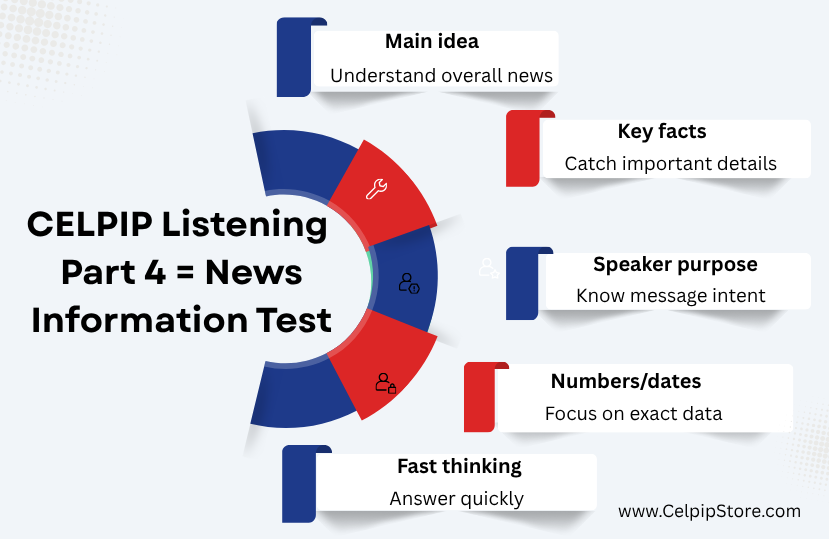
You will usually hear:
- A main topic or headline
- Supporting details
- Background or explanation
- Updates or changes
What You Must Do
Your goal is NOT to memorize everything.
Your goal is to:
- Identify the main idea of the news
- Understand key supporting facts
- Track important updates or changes
The Core News Listening System (Preview Framework)
To succeed in Part 4, follow this system:
Step 1 — Identify Main Idea
Understand what the news is about
Step 2 — Track Key Details
Focus on who, what, when, and where
Step 3 — Follow Updates or Changes
Pay attention to any new information or modifications
Common Mistakes (Why Students Lose Marks)
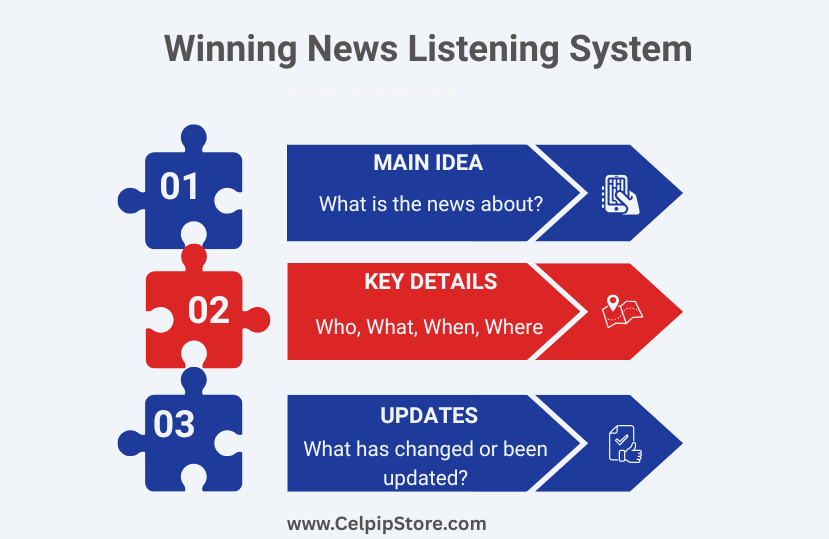
1. Focusing on Minor Details
Students often focus on small facts instead of the main idea.
2. Missing the Main Topic Early
If you don’t understand the headline idea, everything becomes confusing later.
3. Trying to Remember Everything
News passages contain multiple details. Memory overload leads to mistakes.
4. Ignoring Structure
News is structured. Students who don’t follow structure get lost easily.
5. Confusing Similar Details
Dates, locations, or names may appear multiple times and cause confusion. To strengthen your ability to identify main ideas, recognize supporting details, and interpret information accurately, follow CELPIP Listening Mastery: Complete Strategy for CLB 9.
What Makes Part 4 Different?
CELPIP Listening Part 4 tests your ability to:
- Understand structured news content
- Identify the main idea quickly
- Separate important details from background information
- Follow organized information flow
It is more about structured comprehension than casual understanding.
Core Framework: Headline -> Key Details -> Updates System
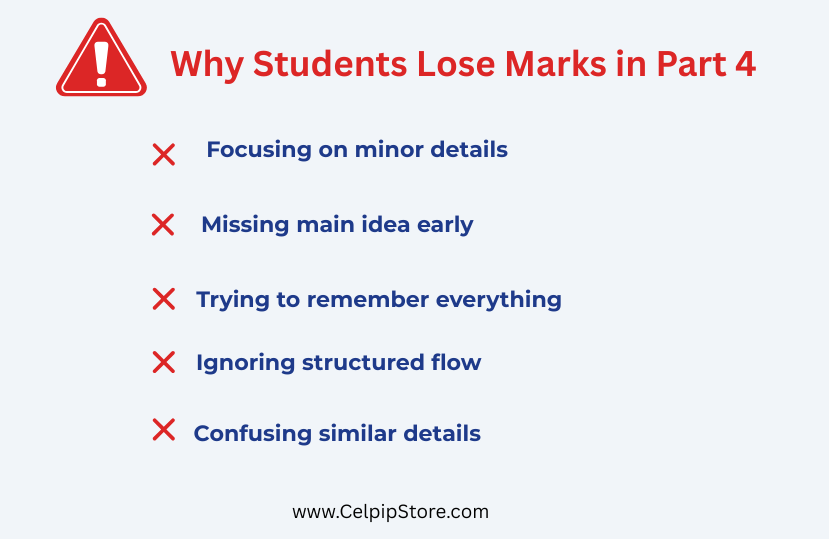
In CELPIP Listening Part 4, every news passage follows a clear structure. If you can track this structure, you can answer questions accurately without remembering everything.
1. Headline (Main Idea)
2. Key Details (Who, What, When, Where)
3. Updates (Changes or new information)
This is the exact pattern used in most news-style listening tasks. If you sometimes miss key details or get distracted by less relevant information, apply the broader listening techniques explained in CELPIP Listening Mastery: Complete Strategy for CLB 9.
Step 1 — Identify the Main Idea (Headline Thinking)
The first few seconds usually introduce the topic of the news.
Common Main Idea Signals
Listen for phrases like:
- “Today’s report is about…”
- “In local news…”
- “Authorities announced…”
- “A new update on…”
Example
“Today’s report is about a road closure in downtown due to construction work.”
Main idea: Road closure due to construction
Exam Tip
Do NOT focus on details first.
Always ask:
“What is this news about?”
Step 2 — Track Key Details (Who / What / When / Where)
Once you know the topic, focus on structured details.
What to Extract
- Who is involved
- What happened
- When it happened
- Where it happened
Example
“The city council announced that Maple Street will be closed from Monday to Wednesday for repairs.”
Key details:
• Who: city council
• What: road closure
• When: Monday–Wednesday
• Where: Maple Street
Important Rule
Do NOT write full sentences.
Only capture structured facts.
Step 3 — Track Updates or Changes
News often includes new or changing information.
Update Signals
- however
- but
- recently
- in addition
- now
- updated
Example
“The road was initially planned to reopen on Tuesday, but it will now reopen on Thursday.”
Update: Tuesday -> Thursday
Exam Insight
Most mistakes happen when students miss changes in information.
Complete Example (Step-by-Step Application)
Audio:
“Local news reports that a community park will be closed this weekend for maintenance. The closure was initially planned for Saturday only, but it will now continue until Sunday.”
Step 1 — Main Idea
Park closure for maintenance
Step 2 — Key Details
• What: park closure
• When: weekend
• Reason: maintenance
Step 3 — Update
Saturday -> Sunday extension
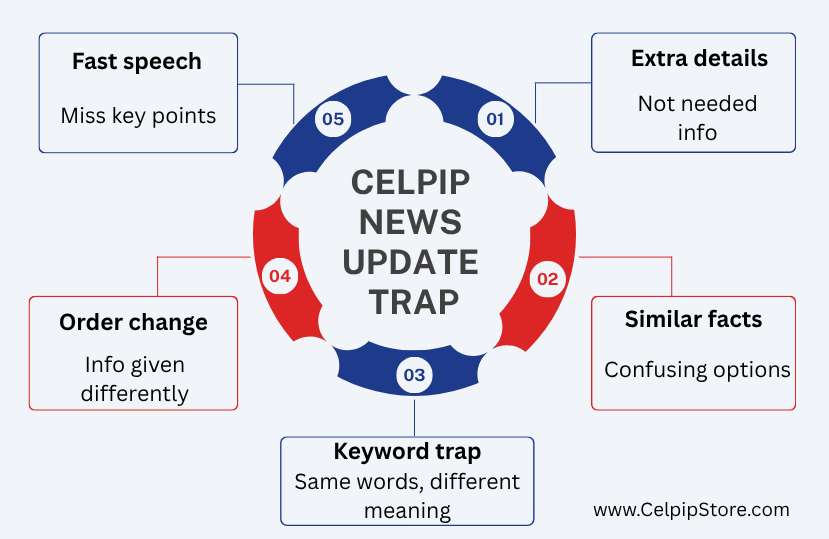
Trap Patterns in Part 4
Trap 1: Background Noise Trap
Extra explanation is NOT the answer.
Focus: history or reasons
Focus: main event
Trap 2: Early Information Trap
First date or plan may change later.
Trap 3: Detail Overload Trap
Too many facts = confusion.
Solution: only track structured points
Fast Listening Strategy (Real Exam Method)
While listening:
Step 1: Identify topic immediately
Ask: “What is the news about?”
Step 2: Capture structured details
Who / What / When / Where
Step 3: Watch for updates
Track any changes or corrections carefully
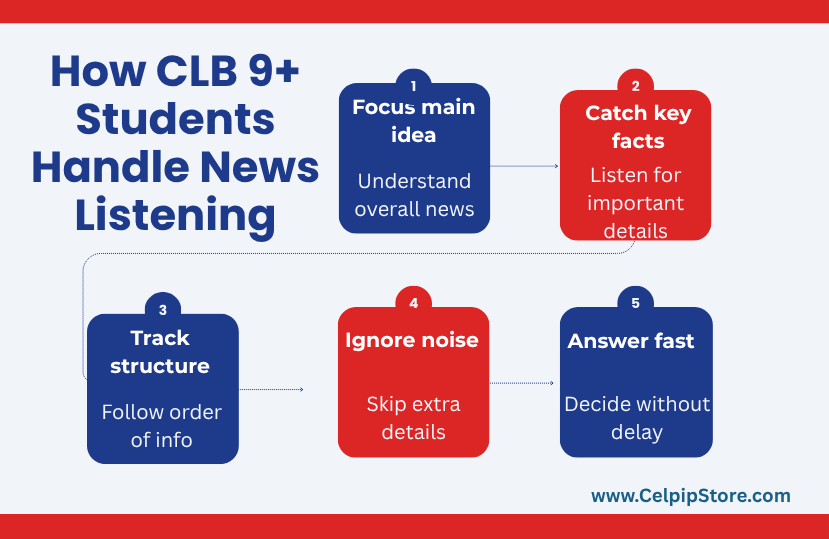
High-Scorer Behavior Pattern
- Think in headlines
- Focus on structure, not sentences
- Capture only key facts
- Track updates carefully
- Ignore background explanations
Advanced Listening Techniques (CLB 9+ Level)
Now you understand the Headline -> Key Details -> Updates system.
We will upgrade this into exam-level control techniques.
CELPIP News Listening becomes difficult because information is structured, fast, and often includes misleading details.
Your job is to stay accurate, not overloaded.
1. Main Idea Lock Technique (Very Important)
Once you identify the main idea, you must “lock” it in your mind.
Example
“Today’s news is about a flood affecting the northern part of the city.”
Locked idea: Flood in northern city
Why This Works
It prevents confusion when extra details appear later.
Rule
Do NOT change main idea unless explicitly updated.
2. Detail Hierarchy System
Not all details are equal.
Priority Order
- Main event (what happened)
- Location (where)
- Time (when)
- People involved (who)
- Extra explanation (least important)
Example
“The festival will take place in Central Park on Sunday, organized by the city council.”
Focus order:
festival -> Central Park -> Sunday -> city council
3. Update Trap (Most Common Error)
News often changes information mid-sentence.
Example
“The event was scheduled for Friday, but it has now been moved to Saturday.”
Student Mistake
Friday (first info)
Saturday (final update)
Rule
Final update = correct answer
Build a consistent practice routine that improves your accuracy across different listening tasks with CELPIP Listening Mastery: Complete Strategy for CLB 9.
4. Distractor Information Strategy
News passages include extra background that is NOT tested.
Types of Distractors
- Historical context
- Opinions or commentary
- Additional examples
- Side explanations
Example
“The city has faced traffic issues for years, and residents have complained frequently. However, a new system will be introduced next week.”
Answer focus: new system next week
Ignore: past complaints
5. Compression Listening Technique
You must convert long sentences into short meaning units.
Example
“The government has announced a new recycling program that will start next month in all public schools.”
Compressed notes:
• recycling program
• next month
• schools
Examiner Insights (What Part 4 Tests)
CELPIP is checking:
- Can you identify the main idea quickly?
- Can you separate key facts from noise?
- Can you follow updates and corrections?
- Can you handle structured information flow?
High-Value Vocabulary for Part 4
News Words
- announcement
- report
- update
- official statement
- confirmation
Event Words
- closure
- delay
- cancellation
- reopening
- expansion
Time Words
- initially
- currently
- previously
- now
- scheduled
Practice Drills (Exam Simulation Style)
Practice 1
“The library will close on Monday for renovation and reopen next Friday.” Improve your ability to process spoken information efficiently and manage the listening test with the strategies in CELPIP Listening Mastery: Complete Strategy for CLB 9.
Answer: closure Monday -> reopening Friday
Practice 2
“A new bus route has been introduced downtown starting this week.”
Answer: new bus route this week
Practice 3
“The concert was planned for Saturday but moved to Sunday due to weather.”
Answer: Sunday
Performance Upgrade Rule
To reach CLB 9+, always:
- Lock main idea early
- Prioritize structured details
- Track updates carefully
- Ignore background noise
- Compress information into keywords
Summary
CELPIP Listening Part 4 is about understanding structured news information, not memorizing sentences.
Every passage follows a clear pattern:
Main Idea (Headline) -> Key Details -> Updates/Changes
If you follow this structure, you can answer questions accurately even when the audio is fast or information-heavy.
Final Checklist (Exam-Day Strategy)
Before Listening
- Read the question quickly
- Predict the topic (event, update, announcement)
- Prepare for structured information
During Listening
- Identify the main idea immediately
- Lock the headline in your mind
- Track key details (who, what, when, where)
- Watch carefully for changes or updates
- Ignore background explanations
Answering Strategy
- Choose answers based on final updated information
- Focus on structured facts, not stories
- Avoid confusion from extra details
- Compress information into keywords only
Common Mistakes Reminder
- Don’t focus on background stories
- Don’t ignore updates or corrections
- Don’t mix early and final information
- Don’t try to remember full sentences
FAQs (CELPIP Listening Part 4)
1. What is tested in Listening Part 4?
Your ability to understand structured news-style information and identify key updates.
2. How do I find the main idea quickly?
Listen for the topic in the first few seconds and “lock” it immediately.
3. What is the most important detail type?
Updated information (changes in time, place, or plan).
4. Should I write full sentences in notes?
No. Only keywords like event, time, and location.
5. Why do students lose marks in Part 4?
They focus on background information instead of structured facts and updates.
Practice Plan (3-Day Focus Training)
Day 1 — Main Idea Training
- Listen to news audio
- Identify only main topics
Day 2 — Detail Tracking
- Practice extracting who/what/when/where
- Ignore explanations
Day 3 — Full Simulation
- Do timed listening tests
- Focus on updates and final answers
Final Mindset for Part 4
- Think like a news reader, not a note taker
- Lock the main idea early
- Track structured facts only
- Always trust final updates
- Ignore background noise
Conclusion
CELPIP Listening Part 4 becomes simple when you follow structure instead of trying to memorize everything. To connect your Part 4 news-listening skills with a complete CLB 9+ preparation plan, review CELPIP Listening Mastery: Complete Strategy for CLB 9.
Use this system:
Headline -> Key Details -> Updates
and your accuracy will improve significantly.