CELPIP Reading Question Types Explained: Complete Strategy to Improve CLB 9–12 Score
Introduction
CELPIP Reading becomes difficult for most students not because the English is hard, but because they don’t recognize what type of question they are solving.
In this test, every question is designed with a different purpose. Some questions are direct and factual, while others are indirect and require interpretation. A few questions test vocabulary in context, and others test how well you can connect ideas across a passage.
If you treat all questions the same way, you will lose time and make unnecessary mistakes. Understanding CELPIP Reading question types is important, but your final score depends on how well you apply a complete reading strategy across all sections. You can learn this in CELPIP Reading Strategy: Complete Guide for CLB 9–12.
The key to CLB 9–12 is simple: identify the question type before answering.
Learning Objectives
By the end of this lesson, you will clearly understand how to:
- Identify CELPIP Reading question types quickly
- Understand what each question is actually testing
- Apply the correct strategy for each type
- Avoid common traps and misleading answer choices
- Improve both speed and accuracy under time pressure
Overview of Question Types
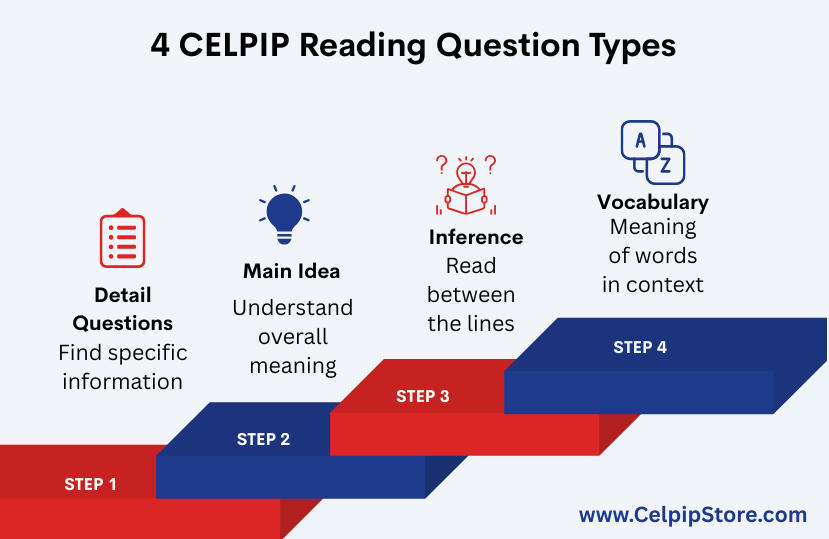
CELPIP Reading mainly tests four core question categories:
- Information-based questions
-> Find direct facts from the passage - Inference questions
-> Understand meaning that is not directly written - Matching questions
-> Match ideas or statements with correct sections - Vocabulary-in-context questions
-> Understand meaning of words based on context
Each of these requires a different thinking approach. This is why one single reading strategy does not work for the entire test. Each question type requires a specific approach, but these techniques must be combined into a full reading strategy to perform effectively under exam conditions. This system is explained in CELPIP Reading Complete Strategy Guide for High Scores.
Common Mistakes
Most students lose marks because they apply the wrong approach. Instead of identifying the question type, they immediately start searching for answers.
Here are the most common mistakes:
- Reading the entire passage before understanding the question
- Looking for exact words instead of meaning
- Using the same strategy for all question types
- Ignoring paraphrased information
- Guessing answers based on familiarity rather than logic
The real issue is not reading ability it is lack of question awareness. Many candidates lose marks because they focus only on question types without developing a complete reading strategy, which affects speed and accuracy. Avoid this with CELPIP Reading Complete Strategy Master Guide.
1. The Core CELPIP Reading Framework (How the Test Really Works)
CELPIP Reading is not a “read and answer” exam. It is a decision-making system under time pressure.
Every question follows a 3-step mental process:
Step 1: Identify the Question Type
Before reading anything, you must understand:
- What is being asked?
- Is it fact, meaning, comparison, or vocabulary?
This step controls your entire strategy.
Step 2: Locate Information Efficiently
Instead of reading everything, you:
- Scan for keywords
- Look for synonyms
- Jump to relevant section
This saves 50%–60% of your time.
Step 3: Confirm Meaning (Final Decision)
You don’t just “find” answers, you verify:
- Does the option match meaning?
- Is it partially correct or fully correct?
- Is it a distractor?
2. Information-Based Questions (FACT QUESTIONS)
These are the most direct questions in CELPIP Reading.
They ask:
- Who did it?
- What happened?
- When or where did it occur?
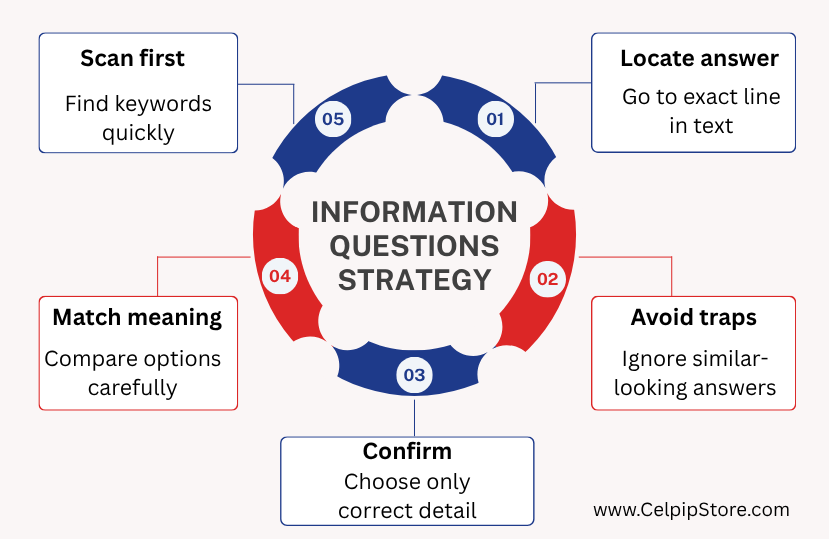
Strategy (Simple but Powerful):
Instead of reading everything, you:
- Take keywords from the question
- Scan passage quickly
- Match exact information
Important Note:
Even if wording changes slightly, meaning stays the same.
Example:
“Start time of meeting” may appear as “meeting begins at 10 AM”. To achieve CLB 9+, you must not only understand question types but also apply skimming, scanning, and time management strategies together. You can build this using CELPIP Reading Strategy for CLB 9–12 Success.
3. Inference Questions (HIDDEN MEANING QUESTIONS)
These are more difficult because answers are NOT directly written.
You must understand:
- implied meaning
- situation behind the sentence
- writer’s intention
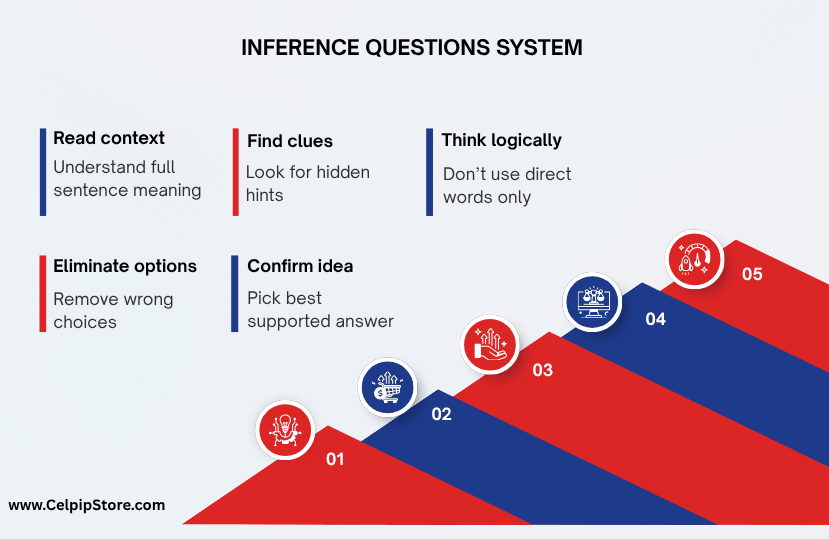
Strategy:
- Read 1–2 lines before and after keyword
- Identify tone (positive / negative / neutral)
- Think logically, not literally
Example Insight:
If someone “left the job due to pressure,” the inference is:
- stress
- workload issue
- dissatisfaction
The answer is not written, but implied.
4. Matching Questions (IDEA COMPARISON SYSTEM)
These questions test your ability to connect ideas, not words.
You may need to:
- match statements to paragraphs
- identify similar meaning sections
Strategy:
- Read paragraph main idea first
- Ignore repeated words trap
- Focus on overall meaning
Important rule:
Same words ? correct answer
Same idea = correct answer
5. Vocabulary-in-Context Questions (MEANING FROM CONTEXT)
These questions test how a word is used inside a sentence.
Strategy:
- Do NOT use dictionary meaning
- Read full sentence carefully
- Replace word with possible meaning in your mind
Example:
“critical” can mean:
- important
- serious
- urgent
Only context decides correct meaning. Your reading performance improves significantly when you combine question-type knowledge with a structured reading strategy for accuracy and speed. This method is explained in CELPIP Reading Master Strategy Guide (CLB 9–12).
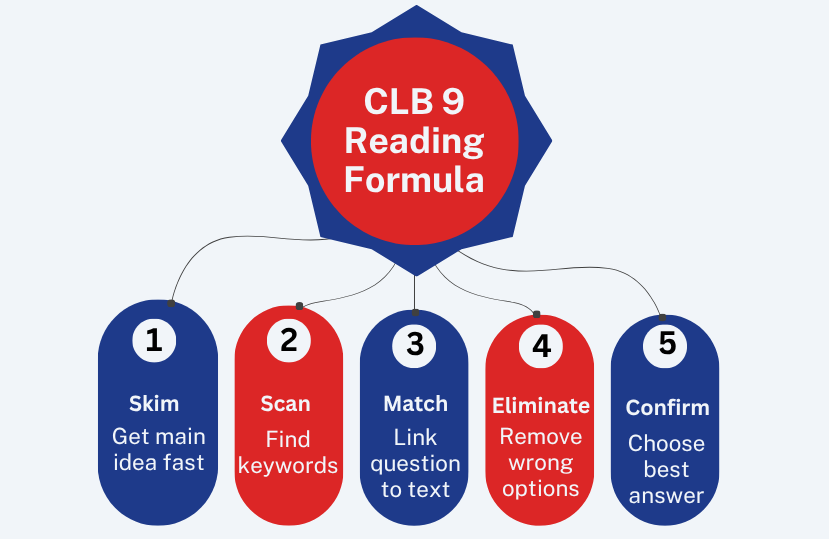
6. The Smart Decision System (CLB 9+ Technique)
High-scoring students follow a fixed pattern:
- Identify question type in 2–3 seconds
- Scan only relevant information
- Eliminate 2 wrong answers first
- Choose between final 2 options logically
1. Advanced Strategy (How CLB 9–12 Students Think Differently)
At higher levels, CELPIP Reading is no longer about understanding text — it is about controlling decisions under pressure.
Strong candidates do not “search for answers randomly.” They follow a fixed mental system:
You first identify what the question is testing, then decide how to approach it. For example, if it is an information question, you immediately switch to scanning mode. If it is inference-based, you slow down and analyze meaning instead of words.
The key difference is this:
Weak students read first and decide later.
Strong students decide first and read with purpose.
2. Examiner Insights (How CELPIP is Designed to Trick You)
CELPIP Reading is carefully designed to test your decision-making, not just your English level.
Examiners often use:
- Paraphrased information instead of exact words
- Distractor answers that look correct but change meaning slightly
- Partial truth options (partly correct but not fully accurate)
- Time pressure traps where easier questions are hidden later
The goal is to see if you can avoid “easy-looking wrong answers.”
Most mistakes happen when students trust familiarity instead of meaning.
Vocabulary System (Context-Based Understanding for CLB 9+)
You do NOT need advanced vocabulary for CELPIP Reading. You need context intelligence.
This means understanding how words change meaning depending on usage.
Core Vocabulary Strategy: Paraphrase Recognition
CELPIP rarely repeats the same words. Instead, it changes form:
- increase -> rise / grow / go up
- decrease -> drop / fall / reduce
- important -> essential / critical / significant
- problem -> issue / challenge / difficulty
If you only search for exact words, you will miss answers.
Functional Vocabulary Awareness
Some words act as “logic signals” in passages:
- however -> contrast
- therefore -> result
- although -> contradiction
- because -> reason
These words help you understand sentence direction.
Key Rule
You are not tested on memorizing vocabulary.
You are tested on recognizing meaning in context.
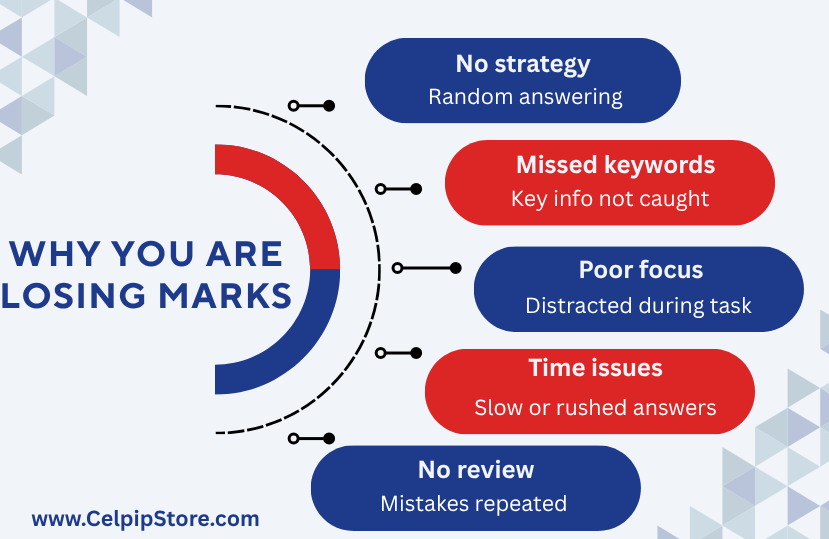
Error Patterns (Why Students Keep Losing Marks)
Most students repeat the same mistakes without realizing it.
Error 1: Keyword Matching Trap
Students select answers just because they see similar words.
Fix: Always check full meaning, not just keywords.
Error 2: Overthinking Simple Questions
Students spend too much time analyzing easy factual questions.
Fix: Scan quickly and move on if answer is clear.
Error 3: Ignoring Question Type
Students jump directly into reading without strategy.
Fix: Always identify question type first.
Error 4: Reading Everything Slowly
Students believe careful reading = better score.
Fix: Use scanning and skimming instead of full reading.
Error 5: Not Learning from Mistakes
Students repeat the same error pattern in every practice test.
Fix: After every test, classify mistake:
- vocabulary error
- time error
- logic error
- distraction error
Summary
CELPIP Reading question types are designed to test different thinking skills, not just reading ability. Each question type information, inference, matching, and vocabulary requires a different strategy.
If you apply the correct approach, you don’t need to read everything. Instead, you scan, interpret, and select answers based on meaning and logic.
The key idea is simple: right strategy beats slow reading every time. Mastering question types is a strong step, but your final success depends on applying a complete reading strategy across the entire test. Start with CELPIP Reading Strategy Complete Guide for CLB 9–12.
2. Final Checklist (Before You Answer Any Question)
Before selecting an answer, make sure you:
- Identify the question type first
- Decide whether to skim, scan, or interpret
- Focus on meaning, not exact words
- Eliminate clearly wrong options first
- Confirm final answer using logic, not guessing
- Manage time and avoid overthinking
FAQs
Q1: Do I need advanced vocabulary for CELPIP Reading?
No. You only need to understand common words in different contexts and recognize paraphrasing.
Q2: What is the biggest mistake students make?
They ignore question types and directly start reading the passage.
Q3: How can I improve speed in Reading?
Use scanning for keywords and avoid reading every sentence in detail.
Q4: Are all questions the same difficulty?
No. Information questions are easier, while inference and matching questions require deeper thinking.
Practice Plan (7-Day Skill Builder)
Day 1–2: Question Type Recognition
- Practice identifying question types only
- Do not focus on answering yet
Day 3–4: Strategy Application
- Apply correct method for each question type
- Focus on accuracy over speed
Day 5–6: Timed Practice
- Full reading sections under time pressure
- Practice skimming and scanning together
Day 7: Error Analysis
- Review all mistakes
- Categorize errors (vocabulary, logic, time, distraction)
- Fix weak areas
Conclusion
CELPIP Reading success is not about reading more it is about thinking smarter.
Once you understand question types and apply the correct strategy, your speed and accuracy naturally improve. This is what separates CLB 6–7 learners from CLB 9–12 achievers.
Master the system, not just the English.