CELPIP Listening Mastery: Complete CLB 9+ Strategy for All Parts (1–6)
Introduction
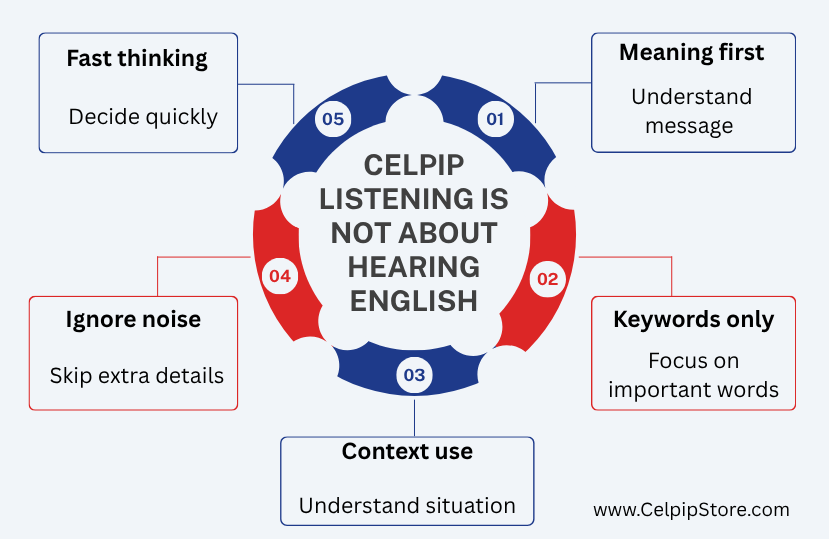
CELPIP Listening is not just about hearing English.
It is about understanding meaning, identifying intent, and making smart decisions under time pressure.
Many students believe listening is the hardest module.
But the truth is different.
High scorers don’t listen better — they listen smarter.
This lesson will give you a complete system to handle all 6 parts of CELPIP Listening with confidence.
You will learn:
- How to predict answers before listening
- How to avoid traps
- How to think like a CLB 9+ test taker
This is not random tips.
This is a complete listening framework used by top scorers. To build a strong foundation before applying advanced techniques across all listening parts, explore CELPIP Listening Mastery: Complete Strategy for CLB 9.
Learning Objectives
By the end of this lesson, you will be able to:
- Understand the structure of all 6 listening parts
- Apply a step-by-step listening system
- Identify keywords and speaker intent quickly
- Avoid common traps and confusing options
- Improve accuracy without replaying audio
- Build confidence for real exam conditions
Overview of CELPIP Listening
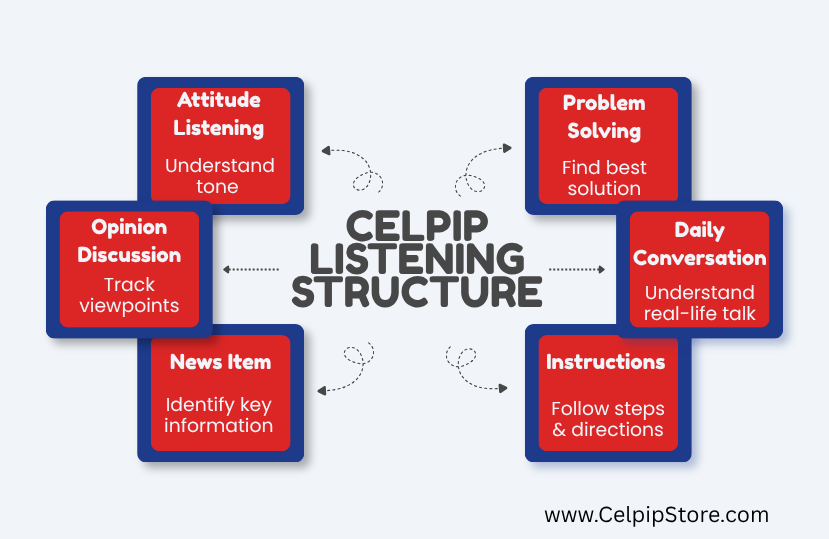
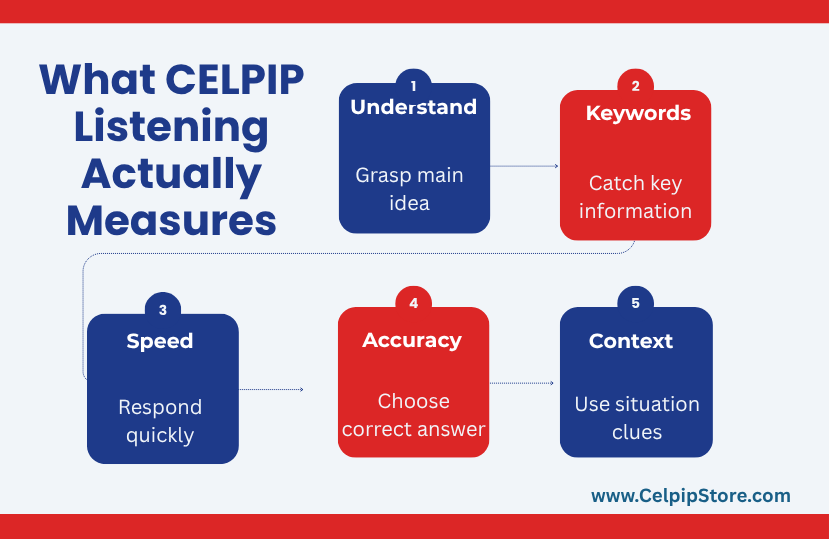
The CELPIP Listening test includes 6 different parts, and each part tests a different skill.
Part 1: Problem Solving
You listen to a conversation and choose the best solution.
Part 2: Daily Life Conversation
You understand everyday discussions and details.
Part 3: Information & Instructions
You follow steps, directions, and explanations.
Part 4: News Item
You understand formal news-style English.
Part 5: Discussion & Opinion
You identify opinions and viewpoints.
Part 6: Attitude & Opinion
You detect tone, emotion, and speaker attitude. Advanced CLB 9 strategies work best when supported by a clear listening framework. Strengthen your foundation with CELPIP Listening Mastery: Complete Strategy for CLB 9.
Key Insight
Each part is different.
But the core skills are the same:
- Listening for meaning (not just words)
- Understanding context
- Identifying intent
- Eliminating wrong answers
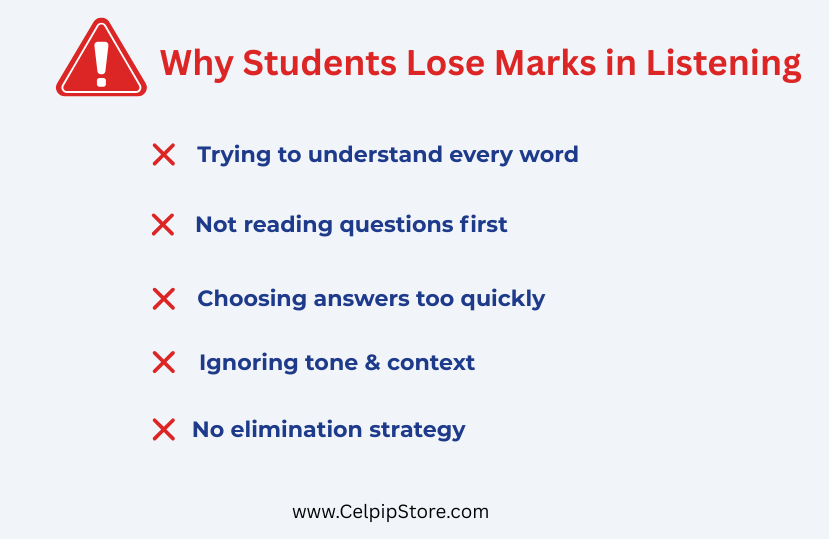
Common Mistakes (Why Students Lose Marks)
Most students don’t lose marks because of English.
They lose marks because of wrong strategy.
Mistake 1: Trying to Understand Every Word
Students panic when they miss one word.
Reality: You only need the main idea.
Mistake 2: Not Reading Questions Before Listening
They start listening without knowing what to focus on.
Result: They miss key information.
Mistake 3: Choosing Answers Too Quickly
They hear one matching word and select the option.
Trap: CELPIP uses distractors (false matches).
Mistake 4: Ignoring Tone and Context
Especially in Part 5 and Part 6.
Students focus only on words, not meaning.
Mistake 5: No Elimination Strategy
They guess instead of logically removing wrong answers.
Mistake 6: Poor Time Management
They spend too long thinking and miss the next question.
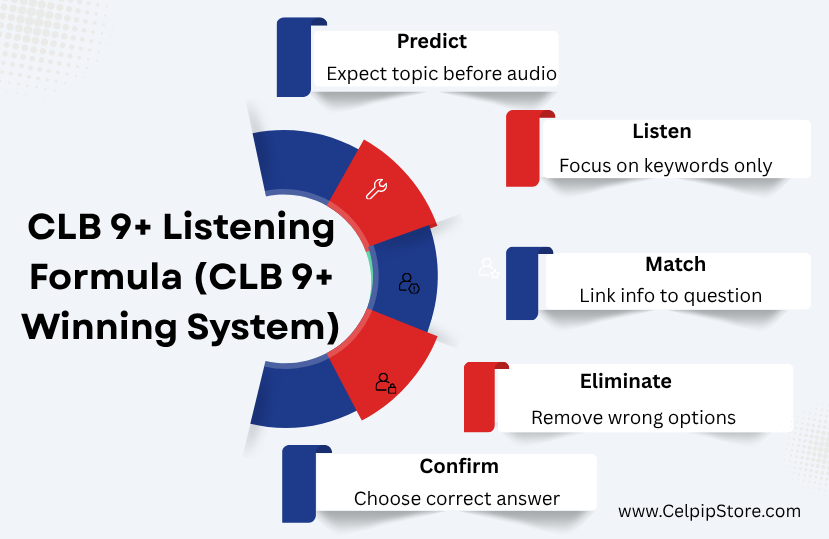
1. The Core Listening Framework (CLB 9 System)
To score high in CELPIP Listening, you must follow a structured thinking system, not random listening.
We use the 4-Step Listening Control System:
STEP 1: Predict the Context (Before Audio Starts)
Before listening, quickly scan the question.
Ask:
- Who is speaking?
- Where is the situation?
- What is the topic?
This prepares your brain to filter information.
STEP 2: Identify Keywords During Listening
Do NOT try to understand everything.
Focus on:
- Names
- Numbers
- Action verbs
- Opinion words (like think, feel, should, suggest)
These are your “answer signals”.
STEP 3: Match Meaning, Not Words
CELPIP is NOT word-matching.
Example:
- Audio says: “I can’t make it today.”
- Option says: “He will not attend.”
Same meaning, different words.
STEP 4: Eliminate Wrong Options
Do not ask “Which one is correct?”
Ask:
“Which options are definitely wrong?”
Then remove them one by one. To understand how the different listening tasks fit into one complete preparation system, follow CELPIP Listening Mastery: Complete Strategy for CLB 9.
2. Listening Strategy by Question Behavior
Strategy A: First 5 Seconds Rule
The first few seconds give context.
Train yourself to:
- Identify topic immediately
- Predict direction of conversation
Strategy B: One Idea Focus Rule
Each audio usually has ONE main idea per question.
Don’t overthink multiple meanings.
Strategy C: Trap Recognition System
CELPIP often uses:
- Similar sounding words
- Partial information
- Emotional reversal (positive -> negative meaning shift)
Always check full meaning.
3. Part-Wise Strategy Overview
Part 1: Problem Solving Strategy
- Identify problem immediately
- Focus on solution keywords
- Ignore emotional distraction
Think: “What should be done?”
Part 2: Daily Conversation Strategy
- Track speaker relationship
- Identify intention (agree/disagree/help)
- Focus on context flow
Part 3: Instructions Strategy
- Listen for steps and sequence words:
- first, next, then, finally
- Visualize process in mind
Part 4: News Strategy
- Focus on:
- Who
- What happened
- Why it happened
- Ignore background noise details
Part 5: Opinion Strategy
- Identify viewpoints:
- agree / disagree / neutral
- Watch for contrast words:
- however, but, although
Part 6: Attitude Strategy
- Focus on tone:
- happy, frustrated, uncertain, confident
- Do NOT rely only on words
- Meaning = tone + context
4. Core Skill Transformation (Important Insight)
Most students think:
“I need to hear everything clearly.”
But CLB 9 students think:
“I need to understand the decision behind the words.”
5. Example Breakdown
Audio Idea:
A student says:
“I thought I could finish the assignment today, but I might need one more day.”
Question: What is the speaker’s situation?
Correct Understanding:
- Not finished yet
- Needs extra time
- Slight uncertainty
6. Golden Rule of CELPIP Listening
You don’t win by hearing more.
You win by thinking faster.
1. Advanced Listening Techniques (CLB 9+ Level)
At this stage, you are not just listening for answers.
You are predicting answers before they fully appear.
Technique 1: Forward Prediction Method
Strong candidates always think ahead.
While listening, ask:
- “Where is this conversation going next?”
- “What will the speaker likely say?”
This keeps your brain one step ahead of the audio. If you want to identify the root causes of incorrect answers and build more consistent listening habits, use the methods in CELPIP Listening Mastery: Complete Strategy for CLB 9.
Technique 2: Emotional Tracking System
CELPIP often tests emotional direction.
Track:
- frustration
- satisfaction
- confusion
- agreement
Emotion often reveals the correct answer faster than words.
Technique 3: Contrast Signal Detection
Watch for contrast words:
- but
- however
- although
- actually
- instead
These words often change the entire meaning.
Technique 4: Hidden Answer Placement
Correct answers are often NOT repeated clearly.
They are:
- paraphrased
- implied
- spread across two sentences
Train your brain to connect meaning.
2. Examiner Insights (How CELPIP Designs Traps)
CELPIP Listening is designed to test decision-making under pressure.
Here is how examiners create difficulty:
Trap 1: Keyword Matching Trap
You hear the same word in the audio and option.
But meaning is different.
Example:
- Audio: “I missed the meeting.”
- Option: “He attended the meeting.”
Same keyword, opposite meaning.
Trap 2: Partial Information Trap
Only part of the statement is correct.
Example:
- “He will go tomorrow, not today.”
Options may confuse “go” without timing.
Trap 3: Emotional Reversal Trap
Tone changes meaning.
Example:
- “That was fine… I guess.”
Sounds positive but actually uncertain. Make your preparation more structured by combining advanced techniques with the core practice framework in CELPIP Listening Mastery: Complete Strategy for CLB 9.
Trap 4: Distractor Overload
Multiple similar options are given to confuse you.
Only one matches full meaning.
3. High-Scoring Vocabulary System (CLB 9 Toolkit)
You don’t need advanced English.
You need functional listening vocabulary recognition.
Opinion Words
- I believe
- I feel
- I think
- In my opinion
- It seems
Decision Words
- decide
- choose
- suggest
- recommend
- agree / disagree
Problem Words
- issue
- difficulty
- challenge
- mistake
- delay
Solution Words
- fix
- resolve
- improve
- handle
- manage
Emotion Words
- frustrated
- relieved
- confused
- excited
- disappointed
These words signal answer direction immediately. To develop consistent listening habits and manage different question types more effectively, review CELPIP Listening Mastery: Complete Strategy for CLB 9.
4. Practice System (Daily Training Model)
To reach CLB 9, you need structured practice.
STEP 1: Active Listening (10–15 min daily)
- Listen to English conversations or podcasts
- Focus on main idea only
- Do NOT pause repeatedly
STEP 2: Keyword Tracking Practice
- Write down only:
- names
- actions
- opinions
STEP 3: Paraphrase Training
Take one sentence and rewrite meaning:
Example:
- “I can’t attend today.”
-> “He is unavailable today.”
STEP 4: Mock Test Simulation
- No pause
- No replay
- Real exam timing
This builds pressure control.
5. CLB 9 Listening Mindset Shift
Low scorers think:
“I must understand everything.”
High scorers think:
“I must understand what matters.”
Summary
CELPIP Listening is not a passive skill.
It is a structured thinking and decision-making test. To connect your advanced listening strategies with a complete test-preparation framework, revisit CELPIP Listening Mastery: Complete Strategy for CLB 9.
To score CLB 9+, you must:
- Predict context before listening
- Focus on keywords and meaning
- Avoid word-matching traps
- Understand tone and intent
- Eliminate wrong options logically
- Think faster, not harder
Success in Listening comes from strategy, not hearing ability.
2. CLB 9 Listening Checklist
Use this checklist before and during the test:
Before Listening
- Read the question quickly
- Identify topic and situation
- Predict possible answers
During Listening
- Focus on keywords only
- Track speaker intention
- Notice contrast words (but, however, although)
- Ignore distractor details
- Stay calm if you miss one sentence
After Listening
- Eliminate clearly wrong options
- Choose based on meaning, not words
- Do not overthink or change answers
3. Frequently Asked Questions (FAQs)
Q1: Is CELPIP Listening difficult?
Not if you use the right system. It is more about strategy than English level.
Q2: How can I improve my listening score quickly?
Practice daily with focus on keywords, paraphrasing, and mock tests under time pressure.
Q3: Should I try to understand every word?
No. Focus only on main ideas and important signals.
Q4: What is the biggest mistake students make?
They choose answers based on word matching instead of meaning.
Q5: Can I get CLB 9 in Listening?
Yes, if you consistently apply prediction, elimination, and meaning-based listening.
4. Practice Plan (7-Day CLB 9 System)
Day 1–2: Foundation Training
- Practice identifying keywords
- Listen to short English conversations
- Focus on general meaning
Day 3–4: Strategy Training
- Practice prediction before listening
- Identify tone and intention
- Train elimination technique
Day 5–6: Mock Practice
- Full listening tests
- No pause, no repetition
- Time pressure simulation
Day 7: Review & Correction
- Analyze mistakes
- Identify trap patterns
- Improve weak areas
5. Final Conclusion
CELPIP Listening is not about being a perfect listener.
It is about becoming a strategic listener under pressure.
If you follow the system in this lesson:
- You will stop panicking during audio
- You will recognize traps quickly
- You will improve accuracy significantly
- You will move closer to CLB 9+ performance