CELPIP Listening Part 3 Strategy: Information Extraction System for CLB 9 Accuracy
Introduction
CELPIP Listening Part 3 focuses on your ability to extract clear information from structured listening content.
Unlike casual conversations, this section is more organized. You may hear instructions, explanations, or detailed information where multiple facts are presented quickly.
The biggest challenge is not understanding English. The real challenge is selecting the correct information while ignoring unnecessary details.
Many students lose marks because they try to remember everything. High scorers do the opposite they focus only on required information. To understand how information extraction fits into the complete CELPIP Listening test, explore CELPIP Listening Mastery: Complete Strategy for CLB 9.
In this lesson, you will learn how to extract key details quickly and accurately using a structured system.
Learning Objectives
By the end of this lesson, you will be able to:
- Understand the structure of CELPIP Listening Part 3
- Identify required information quickly
- Extract key details without confusion
- Avoid information overload during listening
- Improve accuracy in instruction-based audio
- Apply a structured information extraction system
Overview of CELPIP Listening Part 3
This section is based on structured informational content, such as:
- Instructions or announcements
- Service or process explanations
- Step-by-step procedures
- Informational updates
- Detailed descriptions of events or systems
Extracting key details is only one part of listening success. Learn how to strengthen your performance across all listening tasks with CELPIP Listening Mastery: Complete Strategy for CLB 9.
What You Will Hear
You will typically hear a speaker explaining:
- What something is
- How something works
- What steps to follow
- What details are important
What You Must Do
Your task is NOT to remember everything.
Your task is to:
- Identify required information
- Capture key details only
- Ignore extra explanations or background noise
The Core Information Extraction System (Preview Framework)
To succeed in Part 3, you must follow this system:
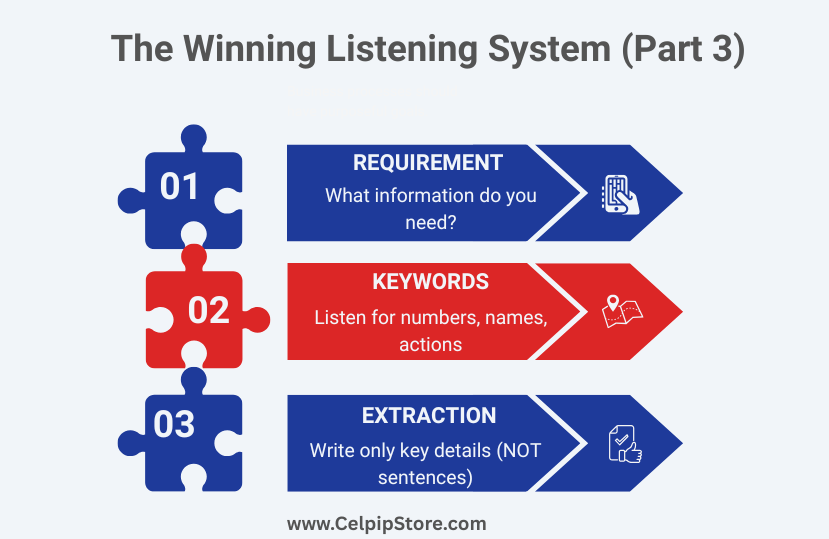
Step 1 — Identify Required Information
Understand what the question is asking for
Step 2 — Listen for Keywords
Focus on numbers, steps, names, and actions
Step 3 — Capture Only Key Details
Ignore full sentences and unnecessary explanations
Common Mistakes (Why Students Lose Marks)
Many students struggle in Part 3 due to poor listening strategy.
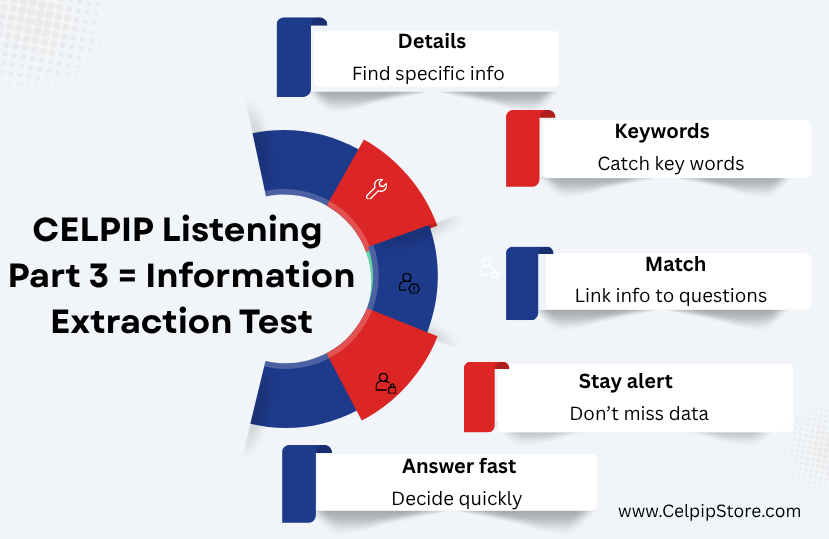
1. Trying to Remember Everything
Students attempt to memorize full audio instead of focusing on key points.
2. Writing Too Much Information
Full sentence note-taking causes you to miss new information.
3. Missing Keywords
Important details like numbers, names, and steps are often ignored.
4. Getting Lost in Explanations
Extra explanations distract from actual required answers.
5. Not Understanding Question Requirement
If you don’t know what information is needed, you cannot filter correctly.
To improve your ability to recognize important facts, understand context, and select accurate answers, follow CELPIP Listening Mastery: Complete Strategy for CLB 9.
What Makes Part 3 Different?
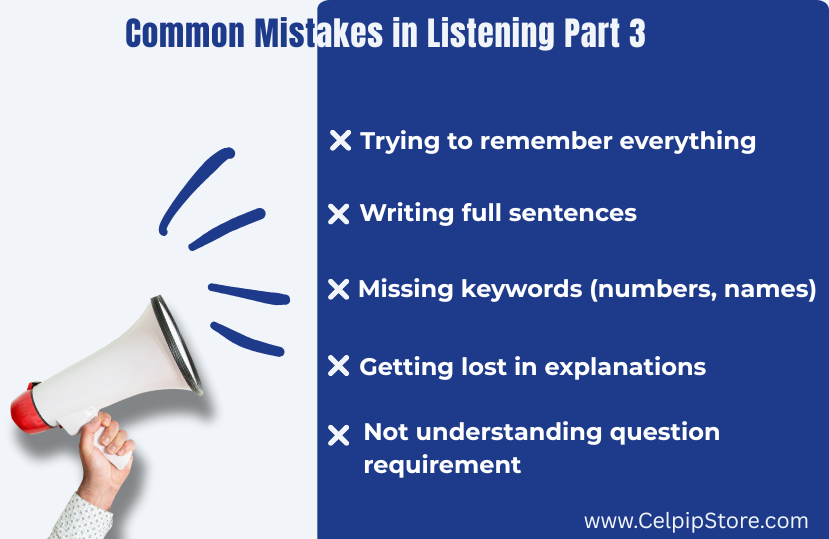
CELPIP Listening Part 3 is designed to test:
- Your ability to filter information
- Your focus on accuracy over memory
- Your skill in identifying key details quickly
- Your ability to follow structured spoken content
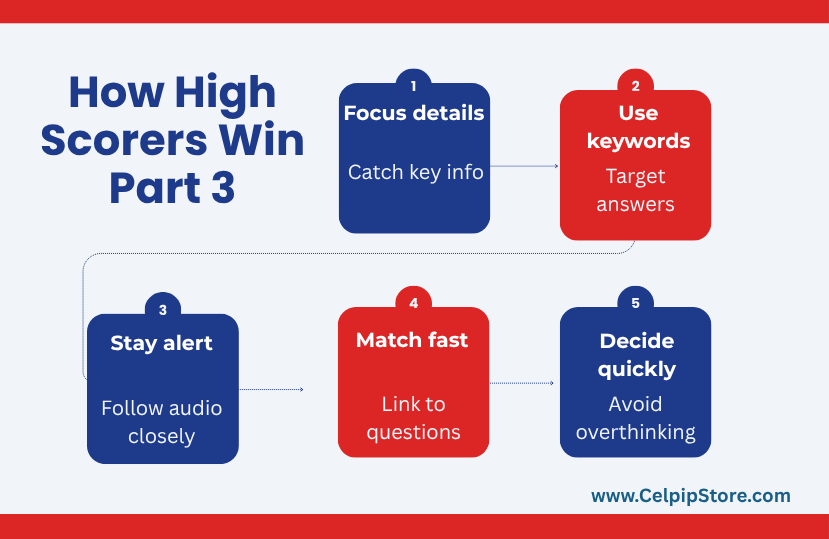
Core Framework: Requirement -> Keyword -> Extraction System
In CELPIP Listening Part 3, success depends on one simple structure:
1. Requirement (What do I need to find?)
2. Keywords (What should I listen for?)
3. Extraction (What should I write/keep?)
If you follow this flow, you will stop getting lost in long explanations and start capturing only scoring information.
Step 1 — Identify the Requirement First
Before the audio starts or at the beginning, you must understand what information is being asked.
Common Requirement Types
You may need to find:
- Dates or times
- Names or locations
- Steps or procedures
- Prices or numbers
- Rules or instructions
Example
Question:
“What time does the event start?”
Requirement: Time
Exam Tip
If you don’t know what you are listening for, everything sounds important.
So always ask:
“What information do I need?”
Step 2 — Listen for Keywords (Signal Information)
Once you know the requirement, focus only on keywords related to it.
High-Value Keywords
- Numbers (10, 25, 3 PM)
- Names (John, library, room B)
- Actions (register, submit, cancel)
- Locations (office, center, online)
- Dates (Monday, June 5th)
Example
“The workshop will begin at 3:30 PM in Room 204.”
Keywords:
• 3:30 PM
• Room 204
Important Rule
Do NOT try to understand every sentence.
Only extract required information.
If you often miss important information or get distracted by unnecessary details, use the broader techniques in CELPIP Listening Mastery: Complete Strategy for CLB 9.
Step 3 — Extraction (Keep Only What Matters)
Now you must convert listening into short usable notes or mental answers.
Correct Extraction Style
Full sentence:
“The workshop will begin at 3:30 PM in Room 204.”
Extracted form:
• 3:30 PM
• Room 204
Why This Works
- Faster processing
- Less confusion
- Easier to match answers
Information Flow Strategy (Real Exam Technique)
While listening, follow this cycle:
Step 1: Identify requirement early
Example: “What is the location?”
Step 2: Ignore unrelated content
Do not focus on background stories or extra explanation.
Step 3: Capture only target information
Write only location-related words.
Complete Example (Step-by-Step Application)
Audio:
“The seminar will take place on Friday at 2 PM in the downtown conference hall. Registration starts at 1:30 PM.”
Step 1 — Requirement
“When and where is the seminar?”
Step 2 — Keywords
• Friday
• 2 PM
• downtown conference hall
Step 3 — Extraction
Answer: Friday, 2 PM, downtown conference hall
Build a consistent listening practice routine that develops accuracy across different question types with CELPIP Listening Mastery: Complete Strategy for CLB 9.
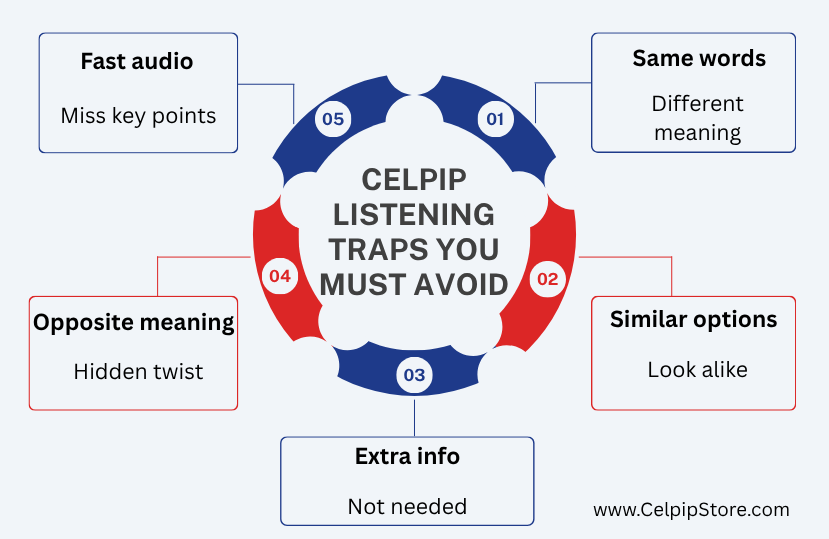
Trap Patterns in Part 3
CELPIP includes information traps to confuse you.
Trap 1: Extra Detail Trap
- Wrong focus: registration time (1:30 PM)
- Correct focus: event time (2 PM)
Trap 2: Multiple Numbers Trap
Students confuse similar numbers (1:30 vs 2:00)
Trap 3: Background Noise Trap
Extra explanation is NOT needed for answers.
Fast Listening Strategy (Real Exam Method)
While listening:
Step 1: Identify question focus immediately
Step 2: Track only relevant keyword type
(numbers / names / time / location)
Step 3: Ignore everything else
Stay focused on required category only.
High-Scorer Behavior Pattern
- Focus on question requirement first
- Listen selectively, not fully
- Extract only key information
- Ignore explanations and fillers
- Use keyword-based memory
This section is less about conversation and more about precision listening.
Advanced Listening Techniques (CLB 9+ Level)
Now you understand Requirement -> Keyword -> Extraction, we will upgrade this into exam-level precision skills.
Part 3 becomes difficult when information is fast, structured, and includes multiple similar details. Improve your ability to process information efficiently and manage the listening test with the strategies in CELPIP Listening Mastery: Complete Strategy for CLB 9.
Your goal is not just to listen it is to filter correctly under pressure.
1. Priority Listening (What to Focus First)
Not all information has equal importance.
Priority Order
- Information directly linked to the question
- Numbers, dates, times
- Locations and names
- Actions or instructions
- Extra explanations (LOW priority)
Example
“The meeting is at 4 PM in Room 12. We will also discuss last week’s report.”
- Answer focus: 4 PM, Room 12
- Ignore: report discussion
2. Multi-Detail Confusion (Very Common Trap)
CELPIP often gives similar details close together.
Example
“Session A is at 10 AM, Session B is at 11 AM.”
Students confuse:
- wrong session timing
- correct matching required
Rule
Always match label + detail together
(do not separate them)
3. Distractor Information Strategy
Examiners add extra information to confuse you.
Types of Distractors
- Extra explanations
- Repeated ideas in different words
- Irrelevant background details
- Additional optional information
Example
“You can register online, but you can also visit in person. However, registration closes at 5 PM.”
- Important: 5 PM deadline
- Ignore: registration methods
4. Number & Time Trap (High Error Area)
Numbers are often close and confusing.
Example
“Call at 2:30 PM, not 3:30 PM.”
Students often mishear:
3:30 instead of 2:30
Strategy
- Always confirm final number
- Do not guess
- Wait for repetition or clarification
5. Structured Note Compression Technique
You must reduce listening into compressed keywords.
Bad Notes
“The workshop will start at 3:30 PM in the main hall of the building.”
Good Notes
• 3:30 PM
• main hall
Why This Works
- Faster processing
- Less confusion
- Easy answer matching
High-Value Vocabulary for Part 3
Instruction Words
- submit
- register
- complete
- fill out
- confirm
Information Words
- schedule
- deadline
- location
- requirement
- procedure
Number Words
- first
- second
- finally
- before
- after
Practice Drills (Exam Simulation Style)
Practice 1
“The training starts at 9 AM in Room 101. Registration closes at 8:30 AM.”
Answer focus: 9 AM, Room 101
Practice 2
“You can pick up the package from Monday to Friday between 10 AM and 4 PM.”
Answer: Monday–Friday, 10–4
Practice 3
“The fee is $25, but students only pay $15.”
Answer depends on condition -> student price = $15
Performance Upgrade Rule
To reach CLB 9+, always:
- Prioritize question-linked info
- Compress notes into keywords
- Ignore explanation noise
- Double-check numbers and times
- Match labels with details
To connect your Part 3 information-extraction skills with a complete CLB 9+ preparation plan, review CELPIP Listening Mastery: Complete Strategy for CLB 9.
Summary
CELPIP Listening Part 3 is a filtering test, not a memory test.
You are not expected to remember everything.
You are expected to extract only the required information accurately.
The entire system can be reduced to one flow:
Requirement -> Keyword -> Extraction -> Answer
If you follow this correctly, even fast or dense audio becomes manageable.
Final Checklist (Exam-Day Strategy)
Before Listening
- Read the question carefully
- Identify what is needed (time, place, number, etc.)
- Predict the type of information expected
During Listening
- Focus only on required information type
- Track keywords (numbers, names, dates, locations)
- Ignore explanations and extra details
- Match labels with correct details
Answering Strategy
- Write short keyword notes only
- Do not store full sentences in memory
- Confirm final numbers/times carefully
- Avoid mixing similar details
Common Mistake Reminder
- Don’t try to remember everything
- Don’t focus on background explanations
- Don’t mix multiple numbers or times
- Don’t ignore question focus
FAQs (CELPIP Listening Part 3)
1. What is tested in Listening Part 3?
Your ability to extract key information from structured audio like instructions and announcements.
2. How do I avoid missing details?
Focus only on required information and ignore extra explanations.
3. Should I write full sentences in notes?
No. Only keywords like numbers, names, and locations.
4. What is the biggest mistake in Part 3?
Trying to remember everything instead of filtering important information.
5. How can I improve accuracy quickly?
Practice keyword extraction with timed listening exercises.
Practice Plan (3-Day Focus Training)
Day 1 — Keyword Training
- Listen and extract only numbers, names, places
Day 2 — Requirement Training
- Read questions first, then identify needed info
Day 3 — Full Simulation
- Practice full Part 3 tests under exam timing
- Focus on filtering only
Final Mindset for Part 3
- Listen for purpose, not full content
- Filter information actively
- Focus on keywords only
- Avoid mental overload
- Stay calm under fast delivery
Conclusion
CELPIP Listening Part 3 is about control, not memory.
If you apply:
Requirement -> Keyword -> Extraction
you will consistently improve accuracy and reduce confusion.