
CELPIP Listening Part 5 Strategy: Discussion & Opinion System for CLB 9+ Accuracy
Introduction
CELPIP Listening Part 5 is one of the most challenging sections because it is based on discussion and opinion-based conversations.
Unlike news or instructions, there is no fixed structure here. Instead, you will hear multiple speakers sharing ideas, agreeing, disagreeing, and justifying their opinions.
Most students struggle because they try to follow every sentence. However, success in this section depends on understanding who thinks what, and why.
In this lesson, you will learn how to track opinions clearly and avoid confusion when multiple viewpoints are discussed at the same time. To understand how discussion-based listening fits into the complete CELPIP Listening test, explore CELPIP Listening Mastery: Complete Strategy for CLB 9.
Learning Objectives
By the end of this lesson, you will be able to:
- Identify different speaker opinions quickly
- Understand agreement and disagreement clearly
- Track reasons behind each viewpoint
- Handle multiple perspectives without confusion
- Recognize tone changes in discussions
- Apply a structured opinion-tracking system
Overview of CELPIP Listening Part 5
This section focuses on interactive discussions, such as:
- Friends debating ideas
- Colleagues discussing a decision
- Group conversations about plans
- Opinions about services, events, or choices
Understanding speakers’ opinions is only one part of listening success. Learn how to improve your performance across all listening tasks with CELPIP Listening Mastery: Complete Strategy for CLB 9.
What You Will Hear
You will usually hear:
- Multiple speakers giving opinions
- Agreement or disagreement between speakers
- Reasons supporting each opinion
- Final or suggested decisions
What You Must Identify
In every discussion, focus on:
- Who is speaking
- What their opinion is
- Whether they agree or disagree
- Why they hold that opinion
The Core Opinion Tracking System (Preview Framework)
To succeed in Part 5, use this system:
Step 1 — Identify Speaker Opinions
Understand each speaker’s view
Step 2 — Track Agreement or Disagreement
Notice if speakers support or oppose ideas
Step 3 — Focus on Reasons
Understand why they think that way.
To strengthen your ability to recognize key information, interpret speakers’ intentions, and select accurate answers, follow CELPIP Listening Mastery: Complete Strategy for CLB 9.
Common Mistakes (Why Students Lose Marks)
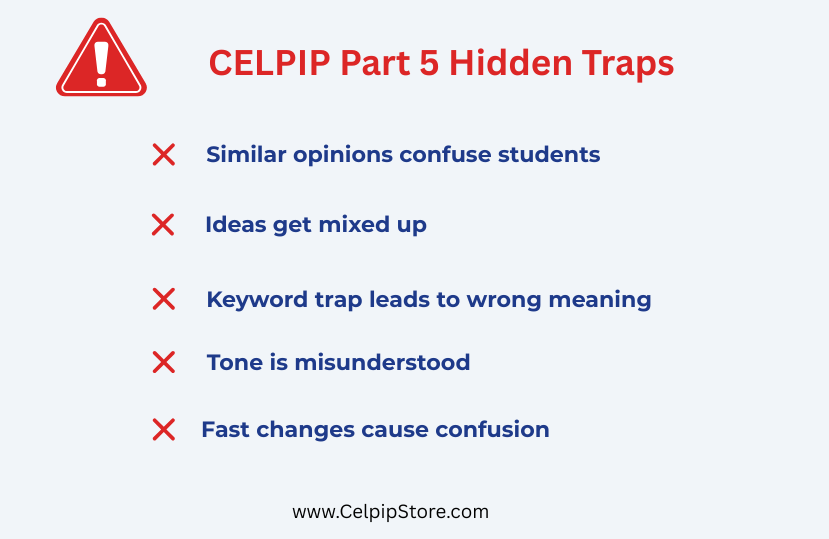
1. Mixing Up Speaker Opinions
Students often confuse who said what.
2. Focusing Only on Topic, Not Opinion
Understanding the topic is not enough you must track viewpoints.
3. Missing Agreement/Disagreement Signals
Small phrases like “I don’t think so” change meaning completely.
4. Ignoring Reasons Behind Opinions
Answers often depend on “why,” not just “what.”
5. Trying to Remember Every Sentence
This leads to overload and confusion.
What Makes Part 5 Different?
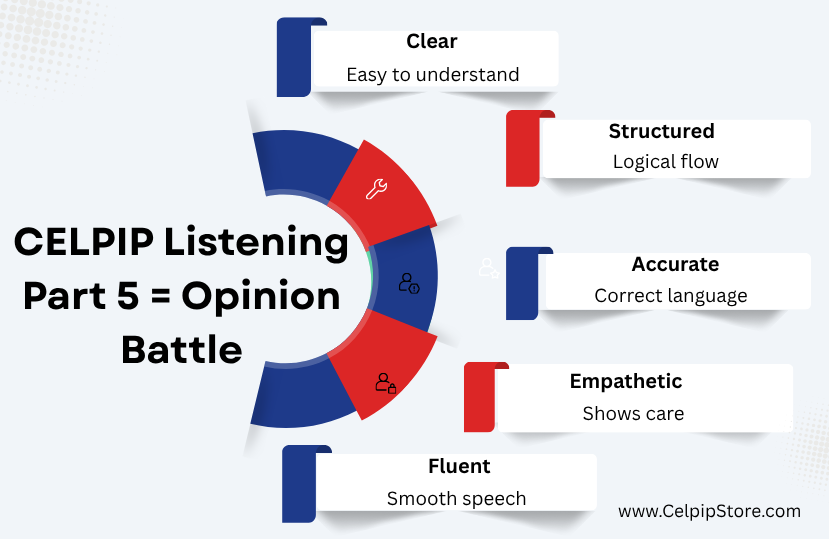
CELPIP Listening Part 5 tests your ability to:
- Understand multiple viewpoints
- Track speaker intentions clearly
- Identify agreement and disagreement
- Follow reasoning in discussions
This section is not about facts it is about opinions and logic flow. If you struggle to compare different perspectives or distinguish opinions from supporting details, apply the broader techniques explained in CELPIP Listening Mastery: Complete Strategy for CLB 9.
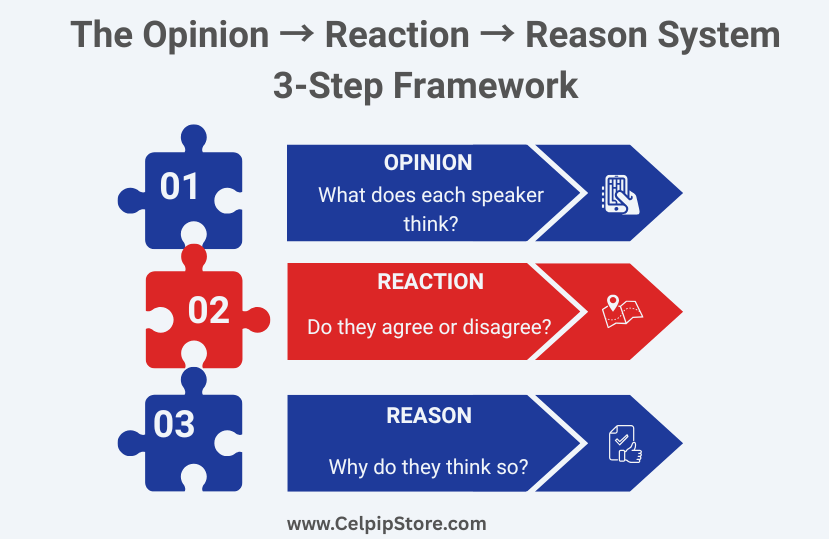
Core Framework: Opinion -> Reaction -> Reason System
In CELPIP Listening Part 5, every discussion becomes clear if you follow one structure:
1. Opinion (What does each speaker think?)
2. Reaction (Do they agree or disagree?)
3. Reason (Why do they think so?)
If you track this flow, multiple speakers will no longer feel confusing.
Step 1 — Identify Each Speaker’s Opinion
Your first task is to separate who thinks what.
Common Opinion Signals
- “I think…”
- “In my opinion…”
- “I don’t think…”
- “I believe…”
- “I’m not sure about that…”
Example
“I think we should go with the cheaper option.”
Opinion: prefers cheaper option
Exam Tip
Do NOT focus on topic first.
Focus on viewpoint first.
Step 2 — Track Agreement or Disagreement
After identifying opinions, check how speakers respond.
Agreement Signals
- “I agree”
- “That’s true”
- “Exactly”
- “Good point”
Disagreement Signals
- “I don’t think so”
- “I’m not sure about that”
- “Actually…”
- “I disagree”
Example
Speaker A: “We should take the bus.”
Speaker B: “I don’t think that’s a good idea.”
B = disagreement
Step 3 — Understand Reasons Behind Opinions
CELPIP often tests why someone holds an opinion.
Reason Signals
- because
- since
- the reason is
- that’s why
- due to
Example
“I prefer online shopping because it’s faster and more convenient.”
Opinion: prefers online shopping
Reason: faster and convenient
Complete Example (Step-by-Step Application)
Conversation:
“I think we should delay the project. The team is too busy right now.”
“I disagree. If we delay it, we might miss the deadline.”
Step 1 — Opinions
• Speaker A -> delay project
• Speaker B -> do not delay
Step 2 — Agreement/Disagreement
• A = suggestion
• B = disagreement
Step 3 — Reasons
• A -> team is busy
• B -> risk of missing deadline
Final Understanding:
Two opposing viewpoints with clear reasons. Improve your listening accuracy by identifying recurring errors and practicing strategies that work across question types with CELPIP Listening Mastery: Complete Strategy for CLB 9.
Trap Patterns in Part 5
Trap 1: Speaker Confusion Trap
Students mix opinions between speakers.
Solution: label Speaker A / B mentally
Trap 2: Topic vs Opinion Trap
Students remember topic but forget viewpoint.
Always track “who thinks what”
Trap 3: Agreement Misunderstanding
“Yeah” or “okay” does NOT always mean full agreement.
Check tone and context
Fast Listening Strategy (Real Exam Method)
While listening:
Step 1: Identify speaker opinions immediately
Step 2: Mark agreement/disagreement signals
Step 3: Listen for reasons only
Ignore repeated or emotional statements.
High-Scorer Behavior Pattern
- Separate speakers clearly
- Track opinions, not just topic
- Focus on agreement/disagreement
- Listen for reasons, not extra talk
- Avoid mixing viewpoints
Advanced Listening Techniques (CLB 9+ Level)
Now you understand the Opinion -> Reaction -> Reason system.
We will upgrade it into high-level exam control techniques used in complex multi-speaker discussions.
CELPIP Part 5 becomes difficult because speakers overlap ideas, change opinions, and subtly disagree without direct words. Build a consistent listening practice routine that develops comprehension and accuracy across all parts of the test with CELPIP Listening Mastery: Complete Strategy for CLB 9.
Your job is to track thinking patterns, not just sentences.
1. Speaker Mapping Technique (Critical Skill)
You must mentally separate speakers from the beginning.
Method
- Speaker A = Opinion 1
- Speaker B = Opinion 2
- Speaker C (if present) = final opinion or neutral view
Example
A: “We should cancel the trip.”
B: “No, we should continue.”
Clear mapping prevents confusion
Rule
Never mix speaker identities.
Each speaker = one viewpoint lane.
2. Hidden Opinion Trap (Very Common)
Sometimes opinions are not direct.
Example
“I’m not completely convinced that this is the best option.”
Hidden meaning: disagreement
Signal Types
- “I’m not sure…” -> weak disagreement
- “It might not be…” -> doubt
- “I guess…” -> uncertain agreement
Rule
Uncertainty = hidden opinion
3. Soft Disagreement vs Strong Disagreement
CELPIP uses polite disagreement language.
Soft Disagreement
- “I see your point, but…”
- “That might work, however…”
- “I’m not sure about that…”
Strong Disagreement
- “I don’t agree”
- “That’s not a good idea”
- “Absolutely not”
Exam Insight
Soft disagreement is more common in real tests.
4. Reason Tracking System (High Scoring Skill)
Answers often depend on reasons, not opinions alone.
Example
“I prefer online classes because they save time and travel cost.”
Opinion: online classes
Reason: time + cost
Rule
Always ask:
“Why does the speaker think this?”
5. Opinion Shift Trap (Advanced)
Speakers may change their mind.
Example
“At first I thought we should wait, but now I think we should start immediately.”
Student Mistake
First opinion only
Final opinion is correct
Rule
Final opinion = correct answer
6. Distraction Language Strategy
Speakers often add extra emotional or filler content.
Examples
- “To be honest…”
- “I mean…”
- “You know…”
- “Well…”
Rule
Ignore emotional fillers
Focus only on meaning changes.
To connect your Part 5 discussion and opinion skills with a complete CLB 9+ preparation plan, review CELPIP Listening Mastery: Complete Strategy for CLB 9.
Examiner Insights (What Part 5 Tests)
CELPIP is evaluating:
- Can you track multiple viewpoints accurately?
- Can you identify agreement vs disagreement?
- Can you follow reasoning under pressure?
- Can you separate speakers correctly?
High-Value Vocabulary for Part 5
Opinion Words
- I believe
- I feel
- I suppose
- I doubt
- I prefer
Agreement Words
- exactly
- absolutely
- I agree
- that’s true
Disagreement Words
- I don’t think so
- I disagree
- not really
- I’m not convinced
Reason Words
- because
- since
- due to
- that’s why
Practice Drills (Exam Simulation Style)
Practice 1
“I think we should move to a bigger office because we are running out of space.”
Opinion: bigger office
Reason: space issue
Practice 2
“I don’t agree. Renting a bigger place will increase costs too much.”
Opinion: disagree
Reason: cost
Practice 3
“At first I supported the idea, but now I think it’s too risky.”
Final opinion: against idea
Performance Upgrade Rule
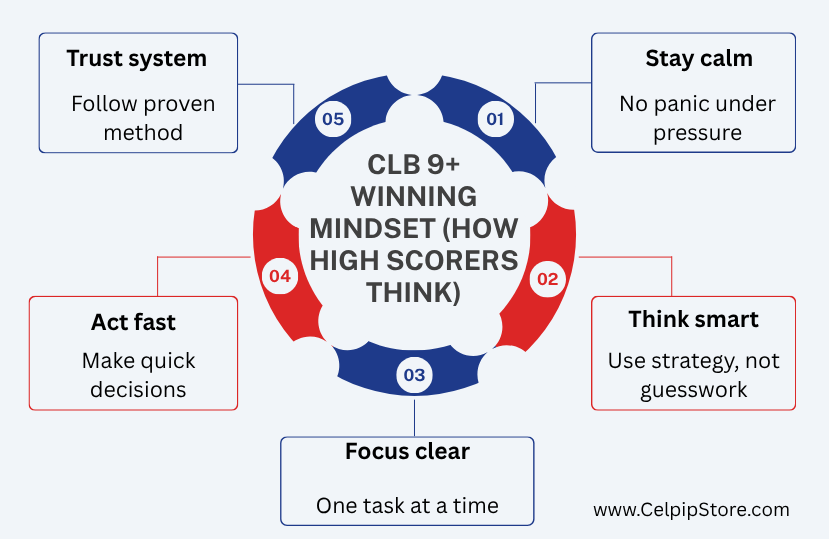
To reach CLB 9+, always:
- Separate speakers clearly
- Detect hidden opinions
- Track agreement types
- Focus on reasons
- Always trust final opinion
Advanced Discussion & Opinion Tracking Framework
In CELPIP Listening Part 5, you are not just listening for facts you are tracking opinions, agreement/disagreement, reasoning, and attitude shifts between two or more speakers. At CLB 9+ level, the challenge is that answers are often not directly stated, but hidden inside conversational flow.
To score high, you need a Discussion & Opinion System that helps you identify who thinks what, why they think it, and how opinions change during the conversation.
1. Core Principle: Track Opinion = Track Position Changes
Most CLB 9+ questions are built around:
- Agreement vs disagreement
- Strong vs weak opinion
- Change of mind
- Reason vs emotional response
- Comparison of two viewpoints
Your goal is NOT just “understanding conversation”
Your goal is mapping opinion movement
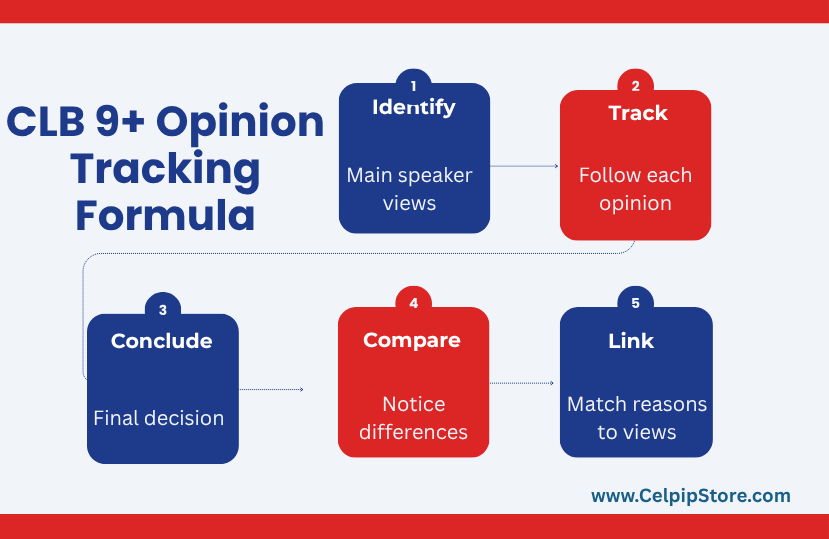
2. CLB 9+ Opinion Tracking Formula
Use this 3-step mental system while listening:
Step 1: Identify Speaker Position
Ask:
- Is Speaker A in favor or against?
- Is Speaker B supporting or challenging?
Signal phrases:
- “I think…” -> personal stance
- “I’m not sure…” -> weak opinion
- “That doesn’t make sense…” -> disagreement
- “You might be right, but…” -> partial agreement
Step 2: Detect Reason Behind Opinion
CELPIP often hides answers in justification.
Look for:
- Because / since / that’s why
- Personal experience
- Cost, time, effort
- Emotional reasoning (“I feel like…”)
CLB 9 trick:
Answer is usually in the reason, not the opinion itself
Step 3: Track Opinion Shift (MOST IMPORTANT)
Many questions test change of mind.
Watch for:
- “Actually…”
- “Now that you mention it…”
- “I didn’t think about that…”
- “Maybe you’re right…”
This signals final answer direction.
3. High-Scoring Listening Map (CLB 9 System)
While listening, mentally structure like this:
- Speaker A -> Opinion -> Reason
- Speaker B -> Opinion -> Reason
- Interaction -> Agreement / Conflict / Change
- Final direction -> Who is convincing whom
This prevents confusion in fast conversations.
4. Common Question Types in Part 5
You will usually face:
A. Opinion Identification
- Who agrees with the proposal?
- What does Speaker B think?
B. Reason-Based Questions
- Why does Speaker A disagree?
- What is the main concern?
C. Decision Questions
- What do they finally decide?
- Who influences the final choice?
CLB 9 key: Final answer is often last influenced speaker
5. CLB 9+ Listening Strategy (Real Exam Technique)
Focus Rule
Do NOT try to remember everything
Focus only on:
- Opinions
- Reasons
- Changes
Contrast Listening
Whenever you hear:
- “but”
- “however”
- “on the other hand”
Mark it mentally -> this is a test shift point
Final Statement Priority
In CELPIP, the last opinion usually dominates unless contradicted strongly.
6. High-Level Mistakes Students Make
Mistake 1: Memorizing details instead of opinions
-> Leads to confusion in MCQs
Mistake 2: Ignoring tone
-> Agreement vs sarcasm gets missed
Mistake 3: Stopping attention after first answer
-> Final change is often the correct answer
Mistake 4: Not tracking “BUT / HOWEVER” shifts
-> Biggest CLB 7 vs CLB 9 gap
7. CLB 9 Master Upgrade Rule
To reach CLB 9+, apply this rule:
“Every conversation is a debate, not a story.”
You are not listening for events
You are listening for:
- Position
- Argument
- Persuasion
- Decision outcome
8. Quick Revision Formula (Before Exam)
DISCUSSION TRACKING SYSTEM
- Speaker A -> Opinion + Reason
- Speaker B -> Opinion + Reason
- Shift words -> Change direction
- Final line -> Most important