1.png)
CELPIP Writing Templates (Task 1 & Task 2) Ready-to-Use Exam Framework
Introduction
One of the fastest ways to improve your CELPIP Writing score is not grammar or vocabulary it is structure control.
Many students know English well, but they lose marks because:
- They don’t know how to start writing
- They don’t follow a clear structure
- Their ideas feel random and unorganized
This lesson solves that problem.
You will learn ready-to-use writing templates for:
- Task 1: Email Writing
- Task 2: Opinion Essay
These templates are designed to help you write faster, clearer, and more confidently in the exam. While these templates are very useful for structuring your responses in CELPIP Writing Task 1 and Task 2, they should be used along with a complete understanding of the Writing section, including scoring criteria, task requirements, and overall strategy. For a full breakdown of the CELPIP Writing exam, you should also read our Ultimate CELPIP Writing Guide.
Learning Objectives
By the end of this lesson, you will be able to:
- Use a fixed structure for CELPIP Writing Task 1
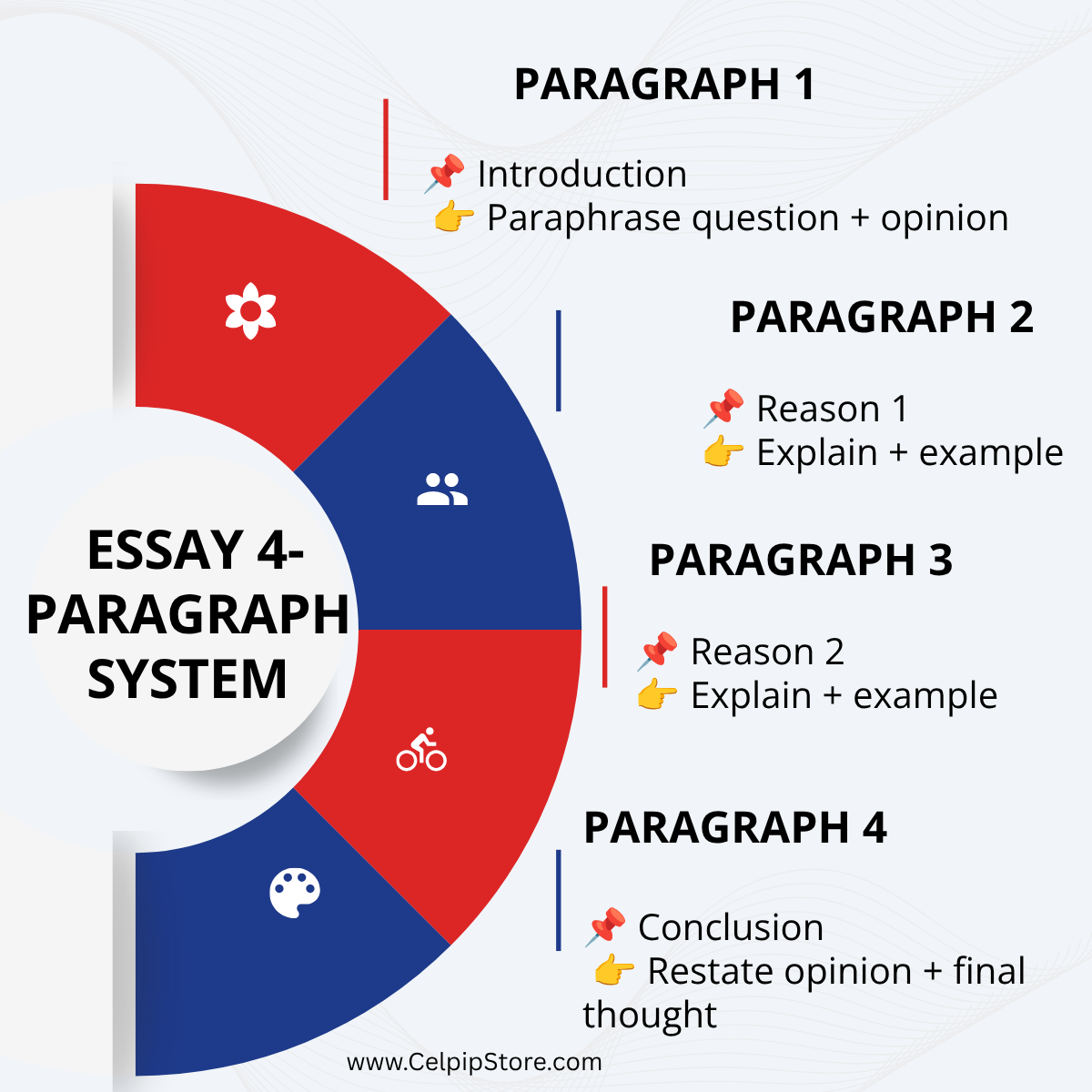
- Use a 4-paragraph system for Task 2
- Start writing without confusion or hesitation
- Organize ideas logically under time pressure
- Improve score consistency in writing tasks
Overview: Why Templates Matter in CELPIP Writing
CELPIP Writing is not just about English level.
It is about:
- Organization
- Clarity
- Task completion
- Time management
Templates help you:
- Save time in the exam
- Avoid structure mistakes
- Improve coherence score
- Stay focused under pressure
Task 1 vs Task 2 Template Difference
Task 1: Email Writing (Flexible Template)
- Purpose: Communication
- Structure: Semi-flexible
- Tone: Formal / informal depending on situation
Focus: Clear message + polite response
Task 2: Opinion Writing (Fixed Template)
- Purpose: Argument
- Structure: Fixed 4 paragraphs
- Tone: Formal
Focus: Logic + reasoning + development. To make Writing Task 1 and Task 2 easier and more effective, it is important to follow proven writing structures and templates. These templates help you organize ideas, maintain proper tone, and save time during the exam. You can use our CELPIP Writing Templates for Task 1 and Task 2 to improve your writing structure and score higher.
Common Mistakes Students Make
1. No structure planning
Students start writing without knowing layout.
2. Mixing formats
Using essay style in emails or casual tone in essays.
3. Uneven paragraphs
One long paragraph, others too short.
4. No clear opinion (Task 2)
Students forget to clearly choose a side.
Many candidates rely only on templates without understanding the full Writing strategy, which can lead to lower scores. Avoid this mistake by learning the complete Writing system in our CELPIP Writing Guide.
Core System: CELPIP Writing Template Framework
Templates are not memorized essays they are structured thinking tools.
They help you:
- Start writing immediately
- Stay organized under time pressure
- Avoid missing task requirements
- Maintain score consistency
Now let’s build the exact exam-ready templates.
1. TASK 1 TEMPLATE (EMAIL WRITING FRAMEWORK)
Structure (4-Part System)
1. Greeting
Start politely and appropriately:
- Hi John,
- Dear Sir/Madam,
- Hello Sarah,
2. Opening Purpose Sentence
Clearly state why you are writing:
- I am writing to inform you about…
- I am writing to request…
- I am writing regarding…
3. Main Body (2 Paragraphs)
Paragraph 1: Situation / Problem / Details
- Explain issue or context clearly
- Keep tone polite and direct
Paragraph 2: Request / Action / Suggestion
- What you want the reader to do
- Be clear and respectful
4. Closing Line
End politely:
- I look forward to your response.
- Thank you for your assistance.
- Best regards,
Task 1 Example Pattern
- Greeting
- Purpose
- Problem explanation
- Request solution
- Closing
2. TASK 2 TEMPLATE (OPINION ESSAY FRAMEWORK)
Fixed 4-Paragraph System
1. Introduction (Opinion Statement)
Start with clear opinion:
- In my opinion, I strongly believe that…
- I agree that…
- I believe that…
End with clear position.
2. Body Paragraph 1 (Reason 1)
- First reason
- Explanation
- Example or impact
Use connectors:
- Firstly
- One important reason is
3. Body Paragraph 2 (Reason 2)
- Second reason
- Explanation
- Result or impact
Use connectors:
- Moreover
- Another reason is
4. Conclusion
- Restate opinion
- Summarize reasons
Example:
- Therefore, I strongly believe that…
Understanding the format is the first step, but using ready-made templates can significantly improve clarity and organization in your writing. These templates provide a clear framework for both Task 1 and Task 2 responses. Explore our CELPIP Writing Templates guide for practical examples.
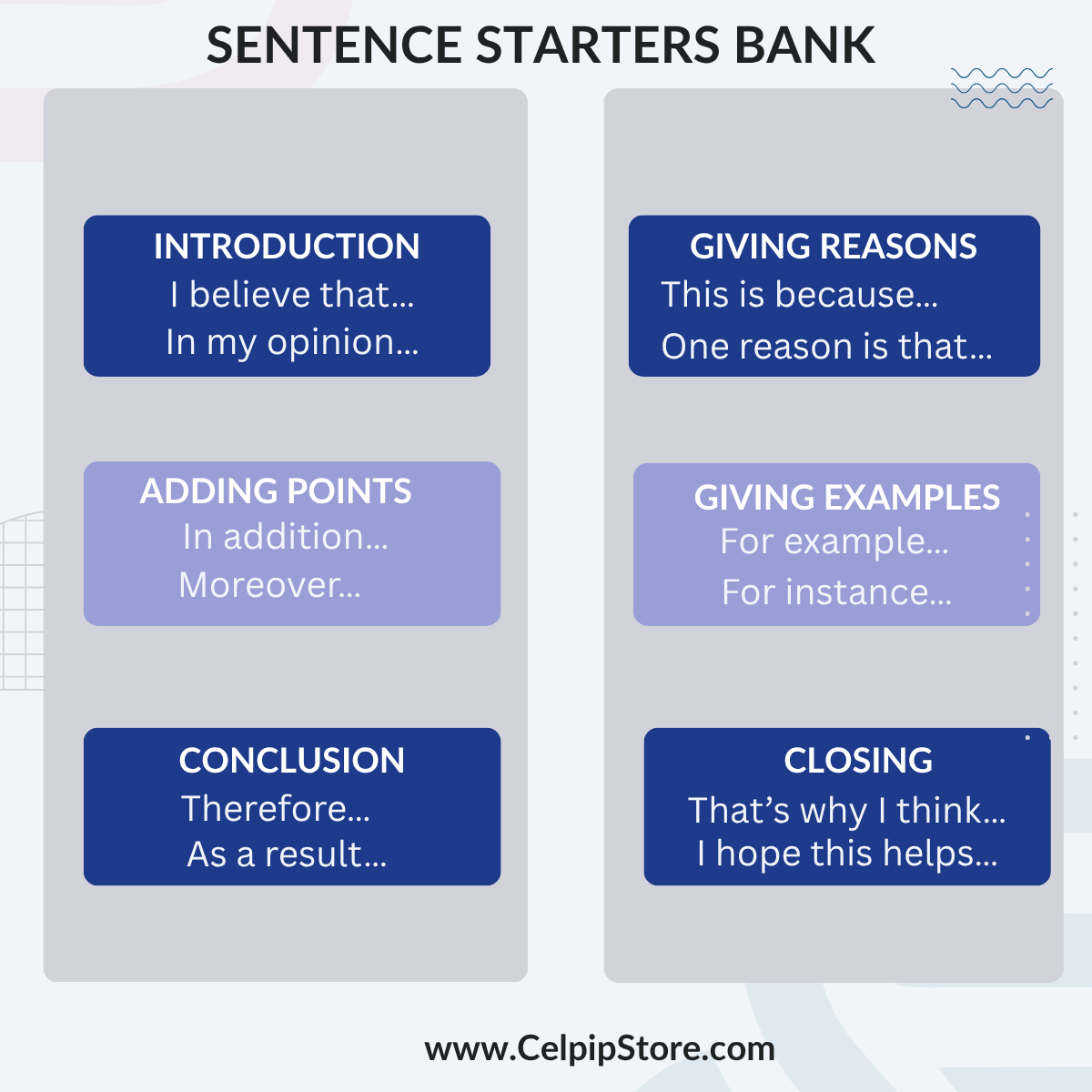
3. SENTENCE STARTER BANK (HIGH SCORE BOOSTER)
Task 1 Starters
- I am writing to inform you that…
- I would like to request…
- I would appreciate your assistance…
- Please let me know…
Task 2 Starters
- In my opinion, I strongly believe that…
- One major reason is that…
- This clearly demonstrates that…
- Therefore, it can be concluded that…
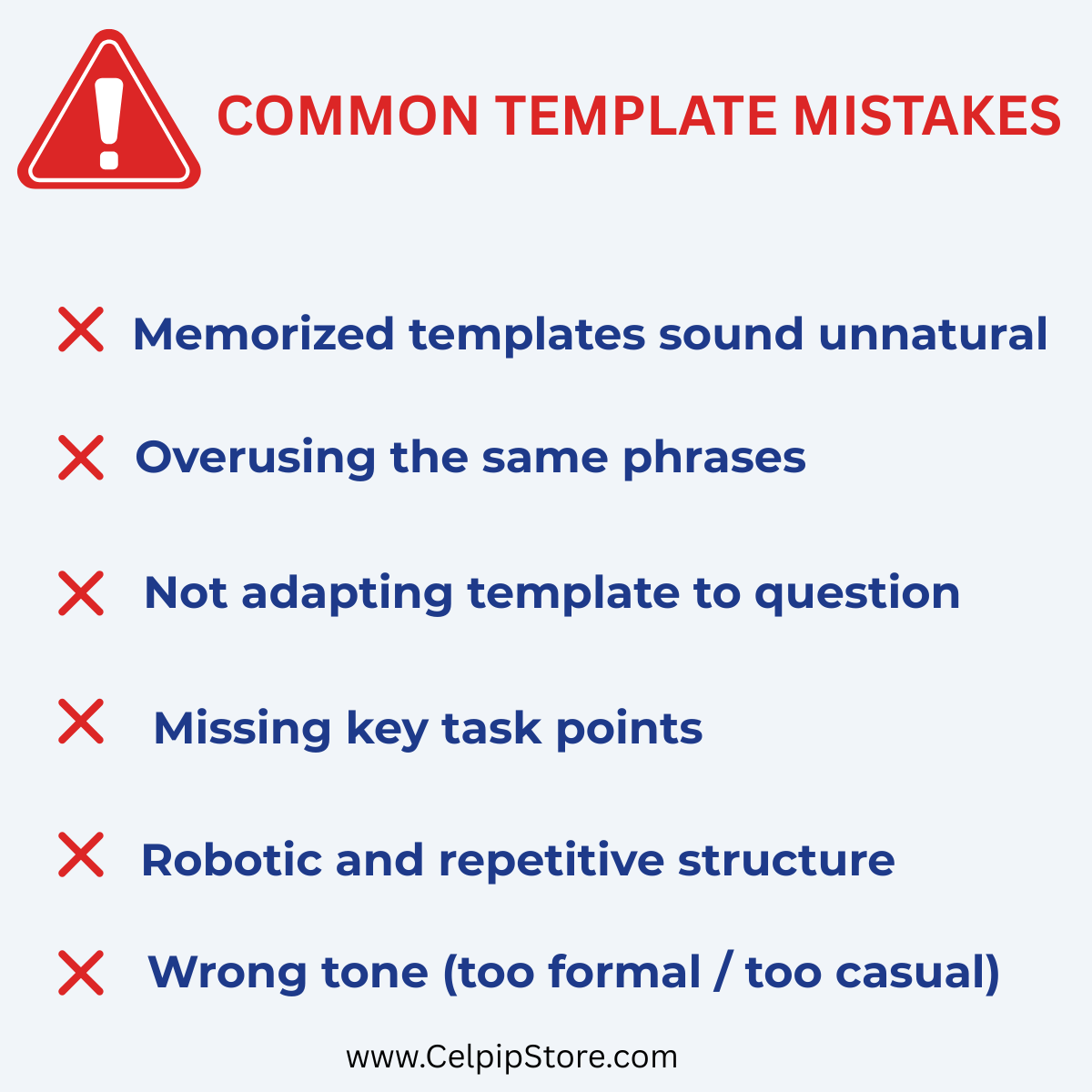
4. COMMON TEMPLATE MISTAKES
Mistake 1: Copying without understanding
Templates must be adapted, not memorized blindly.
Mistake 2: Ignoring task question
Templates must match situation exactly.
Mistake 3: Weak development
Writing structure is not enough ideas must be explained.
Advanced Template System (Band 8–10 Upgrade Level)
Now that you understand basic templates, this section upgrades your writing to a higher scoring level by improving:
- Depth of ideas
- Sentence control
- Examiner impression
- Natural flow
1. ADVANCED TASK 1 TEMPLATE (EMAIL + DETAIL CONTROL)
Upgraded Structure (5-Part System)
1. Greeting
- Hi John,
- Dear Manager,
2. Purpose + Context (Improved Opening)
Instead of just stating purpose, add context:
Example:
- I am writing to inform you regarding an issue I recently experienced with my order.
3. Situation Explanation (Detailed Paragraph)
Include:
- What happened
- When it happened
- Key problem details
Keep clear + structured
4. Request + Expectation (Solution Focus)
Clearly state:
- What you want
- Why you want it
- Expected action
Example:
- I would appreciate it if you could arrange a replacement at your earliest convenience.
5. Polite Closing
- Thank you for your assistance.
- I look forward to your response.
Task 1 Key Upgrade Insight
Strong emails = clear + detailed + polite
Not short or overly simple
2. ADVANCED TASK 2 TEMPLATE (HIGH SCORING ESSAY MODEL)
Upgraded 4-Paragraph System
1. Introduction (Strong Opinion + Rewording)
Instead of simple opinion:
I think…
I strongly believe that…
Add clarity:
- Topic + clear position
2. Body Paragraph 1 (Deep Reasoning)
Structure:
- Clear reason
- Explanation
- Real-world impact
Use:
- This is because…
- As a result…
3. Body Paragraph 2 (Expanded Argument)
Add:
- Second reason
- Strong explanation
- Logical outcome
Use:
- Moreover
- This further demonstrates that…
4. Conclusion (Strong Restatement)
- Reinforce opinion
- Summarize reasons
Example:
- Therefore, I strongly believe that this approach is the most effective solution.
.png "Task_1_Email_Template_Flow_(CELPIP_Writing).png")
3. EXAMINER INSIGHTS (VERY IMPORTANT)
Task 1 Examiner Focus:
They check:
- Did you respond fully?
- Is tone appropriate?
- Is information clear and complete?
They DO NOT want essays in emails.
Task 2 Examiner Focus:
They check:
- Clear opinion from introduction
- Logical development of ideas
- Strong paragraph structure
They DO NOT want casual writing.
4. PRACTICE EXAMPLES (MODEL APPLICATION)
Task 1 Example Idea:
- Complaint about wrong product delivery
Apply:
- Greeting
- Issue explanation
- Request replacement
- Closing
Task 2 Example Idea:
- Should public transport be free?
Apply:
- Introduction (opinion)
- Reason 1 (economic benefit)
- Reason 2 (environmental benefit)
- Conclusion
5. COMMON HIGH-LEVEL MISTAKES
Overwriting templates
Students add unnecessary complexity.
Weak idea development
Structure is correct but explanation is shallow.
Ignoring tone shift
Task 1 and Task 2 tone mismatch.
Final Summary: CELPIP Writing Template System
CELPIP Writing is not about writing more it is about writing with structure, clarity, and control.
If you follow the correct templates:
- You never get stuck starting the answer
- You stay organized under time pressure
- You improve coherence and task achievement score
Core System Recap
Task 1 (Email Writing)
- Flexible structure
- Clear communication
- Polite tone
- Direct response
Goal: Solve a situation clearly
Task 2 (Opinion Essay)
- Fixed 4-paragraph structure
- Formal tone
- Logical arguments
- Strong opinion
Goal: Convince logically
Final Template Blueprint
TASK 1 STRUCTURE
- Greeting
- Purpose statement
- Situation explanation
- Request / solution
- Closing line
Always: polite + clear + complete
TASK 2 STRUCTURE
- Introduction (clear opinion)
- Reason 1 (explained)
- Reason 2 (explained)
- Conclusion (restated opinion)
Always: formal + logical + structured
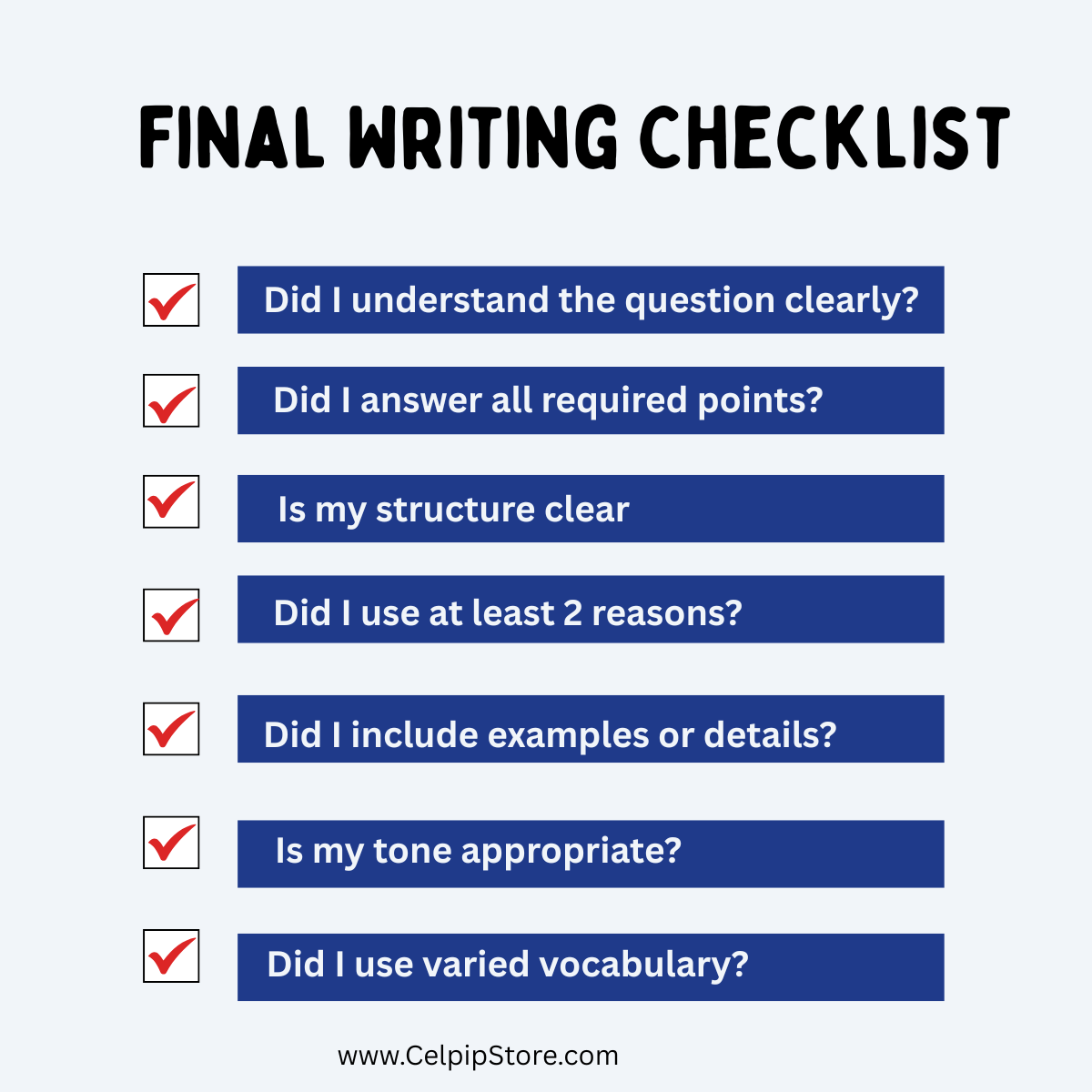
CELPIP WRITING FINAL CHECKLIST
Task 1 Checklist
- Did I answer all parts of the email?
- Is my tone polite and appropriate?
- Did I clearly explain the situation?
- Did I include a clear request?
- Is my writing easy to follow?
Task 2 Checklist
- Did I clearly state my opinion?
- Did I write exactly 2 reasons?
- Did I explain each reason properly?
- Is my structure 4 paragraphs?
- Is my tone formal throughout?
FAQs: CELPIP Writing Templates
Q1: Can I memorize templates for CELPIP Writing?
Yes, but use them as flexible frameworks, not fixed essays.
Q2: Will templates guarantee Band 9?
No. Templates improve structure, but ideas and language still matter.
Q3: How many paragraphs should I write?
- Task 1 -> 3–5 paragraphs
- Task 2 -> Always 4 paragraphs
Q4: Can I use same template in all questions?
Yes, but adjust content based on situation.
7-Day Practice Plan (Template Mastery System)
Day 1–2: Task 1 Template Practice
- Write 2 emails daily using full structure
Day 3–4: Task 2 Template Practice
- Write 1 essay daily with 4-paragraph system
Day 5: Mixed Practice
- 1 Task 1 + 1 Task 2
Day 6: Timed Practice
- 26 minutes per task
Day 7: Full Mock Test
- Real exam simulation
Final Strategy Insight
- Templates remove confusion
- Structure improves clarity
- Practice builds speed
- Consistency builds score
One of the fastest ways to improve your CELPIP Writing score is by using structured templates for both tasks. These help you organize ideas quickly and maintain clarity under time pressure. Learn these ready-to-use formats in our Writing Templates guide.
Final Conclusion
To master CELPIP Writing:
- Use templates to start fast
- Use structure to stay organized
- Use clear language to score higher
To achieve a high score in CELPIP Writing, templates are helpful but not enough on their own. You must also understand task requirements, scoring criteria, and overall strategy for both Writing tasks. Start with our Ultimate CELPIP Writing Guide for complete preparation.