The Ultimate CELPIP Speaking Guide (2026): Master All 8 Speaking Tasks
Speaking confidently in English is one of the most valuable skills you can develop not only for the CELPIP exam but also for living, working, and succeeding in Canada.
Whether you're applying for permanent residency, Canadian citizenship, a work permit, or admission to a college or university, your ability to communicate clearly can make a significant difference. The CELPIP Speaking Test is designed to measure exactly that: how effectively you can express yourself in real-life situations.
Many candidates believe the Speaking section is the most stressful part of the exam. Some worry about running out of ideas. Others fear making grammar mistakes or forgetting vocabulary. Many assume they need to sound like a native English speaker to earn a high score.
The good news is that none of these assumptions are true.
Success in the CELPIP Speaking Test isn't about speaking perfect English. It's about communicating naturally, organizing your ideas clearly, and responding appropriately to different situations.
This guide will show you exactly how to do that.
What Is the CELPIP Speaking Test?
The CELPIP Speaking Test evaluates your ability to communicate effectively in everyday and workplace situations.
Instead of asking academic or theoretical questions, the test presents practical situations you might experience in Canada, such as:
- Giving advice to a friend
- Talking about a personal experience
- Describing a Scene
- Making predictions
- Comparing and Persuading
- Dealing with Difficult Situation
- Expressing an opinion
These tasks are designed to measure how well you communicate not how many difficult words you know.
Examiners want to see whether you can:
- Understand the situation
- Organize your thoughts
- Speak fluently
- Provide relevant details
- and maintain clear communication from beginning to end.
Why the Speaking Section Matters
For many candidates, the Speaking score has a direct impact on their overall CELPIP result.
A strong Speaking score can improve your overall language profile and help you meet the language requirements for immigration or professional purposes.
More importantly, the communication skills you develop while preparing for CELPIP continue to benefit you long after the exam.
Strong speaking skills help you:
- Perform confidently in job interviews
- Communicate with colleagues
- Participate in workplace meetings
- Build friendships
- Solve everyday problems
- And integrate successfully into Canadian society
In other words, preparing for the Speaking Test prepares you for real life.
Why Candidates Find Speaking Difficult
Most candidates already know enough English to answer the questions.
The challenge isn't language knowledge.
It's performance under pressure.
When the recording begins, candidates often:
- Panic
- Speak too quickly
- Forget their ideas
- Repeat themselves
- Lose confidence
- Or stop speaking altogether
These reactions are completely normal.
The key is learning a structured approach that allows you to stay calm and organized even when you receive an unfamiliar question.
Throughout this guide, you'll learn practical techniques that help reduce anxiety while improving the quality of every response.
Common Myths About CELPIP Speaking
Many learners waste valuable preparation time because they believe common misconceptions about the exam.
Let's clear up some of the biggest myths.
Myth 1: I Need Perfect Grammar
No.
Small grammar mistakes are acceptable if your message remains clear and easy to understand.
Communication is always more important than perfection.
Myth 2: I Must Use Difficult Vocabulary
Using advanced words doesn't automatically increase your score.
Examiners prefer natural, accurate vocabulary over words that sound memorized or are used incorrectly.
Simple, precise language is often more effective than complicated expressions.
Myth 3: Memorized Answers Work
This is one of the fastest ways to lose marks.
CELPIP questions change regularly, and examiners can easily recognize responses that sound rehearsed.
Instead of memorizing speeches, learn flexible speaking strategies that allow you to respond naturally to any question.
Myth 4: Accent Determines My Score
Your accent does not determine your CELPIP score.
Whether you speak with an Indian, British, Australian, Filipino, Nigerian, or any other accent, you can achieve a high score as long as your speech is clear and understandable.
Clarity always matters more than accent.
Myth 5: Fast Speaking Means Better English
Speaking too quickly often causes more mistakes.
A calm, steady pace allows you to pronounce words clearly, organize ideas effectively, and sound more confident.
What You'll Learn in This Guide
By the end of this guide, you'll understand:
- How the Speaking Test works
- What examiners are looking for
- How each of the eight speaking tasks is structured
- Practical strategies for answering confidently
- Common mistakes to avoid
- And proven preparation methods that help improve your score
You'll also discover how each speaking task connects to detailed guides that explore individual strategies, sample answers, and practice techniques.
Together, these resources form a complete learning system designed to help you progress step by step.
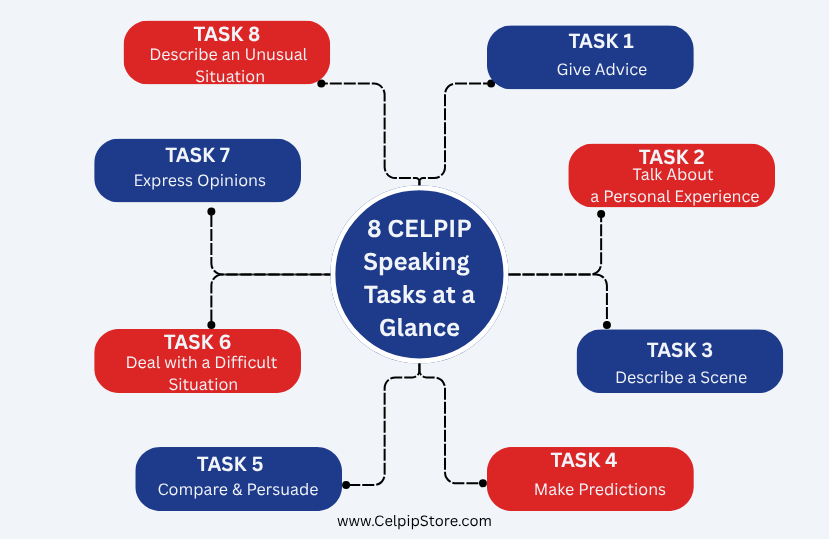
The Eight CELPIP Speaking Tasks at a Glance
The CELPIP Speaking Test consists of eight different tasks.
Each task measures a different aspect of communication.
|
Task |
Communication Skill |
|
Task 1 |
Giving Advice |
|
Task 2 |
Talking About a Personal Experience |
|
Task 3 |
Describing a Scene |
|
Task 4 |
Making Predictions |
|
Task 5 |
Comparing and Persuading |
|
Task 6 |
Handling Difficult Situations |
|
Task 7 |
Expressing Opinions |
|
Task 8 |
Describing an Unusual Situation |
Although the situations change from one test to another, the communication skills remain the same.
Once you understand the purpose behind each task, you'll be able to respond confidently to almost any question.
A Better Way to Prepare
Many candidates spend weeks searching for model answers.
While sample responses can be helpful, they shouldn't become your primary study method.
A more effective approach is to develop communication skills that work in every situation.
Throughout this guide, we'll focus on:
- Organizing ideas quickly
- Expanding simple answers
- Supporting opinions with examples
- Improving fluency
- Speaking naturally under time pressure
- And building confidence through consistent practice
These are the same skills that help candidates succeed in both the CELPIP exam and real-world communication.
Understanding the CELPIP Speaking Test
Now that you understand the purpose of the Speaking section, it's time to explore exactly how the test works.
Many candidates lose valuable marks not because they lack English skills, but because they don't fully understand the test format. When you know what to expect, you'll feel more confident, manage your time better, and give stronger responses.
Let's walk through the Speaking test step by step.
How the CELPIP Speaking Test Works
The CELPIP Speaking Test is completed entirely on a computer.
Unlike traditional speaking exams where you speak to an examiner face-to-face, you'll wear a headset with a microphone and record your responses directly into the computer.
Your recordings are later evaluated by trained CELPIP raters using standardized scoring criteria.
This approach offers several advantages:
- Every candidate receives the same testing conditions.
- There is no interviewer influencing the conversation.
- Your performance is evaluated consistently using official scoring standards.
Speaking Test Format
The Speaking section contains eight different tasks, each designed to measure a specific communication skill.
Although the topics change from one exam to another, the task types remain the same.
|
Task |
Purpose |
|
Task 1 |
Give Advice |
|
Task 2 |
Talk About a Personal Experience |
|
Task 3 |
Describe a Scene |
|
Task 4 |
Make Predictions |
|
Task 5 |
Compare and Persuade |
|
Task 6 |
Handle a Difficult Situation |
|
Task 7 |
Express Opinions |
|
Task 8 |
Describe an Unusual Situation |
Every task presents a realistic situation that someone living or working in Canada might encounter.
Preparation Time vs Speaking Time
One of the biggest differences between CELPIP and everyday conversation is that each task includes both preparation time and response time.
Preparation time allows you to organize your ideas before speaking.
Response time is when your recording begins.
Successful candidates use both periods effectively.
Instead of trying to memorize sentences during preparation, they quickly organize their ideas into a simple structure.
For example:
- Situation
- Main Point
- Reason
- Example
- Conclusion
This simple planning method often produces much more natural responses than trying to memorize complete sentences.
Why Time Management Matters
Many candidates make one of two mistakes.
Mistake 1
They spend too much time thinking.
When the recording begins, they panic because they haven't started speaking.
Mistake 2
They begin speaking immediately without organizing their thoughts.
As a result, they:
- Repeat ideas
- Lose focus
- Pause frequently
- Or finish too early
The strongest candidates balance planning with confident delivery.
The Recording Environment
Because you're speaking into a computer, the experience may feel different from everyday conversations.
You'll typically be seated in a room with other test-takers who are also completing the Speaking section.
That means you'll hear other people speaking around you.
This surprises many first-time candidates.
Fortunately, everyone experiences the same environment.
The best approach is to focus entirely on your own screen and speak naturally into your microphone.
Treat it as if you're having a conversation with one person.
Speaking Into the Microphone
Good microphone technique helps ensure your responses are recorded clearly.
Keep these simple tips in mind:
- Sit comfortably.
- Maintain a consistent distance from the microphone.
- Speak clearly rather than loudly.
- Avoid moving the microphone while speaking.
- Maintain a natural pace.
There's no need to shout.
Clear pronunciation is much more important than volume.
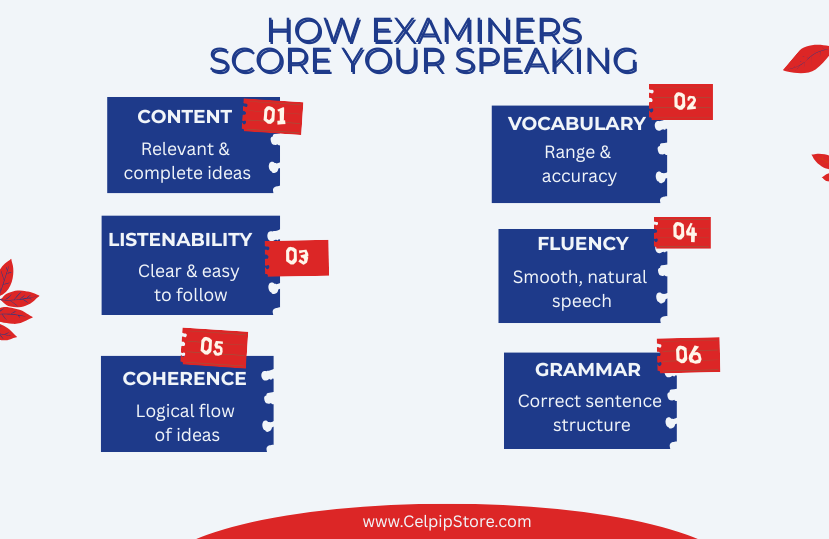
How CELPIP Speaking Is Scored
Many candidates believe examiners count grammar mistakes or difficult vocabulary.
That's only a small part of the evaluation.
The Speaking Test measures your overall ability to communicate effectively.
Examiners look at several different areas together.
1. Content
Did you answer the question?
Did you stay on topic?
Did you provide enough relevant information?
A complete answer almost always scores higher than a short answer with perfect grammar.
2. Organization
Well-organized responses are easier to follow.
Good responses usually include:
-
An introduction
-
Supporting ideas
-
Examples
-
And a clear ending
Ideas should connect naturally from one sentence to the next.
3. Vocabulary
Examiners look for vocabulary that is:
-
Appropriate
-
Varied
-
And accurate
Using simple words correctly is better than using advanced vocabulary incorrectly. Strong vocabulary is essential for Task 3, as you need to describe actions and surroundings clearly. Learn useful expressions in our Task 3 detailed guide.
4. Grammar
Grammar contributes to your score, but perfection is not required.
Occasional mistakes are acceptable if your message remains clear.
The goal is effective communication not flawless grammar.
5. Fluency
Fluency means speaking smoothly and naturally.
Fluent speakers may pause occasionally to think, but they continue communicating without long interruptions.
Natural pacing is much more effective than rushing.
6. Pronunciation
Your pronunciation should be easy to understand.
Remember:
CELPIP does not require a Canadian accent.
Any accent can receive a high score if listeners can understand your speech comfortably.
7. Listener Effort
One of the most important ideas in CELPIP scoring is listener effort.
Imagine someone hearing your response for the first time.
How much work must they do to understand your message?
If your ideas are clear, organized, and easy to follow, the listener doesn't need to work very hard.
That's exactly what examiners want.
What Examiners Want to Hear
Strong responses usually have several things in common.
They:
- Answer the question directly
- Remain focused
- Include relevant details
- Support opinions with examples
- Sound natural
- And finish confidently
Notice what isn't on this list:
- Difficult vocabulary
- Perfect grammar
- Or memorized speeches
Communication always comes first. Task 6 requires you to handle difficult situations professionally and offer practical solutions. Learn the complete approach in our CELPIP Speaking Task 6 guide. A strong Task 7 response requires a clear position, logical reasons, and relevant examples. Learn how to develop these elements effectively in our CELPIP Speaking Task 7 guide.
Building Responses Quickly
Instead of memorizing templates, train yourself to organize ideas rapidly.
A useful framework is:
- Question
- Answer
- Reason
- Example
- Closing Thought
This flexible structure works across almost every CELPIP Speaking task and helps you stay organized under time pressure.
Preparing for Test Day
Before your exam:
- Practice speaking with a timer.
- Record your answers and listen to them.
- Focus on organizing ideas rather than memorizing scripts.
- Get comfortable hearing your own voice.
- Practice in environments with some background noise so you're less distracted on test day. To improve your prediction skills, practise Task 4 regularly using structured techniques. You can find examples in our CELPIP Speaking Task 4 guide.
Confidence comes from familiarity.
The more you To improve your scene description skills, practise Task 3 regularly using structured techniques. You can find examples in our CELPIP Speaking Task 3 guide.under realistic conditions, the more natural the exam will feel.
Common Questions Before Test Day
What if I make a mistake?
Keep going.
Correct yourself naturally if needed, but don't stop speaking.
What if I forget a word?
Use different words to explain the idea.
Communication is more important than finding the perfect vocabulary.
What if I finish early?
Add another example, explain your reason further, or summarize your opinion.
Avoid long periods of silence.
What if I feel nervous?
Almost everyone does.
Take a breath, focus on the task, and remember that examiners evaluate your communication not your emotions.
Mastering All Eight CELPIP Speaking Tasks
Now that you understand how the Speaking Test works and how examiners evaluate your responses, it's time to examine each of the eight speaking tasks.
Many candidates think these tasks require completely different strategies.
In reality, every task measures the same core ability:
Can you communicate clearly, naturally, and effectively in a real-life situation?
Each task simply places you in a different communication scenario.
Once you understand the purpose behind each task, you'll feel much more confident answering unfamiliar questions on test day.
Task 1 – Giving Advice
What You'll Do
You'll be presented with a situation where someone needs your advice.
Examples include:
- Choosing between two jobs
- Managing study time
- Solving a workplace problem
- Improving health habits
- Planning an important decision
Your goal is to provide practical, logical, and supportive advice. Task 1 requires you to give practical advice with clear reasons. For a detailed structure, sample answers, and scoring tips, read our CELPIP Speaking Task 1 guide.
What Examiners Want
Strong candidates:
- Understand the person's situation
- Explain their recommendation
- Provide logical reasons
- Offer practical suggestions
- Finish positively
Common Mistakes
- Giving only one sentence of advice
- Listing ideas without explanation
- Forgetting to explain why the advice is useful
Winning Strategy
Use this structure:
- Situation
- Recommendation
- Reason
- Example
- Encouragement
Example Opening
"If I were you, I would..."
"The first thing I'd recommend is..."
"One possible solution would be..."
Read our complete guide: CELPIP Speaking Task 1 – Giving Advice
Task 2 – Talking About a Personal Experience
What You'll Do
You'll describe something you've personally experienced. Task 2 requires you to describe a past experience clearly using structure and details. For templates, sample answers, and scoring tips, read our CELPIP Speaking Task 2 guide.
Possible topics include:
- A memorable trip
- A challenging situation
- A celebration
- A mistake you learned from
- A successful achievement
What Examiners Want
They want a story that is:
- Organized
- Interesting
- Chronological
- And easy to follow
Strong Structure
- Beginning
- What happened
- How you felt
- What you learned
Common Mistakes
- Too many unnecessary details
- No clear ending
- Jumping back and forth in time
Example Opening
"One experience I'll never forget happened when..."
"A memorable event in my life was..."
Read our complete guide: CELPIP Speaking Task 2 – Talking About a Personal Experience
Task 3 – Describing a Scene
What You'll Do
You'll see a picture and describe everything important.
The picture might include:
- People
- Buildings
- Weather
- Activities
- Vehicles
- Nature
- Public places
What Examiners Want
They aren't testing imagination.
They're evaluating observation skills and clear description. Task 3 requires you to describe a scene clearly using details and structure. For templates, vocabulary, and sample answers, read our CELPIP Speaking Task 3 guide.
Strong Structure
- Overall Scene
- Left Side
- Center
- Right Side
- Background
- Possible Activity
Common Mistakes
- Describing only one person
- Speaking too generally
- Missing obvious details
Example Opening
"This picture appears to show..."
"Overall, I can see..."
Read our complete guide: CELPIP Speaking Task 3 – Describing a Scene.
Task 4 – Making Predictions
What You'll Do
You'll look at a picture and predict what might happen next.
Notice the difference:
Task 3 = What is happening?
Task 4 = What could happen next?
What Examiners Want
Logical predictions supported by evidence.
Current Situation
- Prediction
- Reason
- Alternative Prediction
- Conclusion
Opening
"I think the most likely outcome is..."
"Based on what I can see..."
Common Mistakes
- Unrealistic predictions
- No explanation
- Repeating the picture description instead of predicting
Read our complete guide: CELPIP Speaking Task 4 – Making Predictions
Task 5 – Comparing and Persuading
What You'll Do
You'll compare two options and persuade someone to choose one.
Examples:
- Two vacation destinations
- Two apartments
- Two gifts
- Two restaurants
- Two transportation options
What Examiners Want
A balanced comparison followed by a convincing recommendation. Mastering this structure is essential for a strong Task 5 response. See our Task 5 Comparing and Persuading guide for detailed techniques and examples.
Strong Structure
- Introduce both options
- Compare advantages
- Compare disadvantages
- Recommendation
- Final persuasion
Example Opening
"Both choices have advantages, but..."
"If I had to recommend one..." For more useful expressions and response techniques, explore our CELPIP Speaking Task 5 guide.
Common Mistakes
- Describing only one option
- No comparison
- Weak recommendation
Read our complete guide: CELPIP Speaking Task 5 – Comparing and Persuading
Task 6 – Handling a Difficult Situation
What You'll Do
You'll respond to a realistic problem.
Examples:
- Poor customer service
- Workplace conflict
- Noise complaint
- Late delivery
- Booking problem
What Examiners Want
Professional communication.
Polite but confident.
Problem-solving rather than complaining.
Strong Structure
- State the problem
- Explain why it matters
- Suggest a solution
- Remain polite
- Positive conclusion
This structure can help you respond clearly and professionally when dealing with challenging situations. For more detailed examples and techniques, read our Task 6 Dealing with Difficult Situations guide.
Example Opening
"I'd like to discuss a problem I've experienced..."
"I understand mistakes happen, but..." Want more useful expressions and complete response examples? Explore our CELPIP Speaking Task 6 guide.
Common Mistakes
- Sounding angry
- Blaming people
- Offering no solution
Read our complete guide: CELPIP Speaking Task 6 – Dealing with Difficult Situations.
Task 7 – Expressing Opinions
What You'll Do
You'll give your opinion about a social or everyday topic.
Examples:
- Online learning
- Public transportation
- Technology
- Healthy lifestyles
- Social media
What Examiners Want
A clear opinion supported by logical reasons and examples.
Strong Structure
- Opinion
- Reason 1
- Example
- Reason 2
- Conclusion
Example Opening
"In my opinion..."
"I strongly believe..." For more opinion expressions, response frameworks, and sample answers, see our CELPIP Speaking Task 7 guide.
Common Mistakes
- No examples
- Changing opinions
- Weak organization
Read our complete guide: CELPIP Speaking Task 7 – Expressing Opinions
Task 8 – Describing an Unusual Situation
What You'll Do
You'll explain something unexpected or unusual.
These questions often test your creativity and ability to organize ideas quickly.
What Examiners Want
Not a perfect answer.
A logical explanation delivered confidently.
Strong Structure
- Describe the situation
- Explain why it's unusual
- Discuss possible causes
- Suggest solutions or outcomes
- Summarize
Example Opening
"This is certainly an unusual situation because..."
"One possible explanation could be..."
Common Mistakes
- Panicking
- Giving very short answers
- Repeating the question
Read our complete guide: CELPIP Speaking Task 8 – Describing an Unusual Situation
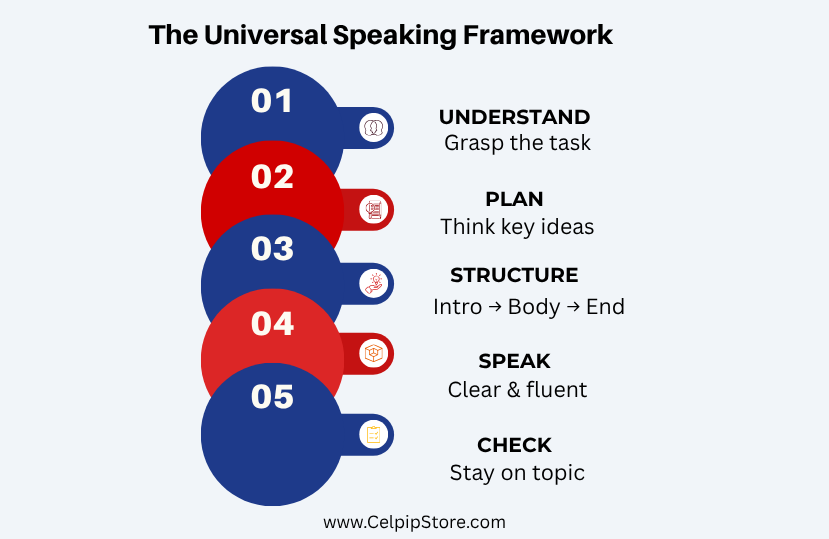
One Framework That Works Across All Eight Tasks
Although each task has a different objective, you can rely on one universal communication pattern:
- Understand the Question
- Answer Clearly
- Explain Your Reason
- Support with an Example
- Finish Confidently
This simple framework helps you stay organized even when you receive a topic you've never seen before. This structure is especially useful for Task 1, where you must give advice clearly and logically. See how to apply it step-by-step in CELPIP Speaking Task 1.
Choosing the Right Examples
Examples make your answers more believable and engaging.
Good examples can come from:
- Your personal experiences
- Family members
- Friends
- School
- Work
- News stories
- Everyday life
If you don't have a real experience, it's acceptable to create a realistic example, as long as it sounds natural and stays relevant to the task.
Building Confidence Across All Tasks
Instead of practicing only one task repeatedly, rotate through all eight tasks during your study sessions.
For example:
- Monday: Tasks 1 & 2
- Tuesday: Tasks 3 & 4
- Wednesday: Tasks 5 & 6
- Thursday: Tasks 7 & 8
- Friday: Mixed practice
- Saturday: Full speaking test
- Sunday: Review recordings and identify areas for improvement
This balanced approach builds flexibility and prepares you for any combination of questions on exam day.
Your Complete CELPIP Speaking Success Roadmap
You've now learned how the CELPIP Speaking Test works, what each of the eight tasks measures, and what examiners expect from high-scoring responses.
The final step is turning that knowledge into a practical preparation plan.
Success in the Speaking Test doesn't come from studying harder it comes from practicing smarter.
This section will help you build a study routine, avoid common mistakes, and develop communication skills that continue benefiting you long after your CELPIP exam.
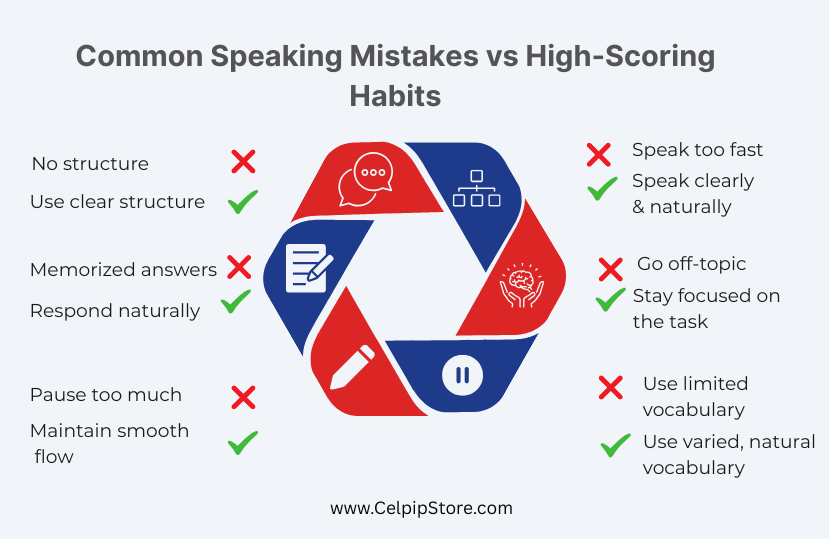
The Most Common Speaking Mistakes
Even candidates with good English sometimes receive lower scores because of avoidable mistakes.
Let's look at the most common ones.
1: Memorizing Answers
Many candidates memorize long speeches hoping they can use them during the exam.
Unfortunately, this usually sounds unnatural. These mistakes are very common in Task 1, especially when candidates fail to explain their advice. Learn how to avoid them in our Task 1 detailed guide.
When the question changes, memorized answers often become irrelevant.
Better Approach
Learn flexible speaking frameworks instead of complete scripts.
Think about ideas not sentences.
Mistake 2: Speaking Too Fast
Nervous candidates often rush through their responses.
As a result:
- Pronunciation becomes unclear
- Grammar mistakes increase
- Ideas become disorganized
- Listeners struggle to follow the response
Better Approach
Slow down.
Speak naturally.
A calm speaker usually sounds more confident than a fast speaker. These mistakes are very common in Task 2, especially when candidates do not organize their story properly. Learn how to avoid them in our Task 2 detailed guide.
Mistake 3: Giving Short Answers
Some candidates answer the question in twenty or thirty seconds and stop.
This doesn't give examiners enough evidence to evaluate your communication ability. A common mistake is treating Task 4 like Task 3 by only describing the image instead of making predictions. Learn how to avoid this in our CELPIP Speaking Task 4 guide.
Better Approach
Expand every answer.
Whenever possible, include:
- A reason
- An example
- A personal experience
- Or an additional explanation
Mistake 4: Ignoring the Question
Sometimes candidates prepare an answer in advance and forget what the actual question asked.
This leads to responses that sound fluent but don't answer the task.
Better Approach
Spend the preparation time identifying exactly what the question requires.
Mistake 5: No Supporting Examples
Opinions without examples sound weak.
Compare these responses.
Weak:
"I think public transportation is good."
Stronger:
"I think public transportation is good because it reduces traffic and pollution. For example, many people in large Canadian cities use buses and trains every day instead of driving."
Examples make your communication more convincing.
Mistake 6: Panicking After a Small Mistake
Everyone makes mistakes.
Even native speakers pause, restart sentences, and correct themselves.
Don't let one mistake affect the rest of your response.
Simply continue speaking.
A Practical CELPIP Speaking Study Plan
Consistency matters more than studying for many hours in one day.
Daily Practice (30–45 Minutes)
- Speak about one everyday topic for two minutes
- Complete one CELPIP speaking task
- Learn five useful expressions
- Record yourself and review your response
- Identify one improvement for tomorrow
Weekly Practice
- Practice every speaking task at least once
- Complete one full Speaking section under timed conditions
- Listen to your recordings
- Compare your newest responses with older ones
- Track your progress
Monthly Practice
- Take one complete CELPIP mock test
- Identify recurring weaknesses
- Focus your next month's practice on those areas
- Measure improvement instead of aiming for perfection
To improve your storytelling skills, practice Task 2 regularly using structured templates. You can find examples in our CELPIP Speaking Task 2 guide.
Building Long-Term Speaking Skills
The goal isn't simply to pass CELPIP.
It's to become a confident English communicator.
Try incorporating English into your daily routine.
Examples include:
- Speaking to yourself while driving
- Describing your surroundings
- Summarizing news articles
- Discussing current events
- Explaining your daily plans
- Recording short video journals
- Participating in English conversations whenever possible
Small daily habits create significant long-term improvement.
Flexible Speaking Frameworks
Instead of memorizing responses, learn reusable structures.
Framework 1 – Advice
- Situation
- Recommendation
- Reason
- Example
- Positive Closing
Framework 2 – Opinion
- Opinion
- Reason
- Example
- Second Reason
- Conclusion
Framework 3 – Story
- Beginning
- Problem
- Action
- Result
- Lesson Learned
Framework 4 – Description
- Overview
- Details
- Interesting Features
- Summary
These frameworks can be adapted to almost every CELPIP Speaking task. This structured approach is especially important for Task 3, where you must organize your description logically. See step-by-step examples in CELPIP Speaking Task 3.
Frequently Asked Questions
How much English do I need for a high Speaking score?
You don't need perfect English.
You need communication that is clear, organized, and appropriate for the situation.
Should I memorize templates?
No.
Memorize structures not complete answers.
Can I correct myself?
Yes.
Natural self-correction is completely acceptable.
Just don't stop speaking for long periods.
Is grammar more important than fluency?
Both matter.
However, communication is always the priority.
A fluent speaker with a few grammar mistakes often performs better than someone who knows grammar well but struggles to communicate.
Does pronunciation affect my score?
Yes, but clarity matters more than accent.
Your goal is to be understood easily.
What if I don't know the answer?
Stay calm.
Create a realistic example.
Keep communicating.
The exam measures communication skills not factual knowledge.
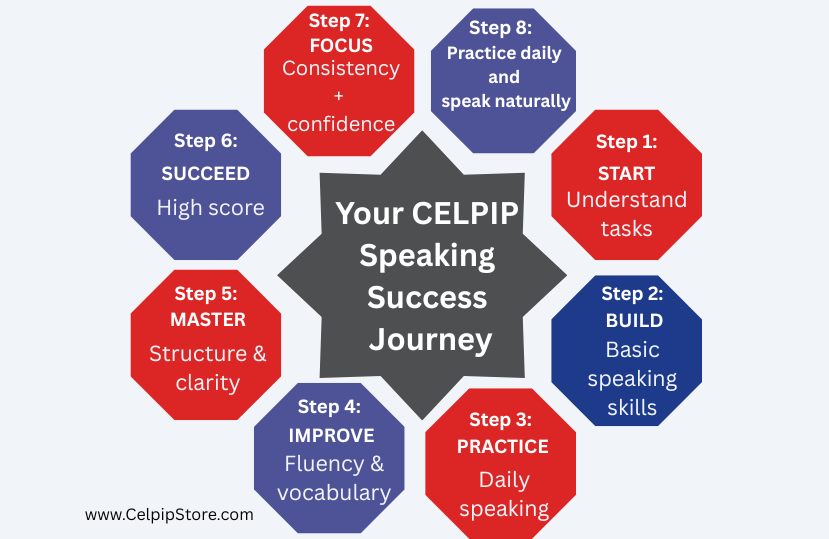
Your CELPIP Speaking Journey
Every successful candidate follows a similar path.
- Build Confidence
- Learn the Speaking Tasks
- Develop Flexible Strategies
- Practice Consistently
- Review Your Performance
- Improve Weak Areas
- Communicate Naturally
- Achieve Your Target Score
Progress happens one conversation at a time.
Final Words
Preparing for the CELPIP Speaking Test is about much more than passing an exam.
It's about learning to express your thoughts clearly, solve problems confidently, and communicate effectively in the situations you'll experience after arriving in Canada.
Every conversation you practice strengthens your confidence.
Every recording you review helps you improve.
Every mistake teaches you something valuable.
Remember:
You don't need to sound perfect.
You need to sound natural.
- Keep practicing.
- Keep speaking.
- Keep improving.
Your target CELPIP score is achievable through consistent effort and smart preparation.
Conclusion
The CELPIP Speaking Test is not a test of perfect English it's a test of effective communication.
If you understand the purpose of each task, organize your ideas clearly, support your responses with relevant examples, and practice consistently, you'll be well prepared to achieve your target score. Start mastering your first speaking task with our CELPIP Speaking Task 1 guide.
Whether your goal is CLB 7, CLB 9, or the highest possible CELPIP Speaking score, remember that improvement comes through regular practice, thoughtful reflection, and the confidence to keep speaking. Master storytelling in CELPIP with our CELPIP Speaking Task 2 guide. Improve your description skills with our CELPIP Speaking Task 3 guide. Master prediction skills with our CELPIP Speaking Task 4 guide.
Good luck with your preparation, and we look forward to helping you succeed on your CELPIP journey with more expert guides, practice tests, sample answers, and video lessons here at CELPIPStore.