1.png)
CELPIP Writing Time Management & Exam Strategy System
Introduction
One of the biggest reasons students lose marks in CELPIP Writing is not grammar or vocabulary it is poor time management.
Many test takers know what to write, but they:
- Spend too long planning
- Run out of time in Task 2
- Don’t leave time for editing
- Rush their conclusion
As a result, their writing becomes incomplete or full of small mistakes.
This lesson solves that problem with a simple, repeatable time management system for both Task 1 and Task 2. While time management is a key factor in scoring well in CELPIP Writing, it must be combined with a clear understanding of task structure, scoring criteria, and writing strategies for both Task 1 and Task 2. To get a complete overview of the Writing section, you should also read our Ultimate CELPIP Writing Guide.
Learning Objectives
By the end of this lesson, you will be able to:
- Manage time effectively in CELPIP Writing
- Allocate time correctly between Task 1 and Task 2
- Plan, write, and review within exam limits
- Avoid rushing and incomplete answers
- Improve score consistency under pressure
Overview: Why Time Management Matters in CELPIP Writing
CELPIP Writing is a timed performance test, not just a writing test.
Examiners assess:
- Completion of task
- Clarity under pressure
- Organization within time limits
What happens without time control?
- Weak conclusion
- Missing points
- Grammar mistakes
- Poor structure
What happens with good time control?
- Balanced writing
- Clear structure
- Polished sentences
- Full task completion
Managing time effectively is only one part of success in CELPIP Writing. You also need to understand how each task is structured and evaluated. Learn the complete Writing system in our CELPIP Writing Guide.
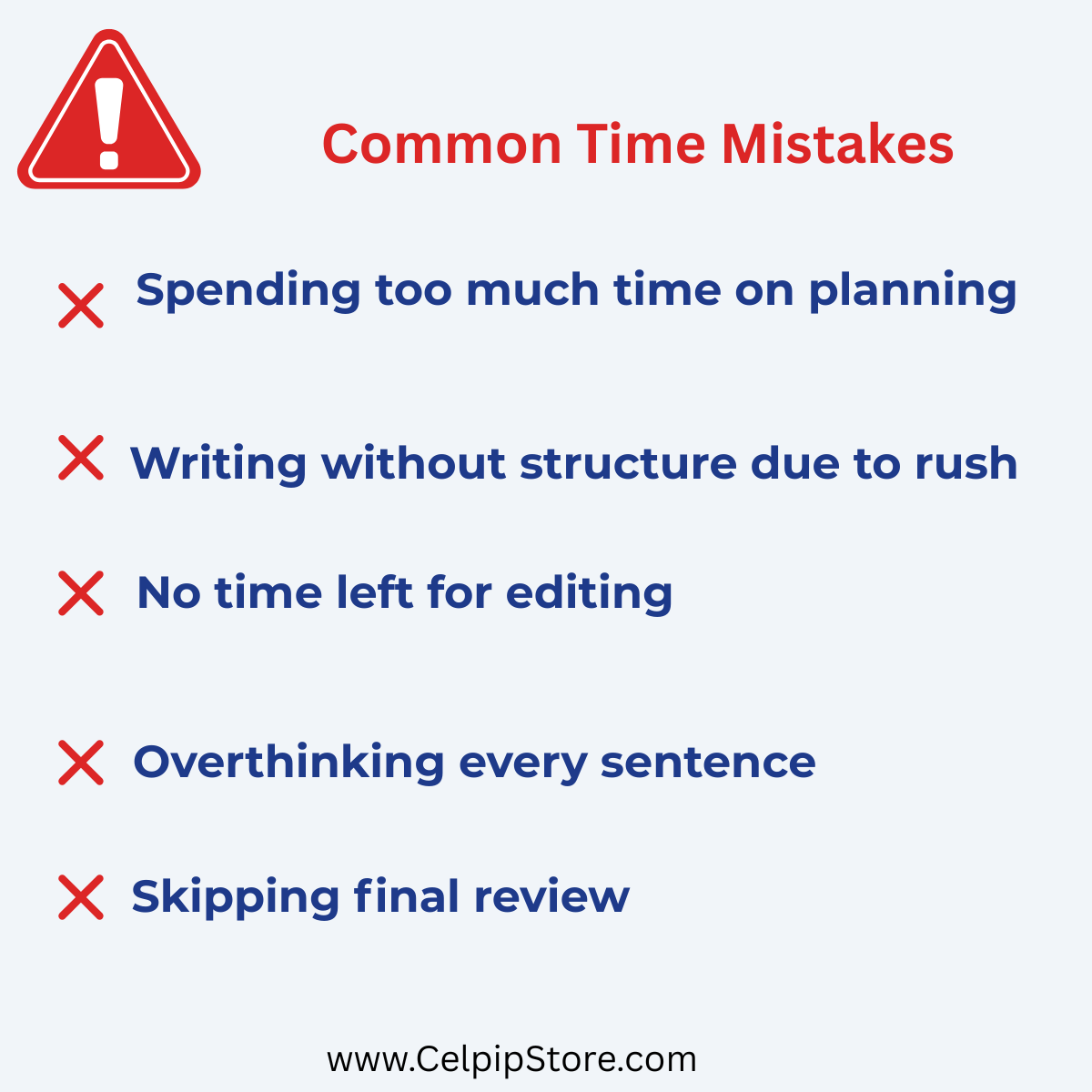
Common Time Management Mistakes
1. Over-planning
Students spend 10–12 minutes just thinking.
Result: not enough writing time
2. Writing too fast at the end
Students rush Task 2 and lose structure.
3. No editing time
Small grammar mistakes reduce score.
4. Unequal time distribution
Too much time on Task 1, less on Task 2.
Core System: CELPIP Writing Time Breakdown (Exam-Ready Strategy)
To score Band 8–10, you must follow a strict time structure, not write randomly.
Here is the official performance-style timing system used by high scorers.
1. TASK 1 (EMAIL WRITING) — 27 MINUTE SYSTEM
Step-by-Step Timing Plan
1. Planning (3 minutes)
- Read question carefully
- Identify purpose (request / complaint / information)
- Note 3 key points
Do NOT write full sentences here
2. Writing (20–21 minutes)
Use this structure:
- Greeting (1 min)
- Purpose (2 min)
- Body Paragraph 1 (8–9 min)
- Body Paragraph 2 (8–9 min)
- Closing (1 min)
3. Quick Review (2–3 minutes)
- Grammar check
- Spelling check
- Missing point check
Task 1 Rule
“Fast, clear, polite — not perfect”
2. TASK 2 (OPINION ESSAY) — 33 MINUTE SYSTEM
Step-by-Step Timing Plan
1. Planning (4–5 minutes)
- Choose opinion (agree/disagree)
- Select 2 ideas
- Apply PERE structure mentally
2. Writing (25–27 minutes)
Structure timing:
- Introduction (4–5 min)
- Body Paragraph 1 (10–11 min)
- Body Paragraph 2 (10–11 min)
- Conclusion (2–3 min)
3. Final Review (2–3 minutes)
- Check sentence clarity
- Fix grammar errors
- Ensure full task completion
Task 2 Rule
“Depth + structure + timing balance = high score”
3. BALANCED TIME STRATEGY (VERY IMPORTANT)
Common Mistake:
- Spending too much time on Task 1
- Rushing Task 2
Correct Strategy:
- Task 1 ? 27 minutes
- Task 2 ? 33 minutes
Always protect Task 2 time. To fully benefit from time management strategies, you must combine them with strong writing skills, task understanding, and scoring awareness. For complete preparation, read our Ultimate CELPIP Writing Guide.
4. REAL EXAM THINKING STRATEGY
Step 1: Don’t think too long
- Start writing quickly after planning
Step 2: Follow structure automatically
- No overthinking during writing
Step 3: Leave time for correction
- Never skip final review
Key Insight
“Planning saves time. Overthinking wastes time.”
5. COMMON TIME ERRORS
Error 1: Slow start
- Students spend too long reading question
Error 2: No time buffer
- No editing time left
Error 3: Uneven writing speed
- Task 1 too slow, Task 2 rushed
Error 4: Panic writing
- Leads to grammar mistakes
Golden Rule
“Time control = score control”
If you manage time properly:
- Ideas become clearer
- Structure improves
- Grammar mistakes reduce
Advanced Time Strategy (Band 8–10 Performance Level)
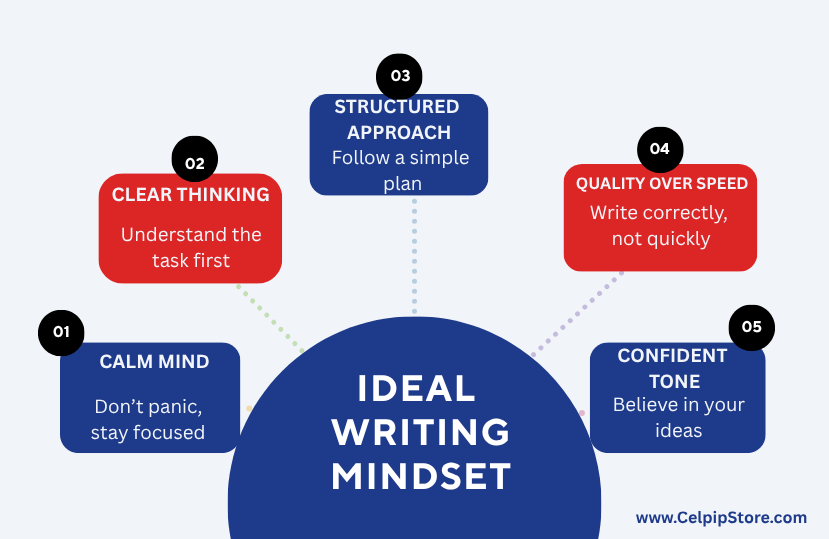
At this stage, time management is not just about minutes it is about writing rhythm and decision speed.
High-scoring candidates don’t “manage time” during the exam.
They follow a pre-trained writing flow automatically.
1. Speed Writing Framework (Automatic Flow System)
Step 1: Read -> Decide (30–60 seconds)
- Identify task type immediately
- Decide tone (formal / semi-formal)
- Select opinion or purpose
No overthinking allowed
Step 2: Plan -> Lock Ideas (3–5 minutes)
- Choose ONLY 2 ideas (Task 2)
- Select 3 bullet points (Task 1)
- Mentally map structure
Planning is “decision making”, not writing
Step 3: Write -> Flow Mode (20–27 minutes)
- Do not stop mid-sentence
- Follow structure automatically
- Avoid editing while writing
Writing must be continuous
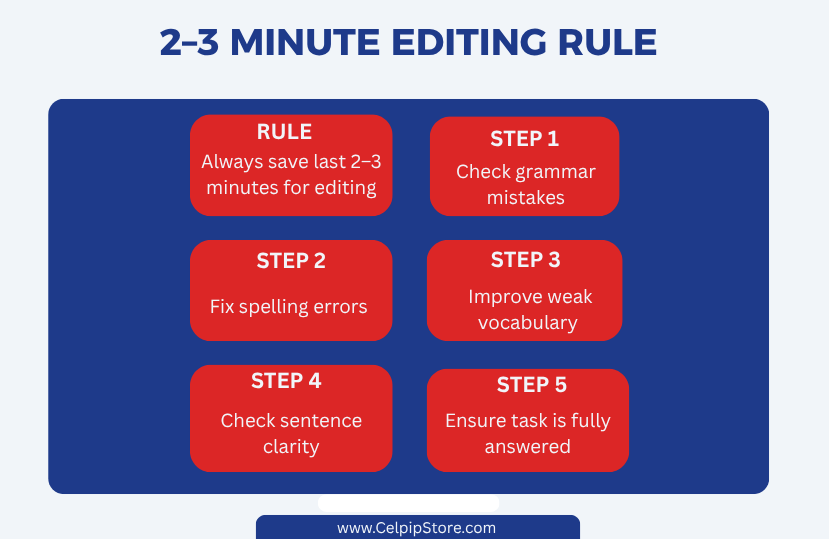
Step 4: Fix -> Polish (2–3 minutes)
- Grammar
- Spelling
- Missing words
- Task completion
2. Examiner Insight: What They See Under Time Pressure
Examiners know you are writing under time limits.
They do NOT expect perfection.
They look for:
- Clear structure
- Complete response
- Logical flow
- Controlled writing (not chaotic)
What lowers score under time pressure:
- Incomplete paragraphs
- Missing conclusion
- Sudden idea changes
- No logical order
What increases score:
- Even paragraph balance
- Clear opinion
- Fully developed ideas
- Simple but correct English
3. Common Time Traps (Avoid These)
Trap 1: “Perfect Sentence Syndrome”
Students stop writing to correct every sentence.
Result: no time left
Trap 2: Idea Switching
Changing ideas mid-writing.
Result: confusion + weak structure
Trap 3: Over-editing Task 1
Spending too much time polishing email.
Trap 4: Panic Writing in Task 2
Rushing final paragraphs.
Many candidates struggle not only with time management but also with understanding task requirements and writing strategies. These problems can be solved by studying the full Writing system.
4. High-Score Time Hacks
Hack 1: Pre-built Structure Memory
You should already know:
- Task 1 template
- Task 2 4-paragraph structure
Saves 5–7 minutes instantly
Hack 2: Idea Locking Rule
Once ideas are chosen:
DO NOT change them
Hack 3: Paragraph Time Balance
- Each paragraph = similar time
- No “extra long” paragraph
Hack 4: No Mid-Editing Rule
Editing only at the end.
Final Summary: CELPIP Writing Time Management System
Success in CELPIP Writing is not about writing faster or writing more.
It is about controlling time with structure.
When your timing is correct:
- Ideas become clearer
- Writing becomes organized
- Stress reduces significantly
- Score consistency improves
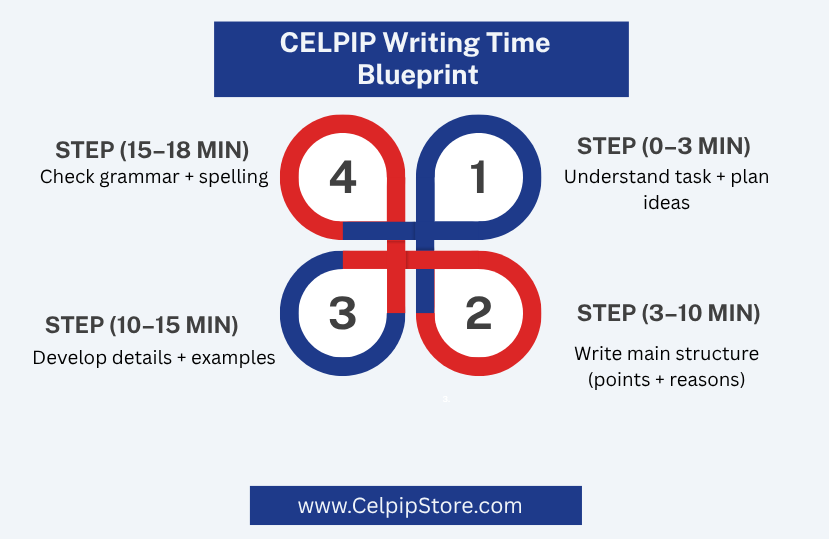
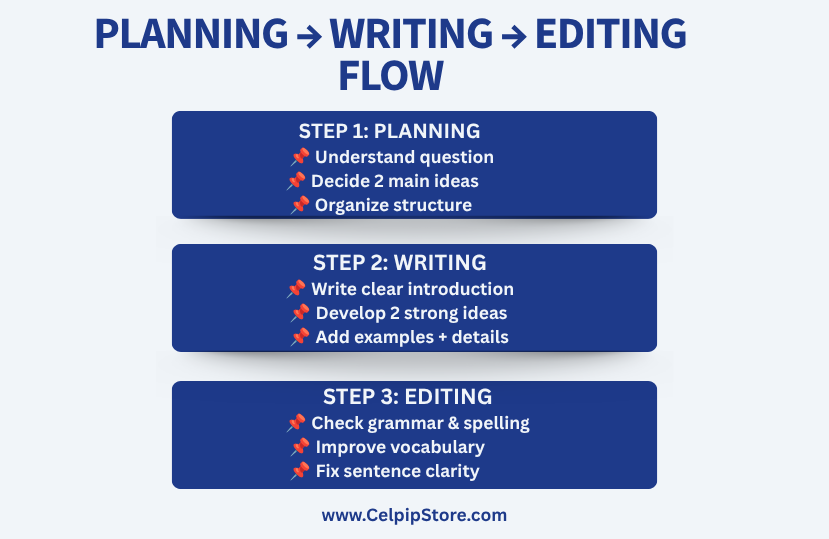
Core Time Blueprint (Final Model)
Task 1 (Email) — 27 Minutes
- 3 min: Planning
- 20–21 min: Writing
- 2–3 min: Editing
Task 2 (Essay) — 33 Minutes
- 4–5 min: Planning
- 25–27 min: Writing
- 2–3 min: Editing
CELPIP Writing Master Checklist
Planning Stage
- I identified task type quickly
- I selected key ideas before writing
- I did not overthink
Writing Stage
- I followed structure strictly
- I kept paragraph balance
- I did not stop mid-flow
Editing Stage
- I checked grammar mistakes
- I fixed spelling errors
- I ensured task completion
Common Time Management Mistakes
Over-planning
Too much thinking before writing
No editing time
Leaving mistakes uncorrected
Uneven timing
Task 1 too long, Task 2 rushed
Perfection delay
Stopping to fix every sentence
Key Insight
“Structure saves time. Time control builds score.”
7-Day Practice Plan (Time Mastery Training)
Day 1–2: Planning Speed Practice
- 10 prompts: plan in 3 minutes each
Day 3–4: Writing Flow Practice
- Write full Task 1 & Task 2 using strict timing
Day 5: Editing Practice
- Rewrite and correct sample essays
Day 6: Full Timed Writing
- Real exam simulation (Task 1 + Task 2)
Day 7: Performance Test
- No stopping rule practice
FAQs: CELPIP Writing Timing
Q1: Can I exceed recommended time per task?
No. It reduces performance in second task.
Q2: Is editing really necessary?
Yes. Even 2–3 minutes improves score quality.
Q3: Should I plan in detail?
No. Only key ideas, not full sentences.
Q4: What if I run out of time?
Always prioritize conclusion over body text.
Final Strategy Insight
“The exam is not a writing test it is a time management test.”
To achieve a high score in CELPIP Writing, effective time management must be combined with strong task strategy, clear structure, and proper understanding of scoring criteria. For a complete guide to mastering the Writing section, start with our Ultimate CELPIP Writing Guide.