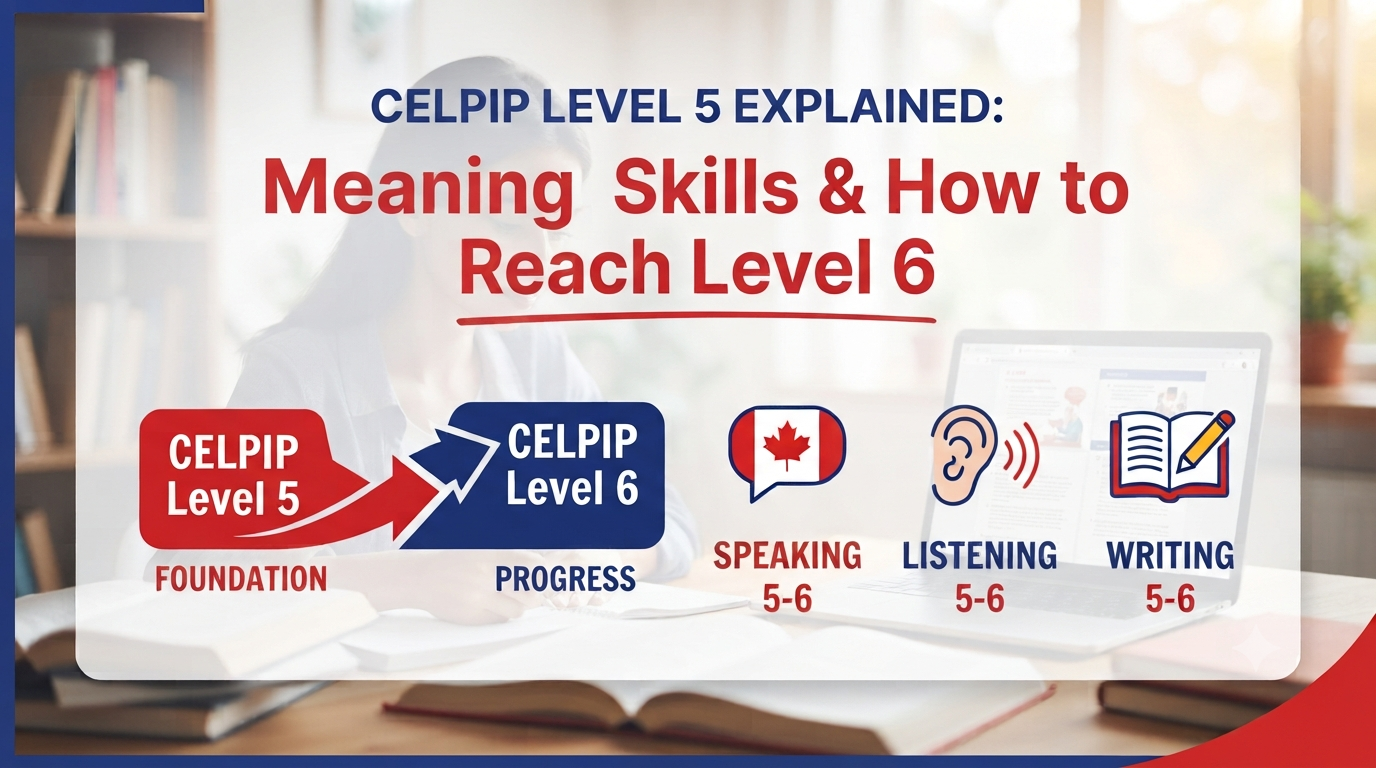
CELPIP Level 5 Explained: Meaning, Skills & Tips to Reach Level 6
Achieving CELPIP Level 5 is a meaningful milestone in your English language journey. It shows that you're moving beyond basic communication and becoming more comfortable using English in a wider range of everyday situations.
At this level, you can usually understand familiar conversations, express your opinions with greater confidence, and complete many daily communication tasks independently. While there is still room for improvement, Level 5 demonstrates that you're developing the practical language skills needed for work, study, and life in an English-speaking environment. CELPIP Level 5 is part of a larger scoring system. To understand how it compares with other levels, read CELPIP levels explained.
Many candidates who receive Level 5 ask questions such as:
- Is CELPIP Level 5 a good score?
- What can I do at this level?
- What skills should I improve next?
- How do I reach Level 6?
The good news is that Level 5 represents real progress. Compared with Level 4, you'll notice that conversations become easier to follow, your vocabulary continues to grow, and you're able to express your ideas with greater clarity.
However, you may still face challenges with complex discussions, advanced vocabulary, and communicating fluently under time pressure. These are normal parts of language development and can be improved through focused practice.
In this guide, we'll explain what CELPIP Level 5 means, explore each of the four language skills in detail, identify common challenges, and share practical strategies to help you confidently progress toward CELPIP Level 6.
What Does CELPIP Level 5 Mean?
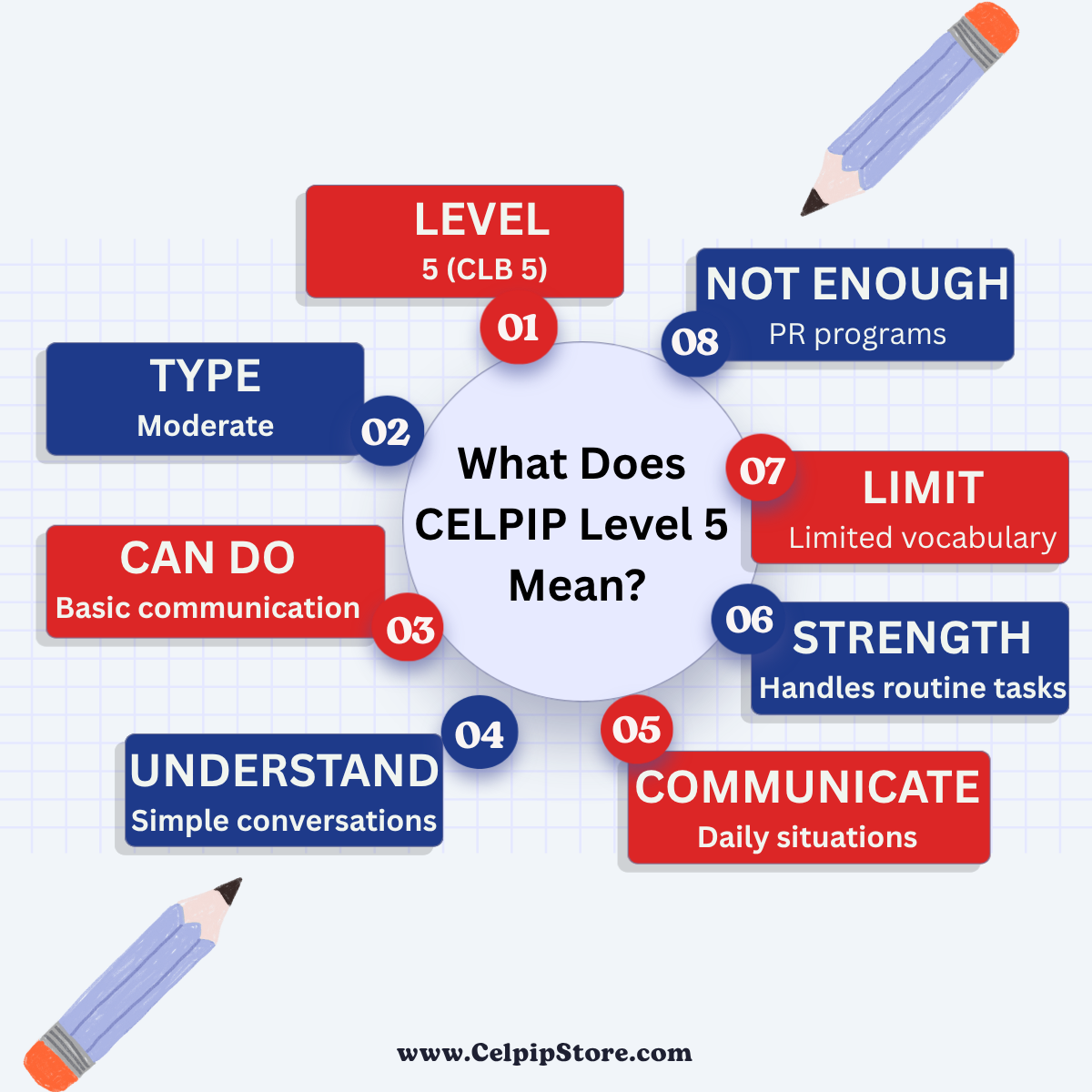
CELPIP Level 5 represents developing English communication skills. At this stage, you can communicate effectively in many everyday situations, understand the main ideas in familiar conversations, and express yourself more naturally than at the beginner level.
You're no longer relying entirely on memorized phrases. Instead, you're beginning to create your own sentences, respond more spontaneously, and handle a wider variety of communication tasks.
Compared with Level 4, Level 5 learners typically demonstrate:
- Better understanding of spoken English.
- Improved reading comprehension.
- More organized writing.
- Greater confidence when speaking.
- A broader vocabulary for everyday topics.
Although mistakes still occur, they usually do not prevent successful communication. Since CELPIP levels correspond directly to CLB levels, it’s useful to see the full scale from Level 1 to 12. You can explore this in this complete levels guide.
Level 4 vs Level 5
One of the easiest ways to understand Level 5 is by comparing it with the previous level.
|
Skill |
Level 4 |
Level 5 |
|
Listening |
Understands simple conversations |
Understands longer conversations with familiar topics |
|
Reading |
Reads short texts |
Understands longer articles with better accuracy |
|
Writing |
Writes basic messages |
Writes clearer paragraphs with improved organization |
|
Speaking |
Handles simple conversations |
Expresses ideas with greater confidence and detail |
Think of Level 5 as the point where English becomes a practical communication tool rather than something you only use in the classroom.
Who Is Usually at CELPIP Level 5?
Many learners at Level 5 have already built a solid foundation and are becoming more confident in everyday communication.
Typical Level 5 learners include:
- Candidates preparing for Canadian immigration.
- International students improving their academic English.
- Professionals who use English occasionally at work.
- Individuals who can communicate comfortably in familiar situations but want greater fluency.
- Learners who practice English regularly but still hesitate during complex conversations.
At this level, many people begin noticing that they can understand English without translating every sentence into their first language. This is an important sign that your language skills are becoming more natural.
What Can You Do at CELPIP Level 5?
Level 5 allows you to participate more actively in everyday life using English.
You can usually:
- Follow conversations about familiar topics.
- Read newspapers, blogs, and emails with reasonable understanding.
- Write organized paragraphs explaining your ideas.
- Participate in discussions at work, school, or in social settings.
- Ask for clarification when something isn't clear.
- Explain personal experiences and opinions with greater confidence.
Although you may still pause occasionally while searching for vocabulary, you're increasingly able to communicate your message successfully.
Real-Life Example
Imagine you've recently started a new job in Canada.
During a team meeting, your manager asks for your opinion on improving customer service.
At Level 4, you might respond with a few short sentences and struggle to explain your ideas in detail.
At Level 5, you're more likely to say:
"I think we could respond to customer emails more quickly and provide clearer information on our website. That would reduce confusion and improve customer satisfaction."
The response is still simple, but it's organized, relevant, and communicates your opinion effectively.
This illustrates the key difference between Level 4 and Level 5: greater confidence and clearer communication.
Understanding the Four Language Skills at CELPIP Level 5
Reaching CELPIP Level 5 means you're becoming a more confident English communicator. You can participate in many everyday conversations, understand more detailed information, and express your thoughts more clearly than before.
However, confidence doesn't mean perfection.
Most Level 5 learners still experience moments when they hesitate, forget a word, misunderstand a fast conversation, or struggle to organize their ideas. These challenges are completely normal and are part of the journey toward higher proficiency.Whether Level 5 is enough depends on your goals. Compare it with higher levels in CELPIP levels explained.
Let's look at what Level 5 typically means for each of the four language skills.
Listening Skills at CELPIP Level 5
At Level 5, your listening skills become noticeably stronger.
You can usually:
- Understand conversations at a natural speaking speed.
- Follow discussions about familiar topics.
- Identify the main ideas and supporting details.
- Understand announcements, interviews, and everyday workplace conversations.
- Recognize the speaker's purpose in simple situations.
However, you may still struggle when:
- Several people speak at the same time.
- Conversations include unfamiliar topics.
- Speakers use idioms or slang.
- The conversation changes direction quickly.
- Important details are mentioned only once.
Real-Life Example
Imagine you're attending a workplace meeting.
Your manager says:
"We'll move the client presentation to Friday because the marketing team needs additional time to finalize the campaign. Please update your reports by Thursday afternoon."
At Level 5, you'll likely understand:
- The presentation date has changed.
- Reports must be submitted before Thursday afternoon.
- The marketing team needs more preparation time.
You may still miss smaller details if the discussion continues rapidly, but you'll understand the overall message with confidence.
How to Improve Listening
To strengthen your listening skills:
- Listen to Canadian English every day.
- Watch interviews instead of scripted TV shows.
- Listen without subtitles first, then check your understanding.
- Focus on understanding ideas rather than every individual word.
- Summarize what you heard in your own words.
Reading Skills at CELPIP Level 5
At this level, reading becomes more comfortable.
You can usually understand:
- News articles.
- Workplace emails.
- Online blogs.
- Product reviews.
- Public information.
- Travel information.
- Community announcements.
Longer articles are no longer intimidating, but you may still slow down when encountering unfamiliar vocabulary or more formal writing.
One noticeable improvement at Level 5 is that many learners begin reading for meaning rather than translating every sentence into their first language.
This is an important milestone because it allows you to read faster and understand ideas more naturally.
How to Improve Reading
Try these habits:
- Read one English article every day.
- Highlight new words instead of stopping to translate them.
- Guess the meaning of unfamiliar vocabulary from context.
- Read about topics that genuinely interest you.
- Practice identifying the author's main idea.
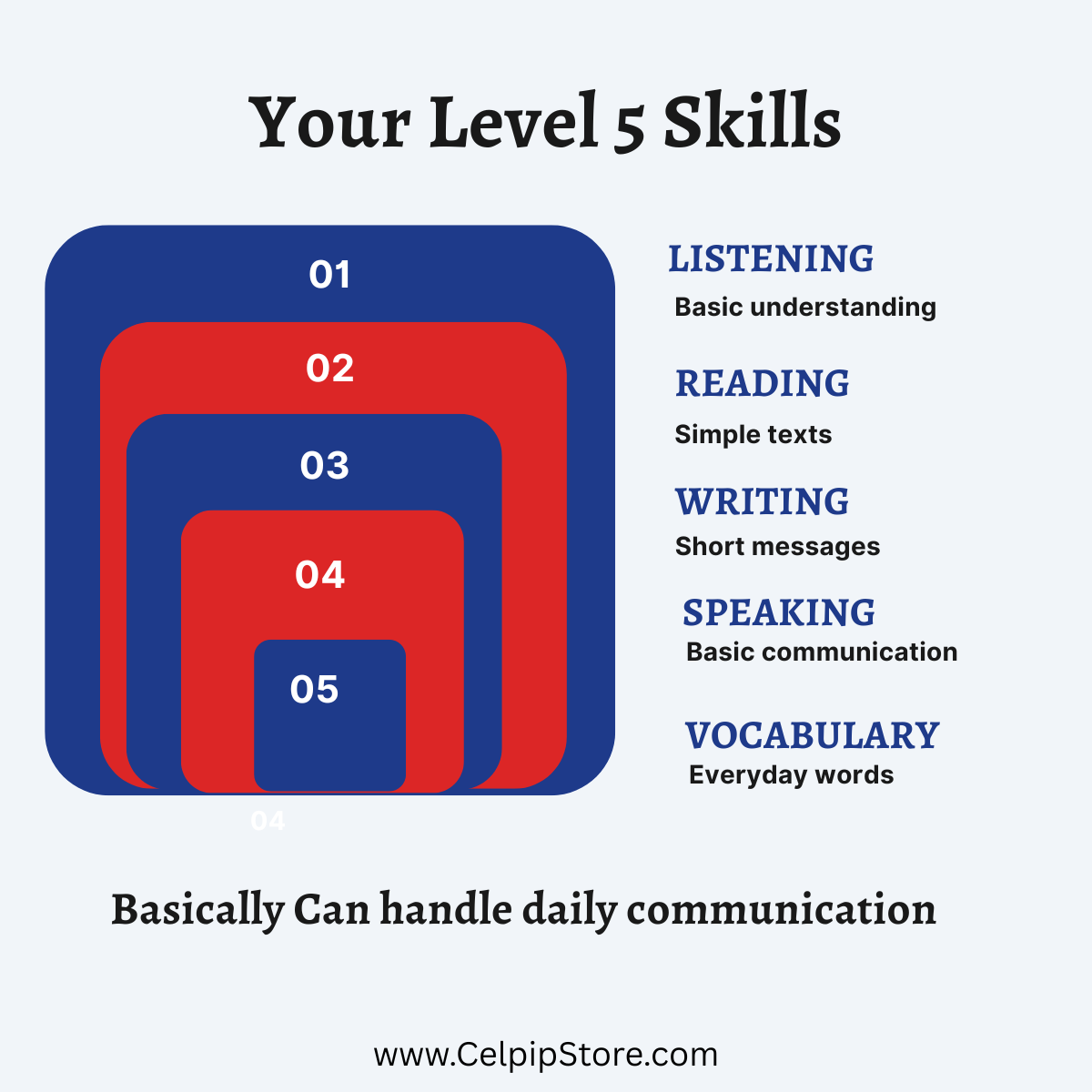
Writing Skills at CELPIP Level 5
Writing becomes much more organized at this stage.
Instead of writing isolated sentences, you're beginning to connect ideas into logical paragraphs.
You can usually:
- Write emails clearly.
- Explain your opinion.
- Describe experiences.
- Give simple recommendations.
- Support your ideas with examples.
Grammar mistakes may still appear, but your message is generally easy to understand.
Example
Level 4:
"I like this job because good people."
Level 5:
"I enjoy this job because my colleagues are supportive, and I have opportunities to learn new skills every day."
Notice the difference.
The vocabulary isn't necessarily advanced.
The improvement comes from better organization, complete sentences, and more detailed explanations.
How to Improve Writing
To move toward Level 6:
- Write one paragraph every day.
- Learn transition words like however, therefore, for example, and in addition.
- Expand your sentences with supporting details.
- Read well-written English articles.
- Edit your writing before considering it complete.
Speaking Skills at CELPIP Level 5
Speaking is where many learners begin to notice significant improvement.
At Level 5, you can:
- Express opinions more confidently.
- Describe experiences with greater detail.
- Ask follow-up questions.
- Handle everyday conversations comfortably.
- Explain simple problems and possible solutions.
You may still hesitate while searching for vocabulary, but those pauses become shorter as your confidence grows.
Example
Question:
"Describe your favorite holiday."
A typical Level 5 response:
"My favorite holiday is New Year's Day because my family gets together every year. We prepare special food, watch fireworks, and spend time talking about our plans for the future. It's always an enjoyable and memorable day."
This response is organized, relevant, and communicates complete ideas.
How to Improve Speaking
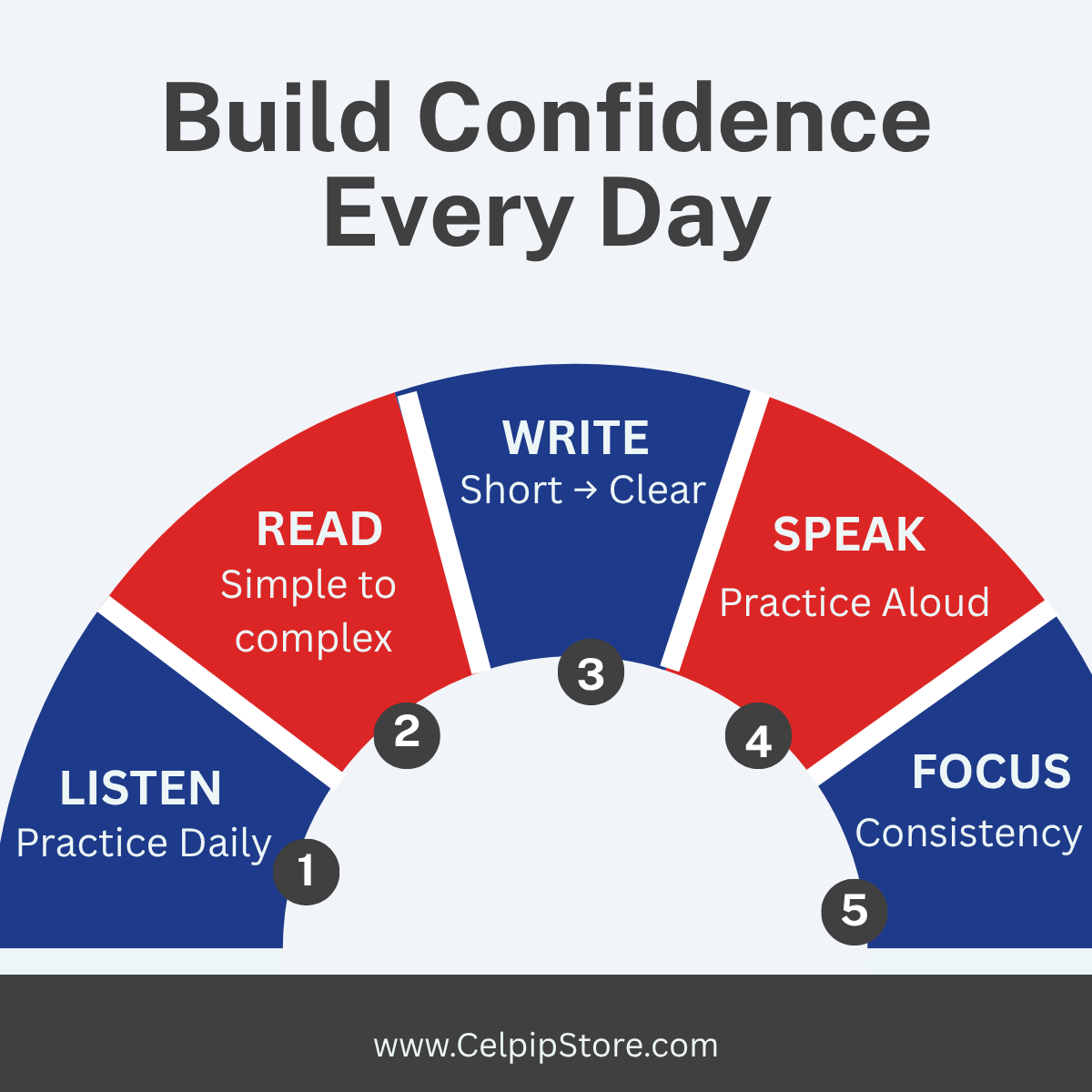
Build confidence through daily practice:
- Speak aloud for two or three minutes on a different topic each day.
- Record yourself and listen for clarity.
- Practice answering sample CELPIP Speaking questions.
- Focus on fluency before perfection.
- Learn useful everyday expressions rather than difficult vocabulary.
Confidence: The Biggest Difference Between Level 4 and Level 5
The biggest change isn't vocabulary.
It isn't grammar.
It isn't pronunciation.
The biggest difference is confidence.
At Level 4, many learners know the answer but hesitate to speak.
At Level 5, learners begin trusting themselves.
They accept that small mistakes are part of communication and focus on expressing their ideas clearly instead of trying to sound perfect.
This mindset often leads to faster improvement than memorizing hundreds of new words.
Did You Know?
Many successful CELPIP candidates don't speak perfect English they speak confidently and clearly. Examiners are looking for effective communication, not flawless grammar in every sentence.
Common Challenges at CELPIP Level 5
Although you're becoming a stronger communicator, certain challenges still appear frequently.
Limited Vocabulary for Specific Topics
You can discuss everyday situations comfortably but may struggle with subjects like business, technology, healthcare, or education.
Speaking Too Quickly
Some learners try to sound fluent by speaking very fast.
Ironically, speaking a little slower often improves pronunciation and clarity.
Weak Supporting Details
Many candidates answer the question but don't provide enough explanation or examples.
Developing your ideas is one of the easiest ways to improve both Speaking and Writing scores.
Inconsistent Grammar
You know many grammar rules but don't always apply them consistently during real communication.
Regular practice helps these rules become automatic.
Fear of Complex Questions
Unexpected questions can reduce confidence.
The solution isn't memorization it's practicing how to organize your thoughts quickly.
Expert Tip
Start every Speaking or Writing response with a simple structure:
Answer -> Explain -> Example -> Conclusion
For example:
- Give your opinion.
- Explain why.
- Provide a real-life example.
- Finish with a short concluding sentence.
This four-step structure works well for many CELPIP tasks and makes your responses clearer and more organized.
How to Improve from CELPIP Level 5 to Level 6
Reaching CELPIP Level 5 is a significant achievement, but progressing to Level 6 requires a different approach.
At Level 4, the goal was to build confidence in using English.
At Level 5, the goal is to become more independent. You should begin relying less on memorized phrases and more on your own ability to understand, think, and communicate in English.
The good news is that you don't need to study twice as much you simply need to study more effectively.
Step 1: Use English Every Day
Many learners only use English during study sessions.
To reach Level 6, start using English in your daily life.
For example:
- Read news articles while having breakfast.
- Watch English videos during your commute.
- Think in English while shopping.
- Write your daily to-do list in English.
- Speak to yourself while doing household tasks.
The more naturally English fits into your routine, the faster you'll improve.
Step 2: Expand Your Vocabulary Naturally
At Level 5, it's time to move beyond common everyday words.
Instead of memorizing long vocabulary lists, focus on learning words related to real-life situations such as:
- Workplace communication
- Healthcare
- Banking
- Education
- Technology
- Travel
- Community services
For example, if you're reading an article about healthcare, learn words like:
- Appointment
- Prescription
- Symptoms
- Treatment
- Diagnosis
Then use them in your own sentences.
Vocabulary becomes much easier to remember when it's connected to real situations.
Step 3: Develop Longer Responses
One of the biggest differences between Level 5 and Level 6 is the ability to explain ideas in greater detail.
Instead of giving short answers, practice expanding them.
For example:
Question: Why do you enjoy reading?
A short response:
"Because I learn new things."
A stronger response:
"I enjoy reading because it helps me learn about different cultures, improve my vocabulary, and relax after a busy day. I especially enjoy reading articles related to education and personal development."
The second response provides reasons and examples, making it more engaging and complete.
Step 4: Improve Fluency Through Speaking Practice
Many learners focus only on grammar, but fluency develops through speaking regularly.
Try these activities:
- Speak for two minutes on a random topic.
- Describe a photo in detail.
- Explain how to complete a simple task.
- Summarize a news article.
- Tell a personal story.
Don't stop every time you make a mistake.
Keep speaking.
Fluency grows when your ideas continue flowing naturally.
Step 5: Learn to Self-Correct
Successful learners don't just practice they reflect on their practice.
After completing a speaking or writing exercise, ask yourself:
- Did I answer the question completely?
- Could I use more descriptive vocabulary?
- Did I organize my ideas clearly?
- Did I repeat the same words too often?
- What will I improve next time?
Keeping a notebook of common mistakes can help you see patterns and measure your progress over time.
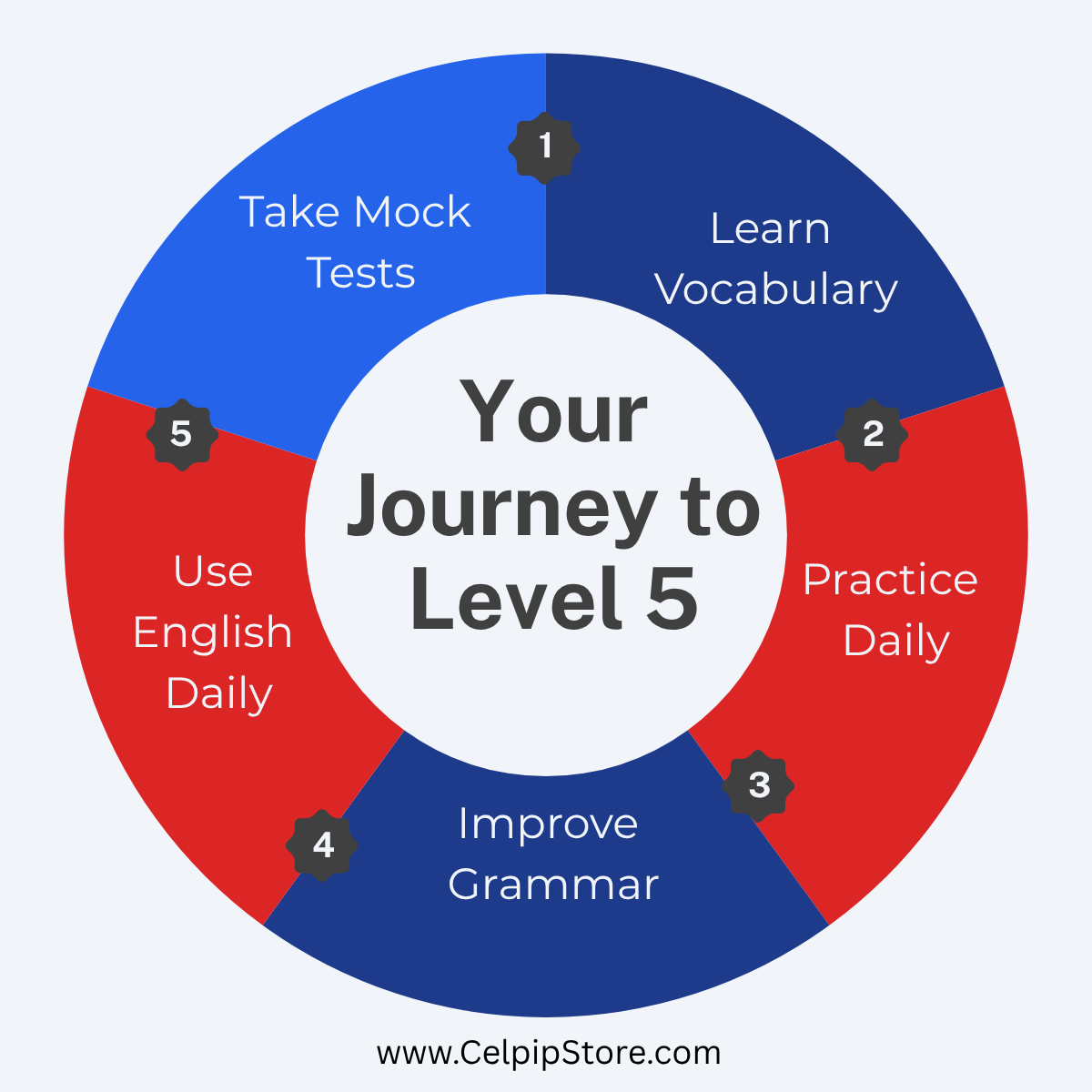
A Weekly Study Plan for Level 5 Learners
As your skills improve, your study sessions should become more focused.
|
Day |
Main Focus |
Secondary Focus |
|
Monday |
Listening |
Vocabulary |
|
Tuesday |
Reading |
Grammar |
|
Wednesday |
Writing |
Self-editing |
|
Thursday |
Speaking |
Pronunciation |
|
Friday |
Mixed Practice |
Mock Questions |
|
Saturday |
Full Practice Test |
Error Review |
|
Sunday |
Revision & Goal Setting |
Light Reading |
This schedule balances all four skills while giving extra attention to reviewing mistakes and building confidence.
Common Mistakes That Prevent Learners from Reaching Level 6
Understanding these mistakes can help you avoid unnecessary setbacks.
Mistake 1: Using the Same Vocabulary Repeatedly
Words like good, nice, bad, and interesting are useful, but relying on them too often makes your communication less precise.
Try learning a few alternative words each week and using them naturally in conversation.
Mistake 2: Giving Short Answers
Many learners answer the question but stop too soon.
Whenever possible, explain your answer, provide an example, and conclude with a final thought.
This simple habit improves both Speaking and Writing.
Mistake 3: Ignoring Pronunciation
Good pronunciation isn't about having a perfect accent.
It's about being understood clearly.
Practice stress, rhythm, and sentence intonation by listening to native speakers and repeating what you hear.
Mistake 4: Avoiding Difficult Topics
If you only practice familiar subjects, your progress will slow down.
Challenge yourself with topics such as:
- Environment
- Technology
- Education
- Public transportation
- Health
- Community issues
The more varied your practice, the more confident you'll become.
Mistake 5: Studying Without Feedback
Practicing without reviewing your performance often leads to repeating the same mistakes.
Whether you use a teacher, study partner, or AI tool, regular feedback helps you improve faster.
Expert Tips for Reaching Level 6
Read Beyond Study Materials
Books, newspapers, blogs, and magazines expose you to natural English and a wider range of vocabulary.
Speak in Complete Sentences
Avoid one-word or very short responses.
Complete thoughts demonstrate stronger communication skills.
Listen Actively
Instead of just hearing English, pay attention to:
- Word choice
- Sentence structure
- Pronunciation
- Expressions
- Tone
This helps you naturally improve your own communication.
Build Topic-Based Vocabulary
Choose one topic each week such as travel, work, or education and learn useful words and expressions related to that subject.
Simulate Real-Life Conversations
Practice situations like:
- Asking for information.
- Making appointments.
- Giving directions.
- Solving customer service problems.
- Participating in workplace discussions.
These activities build practical communication skills that are valuable both for the CELPIP exam and everyday life. To move beyond Level 5, you should understand what higher levels require. Read CELPIP level comparison.
Did You Know?
Many learners begin thinking directly in English around Level 5. This reduces the need to translate every sentence mentally, allowing conversations to become faster, smoother, and more natural.
Self-Assessment Checklist
Before aiming for Level 6, ask yourself:
- I understand most everyday conversations.
- I can explain my opinions with examples.
- I read articles without translating every sentence.
- I write organized paragraphs.
- I speak for two or more minutes on familiar topics.
- I review and learn from my mistakes.
- I practice English consistently every week.
If you answered "Yes" to most of these, you're building the skills needed to move toward Level 6.
Frequently Asked Questions About CELPIP Level 5
1. Is CELPIP Level 5 a good score?
Yes. CELPIP Level 5 indicates that you have developing English communication skills. You can participate in many everyday conversations, understand familiar topics, and express your ideas with reasonable confidence. While there is still room for improvement, Level 5 represents meaningful progress and provides a strong foundation for advancing toward higher levels.
2. Can I reach Level 6 from Level 5?
Absolutely. Many learners move from Level 5 to Level 6 by improving their fluency, expanding their vocabulary, organizing their ideas more clearly, and practicing consistently across all four language skills.
Focus on daily communication rather than occasional intensive study sessions.
3. Which skill is hardest at Level 5?
The answer depends on the learner, but many candidates find Speaking and Writing more challenging because these skills require you to produce language naturally instead of simply understanding it.
Practicing real-life conversations and writing short paragraphs every day can make a noticeable difference.
4. How long does it usually take to improve from Level 5 to Level 6?
There is no fixed timeline because progress depends on your current ability, study habits, and daily exposure to English.
Learners who practice consistently, review their mistakes, and use English in everyday situations often improve more steadily than those who only study before the exam.
5. Should I memorize model answers?
No.
Memorized responses often sound unnatural and may not match the actual exam question.
Instead, learn how to organize your thoughts using a simple structure:
- Answer
- Explain
- Example
- Conclusion
This approach makes your Speaking and Writing responses more flexible and authentic.
6. How can I become more confident when speaking English?
Confidence grows through regular practice.
Some effective strategies include:
- Speaking aloud every day.
- Recording yourself.
- Practicing with a friend or language partner.
- Answering sample CELPIP Speaking questions.
- Accepting that small mistakes are a normal part of learning.
Remember, confidence comes from communication not perfection.
7. What should I focus on most at Level 5?
At this stage, your priorities should be:
- Building topic-based vocabulary.
- Improving fluency.
- Developing longer answers.
- Reading authentic English materials.
- Practicing all four skills consistently.
- Reviewing mistakes after every study session.
These habits create the foundation for reaching Level 6.
Quick Recap
Before you move on, remember these key ideas:
- CELPIP Level 5 reflects developing English communication skills.
- You can participate in many everyday conversations with growing confidence.
- Fluency and vocabulary become more important at this stage.
- Longer, better-organized responses improve both Speaking and Writing.
- Daily practice is more effective than occasional long study sessions.
- Learning from your mistakes is one of the fastest ways to improve.
- Confidence develops through regular communication.
Final Thoughts
Reaching CELPIP Level 5 is an important milestone because it shows that you're becoming a more confident and capable English communicator.
You can already participate in many everyday situations, express your opinions, and understand a wide range of spoken and written English. While you may still hesitate occasionally or search for the right words, these challenges become easier to overcome as you continue practicing. Want to see where Level 5 stands among all levels? Read CELPIP levels explained.
The next stage of your journey is not about becoming perfect.
It's about becoming more independent.
As you expand your vocabulary, improve your fluency, and communicate more naturally, you'll find yourself relying less on memorized phrases and more on your own ability to think and respond in English.
Progress happens through small, consistent improvements.
Read regularly.
Listen actively.
Speak confidently.
Write often.
Review your mistakes.
Most importantly, enjoy the learning process.
Every conversation you have, every article you read, and every practice test you complete brings you one step closer to CELPIP Level 6.
About CELPIPStore
At CELPIPStore, our mission is to help learners achieve their English language goals through practical, high-quality learning resources.
We provide:
- Comprehensive study guides.
- Practice questions.
- Mock tests.
- Vocabulary-building exercises.
- Speaking and Writing strategies.
- Expert preparation tips.
Whether you're preparing for Canadian immigration, citizenship, work, or personal growth, we're here to support every stage of your CELPIP journey.
Call to Action
Ready to Reach CELPIP Level 6?
Continue building your confidence with our expert study guides, realistic practice questions, mock tests, and step-by-step learning resources.
Start practicing today and take the next step toward your target score with CELPIPStore.