
CELPIP Level 8 Explained: Meaning, Skills & How to Reach Level 9
Reaching CELPIP Level 8 is a remarkable achievement and places you among candidates who can communicate with a high degree of confidence, fluency, and flexibility in English.
At this stage, you're no longer focused on simply forming correct sentences. Instead, you're able to communicate naturally across a wide range of professional, academic, and social situations. Whether you're leading a meeting, explaining a complex idea, participating in a debate, or writing a detailed report, Level 8 demonstrates that your English is both practical and highly effective. CELPIP Level 8 is part of a broader scoring system that ranges from Level 1 to 12. To understand how it compares with other levels, read CELPIP levels explained.
Many candidates ask:
-
Is Level 8 considered an advanced CELPIP score?
-
How different is Level 8 from Level 7?
-
What skills define advanced fluency?
-
What should I improve to reach Level 9?
The answer can be summarized in one phrase:
Advanced fluency.
Advanced fluency doesn't mean speaking quickly or using complicated vocabulary.
It means communicating smoothly, accurately, and naturally even when conversations become challenging or unexpected.
At Level 8, you should be able to organize your ideas effortlessly, understand subtle meanings, express opinions with confidence, and adapt your language to different audiences without losing clarity.
In this guide, we'll explore what CELPIP Level 8 means, how each language skill is assessed, the mistakes that often prevent candidates from progressing further, and the practical habits that will help you move toward CELPIP Level 9.
What Does CELPIP Level 8 Mean?
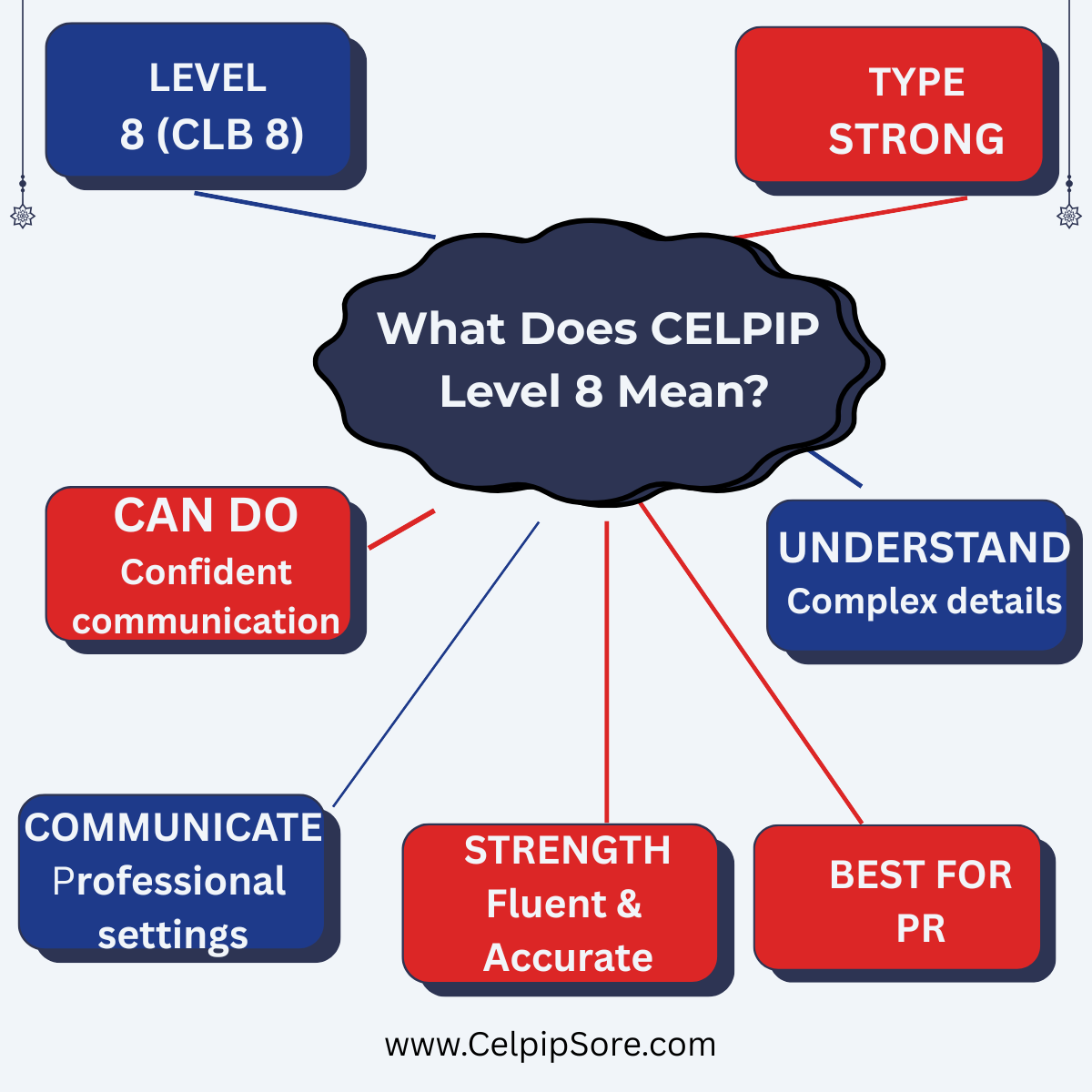
CELPIP Level 8 represents advanced English communication.
At this level, you're expected to communicate comfortably in nearly all professional, academic, and social situations.
You can usually:
-
Understand complex conversations with multiple speakers.
-
Express detailed opinions using well-organized reasoning.
-
Interpret subtle meanings, tone, and intent.
-
Write clear, persuasive, and structured responses.
-
Adapt your communication style depending on the audience and purpose.
-
Recover naturally if a conversation changes direction.
Unlike Level 7, where professional communication is the goal, Level 8 focuses on making that communication feel effortless.
Level 7 vs Level 8
|
Skill |
Level 7 |
Level 8 |
|
Listening |
Professional understanding |
Advanced understanding with subtle meaning |
|
Reading |
Detailed comprehension |
Critical analysis and interpretation |
|
Writing |
Organized and persuasive |
Fluent, precise, and well-developed |
|
Speaking |
Professional communication |
Natural, flexible, and highly fluent |
The defining characteristic of Level 8 is that communication feels smooth and adaptable rather than carefully planned.
Who Usually Achieves CELPIP Level 8?
Many Level 8 candidates include:
-
Experienced professionals working in English-speaking environments.
-
Managers and team leaders.
-
International graduates with extensive English exposure.
-
Candidates preparing for competitive immigration pathways.
-
Individuals who regularly use English in both professional and personal settings.
These learners are comfortable leading discussions, solving complex problems, presenting ideas, and interacting with people from diverse backgrounds. Since CELPIP levels directly correspond to CLB levels, it’s helpful to understand the full range of levels. You can explore this in this complete levels guide.
What Can You Do at CELPIP Level 8?
A Level 8 communicator can typically:
-
Lead workplace discussions with confidence.
-
Explain technical or abstract ideas clearly.
-
Read and analyze detailed reports, articles, and policy documents.
-
Write persuasive reports, proposals, and formal correspondence.
-
Participate in debates while supporting opinions with logical reasoning.
-
Adapt communication style for different audiences.
-
Handle unexpected questions without losing fluency.
Communication is not only accurate it is efficient, natural, and engaging.
Real-Life Example
Imagine you're leading a project review meeting.
A colleague asks:
"What changes would you recommend to improve team productivity over the next quarter?"
A Level 8 response might be:
"I believe we should begin by reviewing our current workflow to identify repetitive tasks that can be automated. At the same time, improving communication between departments through weekly progress updates would reduce misunderstandings and help teams resolve issues more quickly. Together, these changes would improve efficiency while allowing employees to focus on higher-value work."
This response demonstrates:
-
Advanced organization.
-
Precise vocabulary.
-
Logical progression.
-
Professional tone.
-
Practical problem-solving.
Why Level 8 Matters
CELPIP Level 8 shows that English has become a genuine professional advantage.
You're able to communicate effectively not only in routine situations but also when discussions require critical thinking, collaboration, negotiation, and leadership.
For many learners, Level 8 reflects the ability to build relationships, influence decisions, and contribute confidently in English-speaking environments.
Understanding the Four Language Skills at CELPIP Level 8
At CELPIP Level 8, your English should feel natural, flexible, and effortless in most situations.
You're expected to communicate effectively whether you're:
-
Leading a meeting
-
Giving a presentation
-
Resolving workplace problems
-
Participating in debates
-
Or discussing unfamiliar topics
Compared with Level 7, Level 8 focuses less on "correct English" and more on effective communication.
Let's examine each language skill.
Listening Skills at CELPIP Level 8
Listening at Level 8 goes beyond understanding words.
You should comfortably understand:
-
Professional discussions
-
Presentations
-
Interviews
-
Debates
-
Customer interactions
-
And conversations involving multiple speakers
More importantly, you're expected to recognize:
-
Implied meaning
-
Speaker attitude
-
Humor
-
Disagreement
-
Hesitation
-
Persuasion
-
And subtle emotional cues
Real-Life Example
Imagine you're attending a management meeting.
One colleague says:
"Although sales increased this quarter, I don't believe we should expand too quickly until we've evaluated customer feedback more carefully."
The speaker never directly says:
"Don't expand."
Instead, they recommend caution.
A Level 8 learner understands both the spoken message and the implied recommendation.
Understanding these subtleties is one of the defining characteristics of advanced listening.
How to Improve Listening
To strengthen Level 8 listening skills:
-
Watch Canadian panel discussions.
-
Listen to podcasts featuring multiple speakers.
-
Summarize interviews without taking notes.
-
Identify opinions before identifying facts.
-
Pay attention to tone and intention rather than individual words.
Advanced listeners focus on meaning, not translation.
Reading Skills at CELPIP Level 8
Reading at this level requires analytical thinking.
You should confidently understand:
-
Policy documents
-
Editorials
-
Workplace reports
-
Research summaries
-
Opinion articles
-
And formal correspondence
More importantly, you should identify:
-
Assumptions
-
Supporting evidence
-
Logical weaknesses
-
Persuasive techniques
-
And overall purpose
Example
Imagine reading an article about artificial intelligence in healthcare.
A Level 8 reader should identify:
-
The author's argument
-
Supporting evidence
-
Opposing viewpoints
-
Recommendations
-
Potential bias
-
And overall conclusion
Instead of simply understanding information, you evaluate it.
How to Improve Reading
Read materials that challenge your thinking.
Examples:
-
Canadian newspapers
-
Government publications
-
Business magazines
-
Professional journals
-
Opinion editorials
After reading, ask yourself:
-
What is the author's objective?
-
Which evidence is strongest?
-
What assumptions are being made?
-
Would I reach the same conclusion?
Critical reading naturally improves Writing and Speaking.
Writing Skills at CELPIP Level 8
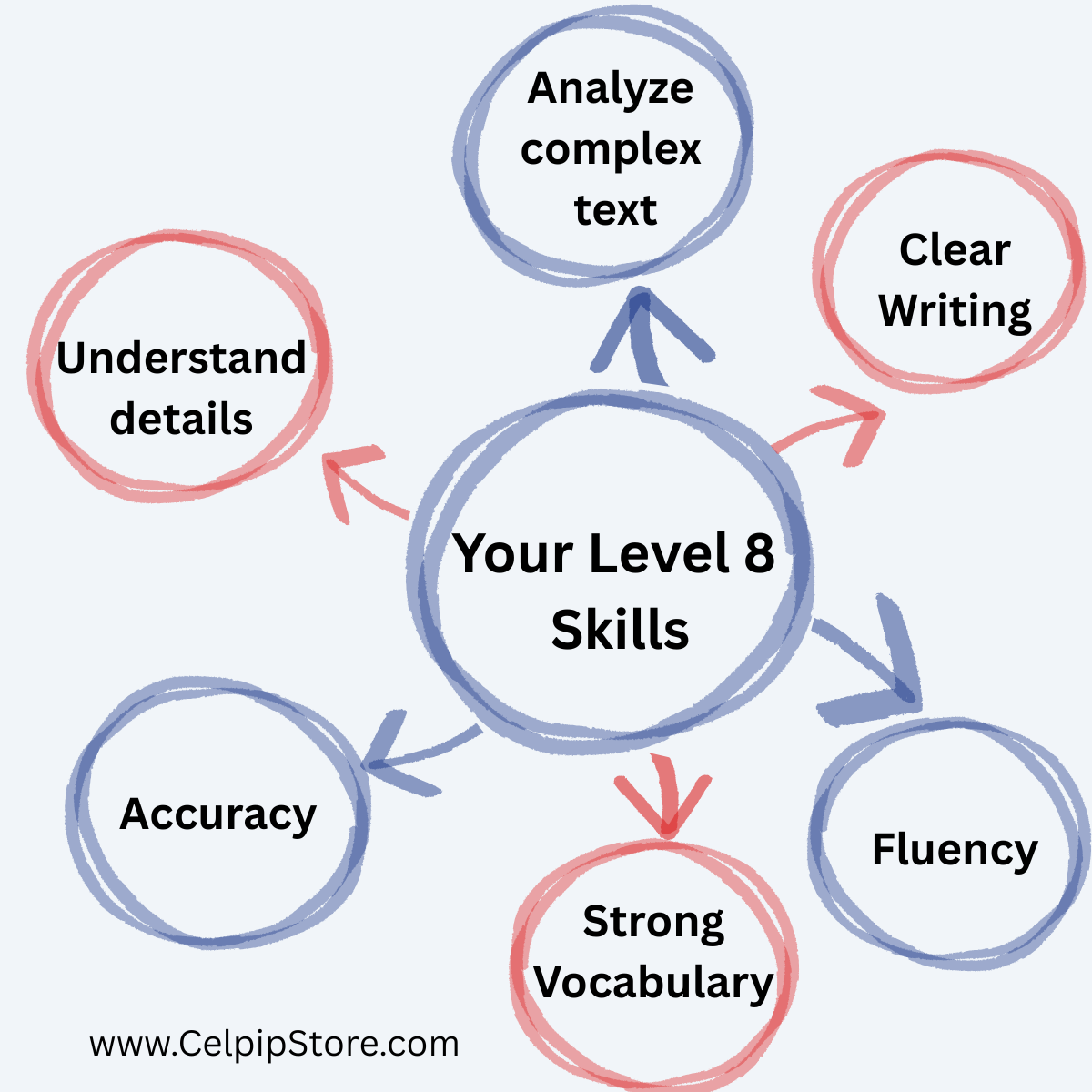
Writing at Level 8 should feel polished.
Your responses should include:
-
Clear organization
-
Logical progression
-
Sophisticated transitions
-
Balanced arguments
-
Relevant examples
-
And precise vocabulary
Grammar mistakes become less frequent.
Ideas become more persuasive.
Paragraphs flow naturally.
Example
Instead of writing:
"Technology helps people work faster."
A stronger Level 8 response might be:
"Modern technology has significantly improved workplace productivity by automating repetitive tasks, enhancing collaboration, and providing employees with faster access to information. However, organizations must also invest in proper training to ensure these tools are used effectively."
Notice the difference.
The response:
-
Explains
-
Balances
-
Supports
-
And concludes logically
That is advanced writing.
How to Improve Writing
Practice writing:
-
Workplace emails
-
Opinion essays
-
Reports
-
Recommendations
-
And problem-solving responses
Always ask yourself:
"Have I explained why, not just what?"
Level 8 writing demonstrates reasoning not just information.
Speaking Skills at CELPIP Level 8
Speaking becomes much more natural.
At Level 8, you should:
-
Express ideas fluently
-
Organize thoughts quickly
-
Explain complex issues
-
Adapt your language naturally
-
Respond confidently without memorization
You should sound comfortable rather than rehearsed.
Example
Question:
"Describe a time you solved a difficult problem at work."
A Level 8 response might be:
"During a particularly busy period, our department experienced repeated communication delays between different teams. I suggested introducing a shared online project tracker where everyone could monitor deadlines, assign responsibilities, and provide daily updates. Within a few weeks, communication improved significantly, project delays decreased, and overall team productivity increased. That experience taught me how important clear communication is when managing complex projects."
Notice how naturally the ideas progress.
The response includes:
-
Context
-
Challenge
-
Solution
-
Result
-
Reflection
This organization is typical of advanced communicators.
How to Improve Speaking
Practice discussing topics such as:
-
Leadership
-
Technology
-
Healthcare
-
Education
-
Environmental issues
-
Workplace management
-
Public policy
Challenge yourself to speak for four minutes without stopping.
Focus on:
-
Smooth transitions
-
Varied vocabulary
-
Natural pronunciation
-
Confident pacing
Remember:
Fluency is the ability to keep communicating even when searching for the perfect word.
The Biggest Difference Between Level 7 and Level 8
The defining difference is advanced fluency.
At Level 7, communication is professional.
At Level 8, communication becomes:
-
Smoother
-
Faster
-
More adaptable
-
More persuasive
-
And more natural
Instead of carefully constructing every sentence, you express ideas with confidence while adjusting naturally to different situations.
Communication becomes instinctive.
Did You Know?
Many candidates who achieve CELPIP Level 8 regularly use English throughout their day not only at work, but also while reading news, listening to podcasts, participating in discussions, and solving real-world problems. Whether Level 8 is enough depends on your goals. Compare it with other levels in CELPIP levels explained.
This consistent exposure strengthens fluency far more effectively than memorizing vocabulary lists alone.
Common Challenges at Level 8
Even advanced learners continue improving.
Typical challenges include:
Communicating Under Pressure
Complex discussions often require quick thinking.
Practice responding without preparing every sentence.
Understanding Nuance
Advanced conversations frequently include humor, sarcasm, indirect suggestions, and implied meaning.
Recognizing these subtleties improves both Listening and Speaking.
Using Varied Vocabulary Naturally
Instead of inserting advanced words artificially, learn to choose precise vocabulary that fits the context.
Natural variety is more impressive than forced complexity.
Developing Stronger Arguments
Many candidates provide examples.
Advanced candidates also explain:
-
Consequences
-
Alternatives
- And long-term impact
-
Limitations
Maintaining Consistency
Strong performance should remain consistent throughout every section of the CELPIP exam.
One excellent answer isn't enough.
Consistency distinguishes advanced communicators.
Examiner's Tip
At Level 8, examiners look for communication that feels effortless.
They expect ideas to be organized logically, vocabulary to be appropriate and varied, and responses to sound natural rather than memorized. A candidate who communicates confidently, adapts to different situations, and supports ideas with clear reasoning is much more likely to demonstrate advanced proficiency.
Quick Practice
Choose one of these topics and speak for three to four minutes without notes:
-
Should artificial intelligence replace certain jobs?
-
Is remote work better than office work?
-
What qualities make an effective leader?
-
How can cities reduce traffic congestion?
After recording yourself, ask:
-
Did I explain my opinion clearly?
-
Did I support it with examples?
-
Did I sound conversational rather than rehearsed?
How to Progress from CELPIP Level 8 to Level 9
Reaching CELPIP Level 8 proves that you're already an advanced English communicator. You can participate confidently in professional discussions, express complex ideas clearly, and adapt your communication to different situations.
But Level 9 represents another significant step forward.
At Level 9, communication becomes even more precise, consistent, and sophisticated. To understand the difference between strong and advanced proficiency, check the full comparison in CELPIP level comparison.
You're expected to express ideas naturally, interpret subtle meanings quickly, and communicate confidently even in high-pressure or unfamiliar situations.
The good news?
You don't need perfect English.
You need consistent excellence.
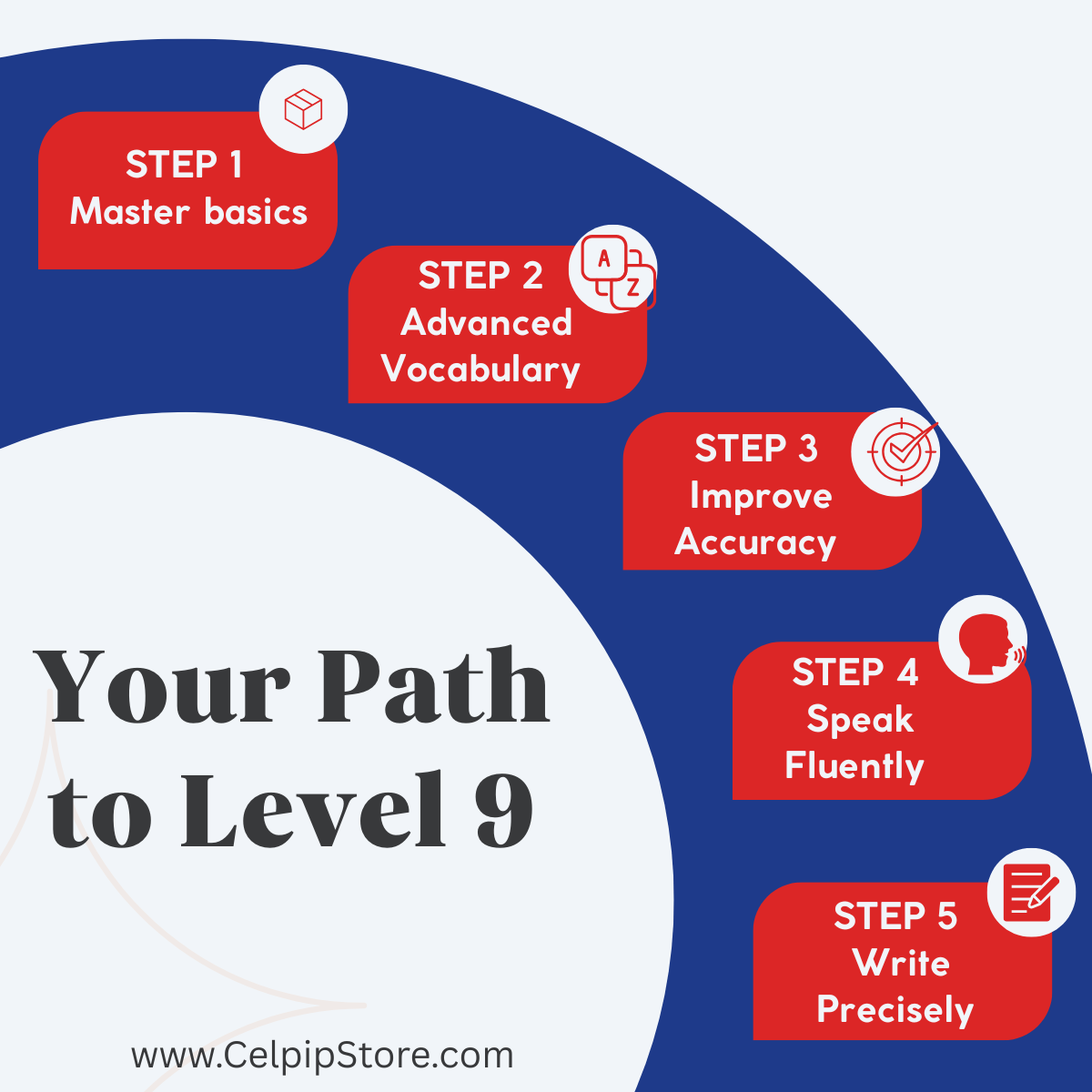
The Five Skills That Will Move You to Level 9
1. Master Precision in Every Response
At Level 8, your communication is already fluent.
To reach Level 9, focus on making every response:
-
More precise
-
More organized
-
More purposeful
Instead of adding unnecessary information, learn to express your ideas efficiently while maintaining clarity.
Professional communicators value precision over length.
2. Expand Your Communication Flexibility
Real conversations rarely follow a script.
Practice responding to:
-
Unexpected questions
-
Different opinions
-
Hypothetical situations
-
Problem-solving scenarios
-
Leadership discussions
Level 9 candidates adjust naturally without losing confidence.
3. Strengthen Critical Thinking
At higher CELPIP levels, strong communication is closely connected with strong thinking.
Instead of giving simple opinions, explore:
-
Causes
-
Consequences
-
Advantages
-
Disadvantages
-
Alternative solutions
-
Long-term effects
The more deeply you think, the stronger your communication becomes.
4. Build Richer Vocabulary Naturally
Avoid memorizing advanced words without context.
Instead,
read quality English every day.
Notice how experienced speakers naturally use expressions during interviews, presentations, and discussions.
The goal isn't to sound impressive.
The goal is to sound accurate.
5. Communicate Every Day
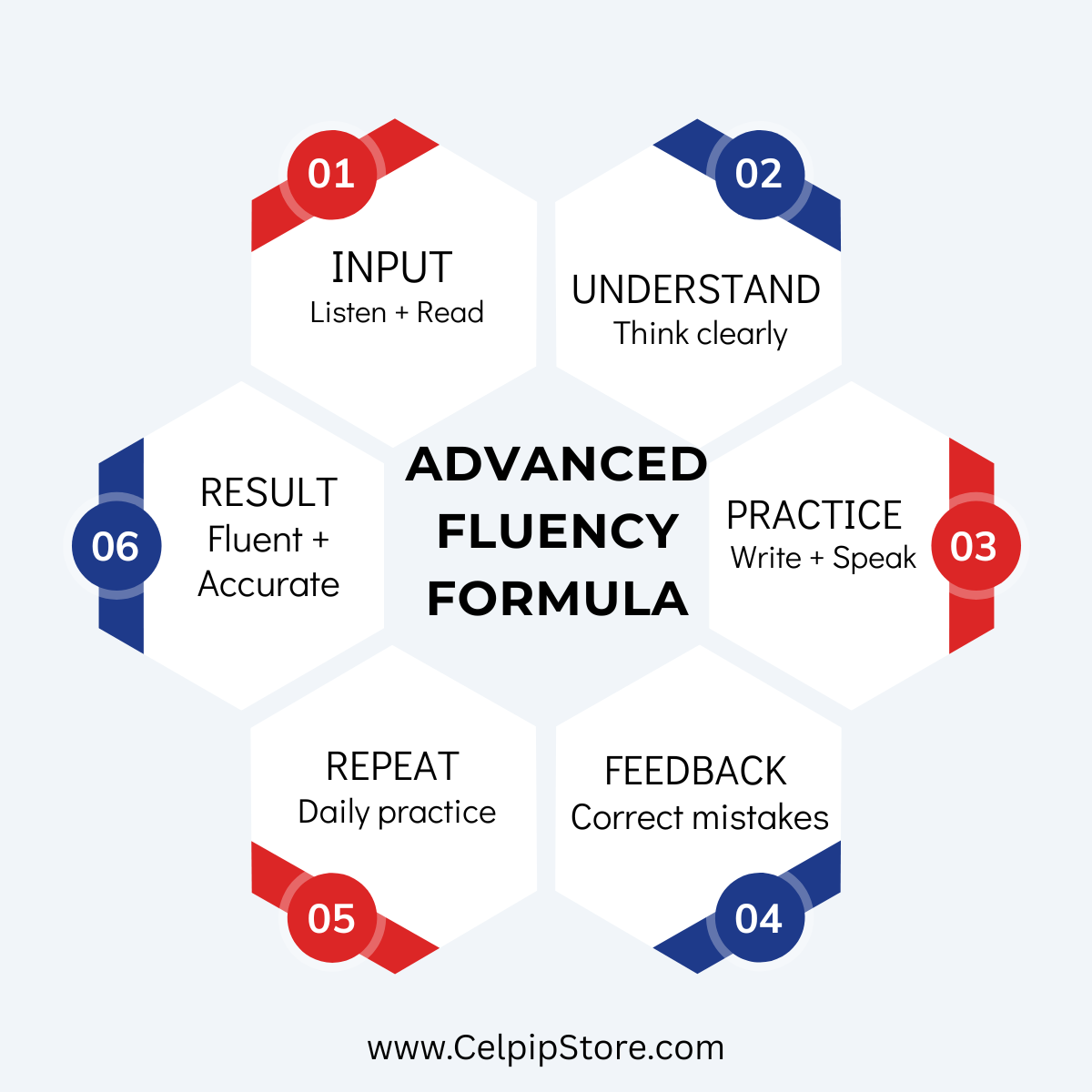
Advanced fluency develops through regular use.
Use English to:
-
Solve problems
-
Explain decisions
-
Discuss current events
-
Negotiate solutions
-
Tell stories
-
Ask thoughtful questions
Communication improves through communication.
A 7-Day Advanced Fluency Challenge
Monday — Listening
Watch a Canadian business panel discussion.
Summarize the main arguments and identify one opinion you disagree with.
Explain why.
Tuesday — Reading
Read an editorial article.
Identify:
-
The author's position
-
Supporting evidence
-
Opposing viewpoints
-
Final recommendation
Wednesday — Writing
Write a 350-word opinion response.
Support every argument with examples and explain possible counterarguments before reaching your conclusion.
Thursday — Speaking
Choose a challenging topic.
Speak continuously for four minutes.
After recording yourself, evaluate:
-
Organization
-
Fluency
-
Pronunciation
-
Vocabulary
-
Confidence
Friday — Vocabulary
Learn ten advanced expressions commonly used in professional communication.
Examples:
-
Facilitate
-
Comprehensive
-
Sustainable
-
Implement
-
Perspective
-
Collaborate
-
Evaluate
-
Efficient
-
Strategic
-
Innovation
Use each expression naturally in conversation.
Saturday — Full Mock Test
Complete a full CELPIP practice section under official exam conditions.
Review every mistake carefully.
Focus on patterns rather than isolated errors.
Sunday — Reflection
Ask yourself:
-
Which communication skill improved most?
-
Which situations still feel uncomfortable?
-
What habits helped me improve this week?
-
What should I focus on next?
Growth begins with reflection.
Common Mistakes That Keep Learners at Level 8
Many candidates stay at Level 8 because they unknowingly repeat the same communication habits.
Let's look at the most common ones.
Speaking Too Quickly
Fast speech doesn't equal fluent speech.
Instead,
Focus on:
-
Natural rhythm
-
Clear pronunciation
-
Thoughtful pacing
A calm speaker is often a more effective speaker.
Giving One-Sided Arguments
Advanced communicators acknowledge different viewpoints.
Instead of saying:
"Online education is better."
Try:
"Online education offers flexibility and convenience, although traditional classrooms still provide valuable face-to-face interaction and collaboration."
Balanced communication demonstrates maturity.
Using Advanced Words Incorrectly
Choosing the wrong advanced word is more damaging than using a simple, accurate one.
Precision always beats complexity.
Avoiding Challenging Conversations
If every practice topic feels easy,
You're no longer challenging yourself.
Practice discussing:
-
Leadership
-
Climate change
-
Healthcare
-
Economic development
-
Artificial intelligence
-
Cultural diversity
-
Public policy
Advanced communicators remain confident even when discussing unfamiliar subjects.
Ignoring Feedback
Many learners practice regularly but never review their performance.
Record yourself.
Read your writing again.
Identify repeated mistakes.
Correct them.
Improvement depends on feedback.
Self-Assessment Checklist
Before aiming for Level 9, ask yourself:
- Can I explain complex ideas naturally?
- Can I support every opinion with convincing examples?
- Can I communicate comfortably with professionals?
- Can I understand implied meaning during fast conversations?
- Can I adapt my communication style for different audiences?
- Can I discuss unfamiliar topics without losing confidence?
- Can I organize long responses logically?
If you answered "Yes" to most of these questions, you're already approaching Level 9.
Advanced Fluency Challenge
This week's challenge is designed to push your communication beyond everyday English.
Day 1
Explain a current news story in your own words.
Day 2
Describe a difficult workplace problem and propose three possible solutions.
Day 3
Write a formal recommendation email to a manager.
Day 4
Debate both sides of a controversial topic for four minutes.
Day 5
Learn ten advanced collocations instead of individual words.
Example:
-
Make a recommendation
-
Reach a conclusion
-
Achieve a balance
-
Address an issue
-
Meet expectations
Day 6
Complete one full Speaking section under timed conditions.
Day 7
Watch your recordings.
Identify:
-
Your strongest habit
-
Your weakest habit
-
One improvement goal for next week
Examiner's Insight
Candidates who achieve Level 9 don't simply answer questions they develop ideas, adapt to new situations, and communicate with confidence from beginning to end.
Examiners pay close attention to consistency. Strong vocabulary, logical organization, and natural fluency across every task are the qualities that distinguish advanced performers.
Motivation
Level 8 already demonstrates excellent English.
Level 9 is about refining that excellence.
Continue reading.
Continue listening.
Continue speaking.
Continue writing.
Most importantly,
continue communicating with real people in real situations.
Every discussion makes you more confident.
Every mistake teaches you something valuable.
Every practice session moves you closer to your goal.
Remember:
Fluency helps people understand you.
Precision helps people trust you.
Consistency helps you achieve Level 9.
Frequently Asked Questions About CELPIP Level 8
1. Is CELPIP Level 8 considered a high score?
Yes.
CELPIP Level 8 is considered an advanced English proficiency level. It demonstrates that you can communicate naturally and confidently in professional, academic, and everyday situations.
Candidates at this level can usually:
-
Understand complex conversations.
-
Express ideas clearly and logically.
-
Write well-developed responses.
-
Participate confidently in professional discussions.
-
Adapt their communication style to different audiences.
For many learners, Level 8 represents the point where English becomes a genuine professional strength rather than simply a language skill.
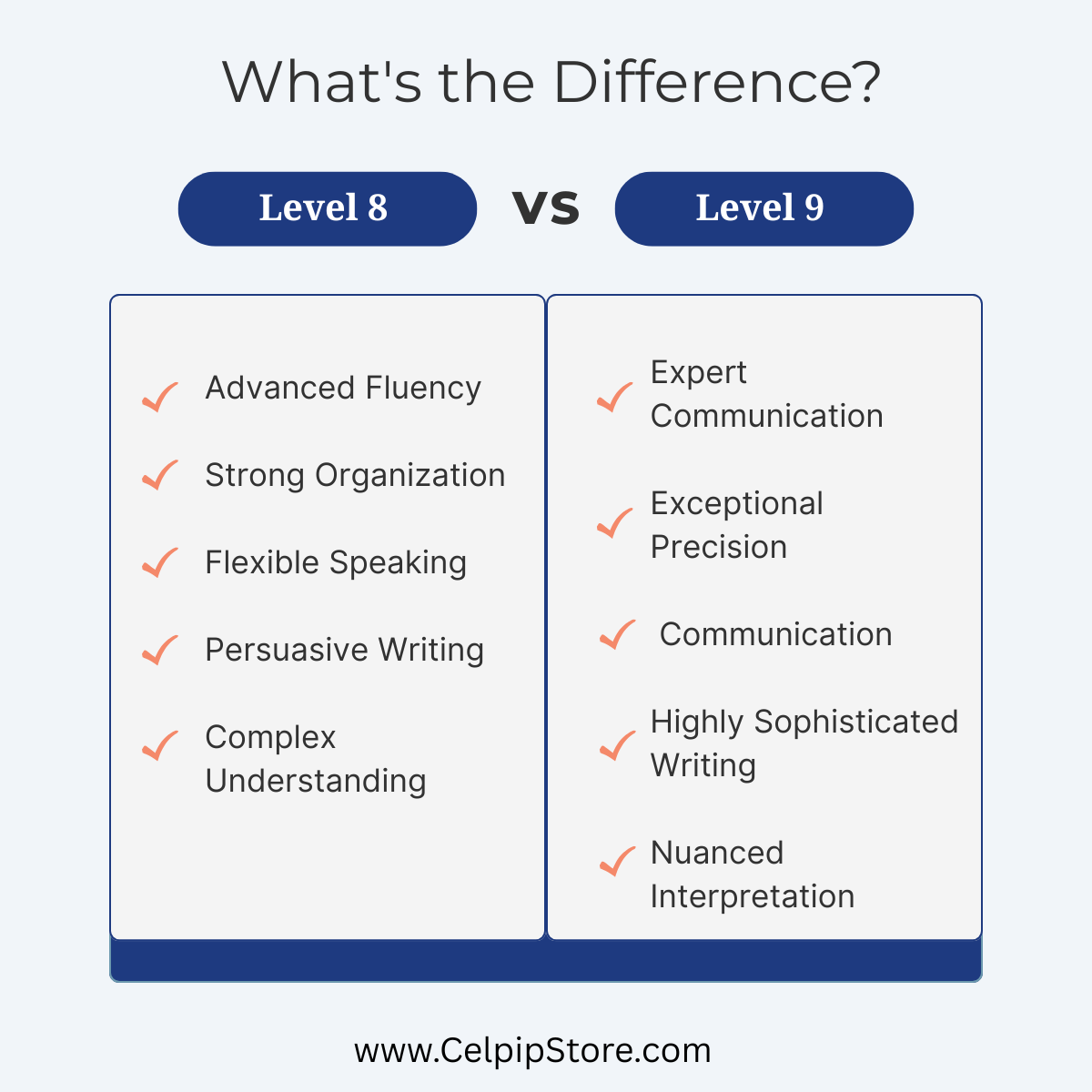
2. What is the biggest difference between Level 8 and Level 9?
The biggest difference is consistency and sophistication.
At Level 8, communication is fluent and effective.
At Level 9, communication becomes even more:
-
Precise
-
Adaptable
-
Persuasive
-
Consistent
-
And effortless
Level 9 communicators rarely struggle to organize ideas, even when discussing unfamiliar or complex topics.
3. Can I move from Level 8 to Level 9?
Absolutely.
Many candidates achieve Level 9 by improving:
-
Vocabulary precision
-
Communication flexibility
-
Pronunciation
-
Organization
-
And critical thinking
Rather than memorizing model answers, successful candidates develop the ability to communicate naturally in a variety of situations.
4. Which skill should I focus on first?
That depends on your current performance.
Most Level 8 learners benefit from improving:
-
Speaking fluency.
-
Writing development.
-
Listening for implied meaning.
-
Reading critical arguments.
Review your practice tests carefully to identify your weakest area before creating a study plan.
5. How long does it take to reach Level 9?
There is no universal timeline.
Progress depends on factors such as:
-
Daily English exposure
-
Quality of practice
-
Regular feedback
-
Confidence
-
And consistency
Candidates who actively use English at work or in everyday life often improve more quickly because they practice communication naturally.
6. Should I learn difficult vocabulary?
Not necessarily.
Examiners reward vocabulary that is:
-
Accurate
-
Appropriate
-
And natural
Using a simple word correctly is always better than using an advanced word incorrectly.
The goal is effective communication not showing off your vocabulary.
7. What is the best preparation strategy?
The strongest study plans combine all four language skills.
A balanced weekly routine should include:
-
Daily reading
-
Daily listening
-
Regular speaking practice
-
Weekly writing exercises
-
Timed mock tests
-
Careful review of mistakes
Consistency matters more than studying for long hours occasionally.
Examiner's Tip
Candidates at Level 8 should focus on making their communication sound natural rather than perfect.
Examiners value clear organization, logical development, appropriate vocabulary, and confident delivery. Small grammar mistakes are acceptable if they do not interfere with understanding.
Quick Recap
Before moving toward Level 9, remember these important lessons:
- CELPIP Level 8 represents advanced fluency.
- Communication should feel smooth, natural, and adaptable.
- Listening requires understanding tone, intention, and implied meaning.
- Reading involves evaluating arguments and evidence.
- Writing should be organized, persuasive, and well supported.
- Speaking should demonstrate confidence, flexibility, and clear reasoning.
- Daily practice is the most reliable path to continued improvement.
Final Thoughts
Achieving CELPIP Level 8 is an outstanding accomplishment because it demonstrates that you can communicate effectively in demanding professional, academic, and social environments.
At this level, you're capable of leading discussions, explaining complex ideas, analyzing information critically, and adapting your communication to different audiences with confidence. To move beyond Level 8, you should understand what higher levels require. Read CELPIP levels explained.
The journey toward Level 9 is not about becoming perfect.
It's about becoming more consistent.
Continue expanding your vocabulary.
Continue refining your pronunciation.
Continue challenging yourself with unfamiliar topics.
Most importantly, continue using English in real conversations.
Every meeting you participate in...
Every article you read...
Every presentation you deliver...
Every discussion you have...
Strengthens the advanced communication skills that Level 9 requires.
Language mastery is built one conversation at a time.
Continue Your CELPIP Journey
Ready for the next challenge?
Continue exploring our complete CELPIP learning series:
-
CELPIP Levels Explained (Complete Guide)
-
CELPIP Level 7 Explained
-
CELPIP Level 9 Explained
-
How CELPIP Is Scored
-
Best CELPIP Study Plan
-
CELPIP Listening Guide
-
CELPIP Reading Guide
-
CELPIP Writing Guide
-
CELPIP Speaking Guide
Each guide is designed to help you strengthen one step of your CELPIP journey.
About CELPIPStore
At CELPIPStore, we believe learning English should be practical, structured, and confidence-building.
That's why we create resources that go beyond exam preparation.
Our platform offers:
-
Comprehensive study guides
-
Full-length mock tests
-
Realistic practice questions
-
Speaking and Writing strategies
-
Vocabulary-building lessons
-
Exam-focused preparation plans
-
Practical communication tips for everyday and professional English
Whether you're preparing for Canadian permanent residency, citizenship, work, or higher education, CELPIPStore is here to support your success.
Call to Action
Ready to Reach CELPIP Level 9?
Take the next step in your CELPIP preparation with CELPIPStore.
Explore our advanced study guides, realistic practice tests, and expert learning resources designed to help you communicate with greater confidence and achieve your target score. Want to see where Level 8 stands among all levels? Read CELPIP levels explained.
Start preparing today and move one step closer to CELPIP Level 9.