CELPIP Speaking Task 6: Dealing with Difficult Situations
Master CELPIP Speaking Task 6
After learning how to compare and persuade in Task 5, you now move to one of the most practical and real-life communication skills handling difficult situations and complaints. This task reflects everyday scenarios such as dealing with customer issues, workplace problems, or misunderstandings.
Many students feel nervous in this task because they are unsure how to respond politely while also solving the problem. Some sound too direct, while others fail to provide a clear solution. The key to success is not perfect English it is politeness, clarity, empathy, and structure. Task 6 is one of the eight speaking tasks in the CELPIP Speaking test. To understand all eight tasks, their strategies, and how they work together, read our Ultimate CELPIP Speaking Guide.
What Is CELPIP Speaking Task 6?
In this task, you are given a situation where someone is unhappy or facing a problem, and you must respond appropriately. Your goal is to handle the situation professionally and calmly. Task 6 is only one part of the complete CELPIP Speaking Test. For an overview of all eight speaking tasks and strategies for each task, explore our complete CELPIP Speaking guide.
Task Requirements:
- Understand the problem
- Respond politely
- Show empathy
- Offer a solution
Time Structure:
- Preparation Time: 60 seconds
- Speaking Time: 60 seconds
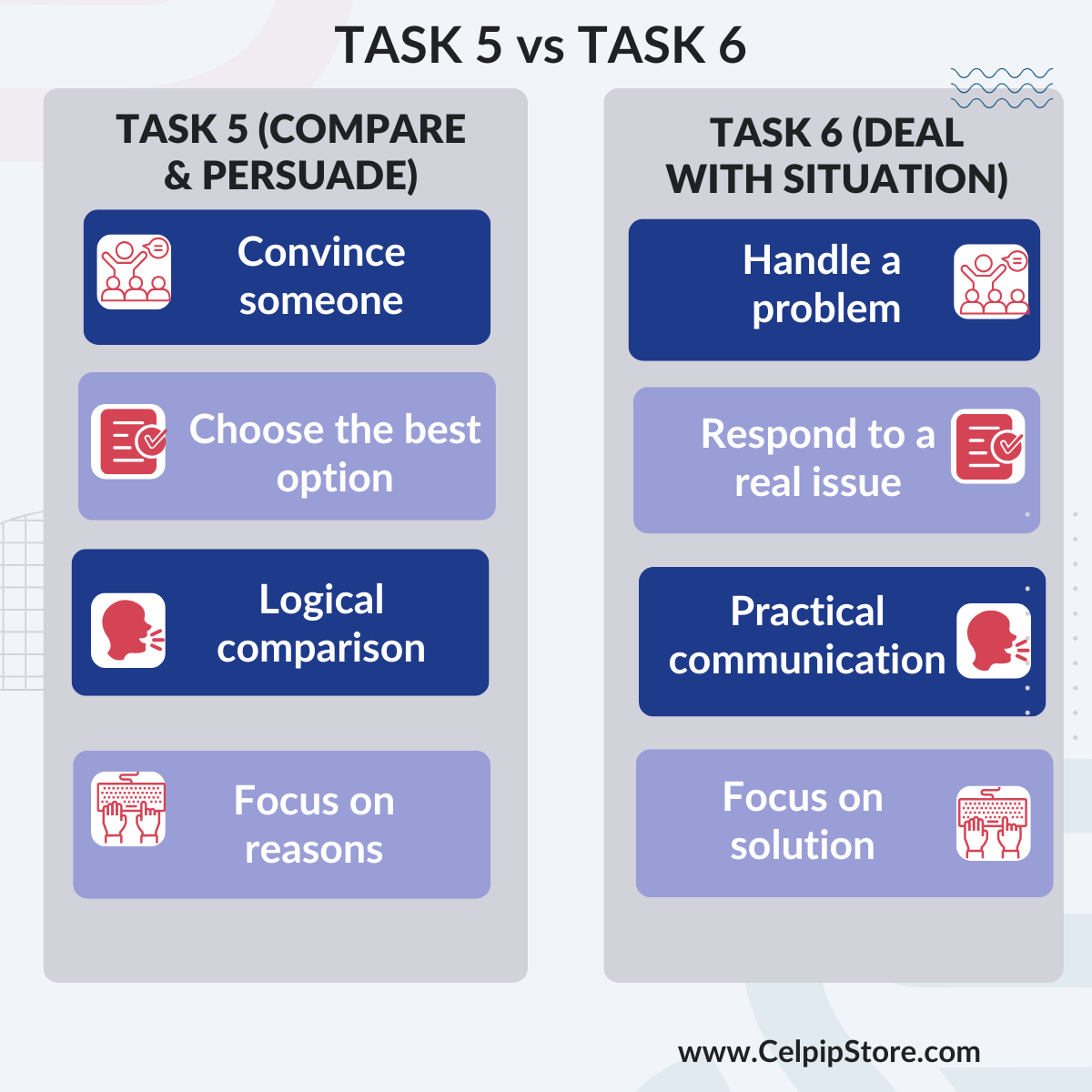
Task 5 vs Task 6 (Critical Difference)
Understanding this transition is important for your overall speaking improvement.
Key Shift:
- Task 5 - Compare and persuade
- Task 6 - Handle problems and respond professionally
You are moving from convincing-problem-solving. Understanding the difference between individual speaking tasks is important, but you should also understand the complete Speaking section. Learn about all eight tasks in our Ultimate CELPIP Speaking Guide.
What Examiners Want
Examiners are not expecting perfect solutions. They want to see whether you can handle a situation calmly, politely, and logically.
A High-Scoring Response Includes:
- Polite and respectful tone
- Clear understanding of the problem
- Empathy (show you understand feelings)
- Practical solution
- Organized response
Why Candidates Lose Marks
Many candidates lose marks because they misunderstand the purpose of this task. Instead of solving the problem, they either panic or give unclear responses.
Common Issues:
- Sounding rude or too direct
- Ignoring the problem
- No empathy
- No clear solution
- Disorganized response
This task tests your professional communication skills.
The Biggest Mistake
The most common mistake is being too direct or aggressive.
Example:
“This is not my fault. You should check properly next time.”
This sounds rude and unprofessional.
Better Approach:
“I understand your concern, and I’m really sorry for the inconvenience. Let me help you resolve this issue.”
Always stay calm, polite, and helpful.
Learning Objectives
By the end of this lesson, you will be able to:
- Respond to complaints politely
- Show empathy naturally
- Offer clear and practical solutions
- Use professional English expressions
- Speak confidently for 60 seconds
- Avoid common mistakes in Task 6
Why Task 6 Is a High-Scoring Opportunity
Task 6 allows you to demonstrate real-world communication skills that are highly valued in Canada. This includes professionalism, emotional intelligence, and problem-solving ability.
Key Advantage:
- You can use simple English
- You can follow a clear structure
- You can show strong communication skills
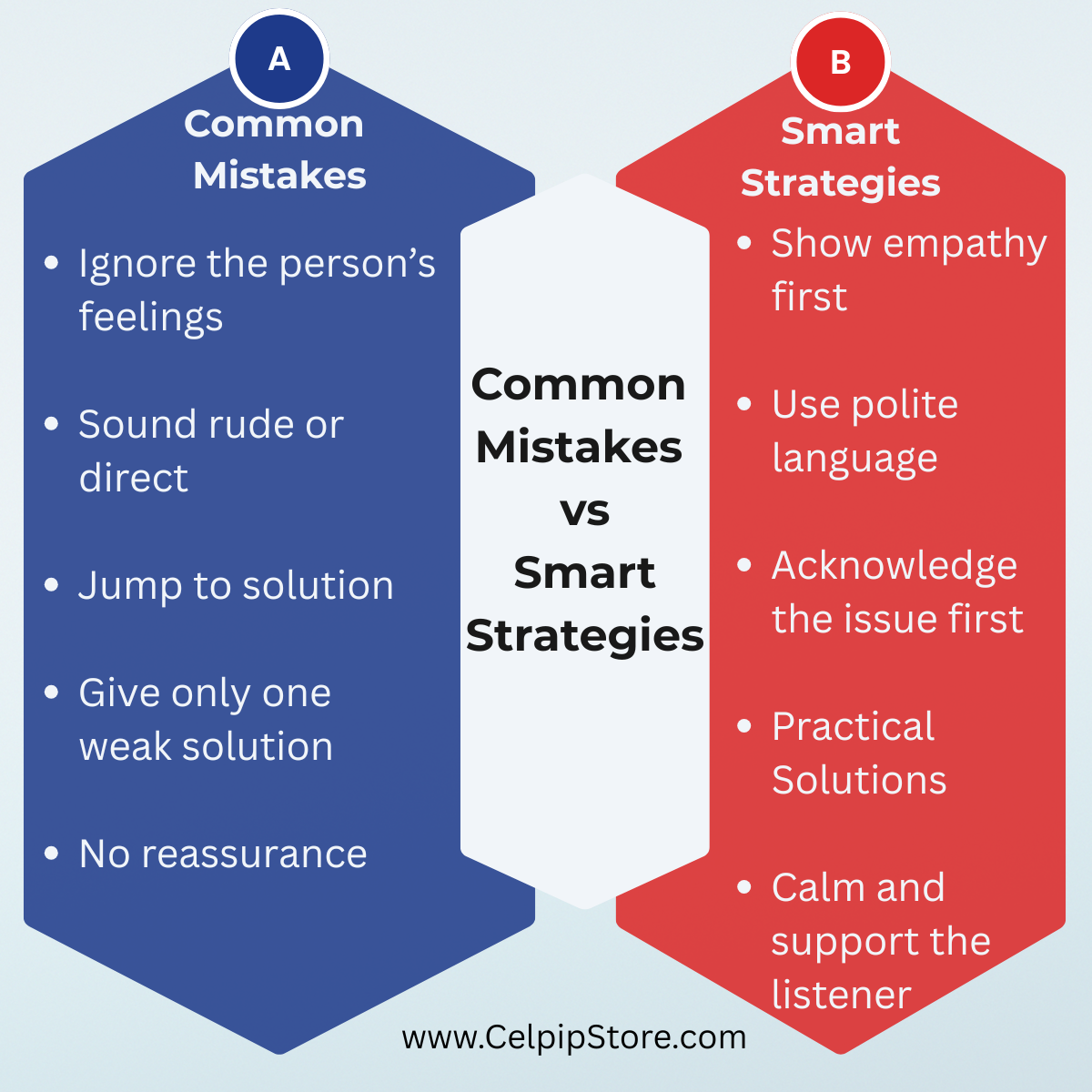
Common Mistakes in Task 6
Understanding these mistakes will help you improve quickly.
Mistake 1: No Empathy
Some candidates jump directly to solutions without acknowledging the problem.
- Weak: “You can do this to fix it.”
- No emotional understanding
Mistake 2: Being Rude or Direct
- Tone matters more than vocabulary.
- Avoid blaming language
Mistake 3: No Clear Solution
- Just saying “I will help” is not enough.
- Always give a practical step
Mistake 4: Overcomplicating the Answer
- Trying to sound too advanced can create confusion.
- Keep your language simple and clear
Mistake 5: Poor Structure
- Jumping between ideas reduces clarity.
- Use a clear framework (coming in Part 2)
Mistake 6: Speaking Too Little
- Ending early lowers your fluency score.
- Always speak for the full
Avoiding mistakes in Task 6 is important, but a strong CELPIP Speaking score requires preparation across all eight tasks. Explore our complete CELPIP Speaking guide for task-by-task strategies and tips.
The CELPIPStore Response Framework
Now that you understand the purpose of Task 6, the next step is learning how to structure your response clearly and professionally. In this task, your tone and organization are just as important as your ideas. A structured response helps you stay calm, sound polite, and deliver a complete answer within 60 seconds.
The CELPIPStore Response Framework is a simple and effective method that ensures you respond logically, respectfully, and confidently.
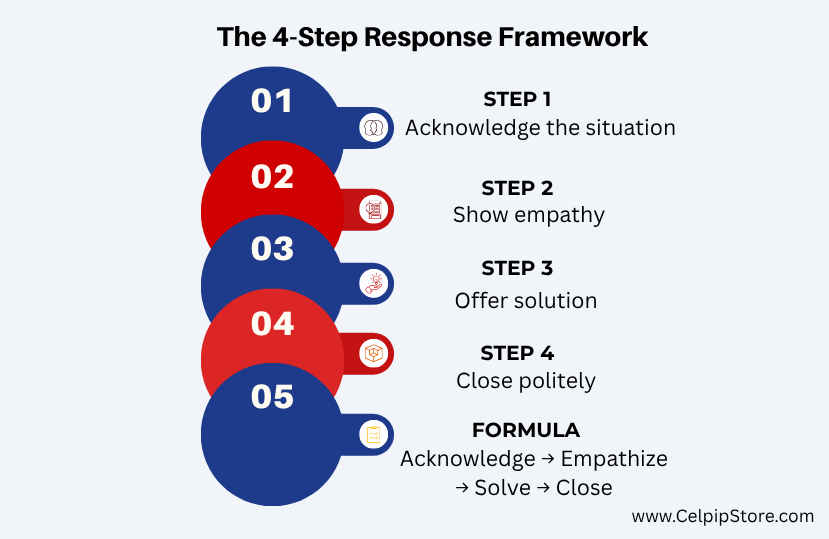
The 4-Step Response Structure
A high-scoring response follows a natural flow: acknowledge the problem, show empathy, provide a solution, and end politely.
Step 1: Acknowledge the Problem
Start by showing that you understand the situation. This builds trust and shows active listening.
Example:
“I understand that you are facing an issue with your order.”
Step 2: Show Empathy
This is the most important step. You must show that you care about the person’s feelings.
Example:
“I’m really sorry for the inconvenience this has caused you.”
Step 3: Offer a Solution
Now provide a clear and practical solution. This is where you solve the problem.
Example:
“I will check the issue immediately and arrange a replacement for you as soon as possible.”
Step 4: Close Politely
End your response in a positive and professional way.
Example:
“Thank you for your patience, and please let me know if you need any further assistance.”
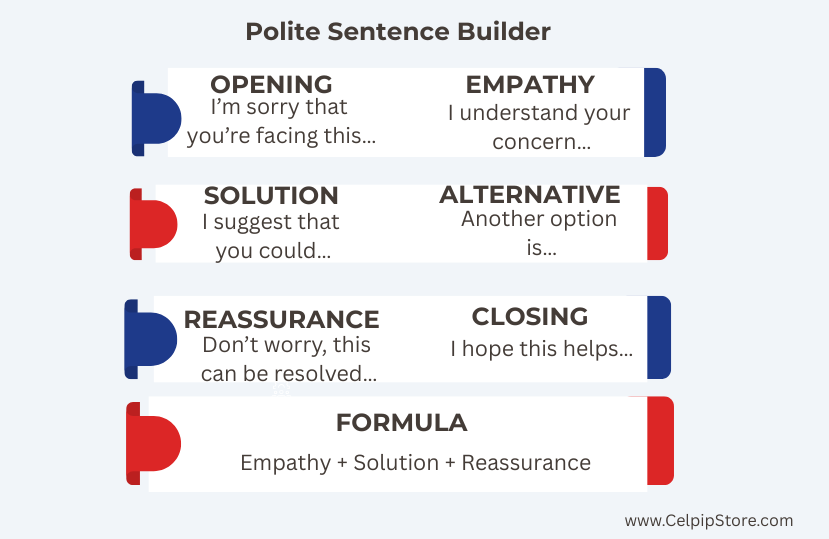
Simple Speaking Template
To make your response easier, use this flexible template.
Template:
- I understand that…
- I’m really sorry for…
- Let me help you by…
- I will make sure that…
- Thank you for your patience
This template helps you stay calm and structured.
High-Scoring Example Answer
Let’s apply the framework to a real scenario.
Example Scenario
A customer received the wrong product and is unhappy.
Sample Answer
“I understand that you received the wrong product, and I’m really sorry for the inconvenience this has caused. Let me help you resolve this issue as quickly as possible. I will check your order details right away and arrange for the correct item to be delivered to you. In addition, I will make sure that the incorrect product is picked up from your location. Thank you for your patience, and please let me know if there is anything else I can assist you with.”
Why This Answer Works
This response is effective because it is polite, structured, and solution-focused. The speaker acknowledges the problem, shows empathy, offers a clear solution, and ends professionally.
Strengths:
- Polite tone
- Clear structure
- Practical solution
- Professional closing
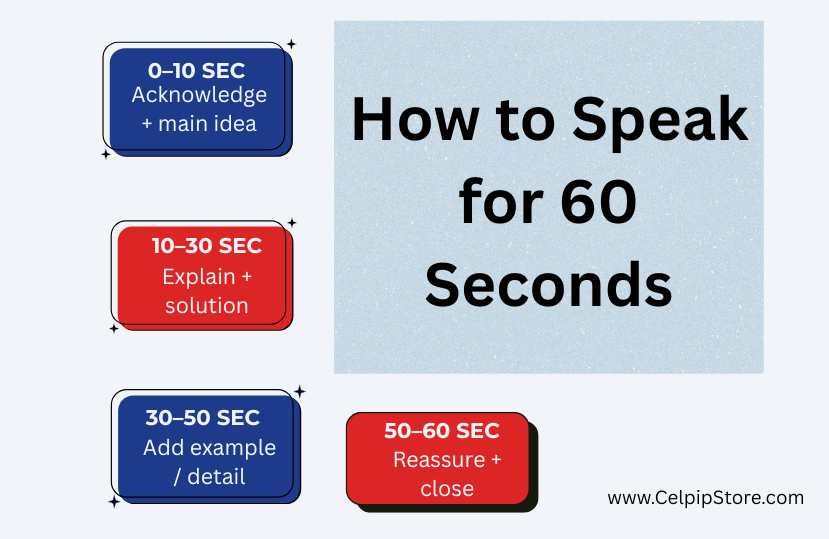
Strategy to Speak for 60 Seconds
Many candidates struggle to continue speaking. The key is to expand your response naturally without repeating ideas.
Practical Strategy
- Acknowledge clearly
- Add empathy
- Give a detailed solution
- Add an extra supportive action
- Close politely
Useful Linking Words
- first
- also
- in addition
- as soon as possible
- for this reason
These help maintain flow and clarity.
Advanced Tips to Achieve a High Score
Once you understand the structure of Task 6, the next step is to improve how you deliver your response. High-scoring candidates do not just solve the problem they sound calm, professional, and empathetic. Your tone plays a major role in this task.
To achieve a high score, focus on politeness, clarity, and confidence, rather than using complex vocabulary.
Key Advanced Strategies
These strategies will help you sound more natural and professional.
1. Use Polite and Soft Language
In difficult situations, your tone should always be respectful and calm. Avoid direct or harsh statements.
Use:
- I understand your concern
- I’m really sorry for the inconvenience
- Let me help you with this
Example:
“I completely understand your concern, and I’m really sorry for the inconvenience caused.”
2. Show Empathy Before Solutions
Do not jump directly to solving the problem. First, show that you understand the person’s feelings.
Structure:
- Acknowledge ? Empathy ? Solution
Example:
“I understand your issue, and I’m sorry for the inconvenience. Let me help you resolve it.”
3. Offer Practical and Clear Solutions
Your solution should be simple, realistic, and easy to understand.
Focus on:
- Immediate action
- Clear steps
- Helpful support
Example:
“I will check your request immediately and arrange a solution as soon as possible.”
4. Maintain a Calm and Professional Tone
Even if the situation is serious, your response should remain calm and controlled.
Tips:
- Speak slowly and clearly
- Avoid emotional or negative words
- Stay positive and helpful
5. Extend Your Answer Naturally
To reach 60 seconds, add small supporting details without repeating yourself.
You can add:
- Additional actions
- Reassurance
- Follow-up support
Example:
“In addition, I will make sure this issue does not happen again in the future.”
Examiner Insights: What Really Matters
Understanding how your answer is evaluated helps you focus on the right areas.
What Examiners Evaluate
1. Content
- Did you understand the problem clearly?
- Did you provide a useful solution?
2. Coherence
- Is your response organized?
- Do your ideas flow logically?
3. Vocabulary
- Do you use polite and professional expressions?
- Are your words appropriate for the situation?
4. Grammar
- Are your sentences clear and mostly correct?
- Do you avoid major errors?
5. Fluency
- Do you speak smoothly for 60 seconds?
- Do you avoid long pauses?
These evaluation areas are important throughout the CELPIP Speaking section, not only in Task 6. Learn how to approach all eight speaking tasks in our Ultimate CELPIP Speaking Guide.
What Examiners Do NOT Care About
Many students focus on the wrong things.
Examiners do NOT expect:
- Perfect grammar
- Complex vocabulary
- Advanced technical language
They care about effective communication and professionalism.
High-Impact Vocabulary for Difficult Situations
Using the right language improves your tone and clarity.
Empathy Expressions
- I understand your concern
- I’m really sorry for the inconvenience
- I completely understand how you feel
Solution Language
- Let me help you
- I will resolve this
- I will make sure that
Reassurance Language
- I will take care of this
- This will be handled quickly
- You don’t need to worry
Polite Closings
- Thank you for your patience
- I appreciate your understanding
- Please let me know if you need further help
Example Combination
“I understand your concern, and I’m really sorry for the inconvenience. I will take care of this issue immediately and make sure it is resolved as soon as possible.”
From Average to High-Scoring Answer
Let’s compare two responses.
Average Answer
“You should check again. I will try to fix it.”
Problems:
- No empathy
- Too direct
- Weak solution
- Not professional
High-Scoring Answer
“I understand your concern, and I’m really sorry for the inconvenience caused. Let me help you resolve this issue as quickly as possible. I will check the details and ensure that the problem is fixed immediately. Thank you for your patience.”
Strengths:
- Polite tone
- Clear structure
- Strong solution
- Professional closing
Practice Questions
Practise with real-life situations to improve your confidence.
Practice Scenario 1
A customer complains about late delivery.
Think About:
- Apology
- Reason
- Solution
Practice Scenario 2
A colleague is upset about extra work.
Think About:
- Understanding feelings
- Offering help
- Suggesting a solution
Practice Scenario 3
A friend is unhappy with a service.
Think About:
- Listening
- Reassurance
- Next steps
Summary
CELPIP Speaking Task 6 tests your ability to handle difficult situations in a calm, polite, and professional manner. A strong response is not about giving a perfect solution it is about showing empathy, understanding the problem, and offering a clear and practical response. By following a simple structure acknowledge, empathize, solve, and close you can communicate effectively and confidently within 60 seconds. With the right tone and organization, this task becomes a powerful scoring opportunity.
Task 6 Quick Checklist
Use this checklist during your exam to stay focused and organized.
During Preparation Time:
- Understand the problem clearly
- Think about the person’s feelings
- Plan a simple solution
During Speaking:
- Acknowledge the issue
- Show empathy politely
- Provide a clear solution
- Add extra support if needed
- Close professionally
- Speak for the full 60 seconds
Language Focus:
- Use polite expressions (I understand, I’m sorry)
- Use solution language (I will help, I will resolve)
- Use connectors (also, in addition, as soon as possible)
- Avoid direct or rude phrases
Frequently Asked Questions (FAQs)
1. What is CELPIP Speaking Task 6?
It is a task where you respond to a complaint or difficult situation politely and professionally.
2. What is the most important skill in Task 6?
Empathy and politeness are the most important.
3. Do I need to solve the problem perfectly?
No, you just need to provide a logical and helpful solution.
4. How long should I speak?
You should speak for the full 60 seconds.
5. What language should I use?
Use polite, calm, and professional language.
6. What are common mistakes?
Common mistakes include being rude, not showing empathy, and giving unclear solutions.
7. Can I use simple English?
Yes, simple and clear English is better than complex language.
8. How can I improve quickly?
Practice regularly, use a clear structure, and record your responses.
7-Day Practice Plan
Consistent practice will help you improve your confidence and fluency.
Day 1–2:
- Understand the task format
- Practise identifying problems and solutions
Day 3–4:
- Use the response framework
- Focus on empathy and politeness
Day 5:
- Practise speaking for full 60 seconds
- Record and review your responses
Day 6:
- Improve vocabulary for polite communication
- Practise using connectors and transitions
Day 7:
- Take a full speaking practice test
- Evaluate your performance
Final Tips for Success
To succeed in Task 6, focus on being calm, polite, and helpful. Do not rush or panic when you hear a complaint. Instead, take a moment to understand the situation, respond with empathy, and provide a clear solution. Keep your tone professional and your language simple. Confidence and clarity are more important than perfection. With regular practice, you can handle this task smoothly and effectively.
Conclusion
CELPIP Speaking Task 6 is not just an exam task it is a real-life skill. By learning how to respond to difficult situations professionally, you are improving your communication skills for both work and daily life. With the right strategy and mindset, this task can become one of your strongest scoring areas.