.png)
CELPIP Level 7 Explained: Meaning, Skills and How to Reach Level 8
Achieving CELPIP Level 7 is a significant accomplishment that reflects your ability to communicate effectively in both everyday and professional environments. At this stage, English is no longer simply a language you understand it is a language you can confidently use to solve problems, participate in discussions, and express ideas with clarity.
Many employers, educational institutions, and immigration pathways recognize Level 7 as evidence of strong practical English skills. While occasional mistakes may still occur, they rarely interfere with communication.
If you've recently achieved Level 7, you might be asking yourself:
-
Is Level 7 considered a strong CELPIP score?
-
What communication skills should I already have?
-
How is Level 7 different from Level 6?
-
What do I need to improve to reach Level 8?
The answer lies in one important concept:
Professional communication.
At Level 7, you're expected to communicate confidently in situations that require more than basic conversation. You should be able to explain ideas logically, participate in workplace discussions, understand detailed written information, and adapt your communication to different audiences.
Reaching Level 8 isn't about making fewer grammar mistakes alone. It's about communicating with greater precision, flexibility, and fluency across a wider variety of situations. CELPIP Level 7 is part of a broader scoring system that ranges from Level 1 to 12. To understand how it compares with other levels, read CELPIP levels explained.
In this guide, you'll learn exactly what CELPIP Level 7 means, how each language skill is assessed, common challenges candidates face, and the practical habits that will help you move confidently toward Level 8.
What Does CELPIP Level 7 Mean?
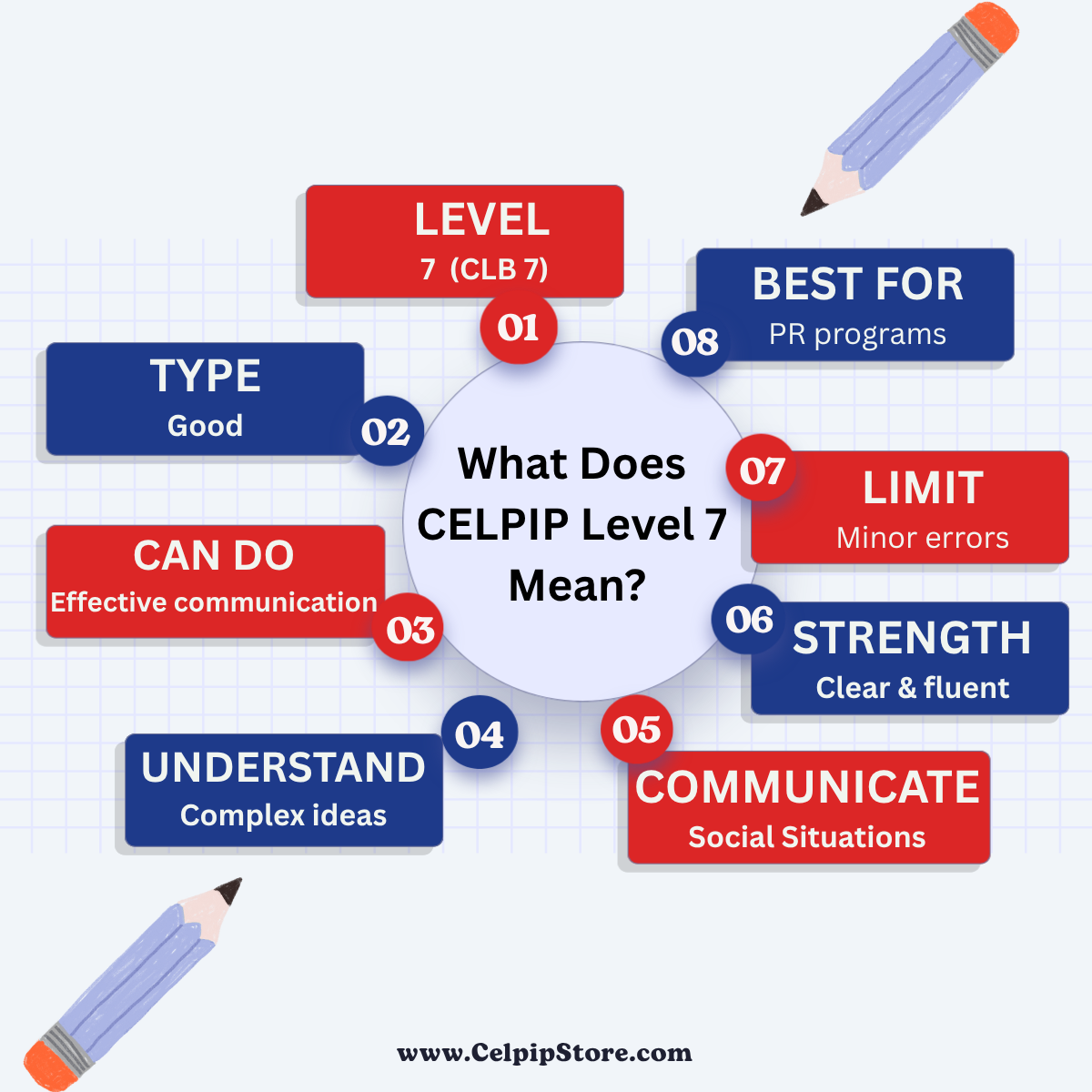
CELPIP Level 7 indicates that you can communicate effectively in professional, academic, and everyday situations. You can understand detailed conversations, organize your thoughts clearly, support your opinions with relevant examples, and adjust your language depending on the audience and purpose.
Compared with Level 6, Level 7 learners typically demonstrate:
-
Stronger fluency during extended conversations
-
More precise vocabulary choices
-
Better organization in writing
-
Improved understanding of implied meaning
-
Greater confidence discussing unfamiliar topics
-
More flexibility when responding to unexpected questions
Rather than simply participating in conversations, you're able to contribute meaningful ideas and maintain communication even when topics become more complex. Since CELPIP scores directly correspond to CLB levels, it’s helpful to understand the full range of levels. You can explore this in this complete levels guide.
Level 6 vs Level 7
|
Skill |
Level 6 |
Level 7 |
|
Listening |
Understands most everyday conversations |
Understands detailed and professional discussions |
|
Reading |
Reads confidently |
Interprets more complex texts and viewpoints |
|
Writing |
Organized responses |
Well-developed, persuasive communication |
|
Speaking |
Independent communication |
Flexible, professional communication |
The defining characteristic of Level 7 is your ability to communicate effectively in situations that require greater accuracy, organization, and adaptability.
Who Usually Achieves CELPIP Level 7?
Many Level 7 candidates include:
-
Skilled professionals working in English-speaking environments
-
Candidates preparing for Canadian immigration
-
International graduates entering the workforce
-
Business professionals communicating with colleagues and clients
-
Learners who actively use English in daily life
These learners are generally comfortable participating in meetings, explaining ideas, asking follow-up questions, and adapting their communication style depending on the situation.
What Can You Do at CELPIP Level 7?
At this level, you can typically:
-
Participate confidently in professional meetings
-
Understand detailed workplace instructions
-
Read reports, articles, and official documents with good comprehension
-
Write organized emails, reports, and opinion responses
-
Explain complex ideas using examples and logical reasoning
-
Respond naturally to follow-up questions
-
Communicate effectively with both native and non-native English speakers
Although advanced vocabulary and highly specialized topics may still require additional learning, you can usually communicate successfully without losing clarity.
Real-Life Example
Imagine your manager asks:
"How could our team improve communication with clients during busy periods?"
A Level 7 response might be:
"I think we should establish a standard communication schedule so clients receive regular updates, even when projects are delayed. This would help manage expectations, improve transparency, and strengthen client trust over the long term."
This answer demonstrates:
-
A clear recommendation
-
Logical reasoning
-
Supporting benefits
- Natural communication
-
Professional vocabulary
Why Level 7 Matters
For many candidates, Level 7 is the point where English becomes a professional asset rather than simply a communication tool.
You can contribute ideas, solve problems collaboratively, and communicate effectively in situations that involve planning, decision-making, and teamwork. Whether Level 7 is enough depends on your goals. Compare it with lower and higher levels in CELPIP levels explained.
This level prepares you for higher academic expectations, workplace responsibilities, and more advanced communication challenges.
Understanding the Four Language Skills at CELPIP Level 7
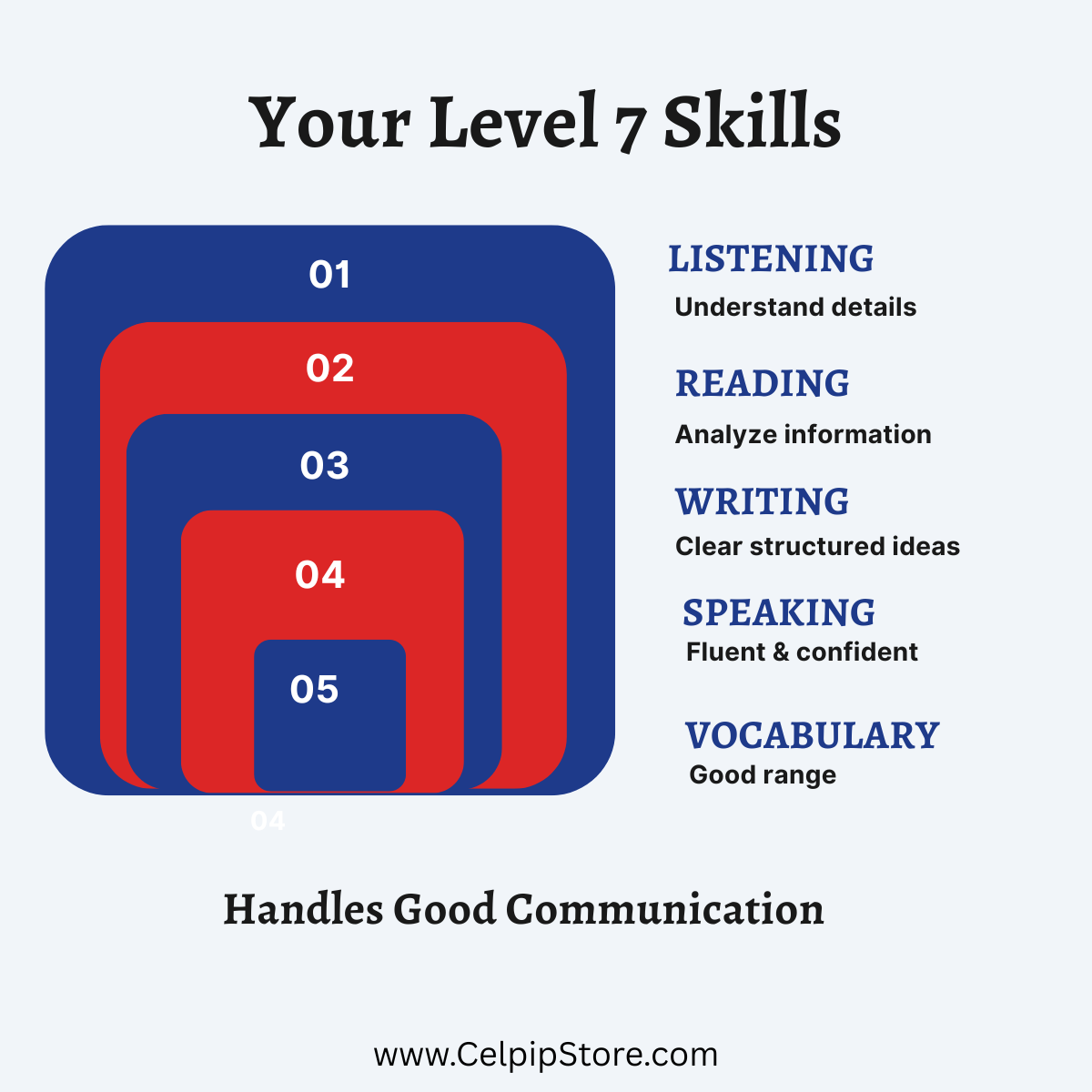
At CELPIP Level 7, your English skills are expected to support communication in professional, academic, and community settings. You should be able to understand detailed information, organize ideas logically, and communicate with confidence even when conversations become more challenging.
Compared with Level 6, you're expected to demonstrate greater flexibility, richer vocabulary, and more polished communication.
Let's explore what this means for each of the four CELPIP language skills.
Listening Skills at CELPIP Level 7
At Level 7, you can understand longer conversations spoken at a natural speed, including discussions that involve opinions, explanations, recommendations, and problem-solving.
You can usually:
-
Follow workplace meetings
-
Understand interviews and presentations
-
Recognize the speaker's attitude and intention
-
Identify both explicit and implied information
-
Follow conversations involving multiple speakers
Although you may occasionally encounter unfamiliar expressions or specialized vocabulary, you can usually understand the overall meaning from context.
Real-Life Example
Imagine you're attending a project meeting.
The team leader says:
"Although the project is progressing well, we'll need to adjust the timeline slightly because several suppliers have requested additional delivery time. I'd also like everyone to review the updated schedule before Friday's client meeting."
A Level 7 learner can usually identify:
-
The project's current status
-
The reason for the delay
-
The required action
-
The upcoming deadline
-
The overall priority
Instead of translating individual words, you understand the message and its implications.
How to Improve Listening
To progress toward Level 8:
-
Listen to Canadian news every day
-
Watch interviews without subtitles
-
Focus on identifying implied meaning
-
Practice summarizing conversations
-
Listen to different Canadian speakers and accents
Reading Skills at CELPIP Level 7
Reading at Level 7 requires more than understanding information.
You should also understand:
-
The writer's purpose
-
Tone
-
Supporting arguments
-
Relationships between ideas
-
Conclusions and recommendations
You can confidently read:
-
Workplace reports
-
Business emails
-
Government publications
-
News articles
-
Opinion pieces
-
Community announcements
-
Professional correspondence
You are expected to identify both facts and opinions while understanding how the writer develops their ideas.
Example
Imagine you're reading an article about flexible work arrangements.
A Level 7 reader should be able to identify:
-
The author's main argument
-
Supporting evidence
-
Counterarguments
-
Final conclusion
-
Overall tone
This deeper level of analysis becomes increasingly important at higher CELPIP levels.
How to Improve Reading
Practice reading materials that require critical thinking.
Examples include:
-
Canadian newspapers
-
Business magazines
-
Government reports
-
Professional blogs
-
Editorial articles
After reading, ask yourself:
-
What is the author's purpose?
-
Which arguments are strongest?
-
Do I agree with the conclusion?
These questions improve both Reading and Writing.
Writing Skills at CELPIP Level 7
Writing at Level 7 should be organized, persuasive, and well developed.
Your responses should include:
-
Clear introductions
-
Logical paragraphs
-
Strong transitions
-
Supporting examples
-
Effective conclusions
Grammar mistakes may still occur, but they should rarely interfere with understanding.
More importantly, your ideas should flow naturally from one paragraph to the next.
Example
Instead of writing:
"Working from home is good because people save time."
A stronger Level 7 response might be:
"Working from home offers several significant advantages. Employees save commuting time, often experience greater flexibility, and may achieve a better work-life balance. However, organizations should also ensure that remote workers receive adequate communication and support to remain productive."
Notice how this response:
-
Presents multiple ideas
-
Acknowledges another perspective
-
Uses professional vocabulary
-
Demonstrates balanced thinking
These are characteristics of stronger Writing responses.
How to Improve Writing
Develop the habit of:
-
Writing 250–300 word responses
-
Supporting every opinion with examples
-
Using varied transition words
-
Editing your work before finishing
-
Reading high-quality English articles to improve sentence structure
Remember:
Professional writing values clarity more than complicated vocabulary.
Speaking Skills at CELPIP Level 7
Speaking becomes noticeably more flexible at Level 7.
You should be able to:
-
Explain complex ideas
-
Participate actively in discussions
-
Express opinions confidently
-
Respond naturally to follow-up questions
-
Adapt your language depending on your audience
For example, you would naturally communicate differently when speaking with:
-
A friend
-
A customer
-
A manager
-
A government officer
This ability to adjust your communication style is an important feature of professional English.
Example
Question:
"Describe a challenge you faced at work and how you solved it."
A Level 7 response might be:
"Last year, our team experienced delays because several projects were scheduled at the same time. I suggested creating a shared project tracker so everyone could monitor deadlines and responsibilities more easily. As a result, communication improved, tasks were completed more efficiently, and the team was able to meet all of our client deadlines."
This response demonstrates:
-
Logical organization
-
Professional vocabulary
-
Clear sequence of events
-
Reflection on the outcome
How to Improve Speaking
To reach Level 8:
-
Speak about unfamiliar topics
-
Record longer responses
-
Practice explaining opinions from different perspectives
-
Focus on pronunciation, stress, and intonation
-
Replace repetitive words with more precise vocabulary
Remember:
Professional communication isn't about sounding like a native speaker.
It's about communicating clearly, confidently, and effectively.
The Biggest Difference Between Level 6 and Level 7
The defining difference is professional communication.
At Level 6, you're comfortable communicating independently in most everyday situations.
At Level 7, you can also communicate effectively in situations that require:
-
Problem-solving
-
Decision-making
-
Collaboration
-
Negotiation
-
Detailed explanations
Instead of simply answering questions, you contribute meaningful ideas, justify your opinions, and adapt your communication based on the context.
Did You Know?
Many Level 7 learners naturally begin using English in professional environments writing emails, participating in meetings, giving presentations, and solving workplace problems. This regular use helps strengthen fluency and confidence far more effectively than memorizing grammar rules alone.
Common Challenges at Level 7
Even strong communicators face areas for improvement.
Using Precise Vocabulary
Candidates often rely on familiar words instead of choosing the most accurate expression.
Explaining Complex Ideas
Some learners understand difficult topics but struggle to explain them in a structured and convincing way.
Maintaining Fluency During Longer Responses
Longer Speaking tasks require sustained organization and confidence without unnecessary repetition.
Understanding Implied Meaning
Professional discussions often include indirect suggestions, subtle opinions, or implied concerns rather than direct statements.
Recognizing these nuances is essential at higher levels.
Writing Balanced Arguments
Many candidates present only one viewpoint.
Level 7 responses become stronger when they acknowledge alternative perspectives before reaching a conclusion.
Expert Tip
When answering Speaking or Writing questions, use this simple structure:
Opinion -> Reason -> Example -> Result
Example:
-
State your opinion
-
Explain why
-
Give a real-life example
-
Describe the outcome or benefit
This structure produces responses that are organized, persuasive, and easy for examiners to follow.
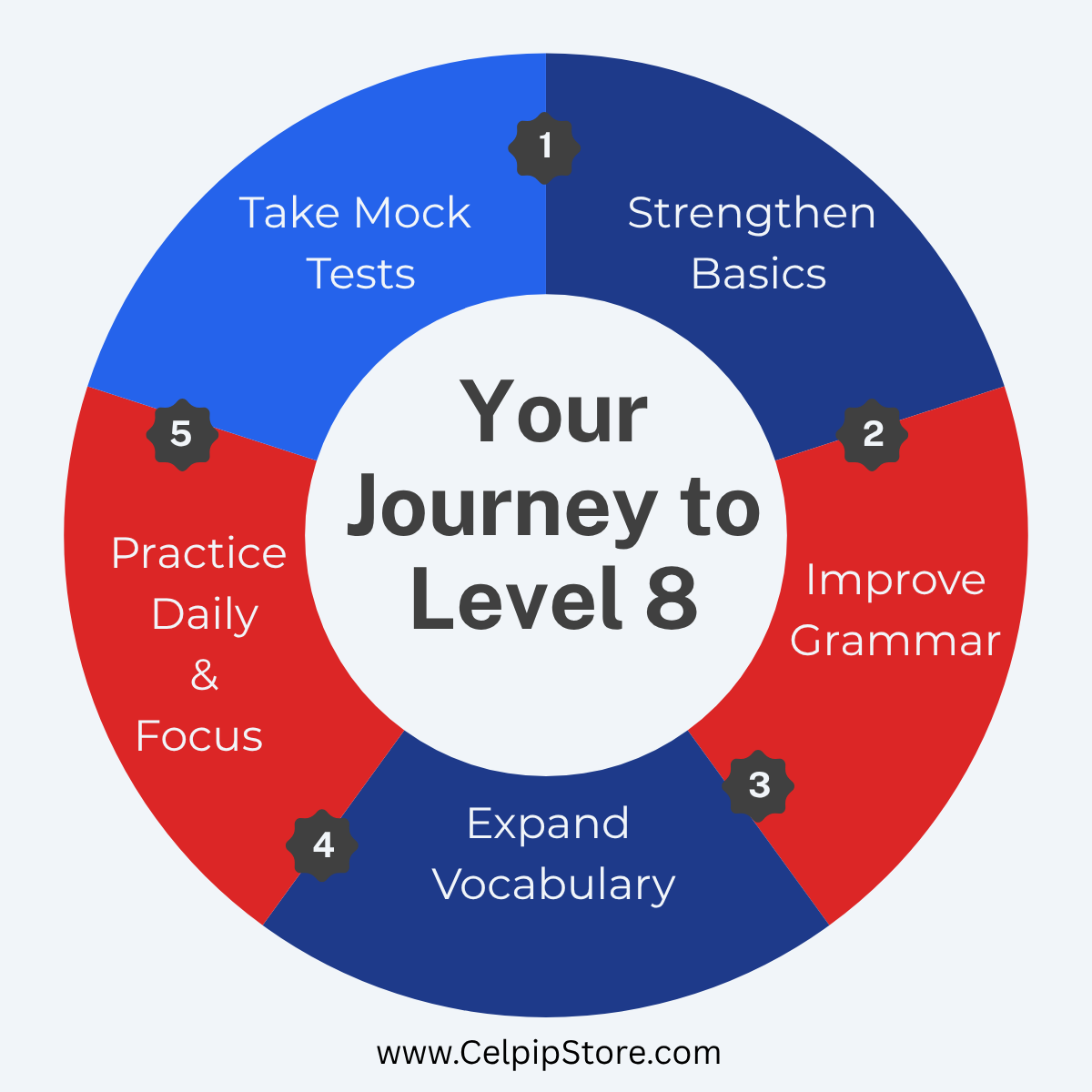
How to Progress from CELPIP Level 7 to Level 8
Achieving CELPIP Level 7 proves that you're a capable English communicator in both professional and everyday situations. You can express your ideas clearly, understand detailed conversations, and communicate confidently in the workplace.
But progressing to Level 8 requires another shift.
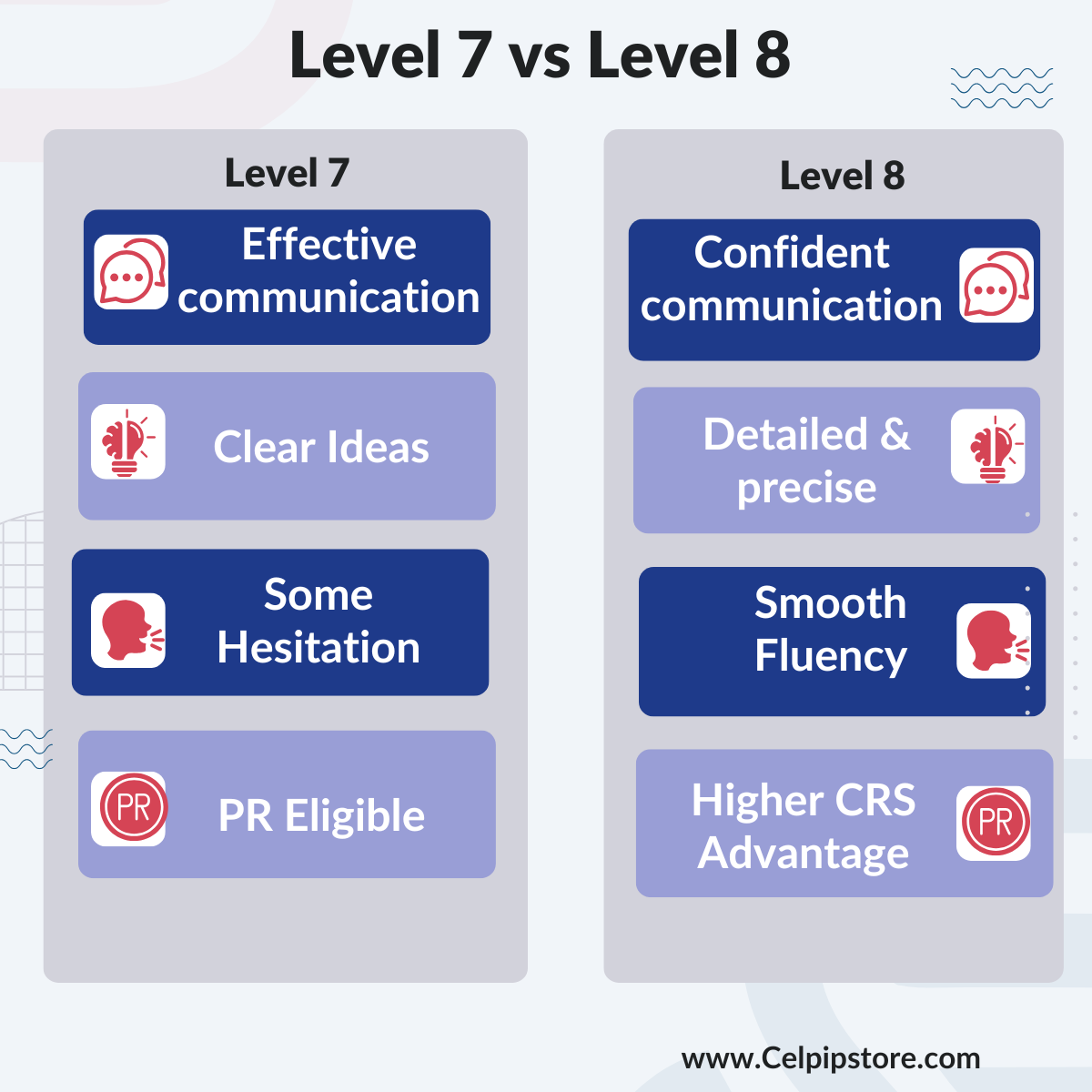
At Level 8, communication becomes more natural, flexible, and sophisticated.
Instead of simply responding correctly, you're expected to communicate with greater precision, richer vocabulary, and stronger control over complex ideas.
Fortunately, reaching Level 8 doesn't require perfection. To understand the difference between intermediate and advanced proficiency, check the full comparison in CELPIP level comparison.
It requires consistent practice, better communication habits, and regular exposure to authentic English.
The Five Skills That Will Move You to Level 8
1. Speak More Naturally
Many Level 7 learners still sound slightly "prepared."
Their answers are correct but sometimes feel rehearsed.
To reach Level 8, aim for conversations that sound spontaneous.
Practice by:
-
Discussing current events
-
Explaining workplace situations
-
Giving opinions without preparation
-
Answering unexpected questions
The more comfortable you become thinking in English, the more natural your communication will sound.
2. Build Precision Instead of Complexity
Many learners believe Level 8 requires difficult vocabulary.
Not necessarily.
Professional communication values precision.
Instead of saying:
"The meeting was good."
Say:
"The meeting was productive because everyone agreed on a clear action plan."
Specific language always creates a stronger impression than complicated words.
3. Improve Your Listening Beyond Words
At Level 8, understanding individual words isn't enough.
You should also recognize:
-
Speaker Attitude
-
Implied Meaning
-
Humor
-
Disagreement
-
Uncertainty
-
Recommendations
Listen carefully to how people express ideas not just what they say.
4. Learn to Support Every Opinion
Examiners reward well-developed responses.
Instead of giving one reason, develop your answer fully.
Example:
Question:
"Should companies allow employees to work remotely?"
Weak response:
"Yes, because it's convenient."
Stronger Level 8 response:
"Yes, because remote work gives employees greater flexibility and often improves work-life balance. It can also reduce commuting time and increase productivity, provided organizations maintain effective communication and clear performance expectations."
Notice how the answer:
-
Presents a clear opinion
-
Explains it
-
Supports it
-
Acknowledges conditions
5. Practice Professional English Every Day
Treat English as part of your daily routine rather than a subject.
Examples:
-
Write emails in English
-
Read Canadian business news
-
Watch interviews with professionals
-
Participate in English discussions
-
Explain your daily decisions aloud
Real communication develops real fluency.
A 7-Day Professional Communication Plan
Monday — Listening
Watch a Canadian business or current affairs interview.
Summarize the discussion in your own words.
Tuesday — Reading
Read a workplace article or government publication.
Identify:
-
The main argument
-
Supporting evidence
-
Recommendations
Wednesday — Writing
Write a 300-word opinion response.
Support every point with examples.
Review grammar and organization before finishing.
Thursday — Speaking
Choose one professional topic.
Speak continuously for three minutes.
Record yourself and evaluate:
-
Fluency
-
Pronunciation
-
Organization
Friday — Vocabulary
Learn ten professional words.
Examples:
-
Collaborate
-
Negotiate
-
Implement
-
Evaluate
-
Strategy
-
Objective
-
Priority
-
Efficient
-
Innovation
-
Solution
Use every word in a complete sentence.
Saturday — Mock Test
Complete one full CELPIP section under official time limits.
Review every incorrect answer carefully.
Mistakes are learning opportunities.
Sunday — Reflection
Ask yourself:
-
Which skill improved most?
-
Which task felt difficult?
-
What should I practice next week?
Continuous reflection leads to continuous improvement.
Common Mistakes That Keep Learners at Level 7
Many candidates remain at Level 7 because they repeat the same habits.
Avoid these common mistakes.
Speaking Too Formally
Some candidates sound unnatural because they memorize academic sentences.
Speak naturally.
Professional communication should sound confident not robotic.
Giving Short Answers
Many learners answer the question but don't develop their ideas.
Always include:
-
Opinion
-
Reason
-
Example
-
Conclusion
Limited Vocabulary Variety
Avoid repeating words like:
-
Good
-
Nice
-
Important
-
Bad
Instead, use more accurate alternatives.
For example:
Instead of important
Try:
-
Essential
-
Valuable
-
Significant
-
Critical
Instead of good
Try:
-
Effective
-
Beneficial
-
Practical
-
Successful
Ignoring Pronunciation
Clear pronunciation matters more than having a native accent.
Focus on:
-
Word Stress
-
Sentence Rhythm
-
Natural Intonation
Being easy to understand is more important than sounding perfect.
Avoiding Difficult Topics
Challenge yourself with subjects like:
-
Artificial Intelligence
-
Environmental Protection
-
Healthcare
-
Education
-
Workplace Leadership
-
Technology
-
Public Transportation
The more varied your practice, the more flexible your communication becomes.
Self-Assessment Checklist
Before aiming for Level 8, ask yourself:
- Can I participate comfortably in professional meetings?
- Can I explain complex ideas clearly?
- Can I support my opinions with examples?
- Can I understand implied meaning during conversations?
- Can I write organized responses without repeating ideas?
- Can I speak for three minutes naturally?
- Can I communicate confidently with unfamiliar people?
If you answered "Yes" to most of these questions, you're well on your way to Level 8.
Level Up Challenge
7-Day Professional Communication Challenge
This week's challenge will strengthen the habits expected at Level 8.
Day 1: Watch a Canadian news interview and summarize it in your own words.
Day 2: Write a professional email responding to a workplace scenario.
Day 3: Record yourself explaining a workplace problem and your proposed solution.
Day 4: Learn ten professional vocabulary words and use them in conversation.
Day 5: Read an opinion article and identify the author's strongest argument.
Day 6: Complete one full CELPIP Speaking task under timed conditions.
Day 7: Review your recordings and writing, identify one recurring weakness, and create a plan to improve it during the following week.
Small, consistent improvements create lasting confidence.
Motivation
Moving from Level 7 to Level 8 isn't about becoming someone else.
It's about communicating with greater confidence, flexibility, and precision.
Every meaningful conversation, every thoughtful email, and every practice session helps you become a stronger communicator.
Remember:
Professional communication earns respect.
Natural communication builds trust.
Level 8 combines both.
Frequently Asked Questions About CELPIP Level 7
1. Is CELPIP Level 7 a good score?
Yes. CELPIP Level 7 is considered a strong English proficiency level. It demonstrates that you can communicate effectively in professional, academic, and everyday situations.
At this level, you're expected to:
-
Understand detailed conversations
-
Express ideas clearly
-
Write organized responses
-
Participate confidently in workplace discussions
-
Handle unfamiliar topics with reasonable confidence
For many candidates, Level 7 represents the transition from independent communication to professional communication.
2. What is the biggest difference between Level 6 and Level 7?
The biggest difference is professional communication.
Level 6 focuses on communicating independently in everyday situations.
Level 7 expects you to:
-
Organize ideas more effectively
-
Explain complex topics
-
Adapt your communication
-
Participate confidently in workplace discussions
-
Support opinions with logical reasoning
You're no longer simply communicating you are communicating professionally.
3. Can I move from Level 7 to Level 8?
Absolutely.
Many candidates successfully progress by focusing on:
-
Richer Vocabulary
-
Stronger Fluency
-
Clearer Organization
-
Better Pronunciation
-
More Natural Communication
The key is consistent practice rather than memorizing difficult words.
4. Which skill should I improve first?
Most Level 7 learners benefit from improving:
-
Speaking fluency
-
Writing organization
-
Listening for implied meaning
-
Vocabulary precision
Instead of trying to improve every skill at once, identify your weakest area and dedicate extra practice time to it while maintaining a balanced study routine.
5. How long does it usually take to reach Level 8?
There is no fixed timeline.
Learners who actively use English every day often progress faster than those who study only through textbooks.
Speaking regularly, reading authentic materials, writing consistently, and completing practice tests under timed conditions all contribute to faster improvement.
6. Should I memorize advanced vocabulary?
No.
Examiners reward appropriate vocabulary, not unnecessarily difficult vocabulary.
Instead of trying to impress with uncommon words, focus on choosing the right word for the situation and using it naturally.
Clear communication is always more effective than complicated language.
7. What is the best preparation strategy for Level 8?
A balanced study plan should include:
-
Daily reading
-
Listening to authentic Canadian English
-
Speaking practice with recordings
-
Regular writing exercises
-
Weekly mock tests
-
Reviewing mistakes after every practice session
Improvement comes from using English consistently in meaningful situations.
Quick Recap
Before moving on to Level 8, remember these key ideas:
- CELPIP Level 7 represents professional communication
- You can communicate confidently in workplace and everyday situations
- Your Speaking and Writing responses should include clear opinions, logical reasons, supporting examples, and strong conclusions
- Listening involves understanding both direct and implied meaning
- Precision and flexibility are more valuable than complicated vocabulary
- Consistent practice leads to confident communication
Final Thoughts
Achieving CELPIP Level 7 is an important milestone because it demonstrates that you can communicate effectively in situations that require organization, confidence, and professionalism.
At this stage, you're able to participate in meetings, explain detailed ideas, understand professional documents, and respond naturally during discussions. English has become a practical tool that supports your career, education, and daily life.
The journey toward Level 8 is about refinement.
You'll continue expanding your vocabulary, strengthening fluency, improving pronunciation, and learning to communicate with even greater precision and confidence.
Remember that becoming an advanced English communicator doesn't happen overnight.
It happens through consistent practice, thoughtful reflection, and real-life communication. Want to see where Level 7 stands among all levels? Read CELPIP levels explained.
Every conversation, article, presentation, and writing task helps you move closer to your goal.
Stay curious.
Practice consistently.
Celebrate your progress.
Every step forward makes you a stronger communicator.
About CELPIPStore
At CELPIPStore, our mission is to help learners achieve their target CELPIP scores through practical, exam-focused preparation.
Our platform provides:
-
Comprehensive study guides
-
Realistic practice questions
-
Full-length mock tests
-
Vocabulary-building resources
-
Speaking and Writing strategies
-
Exam tips based on real test formats
Whether you're preparing for Canadian permanent residency, citizenship, work, or study, we're here to support your success every step of the way.
Call to Action
Ready to Reach CELPIP Level 8?
Continue your preparation with CELPIPStore's study guides, practice questions, mock tests, and expert learning resources.
Start practicing today and take the next step toward CELPIP Level 8 with confidence.