(1).png)
CELPIP Level 4 Explained: Meaning, Skills & Improvement Tips (2026 Guide)
If you've recently taken the CELPIP exam or are preparing for it, you may be wondering what CELPIP Level 4 actually means. Is it a good result? Does it show that you can communicate effectively in English? More importantly, how can you improve from Level 4 to higher levels?
These are common questions among CELPIP candidates, especially those preparing for Canadian immigration, citizenship, employment, or personal language development. Understanding your current level is the first step toward creating an effective study plan and improving your English communication skills.
A CELPIP level is much more than a number on your score report. It reflects your ability to understand English, express your thoughts, participate in conversations, and communicate in practical situations. CELPIP Level 4 is just one part of the overall scoring system. To understand how it compares with other levels, read CELPIP levels explained. Each level represents a stage in your language-learning journey and highlights both your current strengths and the areas where further improvement is needed.
This guide explains what CELPIP Level 4 means, what you can typically do at this level, the challenges many learners face, and practical strategies to help you move confidently toward the next level.
By the end of this article, you'll have a clear understanding of what Level 4 represents and a realistic plan for improving your English communication skills.
What Does CELPIP Level 4 Mean?
CELPIP Level 4 generally represents basic English communication ability. At this stage, you can understand familiar words and expressions, participate in simple conversations, and communicate about everyday topics. However, you may still find it difficult to follow longer discussions, explain complex ideas, or understand unfamiliar vocabulary.
Think of Level 4 as the stage where you've built a foundation, but you're still developing confidence and consistency. You can often communicate successfully when conversations are straightforward and the language is familiar, but unexpected questions or fast-paced discussions may become challenging.
For example, someone at Level 4 can usually:
-
Introduce themselves and share basic personal information
-
Ask and answer simple questions
-
Understand everyday instructions
-
Read short emails or notices
-
Write simple messages
-
Participate in basic conversations about familiar topics
However, they may struggle to:
-
Understand long conversations
-
Express detailed opinions
-
Organize ideas clearly when writing
-
Use a wide range of vocabulary
-
Speak fluently without frequent pauses
The encouraging news is that these skills can improve significantly through regular practice and a structured learning plan. Since CELPIP scores correspond directly to CLB levels, it’s useful to see the full scale from Level 1 to 12. You can explore this in this complete levels guide.
.png "What_Does_CELPIP_Level_4_Mean_-_M2P1G1_(1).png")
Who Is Usually at CELPIP Level 4?
Many learners who receive Level 4 already have a basic understanding of English but haven't yet developed the confidence or fluency needed for more advanced communication.
People at this level often include:
-
Beginners who have completed basic English courses
-
Students returning to English after a long break
-
Working professionals who use limited English in daily life
-
Individuals who understand English better than they can speak it
-
Candidates taking the CELPIP exam for the first time
One important point to remember is that every learner progresses at a different pace. Receiving Level 4 does not define your potential—it simply reflects your current stage of development.
With focused practice and regular exposure to English, many learners move beyond Level 4 within a relatively short period.
What Can You Do at CELPIP Level 4?
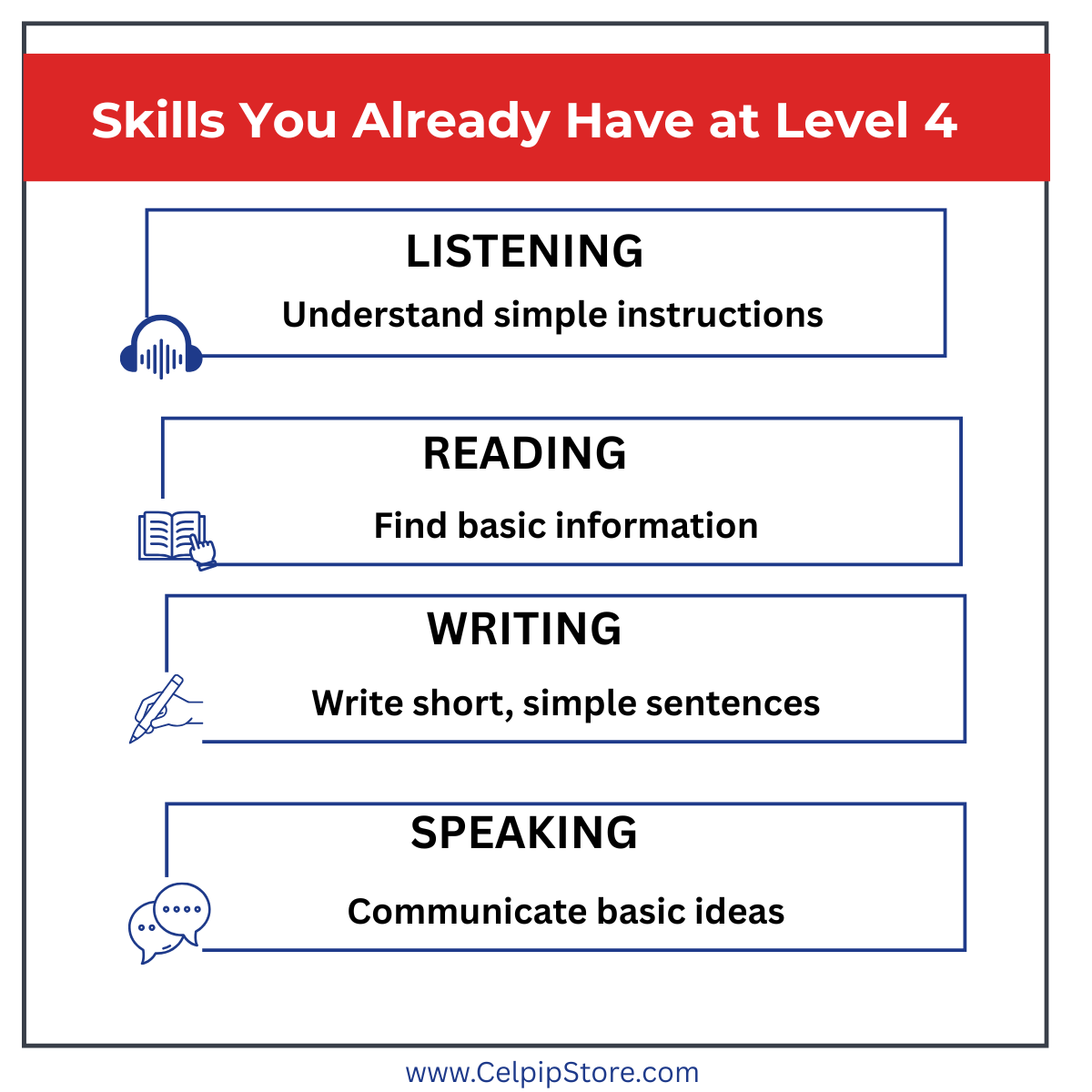
Although Level 4 is considered an early stage of English proficiency, it already allows you to perform many practical communication tasks.
Listening
You can usually understand slow, clear conversations about familiar topics such as shopping, transportation, work schedules, weather, or daily routines. If the speaker uses uncommon vocabulary or speaks very quickly, you may miss important details.
Reading
You can understand simple notices, emails, advertisements, and short articles. Longer passages with complex sentence structures may require multiple readings before the meaning becomes clear.
Writing
You can write short emails, simple messages, and basic descriptions. Your writing usually communicates the main idea, although grammar mistakes, limited vocabulary, or organization issues may reduce clarity.
Speaking
You can introduce yourself, describe familiar experiences, ask questions, and respond to simple situations. You may hesitate while searching for words or struggle to explain more detailed opinions.
Real-Life Example
Imagine you've just moved to Canada and visit a local grocery store.
At CELPIP Level 4, you can comfortably:
-
Ask where a product is located
-
Understand the cashier's questions
-
Request assistance
-
Read product labels
-
Complete your purchase
However, if someone starts discussing nutrition, comparing products in detail, or speaking very quickly, you may find it difficult to follow the conversation.
This example shows that Level 4 provides a practical foundation for everyday communication, while also highlighting the importance of continuing to improve your English skills.
Understanding the Four Language Skills at CELPIP Level 4
One of the biggest misconceptions about CELPIP Level 4 is that every candidate has the same strengths and weaknesses. In reality, many learners perform differently across Listening, Reading, Writing, and Speaking.
For example, someone may be confident while speaking but struggle with reading longer passages. Another learner may understand English well but hesitate when expressing ideas aloud.
That's why improving your overall English requires understanding each language skill individually.
Let's explore what Level 4 typically looks like in each area.
Listening Skills at CELPIP Level 4
Listening is often the first skill that begins to improve because learners are regularly exposed to English through television, YouTube, podcasts, music, and everyday conversations.
At Level 4, you can usually understand:
-
Simple conversations
-
Everyday instructions
-
Basic announcements
-
Familiar topics
-
Common vocabulary
However, you may struggle when:
-
People speak very quickly
-
Multiple speakers are involved
-
The topic is unfamiliar
-
New vocabulary appears frequently
-
Long conversations contain many details
Example
If someone says:
"The meeting has been moved to Thursday because the manager will be attending a conference on Wednesday."
You can probably understand the main message.
But if several people continue discussing schedules, responsibilities, and deadlines, you may begin missing important information.
How to Improve Listening
-
Listen to English every day
-
Watch Canadian news channels
-
Listen to podcasts with transcripts
-
Watch YouTube videos with subtitles first, then without subtitles
-
Practice identifying keywords instead of trying to understand every word
Reading Skills at CELPIP Level 4
Reading at Level 4 generally involves understanding straightforward written English.
Most learners can read:
-
Emails
-
Short articles
-
Advertisements
-
Notices
-
Instructions
-
Menus
-
Public signs
The challenge begins when reading:
-
Long paragraphs
-
Opinion articles
-
Academic writing
-
Professional documents
-
Texts with unfamiliar vocabulary
Instead of understanding the entire passage, many learners focus on translating individual words, which slows them down considerably.
How to Improve Reading
-
Read English every day
-
Start with short news articles
-
Learn vocabulary through context
-
Stop translating every sentence into your native language
-
Practice identifying the main idea first
Writing Skills at CELPIP Level 4
Writing is often the weakest skill for many Level 4 learners because it requires grammar, vocabulary, organization, and clear communication at the same time.
Typical writing at this level includes:
-
Short emails
-
Simple messages
-
Personal opinions
-
Basic descriptions
Common problems include:
-
Short sentences
-
Limited vocabulary
-
Grammar mistakes
-
Repetition
-
Weak organization
For example:
"I like Canada because good country."
The reader understands the idea, but it could be improved by writing:
"I like Canada because it offers many opportunities and has a high quality of life."
The second version communicates the same idea much more naturally and effectively.
How to Improve Writing
-
Write something every day, even if it's only 100–150 words
-
Learn common sentence structures
-
Expand your vocabulary gradually
-
Read well-written English articles
-
Review and correct your own writing regularly
Speaking Skills at CELPIP Level 4
Many learners at Level 4 know the answer in their mind but struggle to express it smoothly in English.
Typical speaking characteristics include:
-
Frequent pauses
-
Searching for vocabulary
-
Repeating words
-
Speaking slowly
-
Simple sentence structures
This is completely normal.
Confidence develops through practice, not perfection.
Imagine someone asks:
"What do you enjoy doing during weekends?"
A Level 4 response might be:
"I like movie... I go friend... sometimes shopping."
Although understandable, the response lacks detail and fluency.
With practice, the same learner might say:
"During weekends, I usually watch movies with my friends or spend time shopping. It helps me relax after a busy week."
Notice that the second answer isn't using difficult vocabulary it's simply clearer, more organized, and easier to understand.
How to Improve Speaking
-
Speak English every day
-
Record yourself answering simple questions
-
Describe pictures or everyday situations
-
Practice speaking without translating from your first language
-
Focus on communicating your ideas instead of speaking perfectly
Did You Know?
Many successful CELPIP candidates improve their speaking skills simply by recording themselves for five minutes every day and listening to the recordings afterward. Whether Level 4 is enough depends on your goal. Compare it with higher levels in CELPIP levels explained. This helps them notice pronunciation, grammar, and fluency issues that they often miss while speaking.
Common Challenges at CELPIP Level 4
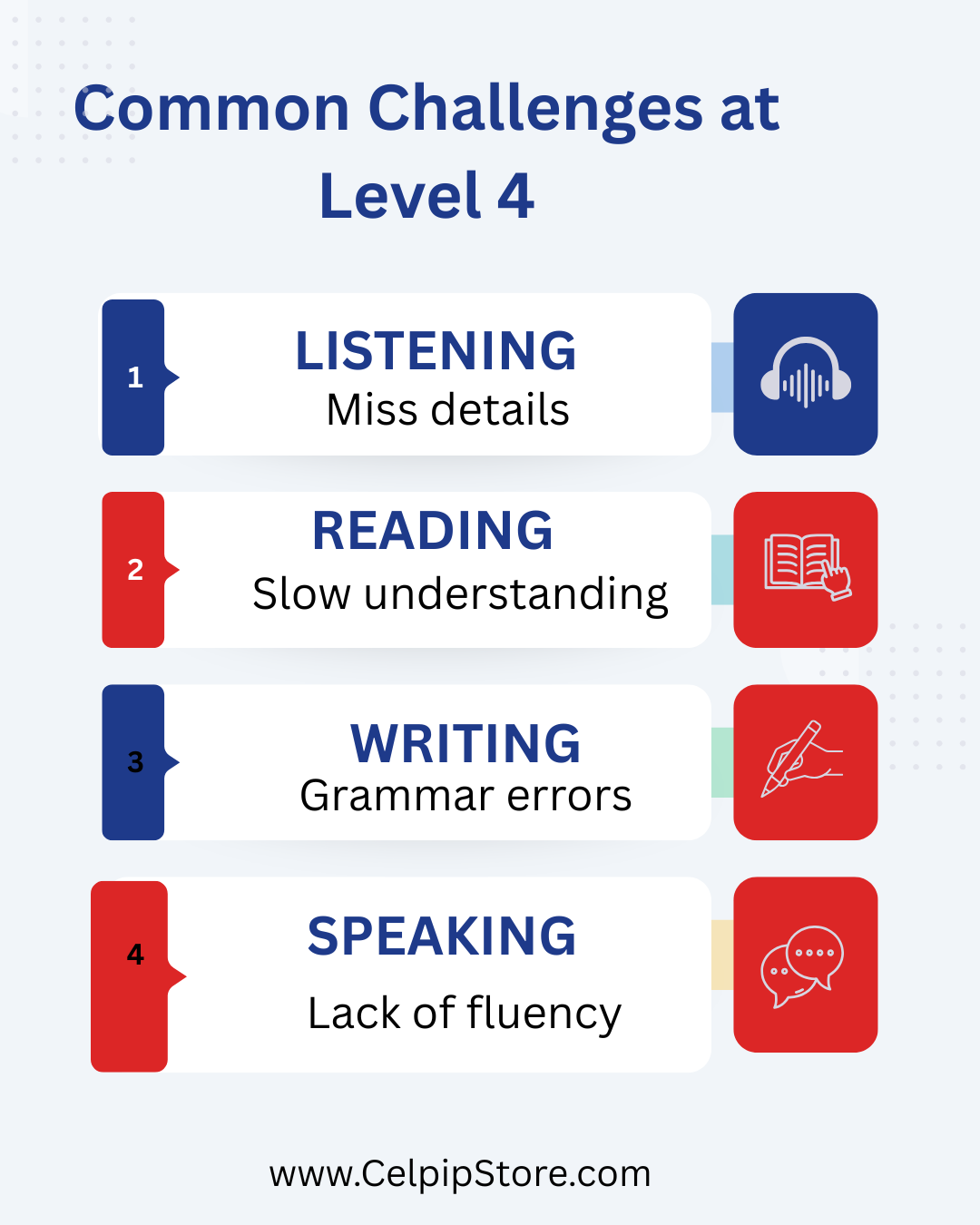
Almost every learner at Level 4 experiences similar difficulties.
These include:
Limited Vocabulary
Knowing enough words to understand simple conversations but struggling with unfamiliar topics.
Low Confidence
Feeling nervous when speaking English, even when you know the answer.
Slow Reading Speed
Spending too much time understanding individual words instead of the overall message.
Grammar Mistakes
Making errors with verb tenses, articles, prepositions, and sentence structure.
Fear of Making Mistakes
Many learners remain silent because they worry about saying something incorrectly.
Ironically, this slows their improvement.
Remember:
The goal is communication not perfection.
Every conversation is an opportunity to improve.
Expert Tip
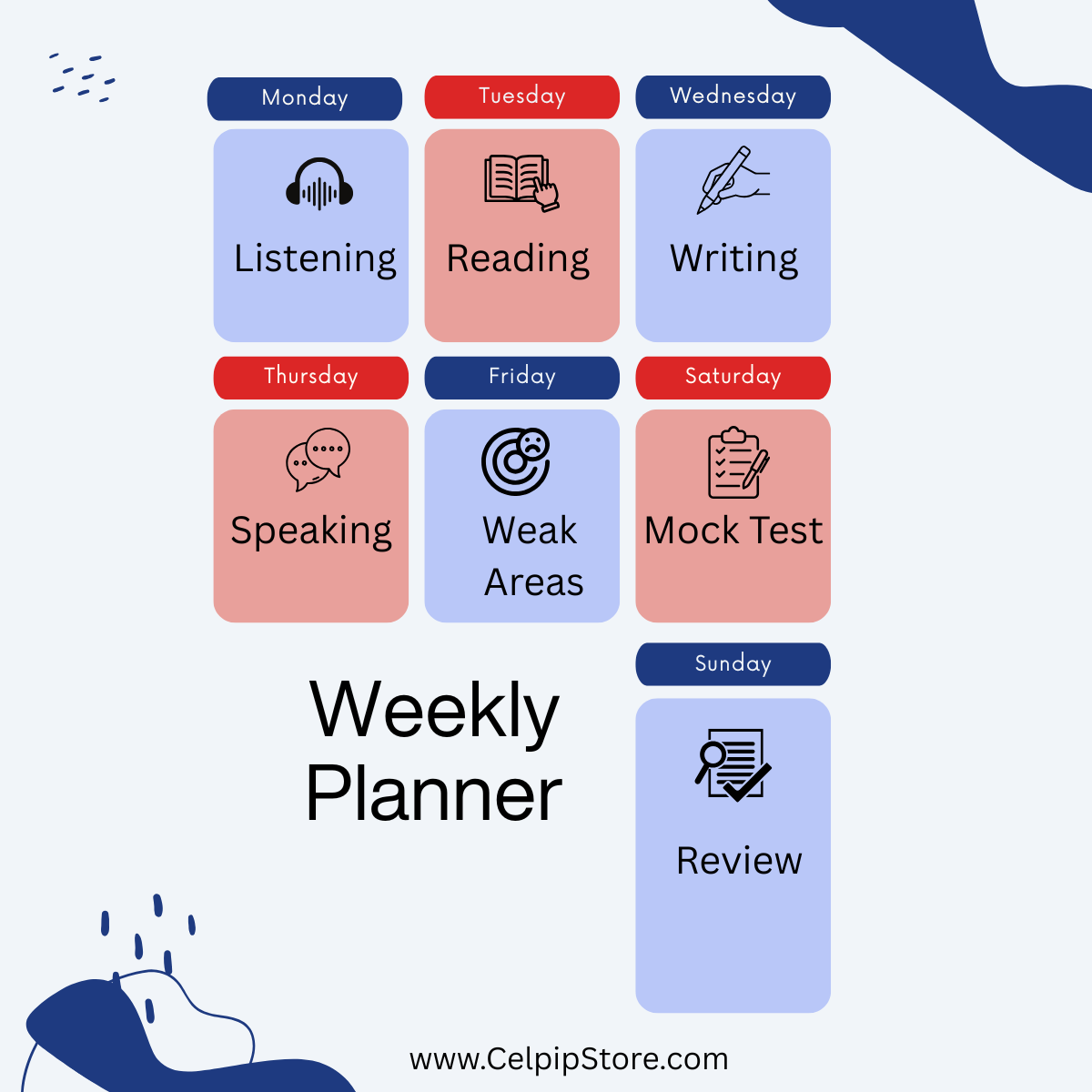
Instead of trying to improve all four skills equally every day, focus on one primary skill while maintaining the others.
For example:
-
Monday: Listening focus
-
Tuesday: Reading focus
-
Wednesday: Writing focus
-
Thursday: Speaking focus
-
Friday: Vocabulary review
-
Saturday: Full mock practice
-
Sunday: Review mistakes and plan the coming week
This balanced approach prevents burnout while ensuring steady progress across all language skills.
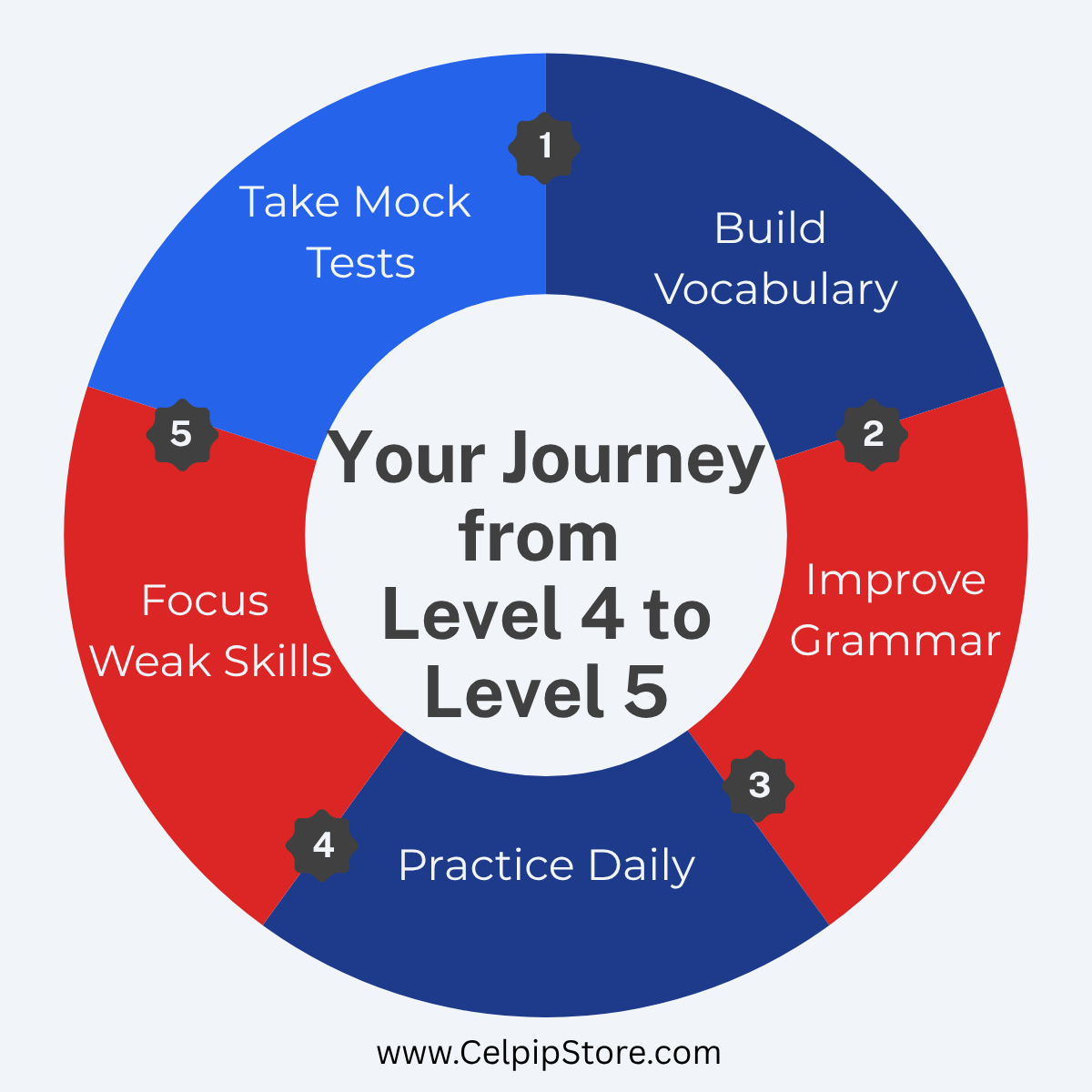
How to Improve from CELPIP Level 4 to Level 5
The difference between Level 4 and Level 5 isn't about learning thousands of new words overnight or mastering complicated grammar rules. It's about becoming more comfortable using English in everyday situations.
Most learners who successfully move beyond Level 4 share one habit: they practice consistently instead of occasionally. To move beyond Level 4, you should understand what higher levels require. Read CELPIP level comparison.
Improvement happens through small daily efforts that build confidence over time.
Let's look at a practical plan you can start today.
Step 1: Build a Daily English Habit
One of the biggest mistakes learners make is studying only when they have free time. A better approach is to make English part of your daily routine.
Even 45–60 minutes of focused practice every day can produce better results than studying for several hours once a week.
A balanced routine might look like this:
|
Activity |
Time |
|
Listening Practice |
15 minutes |
|
Reading Practice |
15 minutes |
|
Vocabulary Review |
10 minutes |
|
Speaking or Writing |
20 minutes |
Consistency matters more than long study sessions.
Step 2: Learn Vocabulary in Context
Many learners try to memorize long vocabulary lists. Unfortunately, isolated words are easy to forget.
Instead, learn vocabulary through real sentences.
For example:
- Memorize:
Opportunity
- Learn in context:
Canada offers many opportunities for skilled workers.
By seeing words used naturally, you'll remember them more easily and understand how to use them yourself.
Step 3: Practice Real Communication
English is a communication skill not just a school subject.
Whenever possible:
-
Speak English with friends or classmates
-
Join online conversation groups
-
Read English aloud
-
Describe what you're doing during the day
-
Answer sample CELPIP questions out loud
The more you use English, the more natural it becomes
Step 4: Review Your Mistakes
Many learners finish an exercise and immediately move to the next one.
That's a missed opportunity.
Instead, ask yourself:
-
Why was this answer incorrect?
-
What grammar rule did I miss?
-
Which new vocabulary did I learn?
-
How can I avoid this mistake next time?
Keeping a simple notebook of common mistakes can help you notice patterns and track your improvement over time.
A Sample Weekly Study Plan
Here's an example of a balanced weekly routine for a Level 4 learner.
|
Day |
Primary Focus |
|
Monday |
Listening + Vocabulary |
|
Tuesday |
Reading + Grammar |
|
Wednesday |
Writing Practice |
|
Thursday |
Speaking Practice |
|
Friday |
Mixed Skills Review |
|
Saturday |
Full-Length Mock Test |
|
Sunday |
Review Mistakes & Set Goals |
This routine helps you develop all four language skills without becoming overwhelmed.
Common Mistakes Level 4 Learners Should Avoid
Understanding what not to do is just as important as knowing what to practice.
Mistake 1: Translating Every Sentence
Many learners mentally translate English into their first language before understanding it.
This slows down both Reading and Listening.
Instead, try to understand the meaning directly in English.
Mistake 2: Memorizing Instead of Communicating
Memorized answers may not fit the actual question in the exam.
Focus on organizing your thoughts and expressing your own ideas naturally.
Mistake 3: Ignoring Weak Skills
Some learners only practice Speaking because they enjoy it.
Others avoid Speaking because they lack confidence.
Neither approach works.
Balanced improvement across all four skills is essential.
Mistake 4: Studying Without a Plan
Random practice often leads to slow progress.
Having a simple weekly schedule keeps your preparation organized and helps you measure improvement.
Mistake 5: Being Afraid of Mistakes
Many learners hesitate to speak because they're worried about making errors.
Remember:
Every fluent English speaker made mistakes while learning.
The key is to learn from them not avoid them.
Expert Tips for Faster Improvement
Read Every Day
Even ten minutes of reading can improve vocabulary, grammar, and comprehension.
Listen to Different English Accents
Expose yourself to Canadian, American, British, and Australian speakers.
This will make it easier to understand different voices during real conversations.
Record Yourself Speaking
Choose one simple topic each day and speak for one minute.
Then listen to your recording and ask yourself:
-
Was I clear?
-
Did I pause too often?
-
Could I organize my ideas better?
You'll notice improvements surprisingly quickly.
Think in English
Instead of translating your thoughts, practice thinking directly in English.
Start with simple daily activities:
"I'm making breakfast."
"I need to send an email."
"It's raining today."
This simple habit gradually builds fluency.
Quick Improvement Checklist
Before moving toward Level 5, ask yourself:
- I practice English every day.
- I listen to English regularly.
- I read short English articles.
- I write something every week.
- I speak English without worrying about perfection.
- I review my mistakes.
- I take regular mock tests.
If you can confidently check most of these, you're already building the habits needed to progress.
Frequently Asked Questions About CELPIP Level 4
1. Is CELPIP Level 4 considered a good result?
CELPIP Level 4 shows that you have a basic ability to communicate in English in familiar, everyday situations. You can understand simple conversations, read straightforward texts, write basic messages, and participate in common interactions. While it is a solid starting point, many learners continue improving their English to meet the requirements of their personal or professional goals.
2. Can I improve from Level 4 to Level 5?
Yes. Many candidates move from Level 4 to Level 5 through regular practice and a structured study plan. Focus on building vocabulary, improving grammar, practicing speaking every day, and taking regular mock tests. Small, consistent improvements usually lead to better results than trying to learn everything at once.
3. Which skill is usually the weakest at Level 4?
The answer varies from person to person. However, many learners find Writing and Speaking more challenging because these skills require them to actively produce English rather than simply understand it. Identifying your weakest area early allows you to create a more effective study plan.
4. How much should I study every day?
There is no perfect number of hours. For most learners, 45 to 60 minutes of focused daily practice is enough to make steady progress. The key is consistency. Studying a little every day is generally more effective than studying for several hours only once or twice a week.
5. Should I memorize answers for the CELPIP exam?
No. Memorized answers often sound unnatural and may not fit the actual question you receive. Instead, practice organizing your ideas, supporting your opinions with examples, and speaking or writing naturally. Clear communication is far more valuable than repeating memorized content.
6. How do I know when I'm ready for Level 5?
You're likely making good progress when you can:
-
Understand everyday conversations with greater confidence.
-
Read short articles without translating every sentence.
-
Write organized paragraphs with fewer grammar mistakes.
-
Express your opinions more clearly when speaking.
-
Complete practice tests more comfortably within the time limits.
Regular mock tests are an excellent way to monitor your improvement.
7. What is the fastest way to improve at Level 4?
There is no shortcut to learning a language, but you can improve more efficiently by:
-
Practicing English every day.
-
Reading and listening to authentic English content.
-
Recording yourself while speaking.
-
Reviewing your mistakes after each practice session.
-
Building vocabulary through real-life examples rather than memorizing word lists.
Quick Recap
Before you leave this guide, remember these key points:
- CELPIP Level 4 represents basic English communication skills.
- It is a starting point not a limitation.
- Every learner progresses at a different pace.
- Daily practice is more effective than occasional intensive study.
- Listening, Reading, Writing, and Speaking all deserve regular attention.
- Reviewing mistakes is one of the fastest ways to improve.
- Confidence develops through consistent communication.
Final Thoughts
Reaching CELPIP Level 4 means you've already taken an important step in your English-learning journey. You have the ability to communicate in familiar situations and understand everyday English, but there is still plenty of room to grow.
The encouraging news is that moving beyond Level 4 is achievable for most learners who follow a structured plan and practice consistently. You don't need perfect grammar or an advanced vocabulary from the beginning. What matters most is building confidence, using English regularly, and learning from your mistakes.
Remember that language learning is a gradual process. Every article you read, every podcast you listen to, every conversation you have, and every practice test you complete helps strengthen your communication skills. Want to see where Level 4 stands among all levels? Read CELPIP levels explained.
Instead of focusing only on your current level, focus on becoming a better communicator each week. Small improvements add up over time, and those improvements can make a significant difference on exam day.
Most importantly, don't compare your progress with others. Compare yourself with where you were a month ago. If you understand more, speak more confidently, and make fewer mistakes than before, you're moving in the right direction.
Stay patient, stay consistent, and keep practicing.
Continue Your Learning Journey
If you found this guide helpful, continue exploring our complete CELPIP learning resources.
Recommended Next Articles
-
CELPIP Levels Explained (Complete Guide)
-
Understanding CELPIP Level 5
-
How Is the CELPIP Exam Scored?
-
Best CELPIP Study Plan for Beginners
-
Common CELPIP Mistakes and How to Avoid Them
-
CELPIP Listening Study Guide
-
CELPIP Reading Study Guide
-
CELPIP Writing Study Guide
-
CELPIP Speaking Study Guide
By reading these related guides, you'll build a stronger understanding of the exam and create a clear roadmap for improving your English skills.
About CELPIPStore
At CELPIPStore, we're committed to helping learners achieve their English language goals through practical, easy-to-understand resources.
Our platform offers:
-
Comprehensive study guides.
-
Practice questions.
-
Mock tests.
-
Vocabulary-building resources.
-
Preparation strategies.
-
Tips from experienced educators.
Whether you're preparing for immigration, citizenship, employment, or personal growth, our goal is to make your CELPIP preparation more effective, more organized, and less stressful.
Call to Action
Ready to move beyond CELPIP Level 4?
Start practicing with our expert study guides, realistic practice questions, and step-by-step learning resources. Build your confidence one lesson at a time and continue your journey toward achieving your target CELPIP level.