1.png)
CELPIP Speaking Task 4
Many CELPIP candidates feel confident after completing Task 3 because they learn how to describe a picture clearly and logically. However, when they move to Task 4 – Making Predictions, they often hesitate. They start thinking, “What should I say next?” or “What if my prediction is wrong?” This confusion usually comes from not understanding the real goal of the task. In reality, there is no single correct answer. CELPIP Speaking includes eight different tasks, and Task 4 is only one part of the complete speaking test. To understand all eight tasks, scoring criteria, strategies, and preparation techniques, read our Ultimate CELPIP Speaking Guide.
The examiner is not testing your ability to predict the future accurately they are evaluating how clearly, logically, and confidently you can express your ideas. Once you understand this, Task 4 becomes much easier to manage.
What Is CELPIP Speaking Task 4?
In this task, you will see a picture similar to Task 3, but your objective changes completely. Instead of describing what is happening now, you must explain what is likely to happen next. This requires you to observe the situation, think logically, and then communicate your predictions in a clear and organized way. Task 4 is one of eight speaking tasks in the CELPIP test. If you want to understand how Task 4 fits into the complete speaking section, explore our complete CELPIP Speaking guide.
Task Requirements:
- You will see one image
- You must predict future events
- Your ideas should be logical and connected
- You should speak clearly and continuously
Time Structure:
- Preparation Time: 30 seconds
- Speaking Time: 60 seconds
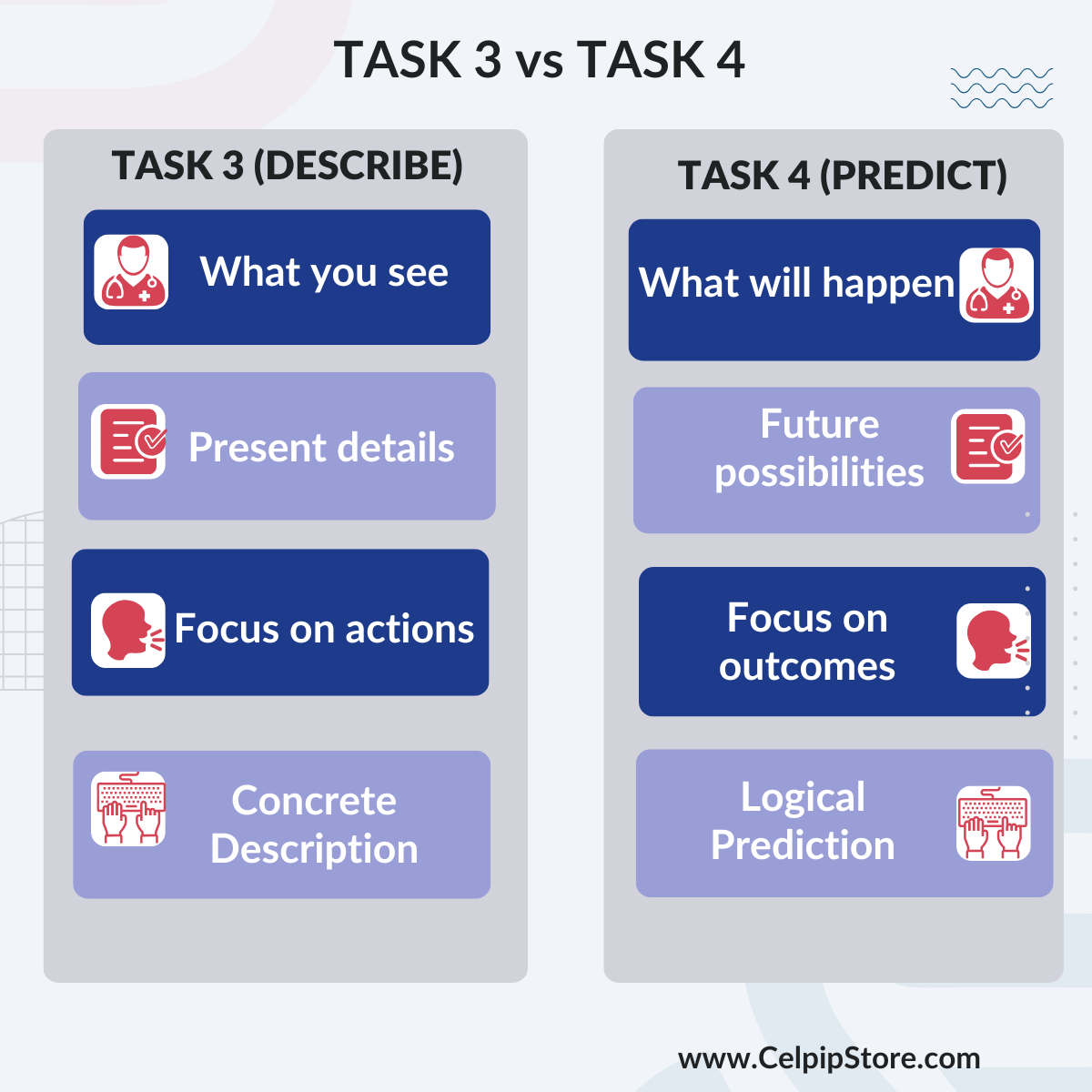
Task 3 vs Task 4 (Critical Difference)
The key difference between Task 3 and Task 4 is the focus. Task 3 is based on observation, while Task 4 is based on prediction. This means you must move beyond simply describing what you see and start thinking about what might happen next.
Key Shift:
- Task 3 - Describe the present
- Task 4 - Predict the future
This transition from observation to prediction is essential for a high score.
What Examiners Want
Examiners are not looking for perfect predictions. They are looking for clear communication and logical thinking. A high-scoring response shows that the candidate understands the situation and can explain future possibilities in a natural and structured way.
A Strong Answer Includes:
- Clear understanding of the situation
- Logical and realistic predictions
- Use of future language
- Smooth transitions between ideas
- Natural fluency and confidence
Why Candidates Lose Marks
Many candidates lose marks because they do not follow a clear strategy. Even students with good English can perform poorly if their ideas are not organized.
Common Issues:
- Repeating simple sentence structures
- Running out of ideas quickly
- Making unrealistic predictions
- Stopping too early
- Using incorrect tense
Without structure, your response sounds weak and incomplete.
The Biggest Myth
A common misunderstanding is that your prediction must be correct. This is not true. The examiner does not evaluate accuracy—they evaluate clarity and reasoning. Your prediction simply needs to make sense based on the situation.
Example:
- He will definitely win the race.
- He will probably win the race because he is already ahead of the others.
Always support your prediction with a reason.
Learning Objectives
By the end of this lesson, you will be able to:
- Make clear and logical predictions
- Organize your ideas effectively
- Use future tenses correctly
- Speak for the full 60 seconds
- Avoid common mistakes
- Sound confident and natural
Why Task 4 Is Easier Than You Think
Although many students find this task difficult, it can actually be easier than Task 3. In Task 3, you are limited to what you can see, but in Task 4, you can expand your ideas as long as they remain logical. This gives you more flexibility and helps you continue speaking without hesitation.
Key Advantage:
- You are not limited to visible details
- You can extend your ideas naturally
- You can maintain fluency more easily
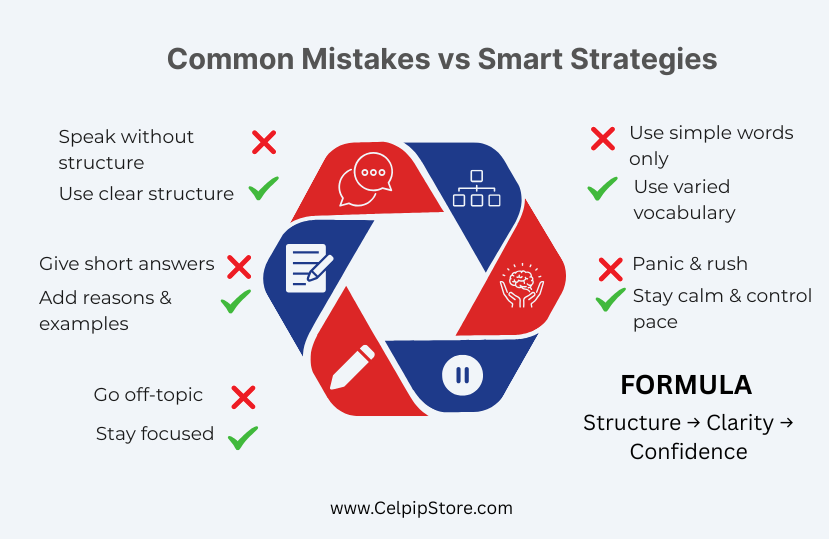
Common Mistakes in Task 4
Many candidates lose marks due to simple but avoidable mistakes. Understanding these errors is the first step toward improvement.
Mistake 1: Only Describing the Picture
Some candidates continue describing instead of predicting.
- Weak: There is a man standing near a car. It is raining.
- Better: The man will probably try to get into the car quickly because it is raining heavily.
Mistake 2: Repeating “Will”
Using the same structure repeatedly makes your answer sound basic.
- Weak: He will go home. He will eat. He will sleep.
- Improve by using:
- might
- probably
- going to
- likely to
Mistake 3: No Explanation
Predictions without reasons are weak.
- Weak: She will leave the office.
- Better: She will probably leave the office soon because it looks late and she seems tired.
Mistake 4: Unrealistic Predictions
Avoid ideas that do not match the picture.
- A helicopter will land here.
- Not logical unless supported
Mistake 5: Speaking Too Little
- Many candidates stop after 20–30 seconds.
- You must speak for the full 60 seconds.
Mistake 6: No Structure
- Jumping randomly between ideas reduces clarity.
-You need a clear prediction framework. Avoiding Task 4 mistakes is important, but a strong CELPIP Speaking score requires preparation across all eight tasks. Explore our complete guide to CELPIP Speaking for task-by-task strategies and tips.
Quick Tip
Before speaking, quickly ask yourself:
- What is happening now?
- What might happen next?
- Why will it happen?
If you answer these three questions, your response will be strong and complete.
The CELPIPStore Prediction Framework
Now that you understand what Task 4 requires, the next step is to learn how to structure your answer. Most candidates struggle not because they lack ideas, but because they don’t know how to organize them. A clear structure helps you speak confidently, avoid long pauses, and use the full 60 seconds effectively. While this framework is designed for Task 4, each CELPIP Speaking task requires a different response strategy. Learn the approaches for all eight tasks in our Ultimate CELPIP Speaking Guide.
The best way to approach this task is to follow a simple and repeatable framework that guides your thinking from the present situation to future possibilities. This is where the CELPIPStore Prediction Framework comes in. It is designed to help you generate ideas quickly and present them in a logical flow.
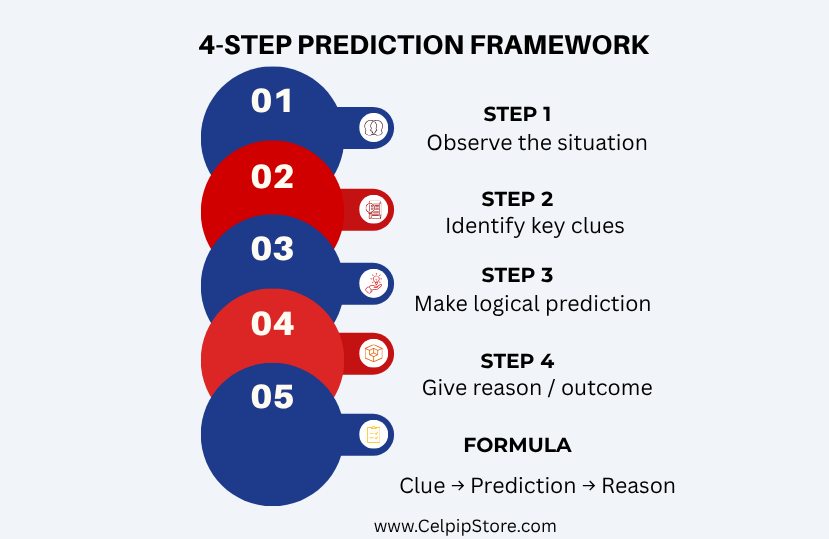
The 4-Step Prediction Structure
A high-scoring response in Task 4 follows a clear progression. You begin by briefly setting the context, then move into predictions, support those predictions with reasons, and finally conclude your response smoothly.
Step 1: Briefly Describe the Situation
Start by giving a short overview of what is happening in the picture. This helps the examiner understand the context of your predictions.
- Keep it short (1–2 sentences)
- Do not spend too much time describing
- Focus only on key details
Example:
“In this picture, I can see a man standing at a bus stop while it is raining heavily.”
Step 2: Make Your First Prediction
After setting the context, move directly into your first prediction. Use natural future expressions and avoid sounding too certain.
Useful Language:
- will probably
- might
- is going to
- is likely to
Example:
“I think he will probably try to find some shelter because the rain is quite heavy.”
Step 3: Add Reasons and Expand
This is the most important part of your answer. You should explain why your prediction makes sense and add more detail to keep speaking fluently.
How to Expand:
- Give reasons
- Add consequences
- Connect ideas
Example:
“Since he is not carrying an umbrella, he might get wet, so he could run towards a nearby shop or building.”
Step 4: Add More Predictions and Conclude
To reach the full 60 seconds, you should include one or two additional predictions and finish your response naturally.
Example:
“After that, he may call someone for help or wait until the rain stops. Overall, it seems like he will try to avoid getting completely soaked.”
Simple Speaking Template
To make your response even easier, you can use a flexible template. This helps you stay organized and reduces hesitation.
Template:
- In this picture, I can see…
- I think … will probably…
- This is because…
- Also, … might…
- As a result,…
- Overall, … will likely…
This template ensures:
- Clear structure
- Logical flow
- Continuous speaking
High-Scoring Example Answer
Let’s see how a full response looks when we apply the framework.
Example Scenario:
A man standing at a bus stop in the rain.
Sample Answer:
“In this picture, I can see a man standing at a bus stop while it is raining heavily. I think he will probably try to find some shelter because he is not carrying an umbrella. Since the rain looks quite strong, he might get completely wet, so he could run towards a nearby shop or building. Also, the bus may be delayed due to the weather, so he might have to wait longer than expected. As a result, he may decide to call a taxi instead of waiting. Overall, it seems like he will try to avoid the rain and find a quicker way to reach his destination.”
Why This Answer Works
This response scores well because it follows a clear structure and uses natural language. It begins with a brief description, moves into logical predictions, provides reasons, and continues smoothly without long pauses.
Strengths:
- Clear organization
- Logical predictions
- Good use of linking words
- Variety of future expressions
- Full use of time
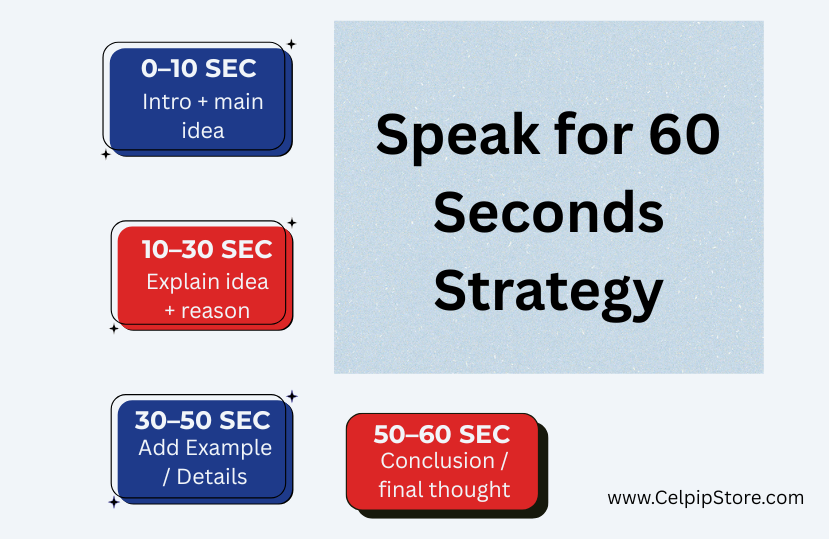
Strategy to Speak for 60 Seconds
Many candidates struggle to fill the full speaking time. The key is to expand your ideas naturally instead of repeating yourself.
Practical Strategy:
- Make at least 2–3 predictions
- Add reasons for each prediction
- Include possible consequences
- Use linking phrases to continue
Useful Linking Words:
- because
- so
- therefore
- as a result
- also
- in addition
These connectors help you continue speaking without hesitation.
Pro Tip: Think Like a Story
Instead of making random predictions, imagine that the situation is part of a short story. Think about what could logically happen next and how events might develop.
Example Thought Process:
- What is happening now?
- What problem might occur?
- How will the person react?
- What could happen next?
This approach makes your response more natural and engaging.
Advanced Tips to Achieve a High Score
Once you understand the basic structure of Task 4, the next step is to refine your performance. High-scoring candidates do not just make predictions—they expand their ideas naturally, use varied language, and sound confident throughout the response. The difference between an average and a high score often comes from small improvements in fluency, vocabulary, and idea development.
To move from a mid-level score to a high band, you must focus on how you connect ideas, how you vary your language, and how naturally you deliver your response.
Key Advanced Strategies
These strategies will help you sound more natural and score higher.
1. Use a Variety of Future Forms
Relying only on “will” makes your answer sound repetitive and basic. A strong response includes a mix of future expressions.
Use:
- will probably
- might
- could
- going to
- likely to
Example:
“He will probably try to find shelter, and he might also call someone for help.”
2. Add Consequences to Extend Ideas
High-scoring answers do not stop at one prediction. They explain what might happen next.
Structure:
- Prediction
- Result
- Further outcome
Example:
“He might miss the bus, so he could decide to take a taxi instead.”
3. Use Linking Language Naturally
Connecting ideas smoothly improves coherence and fluency.
Useful Connectors:
- because
- so
- therefore
- as a result
- also
- in addition
These words help you continue speaking without hesitation.
4. Avoid Overthinking
Many candidates waste time trying to create “perfect” predictions. This leads to long pauses and reduced fluency.
Focus on:
- simple ideas
- clear reasoning
- continuous speech
5. Maintain a Natural Speaking Pace
Speaking too fast leads to mistakes, while speaking too slowly creates unnatural pauses. You should aim for a steady and clear pace.
Remember:
- Speak clearly
- Avoid long pauses
- Keep a natural rhythm
Examiner Insights: What Really Affects Your Score
Understanding how examiners evaluate your response can help you focus on the right areas. They are not judging your imagination—they are assessing your communication skills.
What Examiners Evaluate
1. Content
- Are your predictions logical?
- Do your ideas match the situation?
2. Coherence
- Do your ideas connect smoothly?
- Is your response easy to follow?
3. Vocabulary
- Do you use a range of expressions?
- Are your words natural and appropriate?
4. Grammar
- Are your future forms correct?
- Do you avoid major errors?
5. Fluency
- Do you speak continuously?
- Do you avoid long pauses or hesitation?
What Examiners Do NOT Care About
Many students focus on the wrong things.
Examiners do NOT evaluate:
- Whether your prediction is correct
- Complex or unrealistic ideas
- Perfect grammar in every sentence
They care about clear and effective communication.
High-Impact Vocabulary for Predictions
Using the right vocabulary can immediately improve your score. You should focus on natural expressions that are commonly used in everyday English.
Prediction Phrases
- I think… will probably…
- It seems likely that…
- There is a good chance that…
- He might…
- She could…
Reasoning Language
- because
- since
- due to
- as
Result Expressions
- so
- therefore
- as a result
- which means that
Example Combination
“I think he will probably miss the bus because it is raining heavily, so he might decide to take a taxi instead.”
From Average to High-Scoring Answer
Let’s compare two responses to understand the difference.
Average Answer
“The man will go home. He will eat food. He will sleep.”
Problems:
- Repetitive structure
- No explanation
- Weak vocabulary
- No connection between ideas
High-Scoring Answer
“The man will probably go home soon because he looks tired after a long day. Once he reaches home, he might prepare some food and relax. After that, he is likely to rest early so that he can feel better the next day.”
Strengths:
- Logical flow
- Variety of language
- Clear reasoning
- Smooth transitions
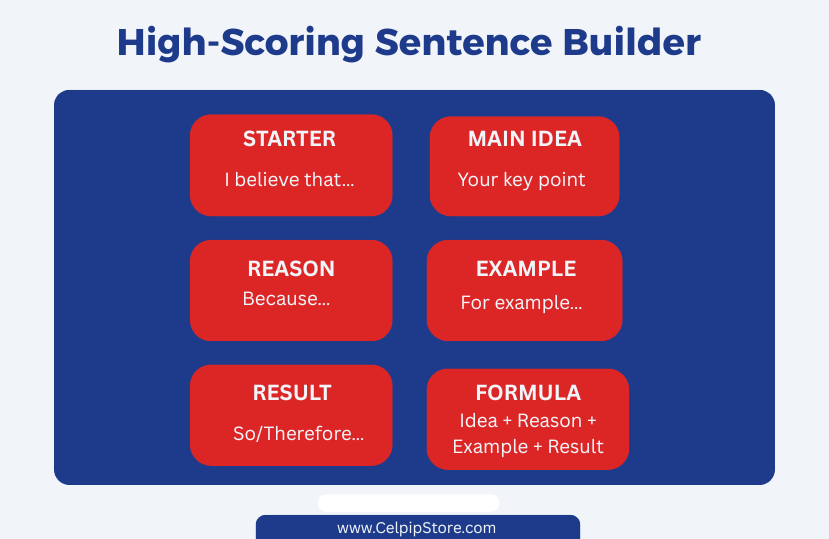
Practice Questions
To improve your skills, you must practise regularly with different types of images.
Practice Scenario 1
A woman holding many shopping bags and looking tired.
Think About:
- What will she do next?
- Will she go home or continue shopping?
- How is she feeling?
Practice Scenario 2
A man using his phone while driving in traffic.
Think About:
- What problem might happen?
- What could be the consequence?
- How might the situation change?
Practice Scenario 3
Children playing football in a park while dark clouds appear.
Think About:
- What will happen with the weather?
- How will the children react?
- What might happen next?
Practice Challenge
Now it’s your turn to apply everything you’ve learned. Regular Task 4 practice can improve your prediction and fluency skills. For a complete preparation strategy covering all eight speaking tasks, see our Ultimate CELPIP Speaking Guide.
Task:
- Look at any picture
- Prepare for 30 seconds
- Speak for 60 seconds
Focus On:
- Making at least 2–3 predictions
- Giving reasons
- Adding consequences
- Speaking without stopping
Pro Tip
Record your answers and listen carefully.
Ask yourself:
- Did I speak for 60 seconds?
- Did I use different future forms?
- Did I give reasons for my predictions?
- Did my ideas sound logical?
Self-evaluation is one of the fastest ways to improve.
Summary
CELPIP Speaking Task 4 focuses on your ability to predict future events based on a given situation. Unlike Task 3, where you describe what is happening, Task 4 requires you to move forward and explain what is likely to happen next. A high-scoring response is not about being correct but about being logical, clear, and fluent. By using a structured approach, adding reasons to your predictions, and speaking continuously for the full time, you can perform confidently and effectively in this task.
Task 4 Quick Checklist
Before the exam, use this checklist to ensure you are fully prepared.
During Preparation Time:
- Understand the situation quickly
- Identify 2–3 possible predictions
- Think of simple reasons
During Speaking:
- Start with a brief description
- Make clear predictions
- Support each idea with a reason
- Add consequences where possible
- Use different future forms
- Speak for the full 60 seconds
Language Focus:
- Use words like probably, might, likely to
- Use connectors like because, so, therefore
- Avoid repeating the same sentence structure
Frequently Asked Questions (FAQs)
1. What is CELPIP Speaking Task 4?
It is a prediction task where you must explain what is likely to happen next based on a picture.
2. How is Task 4 different from Task 3?
Task 3 focuses on describing the present, while Task 4 focuses on predicting the future.
3. How long should I speak?
You should speak for the full 60 seconds without stopping early.
4. What tense should I use?
You should mainly use future forms such as will, going to, might, could, and likely to.
5. Can I give multiple predictions?
Yes, giving 2–3 logical predictions with explanations helps improve your score.
6. What are common mistakes?
Common mistakes include only describing the picture, repeating simple sentences, giving unrealistic ideas, and stopping too early.
7. Do my predictions need to be correct?
No, they only need to be logical and clearly explained.
8. How can I improve quickly?
Practice regularly, record your answers, and focus on structure, fluency, and clarity.
7-Day Practice Plan
Improvement comes with consistent and focused practice. Follow this simple 7-day plan to build confidence in Task 4.
Day 1–2:
- Understand the task format
- Practise identifying predictions from pictures
Day 3–4:
- Use the prediction framework
- Focus on giving reasons
Day 5:
- Practise speaking for full 60 seconds
- Record and review your answers
Day 6:
- Improve vocabulary and connectors
- Use varied future expressions
Day 7:
- Take a full speaking practice test
- Evaluate your performance
Final Tips for Success
To achieve a high score in Task 4, you must focus on clarity, structure, and fluency. Do not try to impress the examiner with complex ideas. Instead, aim for simple, logical predictions that are easy to understand. Keep your speech natural, avoid long pauses, and make sure your ideas are connected. Confidence plays a major role, so practise regularly until speaking feels comfortable and automatic.
Conclusion
CELPIP Speaking Task 4 becomes much easier once you understand its structure and purpose. By combining observation with logical thinking, you can create strong predictions and communicate them effectively. With regular practice and the right strategy, this task can become one of your strongest scoring areas in the speaking section.