1.png)
CELPIP Speaking Task 3: Describing a Scene
CELPIP Speaking includes 8 different tasks, each testing a different communication skill. To understand all tasks, scoring, and strategies, read our Ultimate CELPIP Speaking Guide. Many CELPIP candidates panic when they see the picture for Task 3 – Describing a Scene.
They immediately think:
"There are too many things happening."
or
"I don't know where to start."
The good news is that you don't need to describe everything in the picture.
In fact, trying to mention every object often leads to confusion and lower scores.
Instead, successful candidates describe the scene in a clear, organized order, making it easy for the examiner to visualize what they are seeing.
This guide will teach you exactly how to do that.
What Is CELPIP Speaking Task 3?
In Task 3, you'll see a picture containing people, objects, and activities.
Your job is to describe what you see as clearly as possible.
The picture could show:
- A park
- A beach
- A shopping mall
- A classroom
- A restaurant
- A street
- A sports event
- An airport
- A family gathering
The examiner isn't checking whether you notice every tiny detail.
They're evaluating how effectively you communicate. Task 3 is just one part of the CELPIP speaking test. You can explore all 8 tasks and their strategies in our complete CELPIP speaking guide.
What Examiners Want
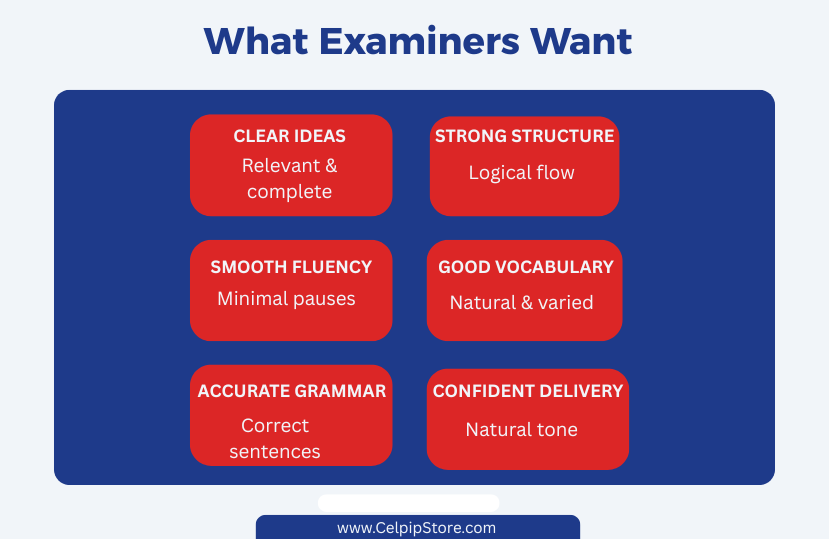
A strong response includes:
- A clear overview
- Logical organization
- Relevant details
- Accurate vocabulary
- Smooth transitions
- Natural fluency
Imagine you're describing the picture to someone who cannot see it.
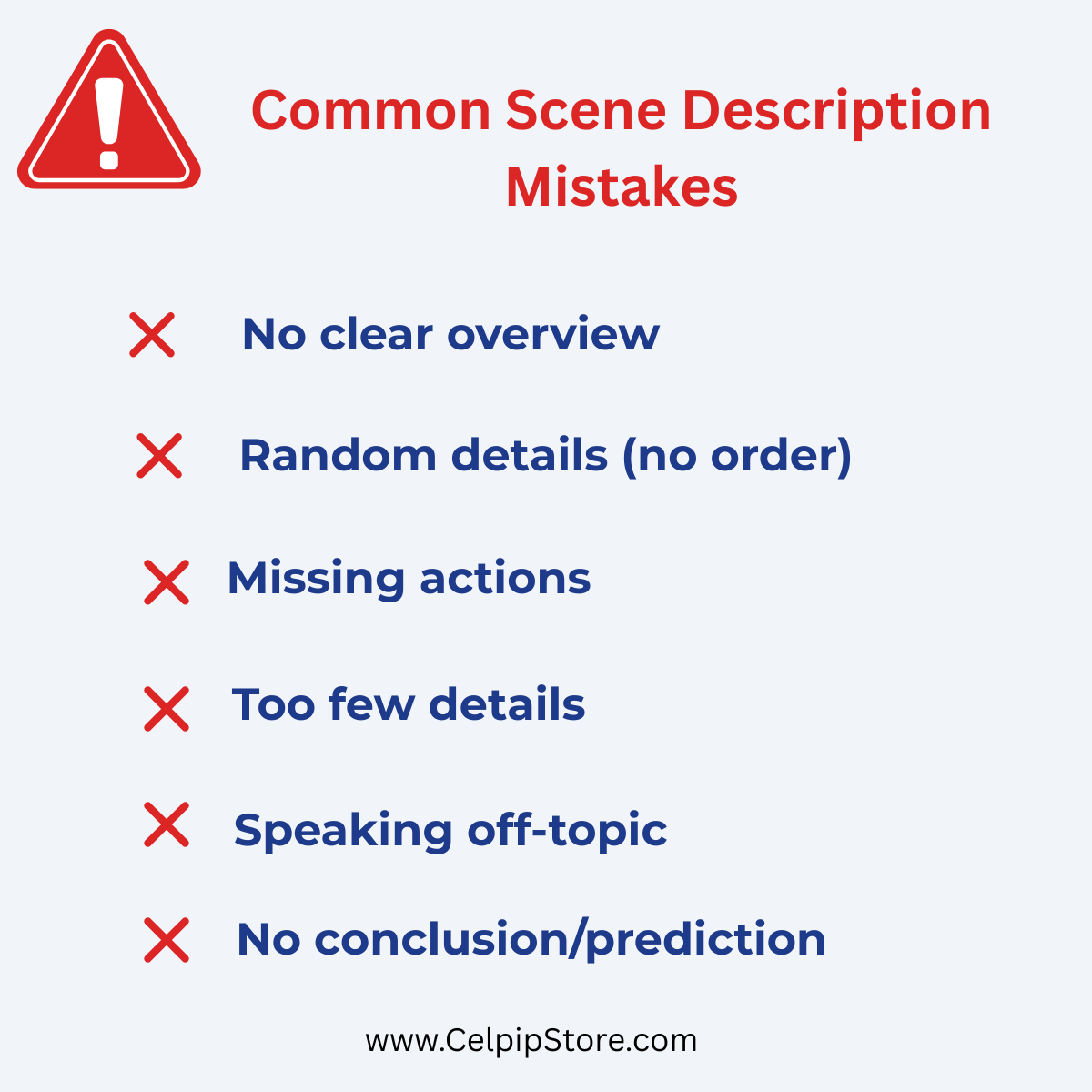
Why Candidates Lose Marks
Many candidates:
- Jump randomly around the picture
- Describe unrelated objects
- Repeat the same words
- Stop speaking too early
- Or focus only on one small area
Without a plan, even good English can sound disorganized.
The Biggest Myth
Many students believe they must identify every object correctly.
Not true.
If you aren't sure what something is, simply describe it.
For example:
Instead of saying:
"It's a violin."
You can say:
"The man appears to be playing a musical instrument."
Communication matters more than perfect identification.
Learning Objectives
By the end of this guide, you'll learn:
- How to organize picture descriptions
- What to describe first
- Useful vocabulary for scenes
- Common examiner expectations
- And strategies to keep speaking confidently
Quick Tip
Don't start describing tiny details immediately.
Begin with the big picture first.
A strong overview helps the examiner understand everything that follows. This structured approach is useful across all speaking tasks. Learn the complete framework in our CELPIP speaking strategies guide.
The 6-Step Scene Description Framework
One of the biggest mistakes candidates make is looking at the picture and immediately describing the first thing they notice.
For example:
"There is a man... there is a tree... there is a dog... there is a woman..."
The description becomes confusing because the ideas have no organization.
Instead, imagine that you're giving someone a guided tour of the picture.
Start with the overall scene, then gradually move to the important details.
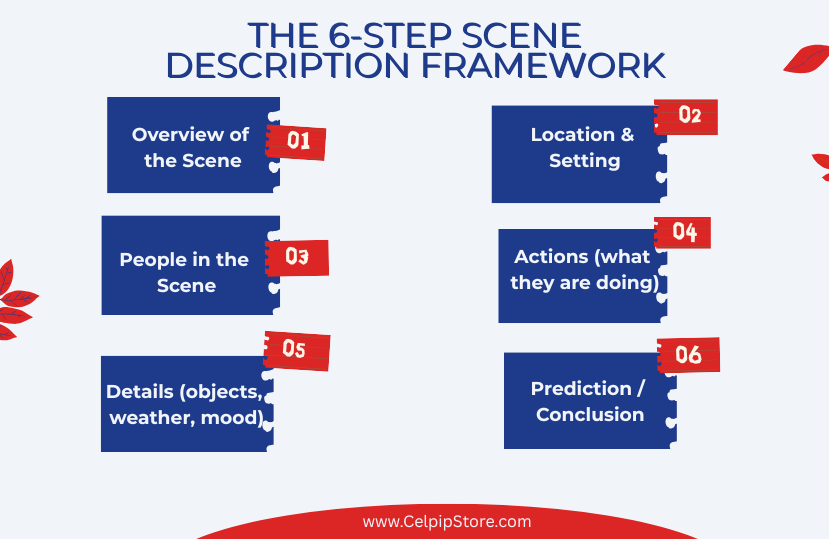
The CELPIPStore 6-Step Framework
Use this structure for almost every picture.
- Overview
- Foreground
- Background
- People
- Actions
- Overall Impression
This simple roadmap helps you speak naturally while keeping your description organized.
Step 1 – Give an Overview
Start with one or two sentences describing the entire scene.
Answer questions like:
-
Where is it?
-
What kind of place is it?
-
What appears to be happening?
Example
"This picture looks like a busy public park on a sunny afternoon. Several people are enjoying outdoor activities."
Avoid describing small details first.
Help the examiner understand the setting.
Step 2 – Describe the Foreground
Now move to the closest part of the picture.
Describe:
-
Large objects
-
Important people
-
Obvious activities
Example
"In the foreground, I can see a young boy flying a colourful kite while his father watches him."
Speak naturally.
You don't need to mention every object.
Step 3 – Describe the Background
Next, move farther away.
Talk about:
-
Buildings
-
Trees
-
Mountains
-
Crowds
-
Weather
-
Distant activities
Example
"In the background, there are several families walking along a path, and I can also see a playground filled with children."
This creates a smooth visual flow.
Step 4 – Focus on People
Now describe the people in the picture.
Mention:
-
Age (if obvious)
-
Clothing
-
Relationships
-
Emotions
-
Positions
Example
"An elderly couple appears to be sitting on a bench, smiling and talking to each other."
Avoid making unrealistic assumptions.
Instead of saying:
"They are celebrating their anniversary."
Say:
"They appear to be enjoying a pleasant conversation."
Use careful language.
Step 5 – Describe Actions
Explain what people seem to be doing.
Useful verbs include:
-
Walking
-
Running
-
Talking
-
Eating
-
Shopping
-
Reading
-
Laughing
-
Playing
-
Waiting
-
Taking Photographs
Example
"A woman seems to be taking photographs while two children are playing football nearby."
Using a variety of action verbs makes your description more dynamic.
Step 6 – Finish with an Overall Impression
End your answer by summarizing the atmosphere.
Examples:
"Overall, the park looks peaceful and family-friendly."
or
"Everyone seems relaxed and happy, so it appears to be a pleasant afternoon."
This gives your response a natural conclusion.
Use Careful Language
Remember:
You cannot know exactly what people are thinking.
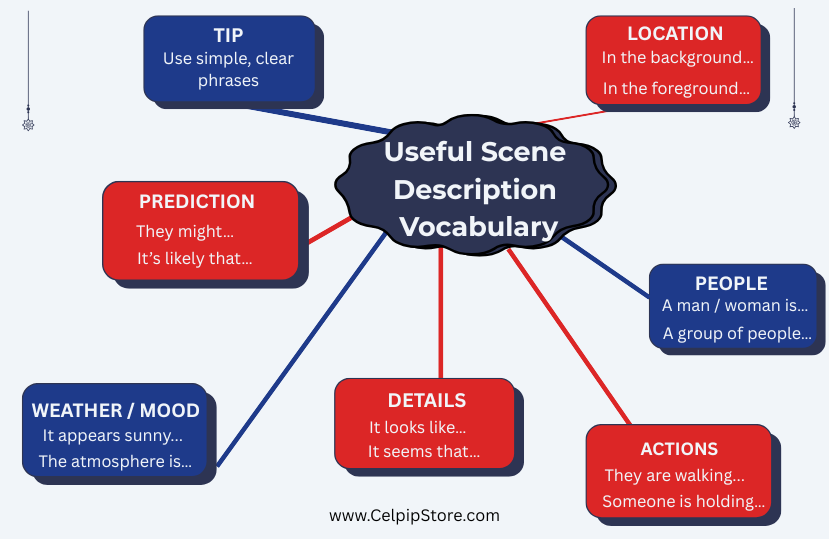
Instead of making definite statements, use expressions like:
- Appears to be...
- Seems to be...
- Looks like...
- Probably...
- Might be...
- Perhaps...
Example
Instead of:
"The man is waiting for a bus."
Say:
"The man appears to be waiting for a bus."
This sounds more accurate and professional.
Useful Direction Words
These expressions help organize your description.
Position
- In the foreground...
- In the background...
- On the left...
- On the right...
- In the middle...
- At the top...
- At the bottom...
- Near...
- Behind...
- Beside...
Sequence
- First...
- Next...
- Meanwhile...
- In addition...
- Finally...
These transitions help your ideas flow naturally.
Timing Your Response
A balanced Task 3 answer might look like this:
- Overview: 10–15 seconds
- Foreground: 20 seconds
- Background: 20 seconds
- People & Actions: 25–30 seconds
- Overall Impression: 10–15 seconds
This keeps your description balanced without spending too much time on one area.
Quick Exercise
Imagine you're looking at a picture of a busy beach.
Before speaking, quickly ask yourself:
- Where am I?
- What's happening overall?
- What do I see in the foreground?
- What's happening in the background?
- What are people doing?
- What's the overall atmosphere?
If you answer these six questions, you've already built a complete Task 3 response. To improve your overall speaking score, you should practise all 8 tasks, not just scene description. Read our complete CELPIP speaking guide for a full roadmap.
Expert Tip
Don't try to describe every object in the picture.
Instead, focus on the most noticeable people, actions, and features. A well-organized description of the important details is far more effective than a rushed list of everything you can see.
High-Scoring Sample Responses & Examiner Analysis
Now that you've learned the 6-Step Scene Description Framework, let's apply it to a realistic CELPIP-style picture.
Remember:
The goal is not to identify every object.
The goal is to help the examiner clearly imagine the scene.
Practice Picture
Imagine the following picture:
- A busy city park on a sunny afternoon.
- Children are playing near a fountain.
- Several people are walking dogs.
- A couple is sitting on a bench.
- Two cyclists are riding along a path.
- Trees, flowers, and tall buildings can be seen in the background.
Sample Response (Estimated Level 5–6)
"This picture looks like a park. I can see many people. There are children playing and some people walking. There are also bicycles and trees. In the background there are buildings. Everyone looks happy. It looks like a nice day."
Examiner Analysis
Strengths
- Clear overview
- Easy to understand
- Basic organization
Weaknesses
- Very limited vocabulary
- Few descriptive details
- Repetitive sentence structure
- Little explanation of actions
- Weak conclusion
Sample Response (Estimated Level 8–9)
"This picture appears to show a lively city park on a beautiful sunny afternoon. It looks like many families and friends have come to enjoy the pleasant weather.
In the foreground, I can see several children playing near a large fountain. They seem excited and are probably enjoying their time together. Nearby, a man is walking his dog while another person is riding a bicycle along the pathway.
In the middle of the picture, a couple is sitting on a bench, talking and smiling. They appear relaxed, and they might simply be enjoying the peaceful atmosphere.
In the background, there are colourful flowers, tall green trees, and several modern buildings that suggest this park is located in the middle of a busy city.
Overall, the entire scene looks cheerful, peaceful, and family-friendly. Everyone appears to be enjoying the warm weather and spending quality time outdoors."
Examiner Breakdown
Content
Excellent.
The candidate describes all the major parts of the picture without trying to mention every small object.
Organization
The response follows a logical order:
- Overview
- Foreground
- Middle
- Background
- Overall Impression
The listener can easily visualize the picture.
Vocabulary
Strong descriptive Strong vocabulary and fluency are important for all speaking tasks, not just Task 3. See how to improve them in our Ultimate CELPIP Speaking Guide.
- Lively
- Pleasant
- Peaceful
- Modern
- Colourful
- Family-friendly
- Atmosphere
The candidate avoids repeating the same words.
Grammar
Good sentence variety.
Accurate use of present continuous and descriptive language.
Fluency
- Natural pace
- Smooth transitions
- No abrupt topic changes
Communication
The description sounds conversational rather than like a checklist.
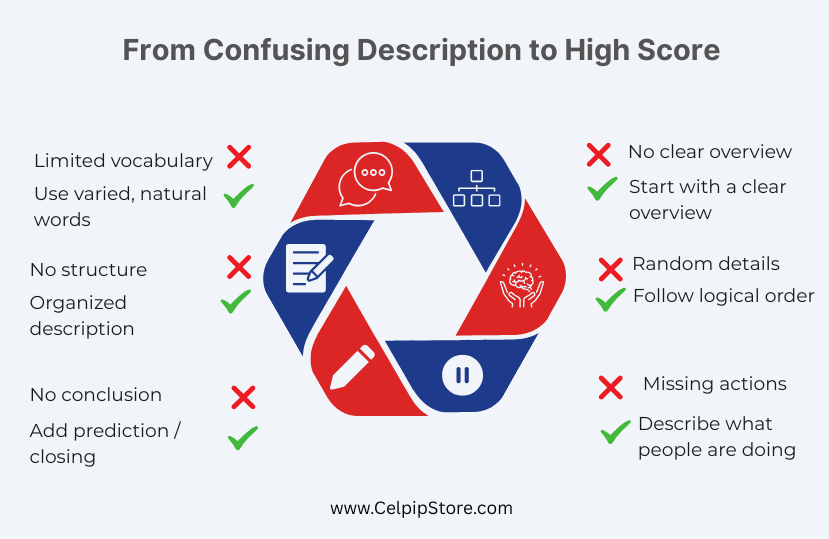
Why the Second Response Scores Higher
The picture itself didn't change.
The candidate simply:
- Described the scene in a logical order
- Used richer vocabulary
- Explained actions
- Avoided repetition
- And finished with an overall impression
These small improvements create a much stronger response.
Expand Your Description Naturally
If you still have time remaining, don't repeat what you've already said.
Instead, expand your description by talking about:
Weather
"The weather appears to be warm and sunny because everyone is wearing light clothing."
Emotions
"The children seem excited and energetic."
Relationships
"The couple might be close friends or family members."
Atmosphere
"The entire park has a calm and welcoming atmosphere."
Possible Reasons
"It could be the weekend because so many families are spending time together."
Notice the careful language:
- Appears
- Seems
- Might
- Probably
- Could
These expressions help you avoid making assumptions.
Descriptive Vocabulary
Weather
- Sunny
- Cloudy
- Windy
- Rainy
- Pleasant
- Warm
- Cool
Places
- Crowded
- Peaceful
- Busy
- Quiet
- Modern
- Spacious
- Colourful
People
- Smiling
- Laughing
- Relaxed
- Energetic
- Excited
- Focused
- Friendly
Actions
Instead of repeating "walking", try:
- Strolling
- Jogging
- Cycling
- Chatting
- Shopping
- Relaxing
- Exercising
- Enjoying
- Observing
- Taking photographs
A wider range of verbs makes your description sound more natural.
Mini Practice Challenge
Imagine a picture showing:
- A busy airport
- Families carrying luggage
- A child waving goodbye
- Flight information screens
- Staff helping passengers
Using the 6-Step Framework, think about:
- Overview
- Foreground
- Background
- People
- Actions
- Overall Impression
Try speaking for one full minute without stopping.
Self-Evaluation Checklist
After each practice recording, ask yourself:
- Did I start with an overview?
- Did I move through the picture logically?
- Did I describe actions, not just objects?
- Did I use "appears" or "seems" where appropriate?
- Did I include an overall impression?
- Did I avoid repeating the same words?
Your Complete Task 3 Success Plan
Congratulations!
You've now learned:
- What CELPIP Speaking Task 3 measures
- The 6-Step Scene Description Framework
- High-scoring sample responses
- Examiner expectations
- Useful vocabulary and transitions
Now let's turn that knowledge into a practical preparation routine.
Your 7-Day Task 3 Practice Plan
Consistent practice is the fastest way to improve picture description skills.
Here's a simple one-week plan.
Day 1 – Learn the Framework
Objective:
Memorize the 6-step structure.
Practice with five different pictures.
For each one, identify:
- Overview
- Foreground
- Background
- People
- Actions
- Overall Impression
Don't speak yet.
Just organize your ideas.
Day 2 – Describe Simple Pictures
Choose pictures showing:
- A park
- A classroom
- A beach
Speak for about one minute using the framework.
Don't worry about mistakes.
Focus on organization.
Day 3 – Build Better Vocabulary
Choose one picture.
Replace simple words.
Instead of:
"nice park"
Try:
"peaceful public park"
Instead of:
"people walking"
Try:
"people strolling along the pathway." These mistakes are common across multiple speaking tasks. Learn how to avoid them in our Ultimate CELPIP Speaking Guide.
Day 4 – Improve Observation
Look at one picture for only 20 seconds.
Then describe it without looking again.
This helps develop quick observation skills similar to the real exam.
Day 5 – Full Exam Practice
Complete five different Task 3 questions.
Use official timing.
No restarting.
Treat every response like the real CELPIP exam.
Day 6 – Listen to Your Recordings
Ask yourself:
- Did I start with an overview?
- Did I follow a logical order?
- Did I describe actions?
- Did I use varied vocabulary?
- Did I finish naturally?
Write down one improvement after every recording.
Day 7 – Compare Two Pictures
Describe two completely different scenes.
For example:
- Busy shopping mall
- Quiet countryside
Notice how the same framework works for both.
Daily Observation Exercise
Improve your description skills without studying.
Look around you.
Describe:
- Your office
- Your classroom
- A coffee shop
- A market
- Or a public park
Everyday observation strengthens your speaking ability.
Exam-Day Checklist
Before speaking, quickly ask yourself:
- Where is this?
- What's happening overall?
- What do I see first?
- What are people doing?
- What's happening in the background?
- What's the overall atmosphere?
If you answer these six questions, you'll already have a well-organized response.
Last-Minute Tips
Start Big
Always describe the entire scene first.
Never begin with tiny details.
Move Naturally
Describe the picture like your eyes are moving across it.
Avoid jumping randomly.
Use Careful Language
Instead of making assumptions:
Say:
- Appears to be...
- Seems to be...
- Looks like...
- Might be...
- Probably...
This sounds more natural and accurate.
Don't Panic About Unknown Objects
If you don't know the exact word,
Describe it.
Example:
"It looks like some kind of musical instrument."
Communication is more important than perfect vocabulary.
Keep Talking
If you finish early,
Expand by discussing:
- Weather
- Emotions
- Atmosphere
- Possible relationships
- Or background details
Never stop speaking too soon.
Frequently Asked Questions
Do I need to describe everything?
No.
Describe the most important people, actions, and objects.
Quality is more important than quantity.
What if I don't know a word?
Describe it using simpler language.
Never stay silent.
Can I guess what's happening?
Yes, but use careful language.
Say:
"They appear to be..."
Instead of:
"They are..."
unless it's obvious.
Should I invent details?
You may make reasonable observations, but avoid unrealistic assumptions. Stay believable.
Is organization important?
Yes, Organization is one of the biggest differences between average and high-scoring responses.
Quick Scene Formula
Whenever you practice Task 3, remember:
- Overview
- Foreground
- Background
- People
- Actions
- Overall Impression
This framework works for almost every CELPIP picture.
Your Task 3 Success Roadmap
- Observe
- Overview
- Describe Main Areas
- Explain Actions
- Use Careful Language
- Finish Naturally
- Practice Again
Repeat this process until it becomes automatic.
Continue Your CELPIP Speaking Journey
You've now mastered:
- Task 1 – Giving Advice
- Task 2 – Talking About a Personal Experience
- Task 3 – Describing a Scene
Next, we'll move to another important Speaking task:
CELPIP Speaking Task 4 – Making Predictions
You'll learn:
- How to predict future events confidently
- Useful future-tense vocabulary
- High-scoring sample answers
- Examiner expectations
- Common mistakes
- Practice activities
Final Thoughts
Many candidates think Task 3 is about having a large vocabulary.
In reality, it's about clear observation and logical organization.
If you can:
- Identify the overall scene
- Describe the important people and actions
- Move through the picture in a logical order
- And finish with a natural summary
You'll create a response that is easy for the examiner to understand. Want to master all CELPIP speaking tasks? Start with our Ultimate CELPIP Speaking Guide.
Remember:
You don't need to describe everything.
You simply need to describe the right things in the right order.
With regular practice, the 6-step framework will become second nature, allowing you to approach every picture calmly and confidently.