1.png)
CELPIP Writing Band 9 Vocabulary & Sentence Upgrade System
Introduction
Vocabulary is one of the most misunderstood parts of CELPIP Writing. Many students believe that using “difficult words” automatically leads to a higher score. This is not true.
In CELPIP, examiners are not impressed by rare or complex words. Instead, they look for clear, accurate, and natural English that communicates ideas effectively.
Your goal is not to sound like a dictionary. Your goal is to sound like a clear, confident communicator. While advanced vocabulary and sentence upgrade techniques are important for achieving a high score in CELPIP Writing, they must be used within a proper structure and task strategy. To understand how vocabulary, grammar, task response, and organization work together in both Task 1 and Task 2, you should also read our Ultimate CELPIP Writing Guide.
This lesson will give you a practical vocabulary system that improves your score without making your writing unnatural.
Key Learning Focus
By the end of this lesson, you will understand:
- How vocabulary is evaluated in CELPIP Writing
- What type of words increase your score
- How to replace weak words with stronger alternatives
- How to sound natural and professional at the same time
How CELPIP Actually Tests Vocabulary
CELPIP does NOT reward:
- Rare academic words used incorrectly
- Memorized “high-level” phrases without context
- Overly complex or unnatural sentences
Instead, it rewards:
- Correct word usage
- Clear meaning
- Natural sentence flow
- Appropriate tone (formal or semi-formal)
In simple terms: Accuracy matters more than difficulty. Vocabulary upgrade techniques are powerful, but they must be applied correctly within CELPIP Writing tasks such as Email Writing and Survey Response. Learn the complete Writing framework in our Ultimate CELPIP Writing Guide.
High-Scoring Vocabulary Strategy
To improve your writing score, focus on three layers of vocabulary:
1. Functional Vocabulary (Most Important)
These are everyday words used correctly in context.
Examples:
- request
- inform
- apologize
- arrange
- confirm
- suggest
These words are extremely powerful in Task 1 emails.
2. Academic Neutral Vocabulary (Task 2 Essential)
These words help you express opinions clearly.
Examples:
- advantage / disadvantage
- benefit / drawback
- impact
- significant
- effective
- solution
These improve clarity in essays without sounding unnatural.
3. Linking Vocabulary (Structure Support)
These words improve flow and coherence.
Examples:
- therefore
- however
- as a result
- in addition
- for instance
- on the other hand
These are essential for Band 8+ structure scores. To achieve a Band 8 or 9 in CELPIP Writing, vocabulary alone is not enough—you must also master task structure, clarity, and scoring criteria. Learn the full system in our CELPIP Writing Guide.
Weak vs Strong Vocabulary Examples
Weak Expression
“I think this is good for people.”
Improved Expression
“This can be highly beneficial for individuals.”
Weak Expression
“It is very important.”
Improved Expression
“It is extremely significant.”
Weak Expression
“This helps people.”
Improved Expression
“This provides substantial support to individuals.”
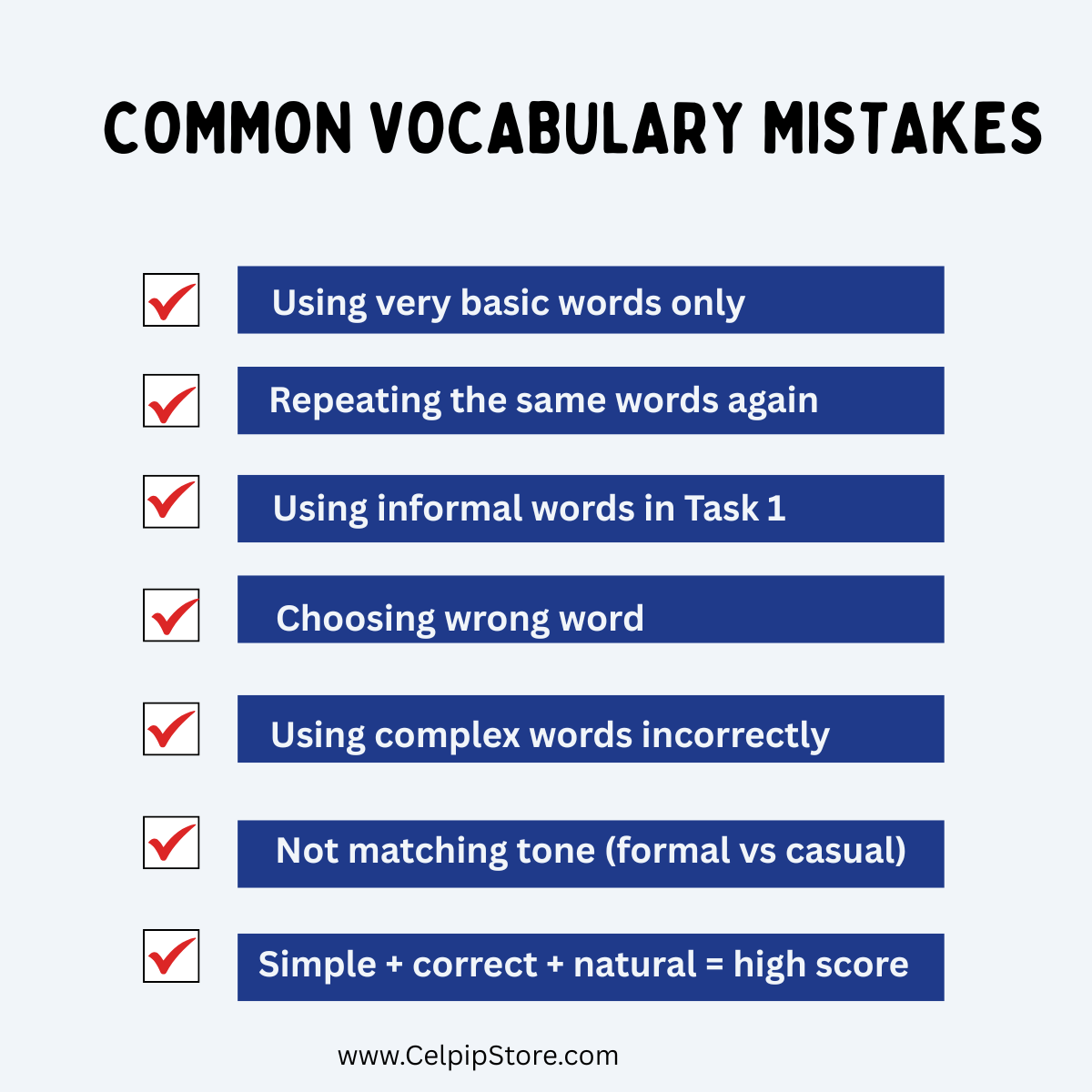
Common Vocabulary Mistakes
Students often lose marks because of:
- Using advanced words incorrectly
- Repeating the same basic words
- Memorizing phrases without understanding meaning
- Forcing unnatural vocabulary into sentences
Remember: Simple + correct is better than complex + wrong
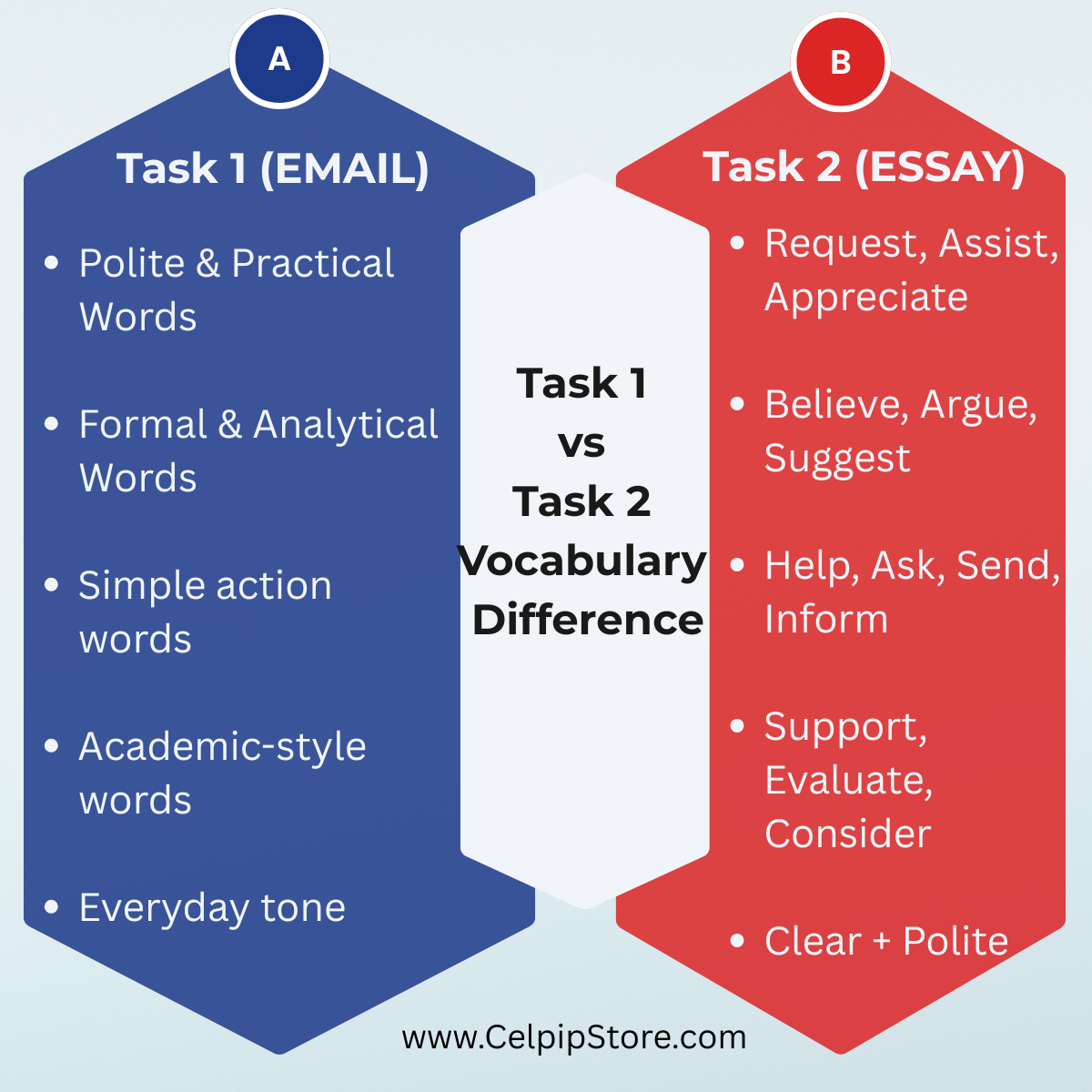
Task-Wise Vocabulary Strategy
Task 1 (Email Writing)
Use:
- polite expressions
- functional verbs
- simple formal tone
Examples:
- I would like to request…
- Could you please…
- I appreciate your assistance…
Task 2 (Essay Writing)
Use:
- opinion vocabulary
- comparison words
- logical connectors
Examples:
- I strongly believe…
- One major advantage is…
- This leads to…
Golden Rule
“Vocabulary should support meaning, not replace clarity.”
If your sentence is clear, your vocabulary is already strong enough.
Core Writing Framework (CELPIP Task 2 Master Structure 2026)
To consistently score Level 8–10, you must follow a fixed writing system. CELPIP Task 2 is not creative writing it is structured argument writing.
Use this 4-Paragraph Framework:
Paragraph 1: Introduction (Position + Choice)
Your introduction must be:
- Direct
- Clear
- Short
- Opinion-focused
Structure:
- Paraphrase the question
- State your choice
- Briefly mention why (optional)
Example:
In my opinion, offering flexible working hours is the most effective solution to improve employee productivity. This option provides employees with better control over their work schedule, leading to improved efficiency.
Paragraph 2: Reason 1 (Strongest Argument)
This is your most important paragraph.
You must:
- Start with a clear topic sentence
- Explain your reason in detail
- Add logical support or example
Example:
Firstly, flexible working hours significantly improve productivity because employees can work during their most focused and energetic time. As a result, they complete tasks more efficiently and produce higher-quality work. For example, many companies have reported better performance after allowing employees to choose their working hours.
Paragraph 3: Reason 2 (Secondary Argument)
This paragraph should support your opinion from a different angle.
Focus areas:
- Employee satisfaction
- Work-life balance
- Cost efficiency
- Long-term benefits
Example:
Secondly, flexible schedules improve employee satisfaction and reduce stress levels. When employees have control over their time, they are less likely to feel burnout, which leads to lower turnover rates and a more stable workforce.
Paragraph 4: Conclusion (Final Reinforcement)
Your conclusion should:
- Restate opinion
- Summarize reasons
- Stay brief
Example:
In conclusion, flexible working hours are the best option because they enhance productivity and improve employee well-being. Therefore, this solution should be implemented by the company.
Strategy 1: The “2-Reason Rule” (Very Important)
Do NOT write many ideas.
High-scoring answers follow:
- 1 clear opinion
- 2 strong reasons only
- Deep explanation of each reason
Weak Approach:
- 4–5 short reasons (no depth)
High Score Approach:
- 2 strong, well-developed reasons
Strategy 2: The “Depth Over Width” Method
CELPIP rewards explanation, not idea count.
Instead of writing:
- Many short points
You should write:
- Fewer points
- But fully explained ideas
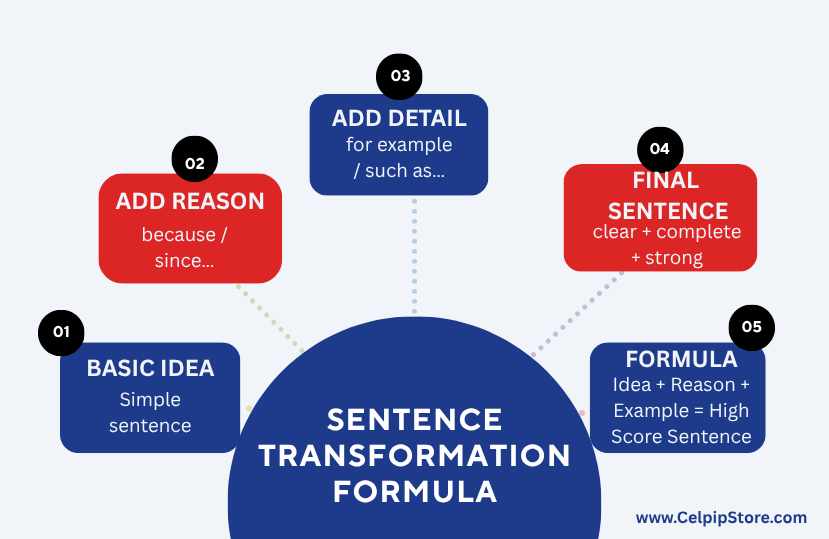
Example Transformation:
Weak:
Flexible hours are good for employees and companies.
Strong:
Flexible working hours improve productivity by allowing employees to work during their most efficient time, which results in higher focus and better quality output.
Strategy 3: Argument Expansion Formula
Use this formula to build strong paragraphs:
Point -> Explain -> Result -> Example
Example:
- Point: Flexible hours improve productivity
- Explain: Employees work when they are most focused
- Result: Work quality improves
- Example: Companies report higher performance after implementation
Strategy 4: Idea Selection Method
Choose options based on:
- Practicality
- Impact on people
- Long-term benefit
- Cost efficiency
- Workplace improvement
Avoid emotional choices like:
- “I like it more”
- “It feels better”
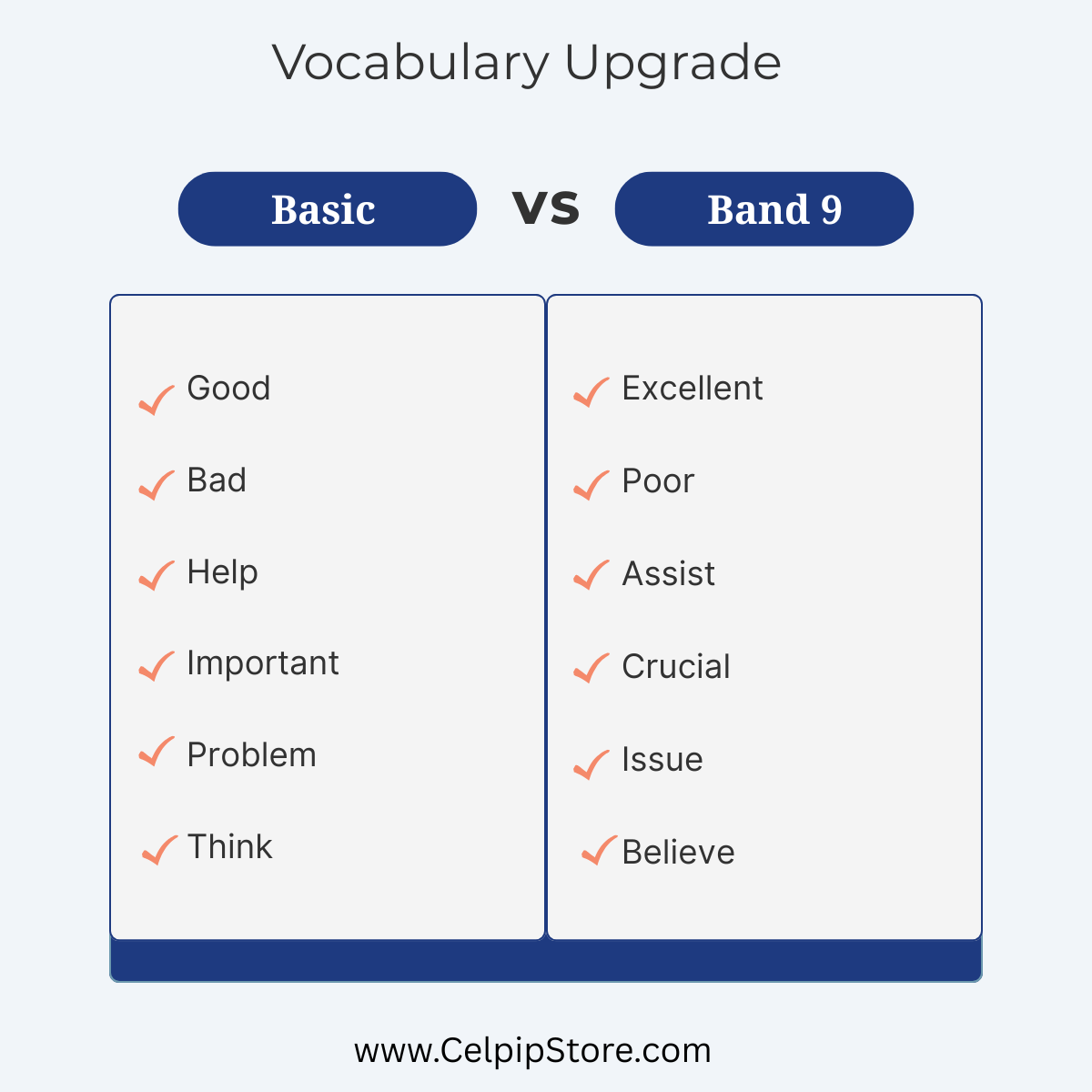
High-Scoring Vocabulary Upgrade
Use academic alternatives:
| Basic Word | Better CELPIP Word |
|---|---|
| Good | beneficial / effective |
| Help | enhance / improve |
| Bad | ineffective / problematic |
| Important | essential / crucial |
| Many | a significant number of |
Mini Example (Full Idea Flow)
Topic: Flexible Hours vs Salary Increase
Flexible working hours are the best option to improve employee productivity. Firstly, they allow employees to work during their peak focus hours, which increases efficiency and output quality. Secondly, flexible schedules reduce stress and improve job satisfaction, leading to better employee retention and long-term organizational stability. Therefore, this option is more effective than increasing salary alone.
Advanced Scoring Techniques (Level 9–10 Strategy)
At this stage, your goal is not just to “write correctly” but to write like a high-scoring candidate with controlled academic reasoning.
CELPIP examiners reward:
- Clear argument progression
- Strong logical development
- Natural academic tone
- Controlled sentence variety
Technique 1: The “Single Idea Expansion Rule”
High scorers do NOT jump between ideas.
Instead, they:
- Take ONE idea
- Expand it deeply
- Support it with logic + result
Weak Writing:
- Multiple short points
- No depth
Strong Writing:
- One idea fully developed
- Clear explanation + impact
Example:
Flexible working hours improve productivity because employees can align their tasks with their most productive time of day. This leads to better focus, fewer errors, and higher-quality output.
Technique 2: Examiner-Friendly Writing Style
Examiners prefer writing that is:
- Easy to follow
- Logically connected
- Not overly complex
- Natural but formal
Avoid:
- Overly complex sentences
- Forced vocabulary
- Unclear reasoning
Ideal Style:
- Simple + strong + clear
Example:
This option is beneficial because it improves both efficiency and employee satisfaction.
Technique 3: Idea Balance Strategy
Your response should feel balanced and structured:
- Paragraph 1 -> Opinion
- Paragraph 2 -> Strongest reason
- Paragraph 3 -> Secondary reason
- Paragraph 4 -> Conclusion
This creates a predictable scoring pattern, which CELPIP rewards.
Technique 4: Logical Connectors (Very Important)
Use connectors to improve flow:
Addition:
- Moreover
- Furthermore
- In addition
Reasoning:
- Because
- As a result
- Therefore
Contrast:
- However
- On the other hand
Conclusion:
- In conclusion
- Therefore
- To summarize
Examiner Insight: What They REALLY Look For
CELPIP examiners are trained to identify:
1. Clarity of Position
- Is your choice obvious?
2. Argument Strength
- Are your reasons logical or emotional?
3. Development Quality
- Do you explain ideas or just mention them?
4. Language Control
- Grammar accuracy matters more than complexity
Common High-Level Mistakes
Even advanced candidates lose marks due to:
- Overcomplicating sentences
- Using too many ideas
- Weak explanation depth
- Repetition of vocabulary
- Forgetting clear conclusion
Many candidates try to use advanced vocabulary but still lose marks due to weak structure and task response. These issues can be avoided by understanding the full Writing system in our Ultimate CELPIP Writing Guide.
Vocabulary Upgrade System (Level 8–10 Boost)
Workplace & Productivity Vocabulary:
- Efficiency -> productivity enhancement
- Job satisfaction -> employee well-being
- Stress -> work-related pressure
- Improve -> optimize / enhance
- Manage -> handle effectively
Argument Vocabulary:
- Reason -> justification / rationale
- Benefit -> advantage / positive outcome
- Problem -> drawback / limitation
- Important -> crucial / essential
Practice System (How to Master Task 2)
Step 1: Daily Practice (10–15 minutes)
- Choose 1 survey question daily
- Write 180–200 words
Step 2: Structure Focus
- Always use 4-paragraph system
- Never break structure
Step 3: Idea Development Drill
- Take 1 idea
- Expand it using Point -> Explain -> Result
Practice Example Task
A city wants to reduce traffic congestion. Which option is better?
Options:
- Improve public transport
- Increase parking fees
- Promote cycling
Your Task:
- Choose ONE option
- Write 2 strong reasons
- Use full structure
Summary: CELPIP Writing Task 2 Master System
CELPIP Writing Task 2 is a structured opinion-based writing task where success depends on clarity, reasoning, and organization not creativity or complex vocabulary.
To score high, you must:
- Choose ONE clear option
- Present a strong, direct opinion
- Develop 2 well-explained reasons
- Use logical structure and smooth flow
- Maintain formal, controlled language
The goal is simple:
Convince the examiner logically, not emotionally.
Final High-Scoring Structure (Quick Revision)
Paragraph 1: Introduction
- Paraphrase question
- State clear choice
Paragraph 2: Reason 1
- Strongest argument
- Explanation + result + example
Paragraph 3: Reason 2
- Second angle (different benefit)
- Clear development
Paragraph 4: Conclusion
- Restate opinion
- Summarize benefits
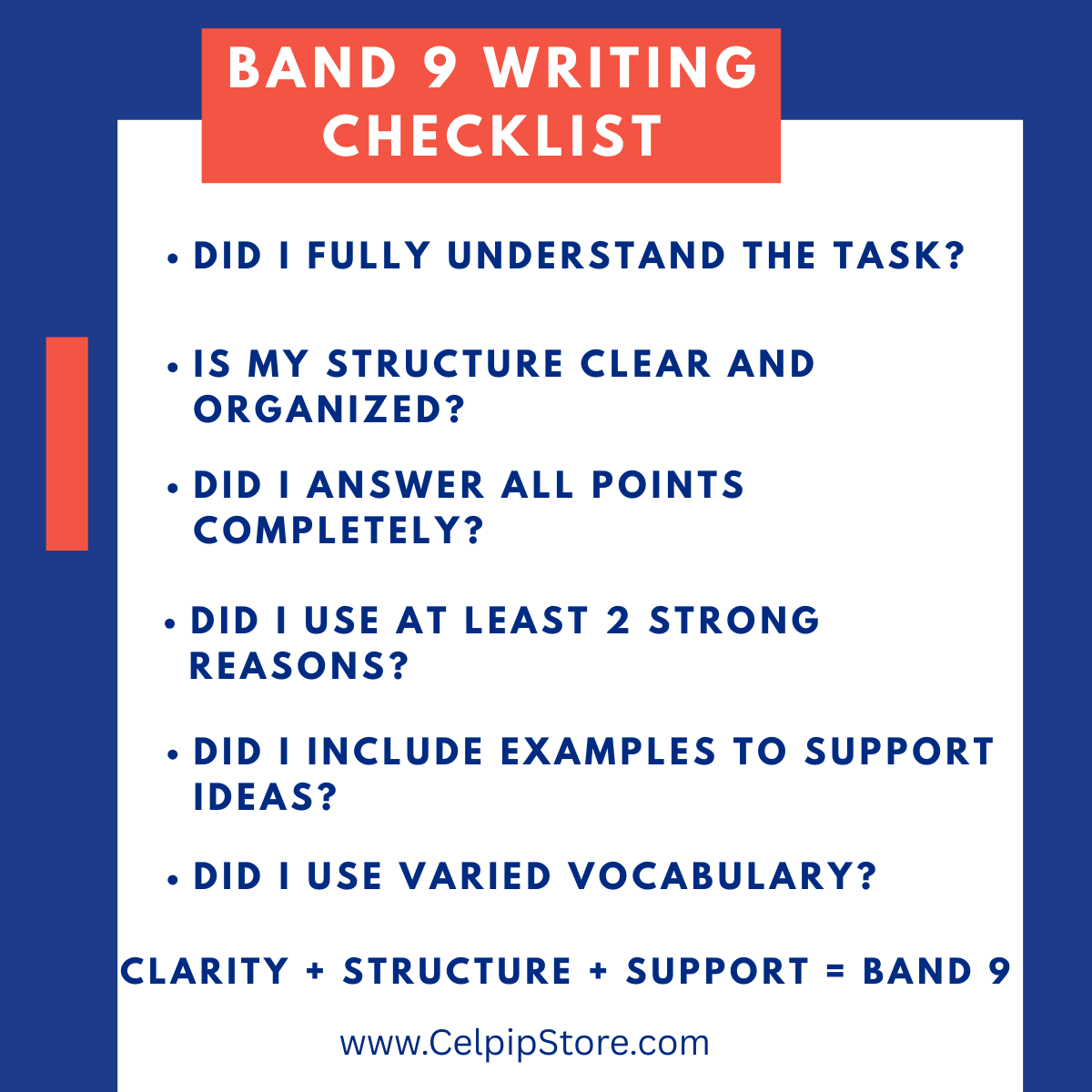
CELPIP Task 2 Final Checklist
Before submitting your answer, check:
Content
- Did I clearly choose ONE option?
- Did I avoid discussing all options equally?
- Are my reasons logical and relevant?
Structure
- Do I have 4 clear paragraphs?
- Is each idea separated properly?
Development
- Did I explain each reason deeply?
- Did I avoid repeating ideas?
Language
- Is my tone formal?
- Did I avoid informal expressions?
- Are my sentences grammatically correct?
FAQs: CELPIP Writing Task 2
Q1: Can I choose more than one option?
No. You must choose ONE option and defend it strongly.
Q2: How many reasons should I write?
Two strong reasons are enough. Depth is more important than quantity.
Q3: Do I need examples in every paragraph?
Not required, but examples improve clarity and score.
Q4: What is the ideal word count?
- Minimum: 150 words
- Ideal: 180–220 words
- Do not overwrite unnecessarily
Q5: Can I use informal language?
No. Always use formal or semi-formal tone.
7-Day Practice Plan (CELPIP Task 2 Mastery)
Day 1–2: Structure Training
- Practice writing only introductions + conclusions
Day 3–4: Reason Building
- Write 2 full reasons using Point -> Explain -> Result
Day 5: Full Essay Practice
- Write 1 complete Task 2 response daily
Day 6: Timing Practice
- Complete writing in 25–26 minutes
Day 7: Mock Test
- Simulate real exam conditions
Pro Tip for Band 9+
High scorers don’t write more they write cleaner and clearer arguments.
Focus on:
- Logic over complexity
- Structure over creativity
- Clarity over vocabulary overload
Final Conclusion
Mastering CELPIP Writing Task 2 requires a system, not memorization.
If you consistently apply:
- 4-paragraph structure
- 2 strong reason system
- Point -> Explain -> Result method
- Formal academic tone
You will naturally move toward Level 8–10 performance. To master CELPIP Writing completely, vocabulary and sentence upgrades must be combined with strong task strategy, structure, and scoring awareness. For a complete guide to all Writing tasks and strategies, start with our Ultimate CELPIP Writing Guide.