CELPIP Speaking Task 1: Giving Advice | Tips, Strategy & Sample Answers
Introduction
The first task of the CELPIP Speaking Test asks you to give advice to someone facing a real-life problem. At first glance, this sounds simple. After all, we give advice to friends, family members, classmates, and colleagues all the time.
However, many candidates lose marks because they misunderstand what the examiner expects. Some give advice without explaining why it is helpful.
Others spend too much time describing the situation instead of offering practical solutions. Some provide only one suggestion and finish too early. CELPIP Speaking consists of 8 different tasks, each testing a different communication skill. To understand all tasks and scoring, read our Ultimate CELPIP Speaking Guide.
The good news is that Task 1 follows a predictable pattern. Once you learn a simple framework, you'll be able to answer almost any advice question confidently even if you've never seen the topic before. This guide will show you exactly how.
What Is CELPIP Speaking Task 1?
In this task, you'll imagine that someone has asked for your advice. You'll receive a short description of a situation and then record your response.
The person may need help making a decision, solving a problem, or choosing between different options. Task 1 is only one part of the full speaking test. You can explore all 8 tasks and their strategies in our complete CELPIP speaking guide. Your role is to respond as if you're speaking directly to that person. The best responses sound supportive, practical, and realistic.
Real-Life Situations You May See
Topics can include situations such as:
- Choosing a university program
- Finding a new apartment
- Preparing for an important interview
- Managing work and study
- Improving health
- Saving money
- Planning a vacation
- Solving a disagreement with a friend
- Starting a new job
- Learning English more effectively
Although the topics change, the communication skill remains the same:
Can you give helpful advice that is easy to understand and supported with logical reasons?
Why Candidates Find Task 1 Difficult
Many learners think they need to provide the "perfect" solution.
That's not true.
There is usually no single correct answer.
Examiners are not judging whether your advice is the best possible advice.
They are evaluating how well you communicate your recommendation.
The quality of your English communication matters far more than the actual advice you choose.
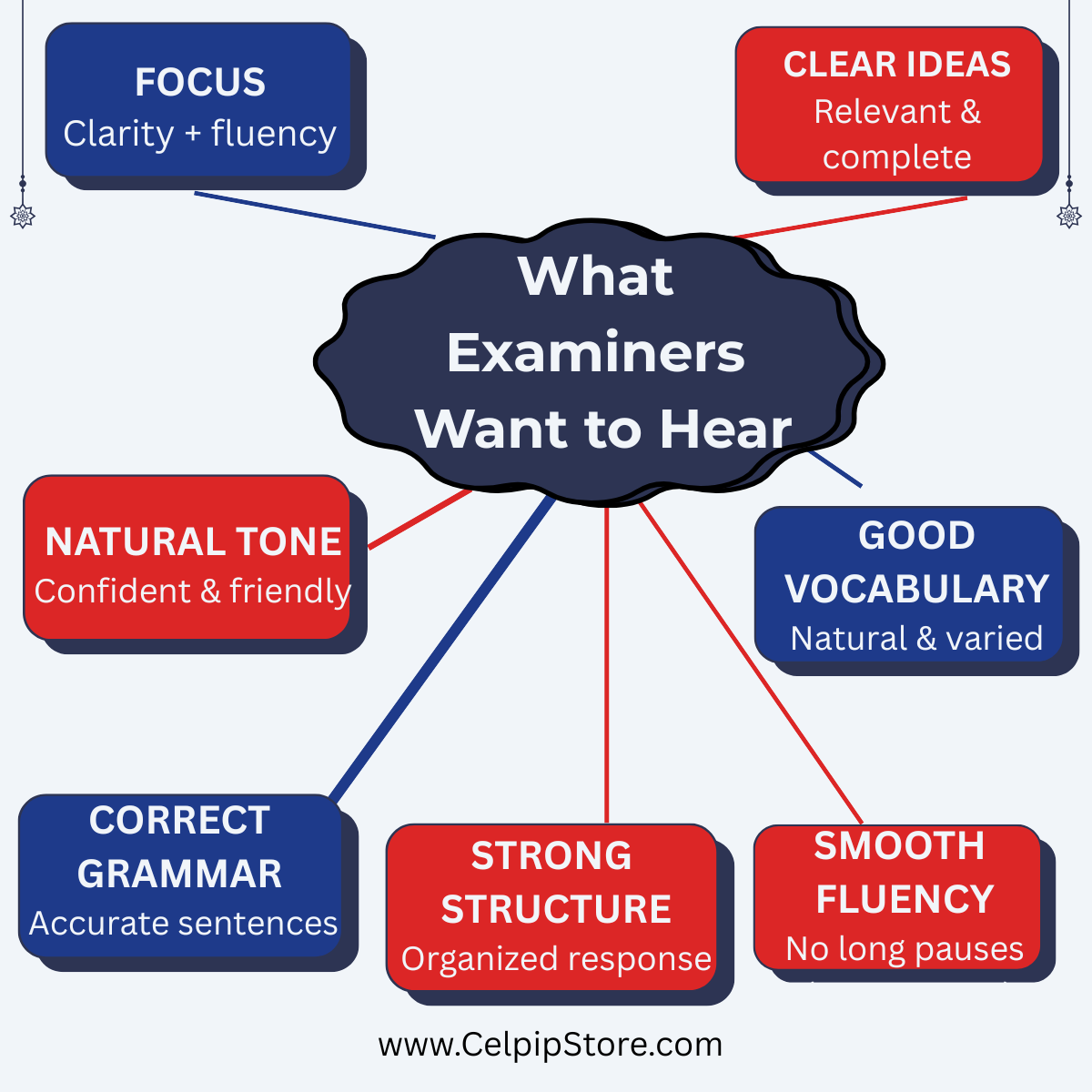
What Examiners Are Looking For
Strong Task 1 responses usually include five elements:
1. A Clear Recommendation
Tell the listener exactly what you think they should do.
Avoid vague answers.
2. Logical Reasons
Explain why your advice makes sense.
Support your recommendation with clear reasoning.
3. Practical Examples
Examples make your advice more convincing.
Personal experiences or realistic situations work well.
4. Organized Communication
Present your ideas in a logical order.
Avoid jumping randomly from one idea to another.
5. Positive Tone
Advice should sound encouraging.
Even when discussing a difficult situation, maintain a helpful and respectful tone.
Common Types of Advice Questions
Although the wording changes, most Task 1 questions fall into a few familiar categories.
Education
Helping someone choose a course, improve grades, or manage studies.
Career
Giving advice about jobs, interviews, promotions, or workplace challenges.
Relationships
Helping friends, family members, or colleagues solve personal problems.
Lifestyle
Advice about health, hobbies, finances, travel, or time management.
Decision Making
Helping someone compare options before making an important choice.
Recognizing these categories helps you think of ideas more quickly during the preparation time.
The Biggest Myth About Task 1
Many candidates believe they must give three or four different pieces of advice.
In reality, one strong recommendation explained well is often much more effective than several weak suggestions.
Quality always beats quantity.
Building Confidence
Task 1 is actually one of the easiest speaking tasks to improve because people naturally give advice in everyday conversations.
Whenever a friend asks:
"What should I do?"
You're already practicing the same communication skill the CELPIP exam measures.
The goal is simply to make that advice more organized, detailed, and persuasive.
Step-by-Step Strategy for CELPIP Speaking Task 1: Giving Advice
Now that you understand what Task 1 measures and what examiners expect, let's focus on the most important question:
How should you actually answer a Giving Advice question?
Many candidates know what they want to say but struggle to organize their thoughts under time pressure.
The solution isn't memorizing answers.
It's learning a simple framework that works for almost every advice question.
Understanding the Flow of Task 1
Every successful Task 1 response follows a logical conversation.
Imagine a friend asks:
"I'm not sure what to do. Can you give me some advice?"
You probably wouldn't immediately start listing ideas.
Instead, you would naturally:
- Understand the problem
- Recommend something
- Explain why
- Give an example
- And encourage them
That's exactly what CELPIP examiners expect.
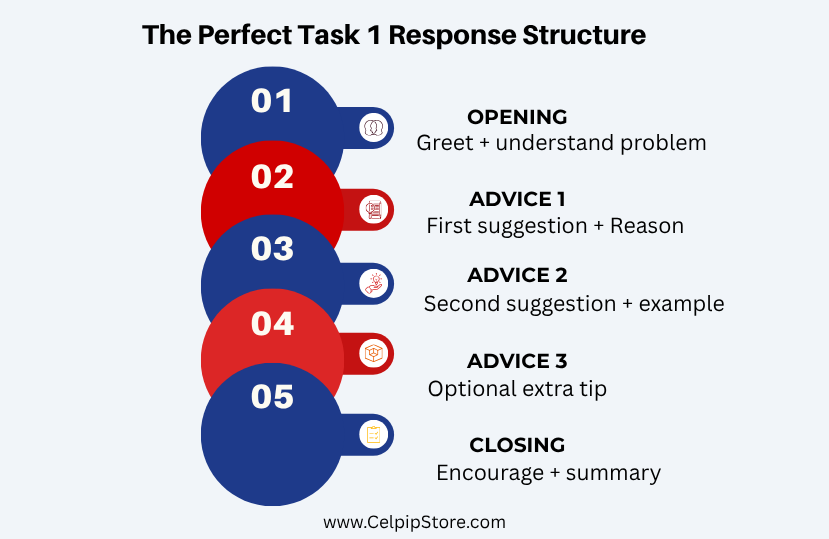
The 5-Step Winning Framework
Instead of memorizing scripts, remember this structure:
Acknowledge the Situation
Give Your Main Advice
Explain Why
Support with an Example
Finish Positively
This framework works for almost every Task 1 question.
Step 1 – Acknowledge the Situation
Begin by showing that you understand the person's problem.
You don't need to repeat the entire question.
Simply recognize the situation naturally.
Useful Expressions
- "I understand why you're worried."
- "That sounds like a difficult decision."
- "I can see why you're unsure."
- "If I were in your position..."
- "Thanks for asking for my advice."
This creates a friendly, conversational tone.
Step 2 – Give Your Recommendation Immediately
Don't make the listener wait.
State your main advice early.
Good Examples
- "I think you should accept the new job."
- "My advice would be to continue your studies."
- "I'd recommend talking to your manager first."
- "If I were you, I'd choose the second option."
Notice that each sentence is direct and confident.
Step 3 – Explain Your Reasoning
This is where many candidates lose marks.
Don't just say:
"You should exercise more."
Explain why.
For example:
"You should exercise more because regular physical activity improves your health, reduces stress, and gives you more energy throughout the day."
Reasons make your advice convincing.
Step 4 – Add an Example
Examples make your response sound realistic.
You can use:
- Personal Experience
- Family
- Friends
- Coworkers
- Or a realistic situation
Example
"One of my friends started exercising three times a week, and after a few months he felt much healthier and more confident."
Realistic examples are perfectly acceptable.
Step 5 – End Positively
Finish with encouragement.
Positive endings leave a strong impression.
Useful Closing Expressions
- "I'm sure everything will work out."
- "I hope this advice helps."
- "Best of luck with your decision."
- "Whatever you choose, I'm confident you'll do well."
Never stop speaking abruptly.
A confident ending makes the response feel complete.
Managing Your Preparation Time
The preparation time passes quickly.
Don't try to write complete sentences in your head.
Instead, identify four things:
- Problem
- Advice
- Reason
- Example
- That's enough
When the recording begins, expand naturally.
Time Management During Your Response
A balanced response might look like this:
First 15–20 Seconds
Understand the situation and give your recommendation.
Next 30–40 Seconds
Explain why your advice makes sense.
Final 20–30 Seconds
Give an example and finish positively.
This simple balance keeps your answer organized without feeling rushed.
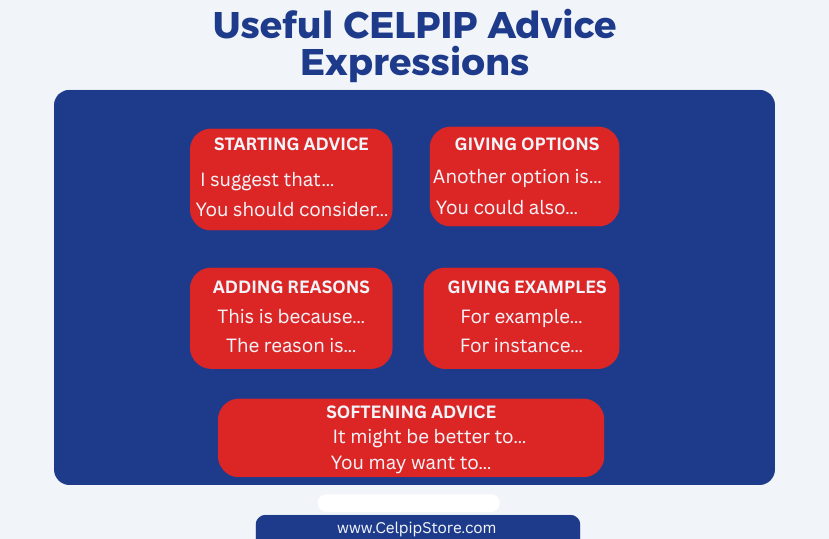
Useful Language for Giving Advice
Instead of repeating:
"You should..."
Use a variety of natural expressions.
Strong Recommendations
- "If I were you..."
- "I'd strongly recommend..."
- "The best option would be..."
- "One thing I'd definitely suggest is..."
- "In my opinion, you should..."
Explaining Reasons
- "The main reason is..."
- "This is important because..."
- "One advantage is..."
- "That would help because..."
Giving Examples
- "For example..."
- "A good example would be..."
- "I experienced something similar..."
- "Someone I know..."
Ending
- "I hope everything goes well."
- "Good luck with your decision."
- "I believe you'll make the right choice."
Using different expressions makes your English sound more natural and demonstrates a wider vocabulary.
How High-Scoring Candidates Think
Average candidates ask themselves:
"What should I say?"
High-scoring candidates ask:
"How can I explain my advice clearly?"
That small change makes a big difference.
Remember:
The examiner is evaluating your communication not your ability to solve the world's problems.
What to Do If You Can't Think of an Idea
Don't panic.
Choose the first reasonable solution that comes to mind.
Then explain it well.
For example:
Instead of searching for the "perfect" answer,
Simply choose:
"I think you should talk to your teacher."
Now spend the rest of your response explaining why that is a good idea.
Simple advice with excellent explanation usually scores better than complicated advice with weak development.
Mini Practice Activity
Imagine your friend says:
"I've received two job offers. One pays more money, but the other offers better career growth. What should I do?"
Using the framework, your notes might look like this:
Problem:
Two job offers
Advice: Choose career growth
Reason: Better future opportunities
Example: Higher salary can come later
Closing: Wish them success
Notice how you only prepare keywords not full sentences.
High-Scoring Sample Answers, Examiner Analysis & Practice
Now that you understand the strategy for Task 1, let's put everything together.
Reading sample answers is useful.
Understanding why they score well is even more valuable.
In this section, you'll learn how examiners evaluate responses and how small improvements can significantly increase your CELPIP Speaking score.
Practice Question
Your friend has recently started a new job but feels overwhelmed by the workload. They are thinking about quitting after only two weeks. What advice would you give?
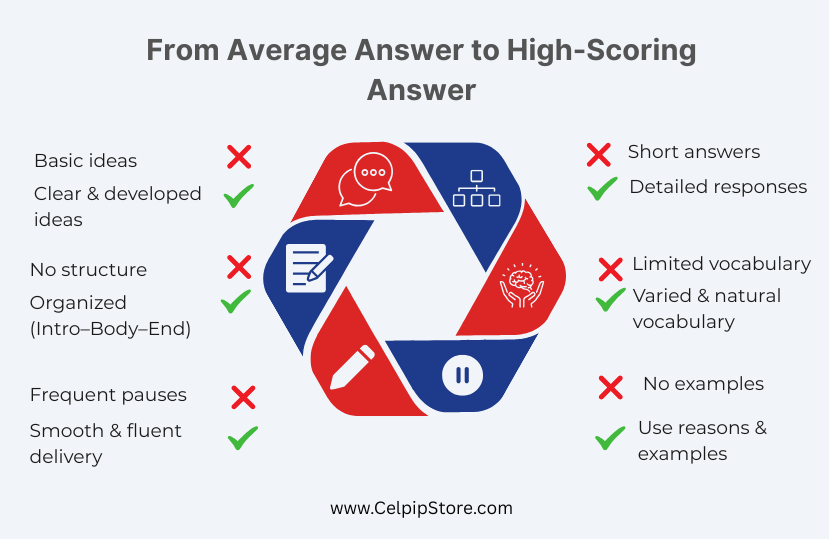
Sample Response (Estimated Level 5–6)
"I think you should not quit your job. Every new job is difficult in the beginning. You should work hard and learn more. Maybe after some time you will feel comfortable. You can also ask your coworkers for help. I hope everything becomes better."
Examiner Analysis
Strengths
- Gives clear advice
- Easy to understand
- Positive conclusion
Weaknesses
- Very short
- Limited vocabulary
- Few supporting details
- No personal example
- Ideas are not fully developed
Estimated Score
CELPIP Level 5–6
Sample Response (Estimated Level 8–9)
"If I were you, I wouldn't resign so quickly. Starting a new job is always challenging because you're learning new responsibilities and meeting new people. I think you should give yourself at least a few months before making such an important decision.
You could also speak with your manager if the workload feels overwhelming. Most employers understand that new employees need time to adjust.
One of my friends experienced something very similar. During his first month, he wanted to quit because everything felt stressful. However, after a few weeks he became much more confident and now really enjoys his job.
I believe you'll probably have the same experience if you stay patient. Good luck, and I'm sure things will improve."
Examiner Breakdown
Content
Excellent.
The candidate fully answers the question.
Organization
- Ideas flow naturally
- Advice
- Reason
- Additional suggestion
- Example
- Positive conclusion
Vocabulary
Uses varied expressions naturally.
Examples:
- Overwhelming
- Responsibilities
- Adjust
- Experienced
- Confident
Grammar
Mostly accurate.
Good variety of sentence structures.
Fluency
Natural conversational rhythm.
No unnecessary repetition.
Communication
Very convincing.
The advice sounds realistic and supportive.
Estimated Score
CELPIP Level 8–9
What Makes the Second Answer Better?
Notice the difference.
The advice itself isn't dramatically different.
Both candidates recommend staying in the job.
The difference lies in how the advice is communicated.
The higher-scoring response:
- Explains the recommendation
- Develops ideas
- Includes an additional suggestion
- Provides a realistic example
- Ends with encouragement
This demonstrates stronger communication skills.
Advanced Tips for Higher Scores
Tip 1 – Think Like a Friend
Don't sound like you're reading from a textbook.
Imagine someone genuinely asked for your help.
Speak as you naturally would.
Tip 2 – Give Reasons Before Examples
Good communication usually follows this order:
- Advice
- Reason
- Example
- Conclusion
Avoid jumping directly into examples.
Tip 3 – Use Positive Language
Instead of saying:
"That's a terrible idea."
Say:
"I think a better option would be..."
Professional, respectful language creates a stronger impression.
Tip 4 – Expand Naturally
Whenever you finish an idea, ask yourself:
"Why?"
Then answer it.
This simple habit helps you develop longer, more detailed responses.
Tip 5 – Vary Your Advice Expressions
Avoid repeating:
"You should..."
Mix different expressions. To improve your overall speaking score, it’s important to practise all tasks, not just Task 1. Read our Ultimate CELPIP Speaking Guide for a complete roadmap.
Examples:
- I'd recommend...
- If I were you...
- One thing I'd suggest...
- It might be better to...
- Have you considered...
- My advice would be...
This creates more natural speech.
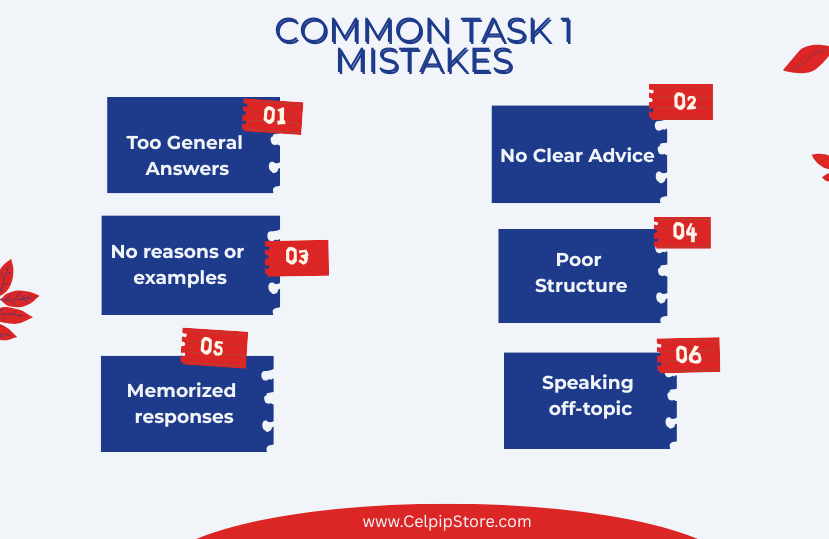
Common Mistakes
Repeating the Question
Question:
"What advice would you give?"
Poor response:
"My advice is my advice would be..."
Start immediately.
Giving Too Many Ideas
Trying to discuss four or five different solutions usually creates confusion.
One well-developed recommendation is much stronger.
Speaking Without Structure
Jumping between ideas makes responses difficult to follow. Similar structured approaches are used across all speaking tasks. Learn the complete framework in our CELPIP speaking strategies guide.
Always organize your thoughts before speaking.
No Example
Advice becomes much stronger when supported by a realistic situation.
Finishing Too Early
If you still have time
Add:
- Another reason
- Another example
- Or a final encouraging statement
Avoid long silence.
Vocabulary Upgrade
Instead of using the same basic words repeatedly, try these alternatives.
|
Basic |
Better |
|
good |
beneficial, helpful, worthwhile |
|
bad |
challenging, difficult, risky |
|
job |
career, position, opportunity |
|
help |
support, assist, guide |
|
think |
believe, recommend, suggest |
|
problem |
issue, challenge, difficulty |
|
choose |
select, decide on, consider |
Use these naturally.
Don't force them into every answer.
Practice Challenge 1
Your cousin wants to improve their English before moving to Canada.
Give them advice.
Try to include:
- One recommendation
- Two reasons
- One example
- One encouraging conclusion
Record yourself and listen to your response.
Practice Challenge 2
Your friend spends too much time on social media and isn't studying enough for the CELPIP exam.
Give advice using the five-step framework.
After finishing, ask yourself:
- Did I answer the question directly?
- Did I explain my recommendation?
- Did I include an example?
- Did I sound supportive?
Self-Evaluation Checklist
After every practice response, rate yourself from 1 to 5.
This habit helps you identify specific areas for improvement instead of practicing without direction.
- Clear recommendation
- Logical reasons
- Relevant example
- Organization
- Fluency
- Vocabulary variety
- Positive conclusion
Your Complete Task 1 Success Plan
Congratulations!
You've now learned:
- What CELPIP Speaking Task 1 measures
- What examiners expect
- A proven response framework
- High-scoring sample answers
- Common mistakes to avoid
- Advanced communication strategies
Now let's turn everything into a practical action plan that you can use every day until your exam.
Your 7-Day Task 1 Practice Plan
One of the biggest mistakes candidates make is practicing randomly.
Instead, follow this structured plan.
Day 1 – Learn the Structure
Objective:
Understand the five-step framework.
Practice:
Read five Task 1 questions.
Without speaking, simply write:
- Advice
- Reason
- Example
- Conclusion
Focus on organizing ideas quickly.
Day 2 – Improve Fluency
Objective:
Speak continuously.
Practice:
Answer three Task 1 questions.
Don't worry about mistakes.
Your goal is to avoid long pauses.
Record yourself.
Day 3 – Improve Vocabulary
Objective:
Replace simple words with stronger expressions.
Practice using phrases such as:
- I'd recommend...
- One possible solution...
- If I were you...
- A better option would be...
Use different expressions in every response.
Day 4 – Build Better Examples
Objective:
Support every recommendation.
Practice:
Answer four Task 1 questions.
Every answer must include at least one example.
Examples may come from:
- Yourself
- Friends
- Family
- Work
- School
- A realistic situation
Day 5 – Practice Under Exam Conditions
Objective:
Develop confidence.
Complete five Task 1 questions using official timing.
No stopping.
No restarting.
Treat every answer like the real exam.
Day 6 – Self-Evaluation
Listen to your recordings.
Ask yourself:
- Did I answer the question?
- Did I explain my advice?
- Was my example relevant?
- Was I organized?
- Did I finish confidently?
Write down one improvement for each recording.
Day 7 – Full Review
Choose your three weakest recordings.
Record them again.
Compare both versions.
You'll be surprised how much you've improved in only one week.
Daily Speaking Habits
Improvement doesn't only happen while studying.
Practice English throughout your day.
For example:
While driving
Pretend someone asks for advice
Answer aloud
While watching YouTube
Pause the video
Imagine the speaker asks
"What would you do?"
Respond immediately
These small habits build confidence naturally
Exam-Day Checklist
Before the recording begins, remember these five questions.
- Do I understand the problem?
- What is my main recommendation?
- Why is it a good idea?
- What example will I use?
- How will I end positively?
If you can answer these questions, you're ready to speak.
Last-Minute Tips
Don't Chase Perfect Grammar
Minor grammar mistakes won't destroy your score.
Stopping communication will.
Keep speaking.
Don't Memorize
Memorized answers sound unnatural.
Flexible ideas score higher.
Don't Panic
If you forget one word,
explain it differently.
Communication is always more important than vocabulary.
Speak Naturally
Imagine you're helping a friend.
Friendly communication sounds far more convincing than formal speeches.
Frequently Asked Questions
How long should my response be?
Use as much of the available speaking time as possible.
Don't finish too early.
Can I give only one piece of advice?
Yes.
One recommendation explained well is usually stronger than several undeveloped suggestions.
What if I can't think of a good example?
Create a realistic one.
The example doesn't have to be true.
It only needs to sound believable.
Should I use difficult vocabulary?
No.
Use vocabulary you can pronounce confidently and accurately.
Natural communication is always better.
What if my advice is different from another candidate's?
That's perfectly fine.
There is rarely only one correct answer.
Examiners evaluate your communication not your opinion.
Can I change my advice while speaking?
It's better to stay consistent.
If you change your opinion halfway through, your response may become confusing.
Quick Review Formula
Whenever you practice Task 1, remember this formula:
- Understand
- Recommend
- Explain
- Give an Example
- Encourage
If every response follows this flow, your communication will become much clearer. Want to master all CELPIP speaking tasks? Start with our Ultimate CELPIP Speaking Guide.
Your Task 1 Success Roadmap
Understand the Situation
Choose One Strong Recommendation
- Explain Why
- Support with an Example
- Speak Naturally
- Finish Positively
- Review Your Recording
- Improve Every Day
Every practice session moves you one step closer to your target CELPIP score.
Continue Your CELPIP Speaking Journey
Now that you've mastered Task 1 – Giving Advice, it's time to move to the next speaking task.
Next Guide:
CELPIP Speaking Task 2 – Talking About a Personal Experience
You'll learn:
- How to tell engaging stories
- How to organize events chronologically
- How to describe emotions naturally
- How to avoid running out of ideas
- High-scoring sample responses
- Examiner analysis
- Practice exercises
Together, these guides will help you master every speaking task with confidence.