CELPIP Speaking Task 5: Comparing and Persuading
After learning how to describe (Task 3) and predict (Task 4), you now move to a more advanced communication skill comparing options and persuading someone to choose one. This is exactly what you do in real life when you recommend a product, suggest a plan, or convince a friend.
Many students find Task 5 challenging because they are unsure how to organize their ideas. They often talk about both options without making a clear choice, or they fail to sound convincing. The key to success in this task is not complex vocabulary it is clear structure, strong reasoning, and confident delivery. Task 5 is one of the eight speaking tasks in the CELPIP Speaking test. To understand all eight tasks, their strategies, and how they work together, read our Ultimate CELPIP Speaking Guide.
What Is CELPIP Speaking Task 5?
In this task, you are given two options and a situation. Your goal is to choose one option and persuade someone that your choice is better. You must compare both options, but your main focus should be on supporting your preferred choice. Task 5 is only one part of the complete CELPIP Speaking test. For an overview of all eight speaking tasks and the strategies required for each one, explore our complete CELPIP Speaking guide.
Task Requirements:
- You will see two options
- You must choose one
- You must explain why it is better
- You must sound convincing and logical
Time Structure:
- Preparation Time: 60 seconds
- Speaking Time: 60 seconds
Task 4 vs Task 5 (Critical Difference)
Understanding this transition is important for your overall speaking performance.
Key Shift:
- Task 4 - Predict what will happen
- Task 5 - Compare options and persuade
You are moving from prediction + decision-making + persuasion. Understanding the differences between individual tasks is important, but you should also understand the complete Speaking section. Learn about all eight tasks in our Ultimate CELPIP Speaking Guide.
_vs_TASK_5_(COMPARE_PERSUADE).png "TASK_4_(PREDICT)_vs_TASK_5_(COMPARE_PERSUADE).png")
What Examiners Want
Examiners are looking for your ability to present a clear opinion and support it with logical reasons. A strong answer is not just descriptive it is convincing and well-structured.
A High-Scoring Response Includes:
- A clear choice (no confusion)
- Logical comparison of both options
- Strong reasons supporting your choice
- Smooth transitions between ideas
- Confident and natural delivery
Why Candidates Lose Marks
Many candidates lose marks because they do not understand the purpose of persuasion. Instead of convincing the listener, they simply describe both options equally or speak without a clear direction.
Common Issues:
- Not choosing an option clearly
- Talking equally about both options
- Weak or unclear reasons
- Lack of persuasive language
- Poor structure and organization
Without persuasion, your answer sounds incomplete.
The Biggest Mistake
The most common mistake in Task 5 is trying to be “neutral.”
Many students think they should describe both options equally. This reduces clarity and weakens their response.
Example:
“Option A is good. Option B is also good. Both are useful.”
This is not persuasive.
Better Approach:
“Although both options have benefits, I strongly recommend Option A because it is more practical and cost-effective.”
Always choose clearly and defend your choice.
Learning Objectives
By the end of this lesson, you will be able to:
- Compare two options clearly
- Choose one option confidently
- Use persuasive language effectively
- Organize your response logically
- Speak fluently for 60 seconds
- Avoid common mistakes in Task 5
Why Task 5 Is a High-Scoring Opportunity
Task 5 allows you to show advanced communication skills. Unlike earlier tasks, you are not just describing—you are expressing opinions and influencing decisions. This gives you a chance to demonstrate higher-level vocabulary, better organization, and stronger fluency.
Key Advantage:
- You control the direction of your answer
- You can expand ideas freely
- You can demonstrate confidence and clarity
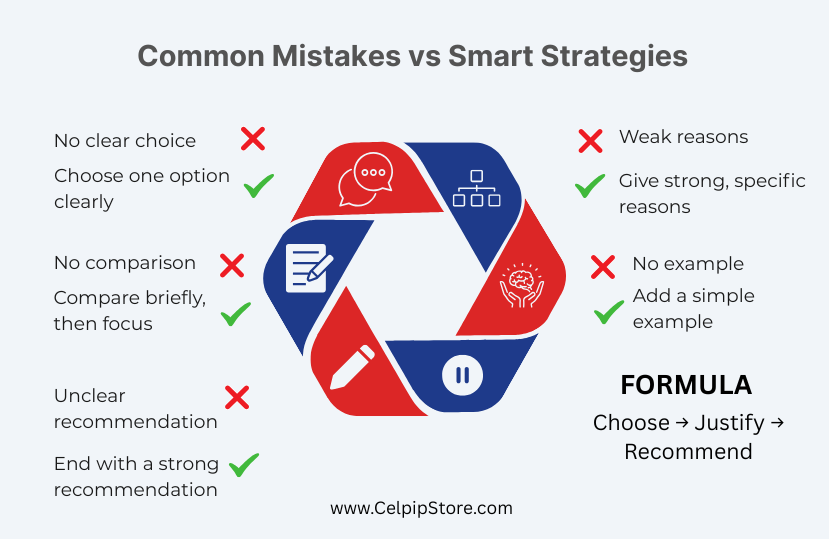
Common Mistakes in Task 5
Understanding these mistakes will help you avoid losing marks.
Mistake 1: Not Choosing an Option
Some candidates talk without making a clear decision.
- Weak: “Both options are good.”
- No persuasion
Mistake 2: Equal Comparison
- Talking about both options equally reduces your impact.
- Focus more on your chosen option
Mistake 3: Weak Reasons
Saying “it is better” without explanation is not enough.
- Weak: “Option A is better.”
- Better: “Option A is better because it saves time and is more convenient.”
Mistake 4: No Persuasive Language
Without persuasive words, your answer sounds flat.
Use expressions like:
- I strongly recommend
- I believe
- In my opinion
- The best choice is
Mistake 5: Poor Structure
- Jumping between ideas makes your answer confusing.
- You need a clear framework (coming in Part 2)
Mistake 6: Speaking Too Little
- Some candidates finish early.
- Always speak for the full
Avoiding mistakes in Task 5 is important, but a strong CELPIP Speaking score requires preparation across all eight tasks. Explore our complete CELPIP Speaking guide for task-by-task strategies and tips.
The CELPIPStore Persuasion Framework
Now that you understand the purpose of Task 5, the next step is to learn how to structure your answer effectively. Many candidates struggle because they talk without direction or fail to sound convincing. A clear framework helps you organize your thoughts, present strong arguments, and speak confidently for the full 60 seconds.
The CELPIPStore Persuasion Framework is a simple and powerful method that ensures your response is logical, structured, and persuasive.
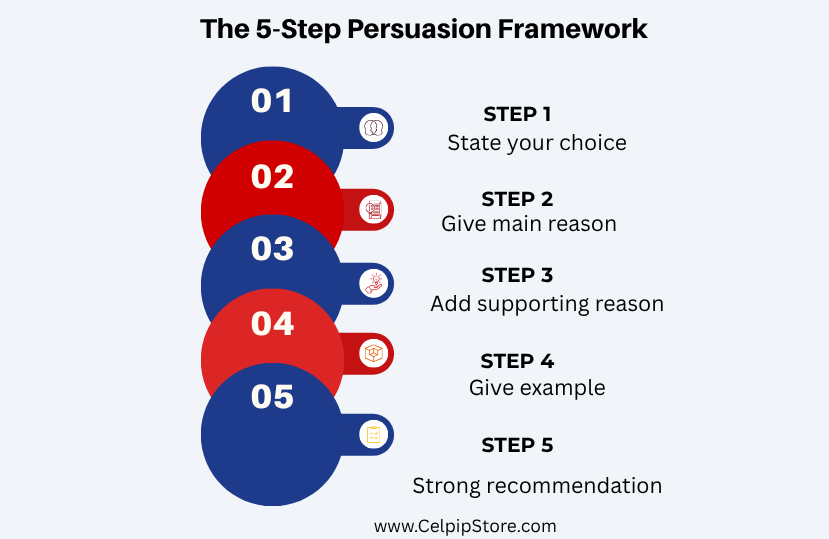
The 5-Step Persuasion Structure
A high-scoring response in Task 5 follows a clear flow. You introduce the situation, clearly choose an option, compare briefly, give strong reasons, and conclude confidently.
Step 1: Introduce the Situation
Start by briefly restating the situation and showing that you understand the task. Keep this short and natural.
Example:
“If I had to choose between these two options, I would definitely recommend one of them based on practicality and convenience.”
Step 2: Clearly Choose One Option
You must clearly state your choice early in your response. This shows confidence and direction.
Example:
“I strongly recommend Option A.”
Step 3: Briefly Compare Both Options
Mention both options, but do not spend equal time on them. Your goal is to show why your chosen option is better.
Example:
“Although Option B has some benefits, it is not as practical as Option A.”
Step 4: Give Strong Reasons (Main Part)
This is the most important part of your answer. You should give 2–3 strong reasons and explain them clearly.
How to Expand:
- Explain benefits
- Add examples
- Show impact
Example:
“Option A is more convenient because it saves time and requires less effort. In addition, it is more affordable, which makes it suitable for most people.”
Step 5: Conclude Confidently
End your response with a strong and clear conclusion. This reinforces your argument.
Example:
“For these reasons, I believe Option A is clearly the better choice.”
Simple Speaking Template
To make your response easier, you can follow this flexible template.
Template:
- If I had to choose, I would recommend…
- Although…, I believe… is better because…
- First,…
- Also,…
- Another reason is…
- For these reasons,… is the best option
This template helps you stay organized and persuasive.
High-Scoring Example Answer
Let’s apply the framework to a real scenario.
Example Scenario
Choose between:
- Working from home
- Working in an office
Sample Answer
“If I had to choose between working from home and working in an office, I would strongly recommend working from home. Although working in an office allows better face-to-face interaction, working from home is much more convenient and flexible. First, it saves a lot of time because you do not need to commute every day. This extra time can be used for personal activities or rest. In addition, working from home is more comfortable, as you can create your own workspace. Another important reason is cost savings, since you spend less on transportation and food. For these reasons, I believe working from home is clearly the better option.”
Why This Answer Works
This response is effective because it is structured, clear, and persuasive. The speaker makes a strong choice, compares both options briefly, and provides logical reasons supported by explanation.
Strengths:
- Clear decision
- Logical comparison
- Strong reasons
- Smooth transitions
- Confident conclusion
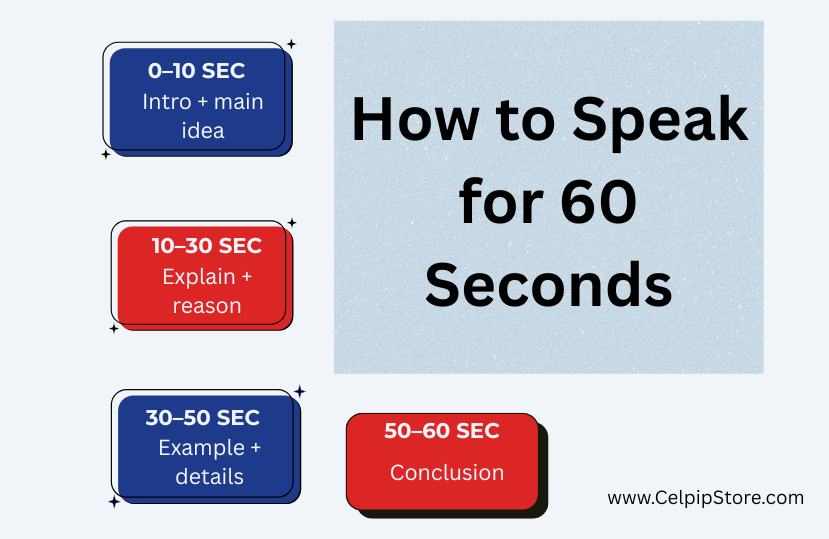
Strategy to Speak for 60 Seconds
Many candidates finish too early. The key is to expand your reasons naturally instead of repeating ideas.
Practical Strategy
- Give at least 2–3 reasons
- Explain each reason clearly
- Add examples or consequences
- Use connectors to continue speaking
Advanced Tips to Achieve a High Score
Once you understand the structure of Task 5, the next step is to improve the quality of your response. High-scoring candidates do not just compare options they sound confident, persuasive, and natural. The difference between an average and a high score often comes from how well you explain your ideas, connect your arguments, and use effective language.
To score higher, you must focus on clarity, variety, and persuasion rather than trying to use complicated vocabulary. These strategies can help you improve Task 5, but mastering the entire Speaking section requires a task-by-task approach. See our Ultimate CELPIP Speaking Guide for strategies covering all eight speaking tasks.
Key Advanced Strategies
These strategies will help you sound more convincing and organized.
1. Use Strong Opinion Language
Your response should clearly show your opinion from the beginning. Weak language makes your answer sound uncertain.
Use:
- I strongly recommend
- I firmly believe
- In my opinion
- The best option is
Example:
“I strongly recommend Option A because it is more practical and efficient.”
2. Develop Each Reason Fully
Do not just list reasons explain them clearly. This helps you speak longer and sound more logical.
Structure:
- Reason
- Explanation
- Benefit
Example:
“Option A saves time because you do not need to travel, which allows you to focus more on your work.”
3. Use Comparison Language Effectively
You should briefly compare both options to show why your choice is better.
Useful Phrases:
- better than
- more convenient than
- more effective than
- unlike Option B
Example:
“Option A is more convenient than Option B because it requires less effort.”
4. Add Real-Life Logic
Your ideas should sound realistic and practical. Avoid extreme or unrealistic claims.
Focus on:
- daily life situations
- practical benefits
- realistic outcomes
5. Maintain a Persuasive Tone
You are not just speaking you are convincing someone.
Tips:
- Speak confidently
- Avoid hesitation
- Use clear reasoning
- Sound natural, not robotic
Examiner Insights: What Really Matters
Understanding how your response is evaluated helps you focus on what actually improves your score.
What Examiners Evaluate
1. Content
- Did you clearly choose one option?
- Are your reasons logical and relevant?
2. Coherence
- Are your ideas organized clearly?
- Do your points connect smoothly?
3. Vocabulary
- Do you use a range of persuasive expressions?
- Are your words natural and appropriate?
4. Grammar
- Are your sentences clear and mostly correct?
- Do you avoid major errors?
5. Fluency
- Do you speak continuously?
- Do you avoid long pauses?
What Examiners Do NOT Care About
Many candidates worry about the wrong things.
Examiners do NOT evaluate:
- Perfect or “fancy” vocabulary
- Extremely complex ideas
- Speaking like a native speaker
They care about clear, confident communication.
High-Impact Vocabulary for Persuasion
Using the right vocabulary makes your answer sound more professional and convincing.
Opinion Expressions
- I strongly believe
- I would definitely recommend
- In my opinion
- The best choice is
Comparison Language
- better than
- more effective than
- more practical than
- unlike
Reasoning Language
- because
- since
- due to
- as
Result Expressions
- Therefore
- As a result
- This means that
- For this reason
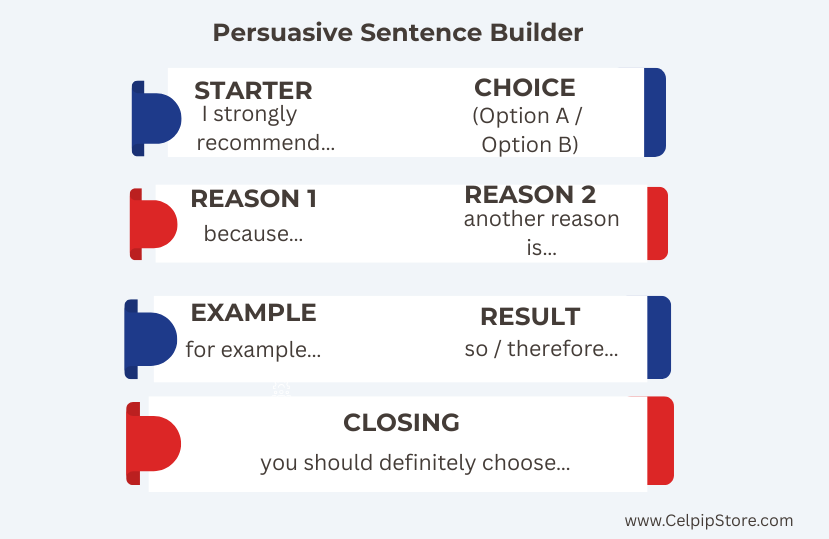
Example Combination
“I strongly recommend Option A because it is more convenient than Option B, so it saves both time and effort.”
From Average to High-Scoring Answer
Let’s compare two responses to understand the difference.
Average Answer
“Option A is good. Option B is also good. I think both are useful.”
Problems:
- No clear choice
- No persuasion
- Weak reasoning
- Poor structure
High-Scoring Answer
“I strongly recommend Option A because it is more convenient and saves time. Although Option B has some advantages, it requires more effort and is less practical. For this reason, Option A is clearly the better choice.”
Strengths:
- Clear decision
- Logical comparison
- Strong reasoning
- Persuasive tone
Practice Questions
To improve your skills, practise with different real-life scenarios.
Practice Scenario 1
Choose between:
- Studying at home
- Studying in a library
Think About:
- Which is more effective?
- Which is more comfortable?
- Which helps concentration?
Practice Scenario 2
Choose between:
- Buying a car
- Using public transport
Think About:
- Cost
- Convenience
- Time
Practice Scenario 3
Choose between:
- Watching a movie at home
- Watching a movie in a cinema
Think About:
- Experience
- Cost
- Comfort
Practice Challenge
Now apply what you have learned.
Task:
- Choose one option
- Give at least 2–3 reasons
- Compare briefly
- Speak for 60 seconds
Summary
CELPIP Speaking Task 5 tests your ability to compare two options and persuade someone to choose one. Unlike earlier tasks, this requires you to express a clear opinion, support it with strong reasons, and communicate confidently. A high-scoring response follows a structured approach: introduce the situation, choose one option clearly, compare briefly, explain your reasons, and conclude with confidence. By focusing on clarity, logical thinking, and persuasive language, you can deliver a strong and effective response within 60 seconds.
Task 5 Quick Checklist
Use this checklist before and during your exam to stay focused and organized.
During Preparation Time:
- Understand both options clearly
- Decide which option is better
- Think of 2–3 strong reasons
During Speaking:
- Start with a clear choice
- Briefly compare both options
- Focus more on your chosen option
- Give strong reasons with explanation
- Use persuasive language
- Speak for the full 60 seconds
Language Focus:
- Use opinion phrases (I strongly recommend, I believe)
- Use comparison words (better than, more convenient)
- Use connectors (because, therefore, in addition)
- Avoid repeating simple sentences
Frequently Asked Questions (FAQs)
1. What is CELPIP Speaking Task 5?
It is a task where you compare two options and persuade someone to choose one.
2. How is Task 5 different from Task 4?
Task 4 focuses on predicting the future, while Task 5 focuses on making a decision and persuading someone.
3. Should I talk about both options equally?
No, you should briefly mention both, but focus more on your chosen option.
4. How long should I speak?
You should speak for the full 60 seconds without stopping early.
5. What type of language should I use?
Use persuasive and opinion-based language such as I strongly recommend and in my opinion.
6. What are common mistakes?
Common mistakes include not choosing clearly, giving weak reasons, and lacking structure.
7. Can I change my opinion during speaking?
No, you should stay consistent with your choice throughout your response.
8. How can I improve quickly?
Practice regularly, use a clear framework, and record your responses for self-evaluation.
7-Day Practice Plan
Consistent practice is key to mastering Task 5. Follow this structured plan to improve quickly.
Day 1–2:
- Understand the task format
- Practise choosing between two options
Day 3–4:
- Use the persuasion framework
- Focus on giving strong reasons
Day 5:
- Practise speaking for full 60 seconds
- Record and review your answers
Day 6:
- Improve vocabulary and persuasive expressions
- Use varied sentence structures
Day 7:
- Take a full speaking practice test
- Evaluate your performance
Final Tips for Success
To succeed in Task 5, focus on being clear, confident, and persuasive. Do not try to use complicated ideas. Instead, choose one option quickly, explain your reasons logically, and support your ideas with simple examples. Maintain a natural speaking pace, avoid hesitation, and use connectors to keep your response smooth. With regular practice and the right structure, you can turn this task into a strong scoring opportunity.
Conclusion
CELPIP Speaking Task 5 becomes much easier when you understand how to organize your ideas and present them confidently. By combining comparison, reasoning, and persuasion, you can deliver a well-structured response that impresses examiners. This task not only improves your test performance but also builds real-life communication skills.