_Master_Tasks_1_22.png)
The Ultimate CELPIP Writing Guide
Introduction
Writing is one of the four language skills tested in CELPIP, and it requires more than simply knowing English grammar. In the Writing section, you need to communicate your ideas clearly, organize information logically, choose appropriate language, and respond directly to the situation presented in the question. A strong response should feel natural, purposeful, and easy for the reader to understand.
The CELPIP Writing section contains two tasks. Task 1 focuses on writing an email, while Task 2 requires you to respond to a survey question. Although the situations are different, both tasks test your ability to communicate effectively in written English.
Many learners make the mistake of treating CELPIP Writing as a vocabulary test. They try to use complicated words, memorize large numbers of expressions, or copy a fixed template into every answer. However, successful writing depends much more on relevant ideas, organization, development, vocabulary, grammar, and appropriate tone.
The goal of this guide is to give you a complete roadmap for CELPIP Writing. You will learn what each task requires, how to organize your response, how to develop your ideas, how to manage your time, and how to avoid the mistakes that commonly prevent learners from reaching their target score.
Think of this article as your main CELPIP Writing classroom. The supporting lessons in this series will then take you deeper into individual skills and strategies. CELPIP Writing Task 1 is the first and most important writing task, where candidates are required to write a clear and structured email based on a given situation. To understand this task in detail, including structure, tone, and examples, you can read our complete guide on CELPIP Writing Task 1: Writing an Email.
CELPIP Writing Task 2 is an important part of the Writing section, but it is only one component of the complete exam. To understand both Task 1 (Email Writing) and Task 2 (Survey Response) along with scoring criteria, structure, and overall strategies, you should also study our Ultimate CELPIP Writing Guide.
The two writing tasks in CELPIP may look similar, but they require completely different strategies, structures, and scoring approaches. To clearly understand how Task 1 (Email Writing) and Task 2 (Survey Response) differ in terms of format, tone, and evaluation criteria, you should also read our detailed comparison guide on CELPIP Writing Task 1 vs Task 2 Complete Strategy Comparison.
What You Will Learn in This Guide
By the end of this guide, you should have a clear understanding of how to approach both CELPIP Writing tasks and how to build an effective preparation routine.
You will learn how to:
- Understand the CELPIP Writing format
- Identify what each task is asking you to do
- Plan your response before you start writing
- Organize your ideas logically
- Develop ideas with explanations and relevant details
- Choose an appropriate tone and level of formality
- Use vocabulary naturally and accurately
- Improve sentence variety and grammatical accuracy
- Manage your writing time effectively
- Recognize common writing mistakes
- Understand the main areas that affect your writing performance
- Practise efficiently instead of simply writing more essays
- Review and improve your own responses
Most importantly, you will learn how to approach Writing Tasks 1 and 2 with a repeatable strategy rather than depending on memorized answers.
Understanding CELPIP Writing
Before learning advanced techniques, you need to understand what you are actually being asked to accomplish.
CELPIP Writing consists of two different communication situations.
Task 1: Writing an Email
In Task 1, you write an email based on a specific situation. You may need to make a request, explain a problem, provide information, make a complaint, offer a suggestion, or communicate with someone about a practical situation.
The important point is that you are writing for a specific purpose and reader.
Your language should therefore match the relationship between you and the person receiving the email.
For example, an email to a manager may require a more professional tone than an email to a close friend.
Task 2: Responding to Survey Questions
Task 2 asks you to respond to a survey question by choosing or supporting a position and explaining your reasons.
The task gives you an opportunity to demonstrate how effectively you can present an opinion, organize supporting ideas, and communicate your reasoning.
A strong response should not simply announce your choice. You should develop your ideas so the reader understands why you have selected that position. While Task 1 and Task 2 are both part of the CELPIP Writing test, they differ significantly in purpose, structure, and marking criteria. Understanding these differences is crucial for avoiding mistakes and improving your score. For a clear side-by-side comparison, read our Task 1 vs Task 2 strategy guide.
One of the most important factors in achieving a high score in CELPIP Writing is using advanced vocabulary and well-structured sentences that clearly express ideas. To learn how to upgrade your writing from basic to advanced Band 8–9 level, you can follow our CELPIP Writing Band 9 Vocabulary & Sentence Upgrade System.
One of the most important skills in CELPIP Writing Task 2 is developing clear ideas and strong arguments with proper supporting reasons and examples. Without strong idea development, even correct grammar and structure will not lead to a high score. To learn how to build powerful arguments and organize ideas effectively, you can follow our CELPIP Writing Task 2 Ideas & Argument Development System.
One of the most important factors in achieving a high score in CELPIP Writing is effective time management. Many candidates know what to write but lose marks because they cannot complete both tasks within the given time. To learn how to divide time properly between Task 1 and Task 2 and manage the exam efficiently, you should follow our CELPIP Writing Time Management & Exam Strategy System.
The Most Important Principle
Whether you are writing an email or responding to a survey, remember this:
Answer the question first. Then make your English work for your message.
This means you should not begin by thinking:
“What impressive vocabulary can I use?”
Instead, think:
“What does the reader need to understand?”
Then choose the vocabulary, grammar, tone, and organization that communicate that message effectively.
CELPIP Writing Is About Communication
Imagine that you are writing to a real person.
If you are complaining about a service, your reader needs to understand:
- What happened
- Why you are dissatisfied
- What you expect
- What action you want
If you are responding to a survey, your reader needs to understand:
- Which option you support
- Why you support it
- How your reasons support your position
This communication-focused approach makes your writing more natural and helps you avoid unnecessary information. Proper planning and time allocation are essential for completing CELPIP Writing tasks successfully. Without time control, even well-written answers may remain incomplete. Learn a complete strategy in our Writing Time Management System guide.
The Five Building Blocks of Strong Writing
Although many factors contribute to a successful response, you can think of CELPIP Writing as being built around five major areas.
1. Task Fulfilment
You need to address the instructions and communicate the required information.
2. Organization
Your ideas should follow a logical order, with clear paragraphs and connections between ideas.
3. Vocabulary
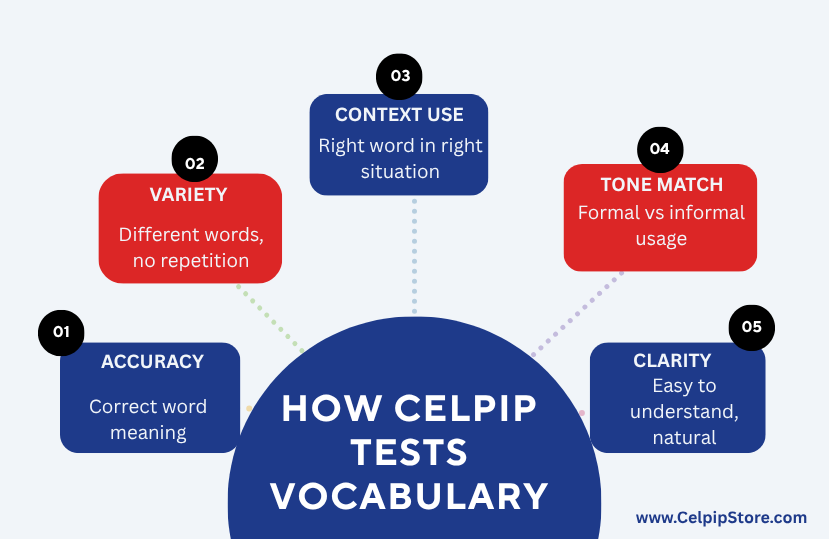
Your word choices should be appropriate, accurate, and varied enough to communicate your meaning effectively.
4. Readability and Grammar
Your sentences should be understandable and demonstrate appropriate grammatical control.
5. Tone and Style
Your language should match the situation, purpose, and intended reader.
These areas work together. Excellent vocabulary cannot rescue an answer that does not address the task. Similarly, perfect grammar cannot compensate for ideas that are poorly organized or insufficiently developed.
Task 1 focuses on writing a professional or semi-formal email based on real-life situations such as requests, complaints, or explanations. For a step-by-step breakdown of structure, tone, and sample answers, see our detailed guide on CELPIP Writing Task 1: Writing an Email.
Common Mistakes in CELPIP Writing
Before learning the correct strategies, it is useful to understand what commonly goes wrong.
Many writing problems are not caused by a lack of English knowledge. They happen because students misunderstand the task, rush their planning, or fail to review their writing.
Mistake 1: Not Answering Every Part of the Prompt
This is one of the most important mistakes to avoid.
If a question gives you several points to address, make sure your response covers them all.
For example, if an email asks you to:
- Explain a problem,
- Describe how it affected you, and
- Request a solution,
You should not spend most of your response explaining only the problem.
Better approach:
Before writing, identify every instruction and make a quick mental checklist.
- Point 1
- Point 2
- Point 3
Then make sure each one appears clearly in your response.
Mistake 2: Writing Without Planning
Some candidates immediately start typing as soon as they see the question.
This can lead to:
- Repeated ideas
- Missing information
- Poor paragraph organization
- Weak conclusions
- Last-minute corrections
Taking a short amount of time to plan can make the entire response easier to write.
Better approach:
Before writing, quickly decide:
- Purpose
- Reader
- Main ideas
- Supporting details
- Overall organization
A short plan can save you much more time later.
Mistake 3: Using Memorized Templates Too Rigidly
Templates can provide structure, but memorizing an entire answer and trying to force it into every question is risky.
For example, using the exact same introduction for every email may make your response sound unnatural or irrelevant.
Better approach:
Memorize useful structures and language patterns, not complete answers.
Learn how to:
- Open an email
- Introduce a purpose
- Give a reason
- Make a request
- Explain a problem
- Give an example
- Express an opinion
- Conclude naturally
Then adapt the language to the specific situation.
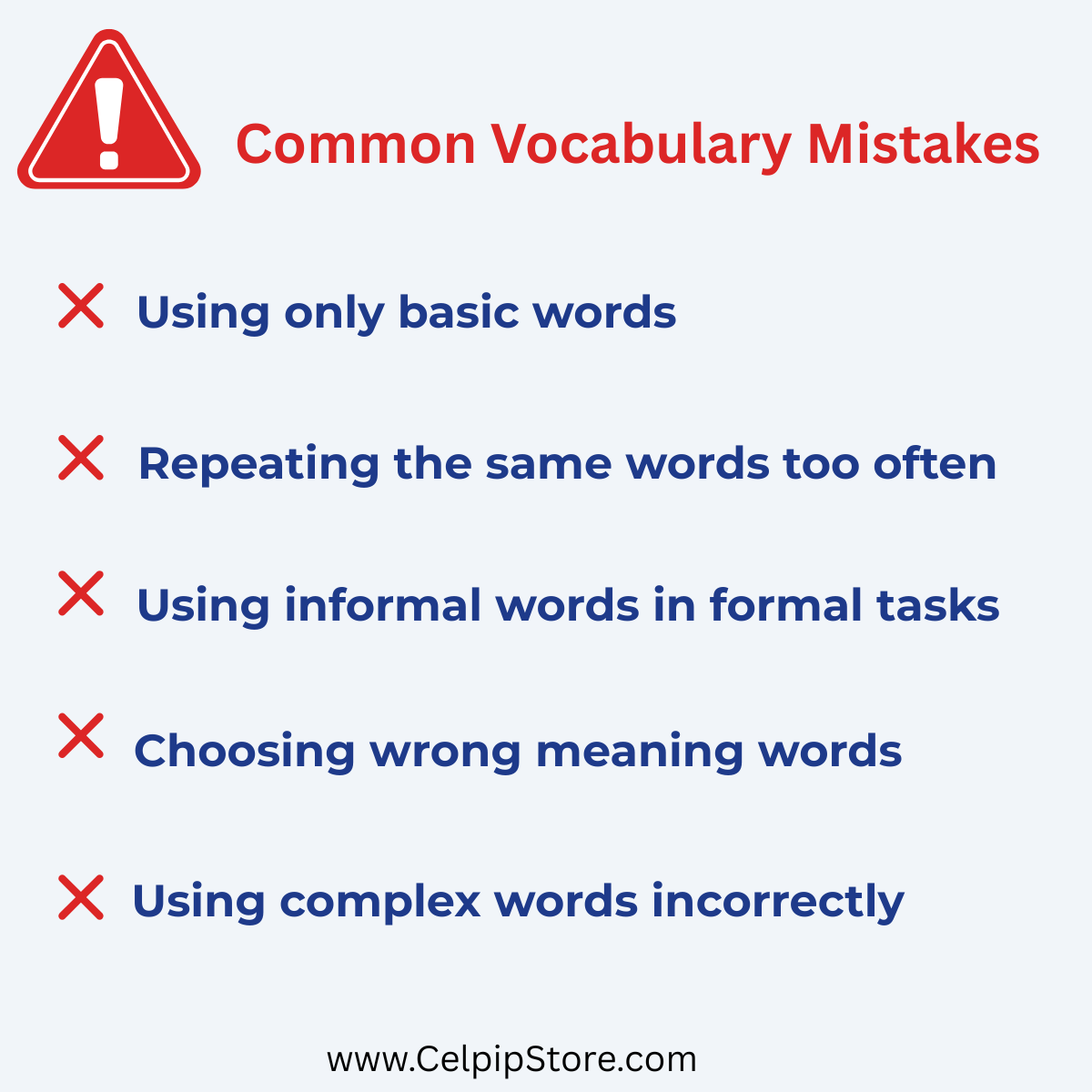
Mistake 4: Trying to Use Extremely Advanced Vocabulary
Some students believe that difficult words automatically produce a higher score.
This often creates another problem: inaccurate word choice.
Using a sophisticated word incorrectly can make a sentence less clear than using a simple word correctly.
Weak approach:
Trying to impress the reader with unfamiliar vocabulary.
Better approach:
Choose words that are:
- Accurate
- Natural
- Appropriate
- Relevant to the situation
For example, “I was extremely disappointed with the service” may be much more effective than using an unnecessarily complicated expression.
Mistake 5: Writing Long Sentences That Become Difficult to Understand
Long sentences are not automatically advanced sentences.
If a sentence contains too many ideas, multiple clauses, and unclear connections, the reader may struggle to understand your meaning.
Better approach:
Use a mixture of sentence lengths.
For example:
“The delivery arrived two days late. This created a problem because I needed the documents for an important meeting. I would therefore appreciate it if you could review the delivery process.”
The sentences are straightforward, but the ideas are connected clearly. Many candidates lose marks in Writing Task 1 due to unclear structure or incorrect tone. These mistakes can be avoided by following a proper email format explained in our CELPIP Writing Task 1 guide. Many students lose marks not only in Task 2 but across the Writing section due to a lack of overall strategy. These mistakes can be avoided by understanding the full Writing framework in our CELPIP Writing Guide.
Many candidates lose marks in Task 2 because their ideas are not well-developed or lack proper explanation. These issues can be fixed using structured argument development techniques.
Mistake 6: Giving Reasons Without Developing Them
Simply listing reasons is not enough.
Weak:
“I prefer public transportation because it is cheap, convenient and environmentally friendly.”
The writer has given three reasons, but there is little development.
Stronger:
“I prefer public transportation because it is more affordable for daily commuters. For example, people who use buses or trains regularly can avoid fuel and parking expenses.”
The second version explains the reason and gives relevant detail.
Remember:
- Reason
- Explanation
- Detail or Example
This is one of the most useful patterns you will learn throughout this Writing course.
Mistake 7: Repeating the Same Idea
Repetition can make a response appear less developed.
For example:
“It saves time. It is time-saving. People can save a lot of time.”
These sentences essentially communicate the same point.
Better approach:
After presenting an idea, develop it instead of repeating it.
Ask:
- Why?
- How?
- What is the result?
- Can I give an example?
These questions help you turn a basic idea into a developed paragraph.
Mistake 8: Ignoring Tone
Writing is not only about what you say. It is also about how you say it.
An email to a friend can sound relaxed and personal.
An email to a company, supervisor, or organization generally requires a more professional tone.
Compare:
Too casual:
“Hey, I need you to fix this problem ASAP.”
More appropriate:
“I would appreciate it if you could look into this matter as soon as possible.”
The second version communicates the same basic request while better matching a professional situation.
Mistake 9: Forgetting the Reader
Always remember who will receive your message.
Ask yourself:
- Who am I writing to?
- Why am I writing to them?
- What do I want them to do or understand?
This is especially important in Task 1 because the relationship between writer and reader affects your tone and word choice.
Mistake 10: Spending Too Much Time on the Introduction
Your introduction should establish the purpose of your response, but it should not consume a large portion of your writing time.
In many situations, a direct opening is more effective.
Instead of spending several sentences introducing the topic, move quickly to the purpose of your message.
Mistake 11: Not Leaving Time to Review
Finishing your final sentence exactly when the timer ends means you lose the opportunity to catch avoidable errors.
A quick review can help you identify:
- Missing words
- Spelling mistakes
- Grammar errors
- Repeated words
- Missing task points
- Incorrect names or details
- Awkward sentences
Build review time into your strategy.
Do not treat proofreading as something you do only if you happen to have extra time.
Mistake 12: Writing More Without Saying More
More words do not automatically mean a better response.
A strong answer should contain relevant development, not unnecessary repetition.
Your goal is not:
“How can I make this longer?”
Your goal is:
“How can I make this idea clearer and more useful to the reader?”
Many candidates lose marks because they apply Task 1 strategies to Task 2 or vice versa. These mistakes can be avoided by understanding the clear differences between both tasks in our comparison guide. Many candidates lose marks because they rely on basic vocabulary and simple sentence structures. These issues can be fixed using advanced writing techniques explained in our Band 9 Vocabulary Upgrade System. Many candidates lose marks because they do not follow a clear structure in their responses. Using proper templates for Task 1 and Task 2 can help avoid these mistakes and improve writing clarity.
Your First CELPIP Writing Mindset
Before you begin practising, change the way you think about the Writing section.
Do not think:
“I need to write a complicated answer.”
Think:
“I need to communicate a clear message to a real reader.”
Then follow this process:
- Understand
- Plan
- Write
- Develop
- Review
This five-stage process will become the foundation of your CELPIP Writing preparation.
Master the CELPIP Writing Framework
Now that you understand the Writing section and the common mistakes to avoid, it is time to build a practical system you can use in the exam.
A good CELPIP Writing response should not be created sentence by sentence without a plan. Instead, you should have a clear process that helps you move from the question to a well-organized response.
The CELPIPStore Writing Framework can be summarized as:
- Understand
- Plan
- Organize
- Develop
- Connect
- Review
This framework can be adapted to both Writing Tasks 1 and 2.
Step 1: Understand the Task
Before writing anything, read the question carefully.
Do not immediately start typing.
First identify three things:
1. Purpose
Why are you writing?
2. Reader
Who will read your response?
3. Requirements
What information does the question ask you to include?
This simple analysis can prevent many task-response problems.
Task 1 Framework: Writing an Email
Task 1 requires you to communicate with a specific person or organization about a particular situation.
Your response should therefore have a clear purpose from the beginning.
A practical structure is:
- Opening
- Purpose
- Main Points
- Details
- Request/Action
- Closing
Let's look at each stage.
Step 1: Opening
Begin appropriately for the person you are writing to.
For a formal or professional email, you might use:
Dear Sir or Madam,
For someone whose name you know:
Dear Mr. Brown,
For a friend or someone you know well:
Hi James,
Your opening should match the relationship with the reader.
Step 2: State Your Purpose
Tell the reader why you are writing.
Do not make the reader guess your purpose.
Example:
I am writing to express my concern about a recent problem with my apartment.
Or:
I am writing to request some information about the community program.
Or:
I am writing to invite you to our upcoming event.
The purpose should be clear early in the email. Strong writing in Task 2 requires more than structure—it requires clear thinking, logical arguments, and well-developed ideas. You can improve this skill using our argument development system guide.
Step 3: Address the Main Points
Next, respond to the specific instructions in the question.
If the prompt contains three bullet points, treat them as three communication goals.
For example:
Prompt requirements:
- Explain the problem
- Describe how it affected you
- Suggest a solution
Your response should contain information addressing all three.
Step 4: Develop Your Ideas
Do not simply mention each point.
Develop it.
A useful pattern is:
- Point
- Explanation
- Detail
For example:
The heating system has stopped working. As a result, my apartment has become extremely cold, especially at night. My family has had difficulty sleeping comfortably for the past three days.
The writer does more than identify the problem. They explain its impact and provide relevant detail.
Step 5: Make Your Request or Recommendation Clear
If the purpose of the email is to request action, make your request specific.
Weak:
Please do something about this.
Better:
I would appreciate it if you could arrange for a technician to inspect the heating system as soon as possible.
The second version tells the reader exactly what action is expected.
Step 6: Close Naturally
End the email according to the situation.
For a formal email:
I look forward to hearing from you.
Thank you for your attention to this matter.
For a friendly email:
I hope to hear from you soon.
Take care and see you soon.
Then add an appropriate closing:
Kind regards,
Alex
or
Best wishes,
Alex
To make Writing Task 1 and Task 2 easier and more effective, it is important to follow proven writing structures and templates. These templates help you organize ideas, maintain proper tone, and save time during the exam. You can use our CELPIP Writing Templates for Task 1 and Task 2 to improve your writing structure and score higher.
Task 1 Example
Sample Prompt
You recently joined a fitness centre, but several facilities are not available as advertised. Write an email to the manager.
Include:
- Explain the problem
- Describe how it has affected you
- Suggest what the fitness centre should do
Planning Notes
Before writing, quickly create three points:
Problem: Swimming pool closed
Effect: Cannot follow planned exercise routine
Solution: Provide alternative classes or extend membership
This plan gives you the content you need without wasting valuable time.
Sample Response
Dear Manager,
I am writing to express my concern about the swimming pool at your fitness centre, which has been unavailable for the past two weeks.
When I joined the centre, I specifically chose the membership because I wanted to include swimming in my weekly exercise routine. Unfortunately, the pool has remained closed, and I have not received any clear information about when it will reopen. This has made it difficult for me to follow the fitness plan I originally created.
I would appreciate it if the centre could provide members with an alternative, such as free access to another nearby facility or additional membership time to compensate for the closure. I believe this would be a fair solution for members who have been affected.
Thank you for taking the time to consider my concerns. I look forward to hearing from you soon.
Kind regards,
Alex
Since both Writing tasks must be completed within a limited time, understanding how to divide time between Task 1 and Task 2 is crucial for success. Read our time management strategy guide to improve your exam performance.
Why This Response Works
The response has a clear progression.
Paragraph 1:
States the purpose and problem.
Paragraph 2:
Explains the situation and its impact.
Paragraph 3:
Provides a practical solution.
Final paragraph:
Closes the email politely.
The writer does not simply list the three requirements. Each point is developed naturally.
Task 2 Framework: Responding to a Survey
Task 2 requires a different approach because you are presenting and supporting a position.
A useful structure is:
- Position
- Reason 1: Explanation/Example
- Reason 2: Explanation/Example
- Conclusion
You do not need to make your response unnecessarily complicated.
Your priority should be clear reasoning and development.
Step 1: Choose Your Position
Read the two options carefully.
Then make your decision.
Do not spend too much time trying to find the “perfect” answer.
Usually, the best choice is the option that gives you the strongest and easiest reasons to explain.
Step 2: Introduce Your Position
Tell the reader which option you support.
Example:
I believe that the city should invest more money in public transportation rather than building additional parking facilities.
This immediately establishes your position.
Step 3: Give Your First Reason
Choose a strong reason that directly supports your position.
Example:
First, improving public transportation would reduce traffic congestion.
Then explain why.
If more residents had access to reliable buses and trains, fewer people would need to drive to work every day.
Now the idea is developed rather than simply listed.
Step 4: Add a Relevant Example
An example can make your reasoning more concrete.
For example, commuters in busy areas often spend a significant amount of time stuck in traffic during peak hours.
The example should support the point you have just made.
Do not add an unrelated personal story simply to increase the word count.
Step 5: Introduce Your Second Reason
Move naturally to another supporting idea.
Useful transitions include:
- In addition,
- Another important reason is that...
- Furthermore,
- Secondly,
- Another advantage is...
For example:
Another important reason is that better public transportation can reduce household expenses.
Step 6: Explain the Second Reason
Again, answer the question:
Why?
Families who use buses or trains regularly can spend less on fuel, parking, vehicle maintenance, and other transportation costs.
Now the reason has meaningful development.
Step 7: Conclude
Finish by reinforcing your position.
Example:
For these reasons, I believe that investing in public transportation would provide greater long-term benefits for the community.
Your conclusion does not need to introduce a completely new idea.
Task 2 Example
Sample Question
A city has extra funding. Which option should it choose?
Option A: Build more public parking facilities.
Option B: Improve public transportation.
Planning Notes
Before writing:
Position: Option B
Reason 1: Less traffic
Example: Fewer cars during rush hour
Reason 2: Lower transportation costs
Example: Less spending on fuel and parking
This is enough to create a focused response.
Sample Response
I believe that the city should use its additional funding to improve public transportation rather than build more parking facilities.
First, better public transportation could significantly reduce traffic congestion. If buses and trains were more reliable and convenient, more residents might choose them instead of driving their own vehicles. For example, commuters could avoid spending long periods in traffic during busy morning and evening hours.
Another important reason is that improved public transportation could reduce the cost of commuting. People who use public transit regularly can save money on fuel, parking, and vehicle maintenance. This would be particularly beneficial for students and families who need to manage their monthly expenses carefully.
For these reasons, I strongly believe that investing in public transportation would be a better long-term choice for the community. Understanding the format is the first step, but using ready-made templates can significantly improve clarity and organization in your writing. These templates provide a clear framework for both Task 1 and Task 2 responses. Explore our CELPIP Writing Templates guide for practical examples.
Why This Response Works
The response follows a logical progression:
- Position
- Reason 1
- Explanation
- Example
- Reason 2
- Explanation
- Conclusion
The reader never has to wonder what the writer believes or why they believe it.
The Idea Development Formula
One of the most important skills for CELPIP Writing is learning how to develop an idea.
Use this simple formula:
- IDEA
- WHY
- RESULT
- EXAMPLE
For example:
Idea:
Public transportation is affordable.
Why:
People do not have to pay for fuel and parking every day.
Result:
They can reduce their monthly transportation expenses.
Example:
A student who takes the bus to university may spend much less than someone who drives and pays for parking.
This transforms a simple idea into a developed argument.
The Paragraph Formula
A strong paragraph can often follow:
- Topic Sentence
- Explanation
- Example/Detail
- Link
For example:
Public transportation can reduce household expenses. People who use buses and trains do not need to spend as much money on fuel or parking. For example, a family that uses public transit regularly can save a significant amount on daily commuting costs. Therefore, improving public transportation can make daily travel more affordable.
This structure is simple but powerful.
How to Connect Your Ideas
Your response should feel like one complete piece of writing rather than a collection of separate sentences.
Use transitions naturally.
To introduce an idea:
- First,
- To begin with,
- One important reason is...
To add information:
- In addition,
- Furthermore,
- Another reason is...
To explain:
- This is because...
- This means that...
- As a result...
To give an example:
- For example,
- For instance,
- A good example of this is...
To conclude:
- Therefore,
- For these reasons,
- Overall,
- In conclusion,
Do not use a connector in every sentence. The goal is natural flow, not a collection of linking words.
Time Management Strategy
Good writing is not only about language. You also need to manage the clock.
A practical approach is to divide your time into three stages:
Stage 1: Planning
Understand the prompt and organize your ideas.
Stage 2: Writing
Develop your response in clear paragraphs.
Stage 3: Reviewing
Check content, grammar, spelling, and clarity.
The exact amount of time you spend on each stage can vary depending on your writing speed. The important principle is to avoid spending all your available time writing and leaving no opportunity to review. One of the most important skills in CELPIP Writing is mastering Task 1 emails, as they test your ability to communicate clearly and follow instructions. You can learn the full format, including paragraph structure and scoring strategy, in our CELPIP Writing Task 1: Writing an Email guide.
Scoring high in CELPIP Writing requires mastering both Task 1 and Task 2 together, not in isolation. For complete strategies and scoring breakdown, read our Ultimate CELPIP Writing Guide.
To score high in CELPIP Writing, it is not enough to prepare each task separately you must also understand how Task 1 and Task 2 differ in expectations and scoring. Learn the complete breakdown in our Task 1 vs Task 2 comparison guide.
One of the fastest ways to improve your CELPIP Writing score is by using structured templates for both tasks. These help you organize ideas quickly and maintain clarity under time pressure. Learn these ready-to-use formats in our Writing Templates guide.
The CELPIPStore Writing Strategy
When you see a new question, use this mental process:
1. What is the situation?
Understand the context.
2. What is my purpose?
Are you requesting, explaining, complaining, suggesting, inviting, or giving an opinion?
3. Who is my reader?
Identify the relationship.
4. What points must I cover?
Turn the instructions into a checklist.
5. What are my strongest ideas?
Choose ideas that you can explain easily.
6. How will I organize them?
Create a simple paragraph plan.
7. Have I developed each important idea?
Add explanations and relevant details.
8. Have I reviewed my response?
Check before submitting.
Don't Memorize Answers — Memorize the Process
A strong CELPIP candidate should be able to handle an unfamiliar topic.
That is why you should practise the process, not memorize complete responses.
Instead of memorizing:
“I am writing this letter to express my deep concern...”
learn how to adapt your opening to the situation.
Instead of memorizing an entire Task 2 answer, learn:
- Position
- Reason
- Explanation
- Example
- Reason
- Explanation
- Conclusion
When the topic changes, your structure remains useful.
Practice Strategy
Do not practise by writing the same type of question repeatedly.
Build variety into your preparation.
Practise Task 1 situations such as:
- Complaints
- Requests
- Invitations
- Suggestions
- Problems
- Information requests
- Recommendations
- Apologies
- Community issues
Practise Task 2 topics such as:
- Education
- Transportation
- Technology
- Workplace
- Environment
- Community
- Health and lifestyle
- Public services
- Shopping
- Recreation
This variety prepares you to think independently on test day.
A Simple Practice Cycle
After writing each response, follow this cycle:
Write
Complete the task under exam conditions.
Review
Identify your mistakes.
Categorize
Ask what type of mistake you made:
- Task response
- Organization
- Vocabulary
- Grammar
- Spelling
- Development
- Tone
Rewrite
Improve the weakest part.
Repeat
Try another question and apply what you learned.
This is much more effective than simply writing dozens of responses without reviewing them.
Advanced CELPIP Writing Strategies
You now know how to understand the task, plan your ideas, organize paragraphs, and develop your points. The next step is to make your writing more precise, natural, cohesive, and effective.
At this stage, avoid the temptation to simply add more difficult vocabulary. Advanced writing is not about making every sentence complicated. It is about communicating your ideas with control and purpose.
A strong writer can take a simple idea and develop it clearly.
1. Focus on Task Fulfilment First
Before worrying about grammar or vocabulary, ask yourself:
Have I actually answered the question?
This should always be your first priority.
A response with impressive vocabulary but incomplete task coverage is not effective writing.
For every question, identify the required actions and make sure your response addresses them.
For Task 1, check:
- Did I clearly state why I am writing?
- Did I address every instruction?
- Did I provide enough relevant detail?
- Did I make my request or recommendation clear?
- Is my tone appropriate for the reader?
For Task 2, check:
- Did I clearly choose a position?
- Did I provide convincing reasons?
- Did I explain those reasons?
- Did I keep my ideas relevant to the question?
- Did I finish with a clear conclusion?
2. Develop Ideas Instead of Adding More Ideas
One of the biggest differences between weaker and stronger responses is idea development.
A weaker candidate may write:
“Public transportation is convenient. It is affordable. It is environmentally friendly.”
The response contains several ideas, but they are not developed.
A stronger writer may take one idea and explain it:
“Public transportation is more affordable for many commuters because they do not have to pay for fuel, parking, and regular vehicle maintenance. For example, someone who takes the bus to work every day can significantly reduce their monthly transportation expenses.”
The second response gives the reader something to understand.
Advanced Rule:
Two well-developed ideas are generally more useful than five undeveloped ideas.
.png "Task-Wise_Vocabulary_Strategy_(1).png")
3. Use the “Why, How, Result” Test
Whenever you write an important point, ask yourself three questions:
Why?
Why is this idea true or important?
How?
How does it affect the situation?
Result?
What happens because of it?
For example:
Idea: Flexible work schedules are beneficial.
Why?
Employees can adjust their working hours.
How?
They can manage family responsibilities more easily.
Result?
They may experience less stress and maintain a better work-life balance.
This method gives you material for developing your paragraph naturally.
4. Improve Coherence With Logical Progression
Coherence means that your response makes sense as a whole.
Your reader should be able to follow your ideas without having to work out how each sentence connects to the next.
Consider this sequence:
I prefer public transportation. It is affordable. Many cities have traffic problems. Buses can carry many people. My family also uses public transportation.
The sentences are individually understandable, but the progression is weak.
Now compare:
I prefer public transportation because it is more affordable than driving. It can also reduce traffic congestion because one bus can transport many passengers at the same time. For example, commuters who normally drive to work may be able to avoid rush-hour traffic by taking public transit.
The ideas build naturally.
5. Use Linking Words Naturally
Connectors are useful, but using too many can make your writing sound mechanical.
Instead of:
Firstly, I believe...
Secondly, I think...
Furthermore, I believe...
Moreover, I think...
Try to create natural connections between ideas.
For example:
One major advantage is affordability. Another important benefit is convenience. As a result, public transportation can be a practical choice for many commuters.
The writing remains connected without sounding like a list of memorized expressions.
6. Vary Your Sentence Structure
Using the same sentence pattern repeatedly can make your writing sound basic.
Repetitive:
It saves money. It saves time. It reduces stress. It improves life.
Instead, combine different sentence structures:
Public transportation can save money and reduce commuting time. Since commuters do not have to drive themselves, they may also experience less stress during busy periods. While Task 2 focuses on survey-based opinion writing, it is part of a larger Writing system that also includes Task 1 email writing. Understanding both tasks together is essential for achieving a high score. Learn the complete system in our CELPIP Writing Guide.
A mixture of sentence lengths makes your writing more natural.
7. Use Complex Sentences Carefully
Complex sentences can help demonstrate grammatical range, but only when they remain clear.
Simple:
The gym is expensive. Many students cannot afford it.
Combined:
Because the gym is expensive, many students cannot afford to use it regularly.
Another example:
Although the membership fee is relatively high, the gym provides several facilities that are unavailable at other centres.
The goal is not to make every sentence complex.
Better rule:
Use complex structures when they make the relationship between ideas clearer.
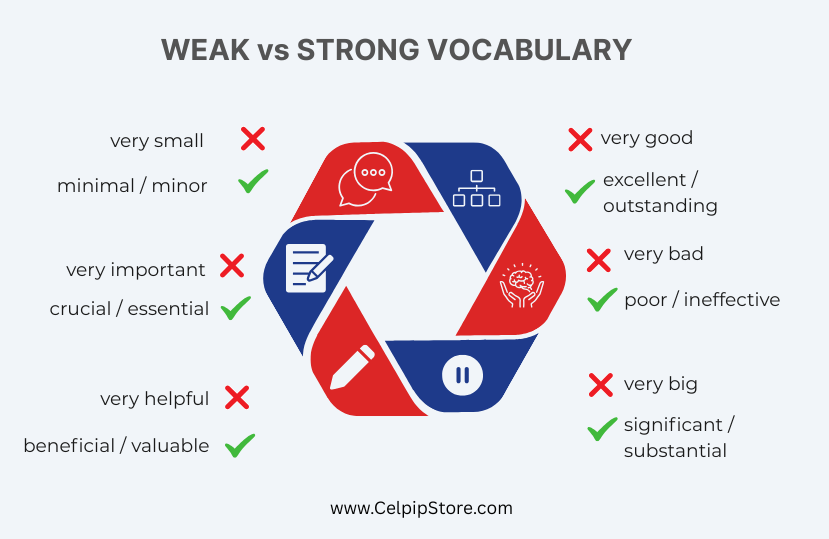
8. Choose Precise Vocabulary
Strong vocabulary is not necessarily complicated vocabulary.
Compare:
The problem was very bad.
with:
The problem caused significant inconvenience for several residents.
The second sentence communicates the situation more precisely.
Instead of repeatedly using general words such as:
- good
- bad
- nice
- big
- thing
- problem
- important
look for more precise alternatives when appropriate.
Examples:
Good: beneficial, effective, practical
Bad: disappointing, inconvenient, ineffective
Problem: issue, concern, difficulty
Important: significant, essential, valuable
Help: assist, support, improve
Always choose the word that fits the context. Do not replace a simple word simply to sound advanced.
9. Avoid Vocabulary Repetition
Repeating the same word several times can make your writing less varied.
For example:
The service was good. The staff were good. The location was good.
You could write:
The service was efficient, the staff were helpful, and the location was convenient.
The meaning remains simple, but the vocabulary is more precise.
10. Use Tone Strategically
Tone should reflect the communication situation.
Formal or Professional Tone
Useful expressions include:
- I would appreciate it if...
- I am writing to request...
- I would like to express my concern regarding...
- I would be grateful if...
- I look forward to your response.
Neutral Tone
- I would like to suggest...
- I believe that...
- I think it would be helpful to...
- Another option would be...
Friendly Tone
- I was really happy to hear that...
- I thought you might be interested in...
- It would be great if you could...
- I hope you can join us.
The key is not memorizing these phrases individually. Understand when they are appropriate.
Examiner-Focused Insights
A useful way to improve your writing is to think beyond individual sentences.
Imagine that someone is reading your response for the first time.
Can they immediately understand:
- What you are trying to communicate?
- Why you are communicating it?
- How your ideas connect?
- What action or conclusion you want them to take?
If the answer is yes, your writing is doing its primary job.
Insight 1: Clear Writing Beats Complicated Writing
Do not confuse sophistication with complexity.
A clear sentence such as:
“I would appreciate a refund because the product I received was different from the one I ordered.”
is more useful than an unnecessarily complicated sentence that contains several grammar or word-choice errors.
Remember:
Accuracy + clarity + development > unnecessary complexity
Insight 2: Relevance Matters
Every sentence should have a reason for being there.
Ask:
“Does this sentence help answer the question?”
If not, remove it or replace it with something more relevant.
This is particularly important when students try to reach a particular word count by adding unrelated information.
Insight 3: Examples Should Support the Idea
A good example explains or illustrates the point immediately before it.
Idea:
Working from home can reduce commuting stress.
Example:
For example, employees who normally spend an hour travelling to work can use that time for sleep, exercise, or family responsibilities.
The example directly supports the argument.
Insight 4: Your Conclusion Should Not Introduce a New Argument
A conclusion should reinforce your position rather than suddenly introduce another major idea.
Better:
For these reasons, I believe that improving public transportation would provide greater benefits to the community.
Avoid:
For these reasons, public transportation is better. The city should also build more hospitals.
The second sentence introduces an unrelated idea at the end.
High-Impact Vocabulary
Instead of memorizing hundreds of words, build vocabulary around communication functions.
Expressing an Opinion
- I believe that...
- In my opinion...
- I strongly believe...
- From my perspective...
- I would argue that...
Giving Reasons
- The main reason is that...
- One important factor is...
- Another significant advantage is...
- This is particularly important because...
Explaining Results
- As a result...
- Consequently...
- This can lead to...
- This would allow...
- This could help...
Giving Examples
- For example...
- For instance...
- A good example of this is...
- This can be seen when...
Making Suggestions
- I would suggest...
- I recommend that...
- One possible solution would be...
- It would be beneficial to...
Making Requests
- I would appreciate it if...
- Could you please...?
- I would be grateful if...
- I kindly request that...
Expressing Concern
- I am concerned about...
- I would like to raise a concern regarding...
- Unfortunately...
- I was disappointed to learn that...
Concluding
- For these reasons...
- Overall...
- In conclusion...
- Taking these factors into account...
- Therefore, I believe...
Grammar Strategies for CELPIP Writing
You do not need to eliminate every minor error to communicate effectively, but you should aim for consistent grammatical control.
Focus particularly on the following areas.
1. Subject-Verb Agreement
Incorrect:
The advantages of public transportation is significant.
Correct:
The advantages of public transportation are significant.
2. Verb Tense
Keep your tense consistent with the situation.
Example:
I purchased the product last week, but it arrived damaged.
If you are discussing a continuing situation:
The problem has continued for several days.
3. Articles
Pay attention to:
- a
- an
- the
Example:
I purchased a new laptop from the store.
4. Prepositions
Common combinations should be practised as phrases.
For example:
- interested in
- responsible for
- concerned about
- satisfied with
- apply for
5. Sentence Boundaries
Avoid joining too many complete ideas with commas.
Weak:
The service was disappointing, I contacted the manager.
Better:
The service was disappointing, so I contacted the manager.
Or:
The service was disappointing. I contacted the manager immediately.
Advanced Task 1 Example
Situation
You purchased a laptop online. When it arrived, the product was damaged. Write an email to the company.
Strong Planning
Purpose: Complaint
Problem: Damaged laptop
Impact: Cannot use it for work
Action: Request replacement
Sample Response
Dear Customer Service Manager,
I am writing to report a problem with a laptop I recently purchased from your website. Unfortunately, the computer arrived with a damaged screen, even though the packaging appeared to be intact.
I purchased the laptop specifically for my work because I needed a reliable computer for several upcoming projects. Since the screen is damaged, I am currently unable to use the laptop properly, which has caused considerable inconvenience.
I would appreciate it if you could arrange a replacement as soon as possible. If a replacement is not available, I would be happy to receive a full refund. Please let me know what information you require from me to process the request.
Thank you for your assistance. I look forward to resolving this matter soon.
Kind regards,
Alex
Why This Is Effective
The response:
- Clearly states the purpose
- Explains the problem
- Describes the impact
- Makes a specific request
- Offers a reasonable alternative
- Maintains a professional tone
- Uses paragraphs effectively
Advanced Task 2 Example
Survey Question
A company wants to improve employee satisfaction. Which would be more effective?
Option A: Flexible working hours
Option B: Higher salaries
Planning
Position: Flexible working hours
Reason 1: Better work-life balance
Example: Employees can manage family responsibilities.
Reason 2: Reduced commuting pressure
Example: Employees can avoid peak travel times.
Sample Response
I believe that offering flexible working hours would be more effective than increasing salaries because it could improve employees' daily quality of life while also helping them manage their responsibilities more effectively.
One major advantage is that flexible schedules can create a better work-life balance. Employees may be able to adjust their working hours around family responsibilities, appointments, or other personal commitments. For example, a parent could start work earlier and finish earlier in order to pick up a child from school.
Another benefit is that flexible schedules can reduce the stress associated with commuting during peak hours. Employees who are able to start or finish at different times may avoid the busiest periods and spend less time travelling.
For these reasons, I believe that flexible working hours would be a more practical way to improve employee satisfaction.
Practice: Improve the Weak Response
Read this example:
I think flexible working hours are better. They are good for employees. They help people. Also, they are convenient. That is why I think companies should use them.
The basic opinion is clear, but the ideas are underdeveloped.
Your task:
Improve it using:
- Reason
- Explanation
- Example
For example:
“Flexible working hours can improve work-life balance because employees can adjust their schedules according to their personal responsibilities. For example, parents may be able to start work earlier so they can spend more time with their children in the evening.”
Notice how one simple idea becomes a developed argument. To take your writing from average to advanced level, you need to focus on sentence upgrading techniques and stronger vocabulary usage. You can learn step-by-step strategies in our CELPIP Writing Band 9 guide.
Practice Challenge 1
Write a response to this Task 2 question:
Question:
A university has funding for one new facility. Which would be more beneficial?
Option A: A larger library
Option B: A new student recreation centre
Before writing:
Spend a short time deciding:
- Which option?
- Why?
- What example can you use?
- What second reason can you explain?
Then write your response using the framework.
Practice Challenge 2
Task 1 Situation:
You recently moved into a new apartment. There is excessive noise from construction near your building.
Write an email to the property manager.
Include:
- Explain the situation
- Describe how it is affecting you
- Suggest a possible solution
Before writing, identify:
- Purpose
- Reader
- Problem
- Impact
- Solution
Self-Evaluation Exercise
After completing either practice task, evaluate yourself using these questions.
Task Response
- Did I answer every part of the question?
- Did I remain relevant?
Organization
- Does each paragraph have a clear purpose?
- Do my ideas follow a logical order?
Development
- Did I explain my main reasons?
- Did I provide relevant details or examples?
Vocabulary
- Did I choose accurate words?
- Did I avoid unnecessary repetition?
Grammar
- Are my sentences clear?
- Did I check verb forms, articles, and sentence structure?
Tone
- Does my language match the reader and situation?
Review
- Did I leave enough time to proofread?
The Advanced Writing Formula
At this point, you can combine everything into one system:
- Task
- Purpose
- Reader
- Position/Points
- Development
- Organization
- Language
- Review
This is the mindset you should develop before the exam.
CELPIP Writing: Complete Summary
The CELPIP Writing section tests your ability to communicate effectively in two different situations. Task 1 focuses on writing an email, while Task 2 focuses on responding to a survey question and supporting your position.
Although the tasks are different, the same fundamental principle applies to both:
Your goal is to communicate your ideas clearly, logically, accurately, and appropriately.
Strong CELPIP Writing is not about using the longest words or memorizing complicated essays. It is about understanding the task, planning your response, developing relevant ideas, organizing your writing, choosing appropriate language, and reviewing your work.
The most useful overall process is:
- Understand
- Plan Organize
- Develop
- Connect
- Review
Make this process automatic through regular practice.
Task 1: Quick Review
For Writing Task 1, remember:
Purpose + Reader + Requirements + Tone + Action
Before writing, identify why you are writing and who will receive your email.
Then make sure you address every instruction in the prompt.
Your email should normally have:
- An appropriate greeting
- A clear purpose
- Well-developed main points
- Relevant details
- A clear request, recommendation, or action when required
- An appropriate closing
The tone should match the relationship between you and the reader.
Task 2: Quick Review
For Writing Task 2, remember:
Position + Reason + Explanation + Example + Reason + Explanation + Conclusion
First, choose the option you can support most effectively.
Then explain why you support it.
Do not simply list reasons.
Develop your ideas by explaining:
- Why the reason matters
- How it affects people
- What result it can produce
- What example supports it
Finally, reinforce your position in the conclusion.
The Golden Rule of CELPIP Writing
If you remember only one principle from this entire guide, remember this:
Clear communication is more important than complicated language.
Do not try to impress the reader with vocabulary you cannot use accurately.
Do not create unnecessarily complicated sentences.
Do not memorize an entire essay.
Instead:
- Understand the question.
- Choose relevant ideas.
- Develop those ideas.
- Organize them clearly.
- Use natural English.
- Review your response.
CELPIP Writing Checklist
Use this checklist when practising.
Before Writing
- Did I read the entire question?
- Do I understand the situation?
- Do I know my purpose?
- Do I know who my reader is?
- Did I identify every instruction?
- Did I decide on my main ideas?
- Do I know how I will organize my response?
During Writing
- Is my purpose clear?
- Am I addressing every part of the prompt?
- Are my paragraphs logically organized?
- Have I developed my main ideas?
- Are my examples relevant?
- Are my transitions natural?
- Is my vocabulary appropriate?
- Am I maintaining the correct tone?
- Am I avoiding unnecessary repetition?
Before Submitting
- Did I answer the complete task?
- Did I check grammar?
- Did I check spelling?
- Did I check verb forms?
- Did I check articles and prepositions?
- Did I look for incomplete sentences?
- Did I check repeated words?
- Is my conclusion clear?
- Does the response sound natural?
- Did I leave enough time for review?
CELPIP Writing Self-Evaluation
After every practice response, give yourself a quick review.
Task Fulfilment
Did I answer what the question actually asked?
Organization
Can the reader easily follow my ideas?
Development
Did I explain my reasons instead of simply listing them?
Vocabulary
Are my words accurate, appropriate, and varied?
Grammar
Are my sentences clear and grammatically controlled?
Tone
Does my writing suit the situation and reader?
Overall Communication
Would a real reader understand my message easily?
This final question is particularly important.
Frequently Asked Questions
1. What are the two CELPIP Writing tasks?
The CELPIP Writing section has two tasks: Writing an Email and Responding to Survey Questions.
2. What should I focus on first in CELPIP Writing?
Start with task fulfilment and clear communication. Make sure you understand the question and address all of its requirements before worrying about advanced vocabulary.
3. Should I memorize a CELPIP Writing template?
It is better to memorize flexible structures and useful language patterns rather than complete responses. Your answer needs to fit the specific situation and communicate relevant information.
4. Do I need advanced vocabulary to get a good CELPIP Writing score?
You do not need unnecessarily complicated vocabulary. Accurate, natural, varied, and context-appropriate vocabulary is more useful than difficult words used incorrectly.
5. How can I develop my ideas?
After stating an important idea, ask:
- Why?
- How?
- What is the result?
- Can I give a relevant example?
This helps you move from a simple statement to a developed explanation.
6. How important is grammar in CELPIP Writing?
Grammar is an important part of effective writing. Focus on consistent control of areas such as verb forms, subject-verb agreement, sentence structure, articles, prepositions, and punctuation.
7. Should I use many linking words?
No. Linking words should make your writing clearer, not make it sound memorized. Use connectors naturally when they help show the relationship between ideas.
8. What should I do if I cannot think of a good idea?
Choose a practical idea that you can explain clearly.
You do not need the most original argument.
A simple idea with strong development is more useful than an impressive idea that you cannot explain.
9. Should every sentence be complex?
No.
Use a mixture of simple and complex sentences. Complex structures are valuable when they communicate relationships between ideas clearly.
10. What is the biggest CELPIP Writing mistake?
One major mistake is failing to address the complete task. A response can contain good English but still be ineffective if important instructions are ignored or ideas are insufficiently developed.
Your 4-Week CELPIP Writing Practice Plan
A structured practice routine is more effective than simply writing random responses.
Week 1 — Build the Foundation
Focus on understanding the two task types.
Study:
- Task 1 purpose and structure
- Task 2 purpose and structure
- Reader and tone
- Basic paragraph organization
- Idea development
Practice:
Write several short planning exercises before writing complete responses.
Your goal this week is:
Understand the task before trying to write quickly.
Week 2 — Build Your Writing Skills
Focus on:
- Vocabulary
- Grammar
- Sentence variety
- Linking ideas
- Paragraph development
- Tone
Practise developing individual ideas using:
- Idea
- Explanation
- Example
Do not worry only about completing full tests.
Learn how to make individual paragraphs stronger.
Week 3 — Timed Practice
Begin completing full Writing tasks under realistic time conditions.
After each response:
- Review it.
- Identify mistakes.
- Categorize the mistakes.
- Rewrite weak sentences.
- Record recurring problems.
Create a personal mistake list.
For example:
| Problem | Example | Correction |
|---|---|---|
| Article | “I bought new laptop” | “I bought a new laptop” |
| Verb form | “It help people” | “It helps people” |
| Repetition | “good” repeated | Use precise alternatives |
| Development | Reason only | Add explanation/example |
This turns practice into measurable improvement.
Week 4 — Exam Simulation
Now combine everything.
Complete Writing practice under realistic conditions.
Focus on:
- Planning efficiently
- Maintaining organization
- Developing ideas
- Managing time
- Reviewing your response
- Staying calm
After each practice test, identify your top three recurring weaknesses.
Work specifically on those weaknesses instead of trying to improve everything at once.
The 10-Minute Improvement Routine
Even when you do not have enough time to write a complete response, you can still practise.
Choose a Task 2 question and spend a few minutes creating:
Position
- Reason 1
- Explanation
- Example
- Reason 2
- Explanation
- Conclusion
Then choose one paragraph and write it fully.
This is an efficient way to improve idea development and organization. Improving vocabulary and sentence structure is essential for achieving a higher CELPIP Writing score. Instead of using basic expressions, candidates should focus on advanced sentence patterns and academic vocabulary. Learn this in our Band 9 Vocabulary Upgrade System guide.
The 5-Minute Editing Routine
Take an old response and look only for:
Minute 1
Task coverage
Minute 2
Grammar
Minute 3
Vocabulary repetition
Minute 4
Sentence structure
Minute 5
Clarity and tone
Final CELPIP Writing Checklist
Before your exam, remember:
Task
Did I answer everything?
Purpose
Is my message clear?
Organization
Are my ideas logically arranged?
Development
Did I explain my main points?
Vocabulary
Are my words accurate and appropriate?
Grammar
Are my sentences clear?
Tone
Does my language suit the reader?
Review
Did I check my work?
If you can consistently answer yes, you are building the writing habits needed for strong CELPIP performance.
This teaches you to become your own editor.
Your CELPIP Writing Improvement Cycle
Your long-term preparation should follow this cycle:
- Learn: Understand the skill.
- Observe: Study strong examples.
- Practise: Write your own response.
- Evaluate: Identify weaknesses.
- Correct: Rewrite problem areas.
- Repeat: Apply the improvement to another task.
This is much more powerful than simply completing practice questions without analysing your performance.
Final Exam-Day Strategy
On test day, do not try to suddenly become a different writer.
Use the process you have practised.
Step 1
Read the question carefully.
Step 2
Identify the purpose and requirements.
Step 3
Create a quick plan.
Step 4
Write clear paragraphs.
Step 5
Develop your important ideas.
Step 6
Use natural vocabulary and grammar.
Step 7
Check your response before moving on.
If you make a small mistake, stay calm and continue.
One mistake does not define your entire response.
Your CELPIP Writing Success Formula
Put everything together:
- Understand the Task: Know exactly what you need to communicate.
- Plan Your Ideas: Choose relevant points before writing.
- Organize: Create a logical structure.
- Develop: Explain your ideas with details and examples.
- Use Natural Language: Choose accurate vocabulary and appropriate grammar.
- Review: Find and correct avoidable mistakes.
- Practise Again: Turn the strategy into a habit.
Conclusion
CELPIP Writing becomes much easier when you stop treating it as a test of complicated English and start treating it as a test of effective communication.
You do not need to memorize hundreds of sentences. You need to understand how to respond to different situations. To achieve a high score in CELPIP Writing, it is not enough to understand structure and task requirements you must also upgrade your vocabulary and sentence formation skills. For advanced techniques to reach Band 8–9 level writing, read our CELPIP Writing Band 9 Vocabulary & Sentence Upgrade System
For Task 1, learn how to communicate with a reader through a clear and appropriately toned email.
For Task 2, learn how to express a position and support it with logical, well-developed reasons.
Across both tasks, focus on organization, vocabulary, grammar, idea development, and clarity.
Most importantly, practise with a purpose. Do not simply count how many responses you have written. Look at what you learned from each response and what you changed in the next one. To master CELPIP Writing completely, it is important to practice Task 1 emails regularly with the correct structure and tone. Start with our detailed guide on CELPIP Writing Task 1: Writing an Email.
With consistent practice and focused feedback, you can turn CELPIP Writing from a difficult section into a predictable, manageable part of your exam preparation. To master CELPIP Writing completely, it is important to understand not only each task individually but also how Task 1 and Task 2 differ in structure, tone, and scoring. For a complete side-by-side breakdown, read our CELPIP Writing Task 1 vs Task 2 Strategy Comparison Guide.
To master CELPIP Writing effectively, you need both strong understanding of task requirements and practical writing structures. Using templates for Task 1 and Task 2 can significantly improve your performance and save time in the exam. Start practicing with our CELPIP Writing Templates guide.
To achieve a high score in CELPIP Writing Task 2, you must focus not only on structure and grammar but also on strong idea generation and argument development. For complete strategies to improve your writing quality, read our CELPIP Writing Task 2 Ideas & Argument Development System.
To succeed in CELPIP Writing, you must combine strong writing skills with effective time management. Without proper timing, even good answers may remain incomplete. For a complete exam strategy, read our CELPIP Writing Time Management & Exam Strategy System.