3.jpg)
CELPIP Score vs CLB Explained
If you are preparing for the CELPIP exam, you have probably come across two important terms: CELPIP score and CLB level. Many students assume they are the same, but this is where confusion begins.
Understanding the difference between CELPIP and CLB is essential especially if your goal is Canadian immigration, work, or study. As a CELPIP instructor, I often see students focusing only on their test score without realizing that CLB is what truly matters in immigration decisions.
In this article, we will break everything down in simple English so you clearly understand how CELPIP scores relate to CLB and how this impacts your future in Canada.
What Is CELPIP?
CELPIP (Canadian English Language Proficiency Index Program) is an English language test used to assess your ability in four skills:
- Listening
- Reading
- Writing
- Speaking
You receive a score from Level 1 to Level 12 in each section. These scores reflect how well you can communicate in English in everyday and workplace situations.
What Is CLB?
CLB stands for Canadian Language Benchmarks. It is the official system used by the Canadian government to measure language ability.
Instead of CELPIP scores, immigration programs use CLB levels to:
- Determine eligibility
- Compare applicants fairly
- Calculate CRS (Comprehensive Ranking System) points
In simple terms:
CELPIP is the test, but CLB is the standard used for decisions.
Quick Answer: CELPIP vs CLB
To make it very clear:
- CELPIP = Your test result
- CLB = Your immigration language level
Your CELPIP score is directly converted into a CLB level.
CELPIP Score to CLB Conversion
The conversion between CELPIP and CLB is straightforward. Each CELPIP level corresponds to the same CLB level. To understand how these CLB levels translate into actual requirements, you should also check the CELPIP passing score requirements for different immigration programs.
Conversion Overview:
- Level 10–12: CLB 10+
- Level 9: CLB 9
- Level 8: CLB 8
- Level 7: CLB 7
- Level 6: CLB 6
- Level 5: CLB 5
- Level 4: CLB 4
This means there is no complicated calculation you simply match the levels.
1.png "Comparision-Sub3_(1)1.pngg")
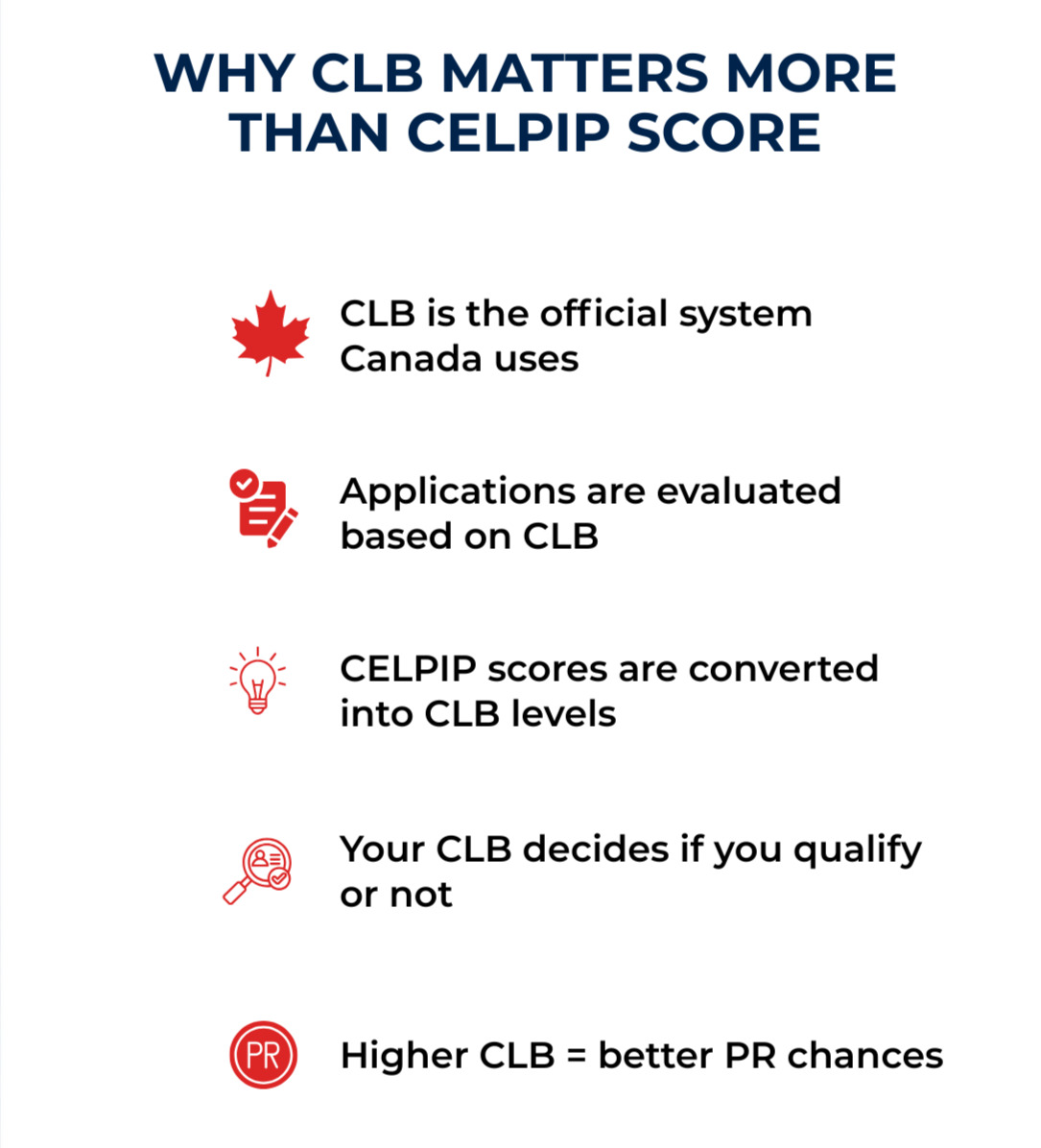
Why CLB Matters More Than CELPIP Score
Many students make the mistake of focusing only on their CELPIP score. However, immigration programs in Canada do not evaluate your application based on CELPIP levels directly.
They use CLB levels to:
- Set minimum eligibility requirements
- Award CRS points
- Compare applicants in Express Entry
For example:
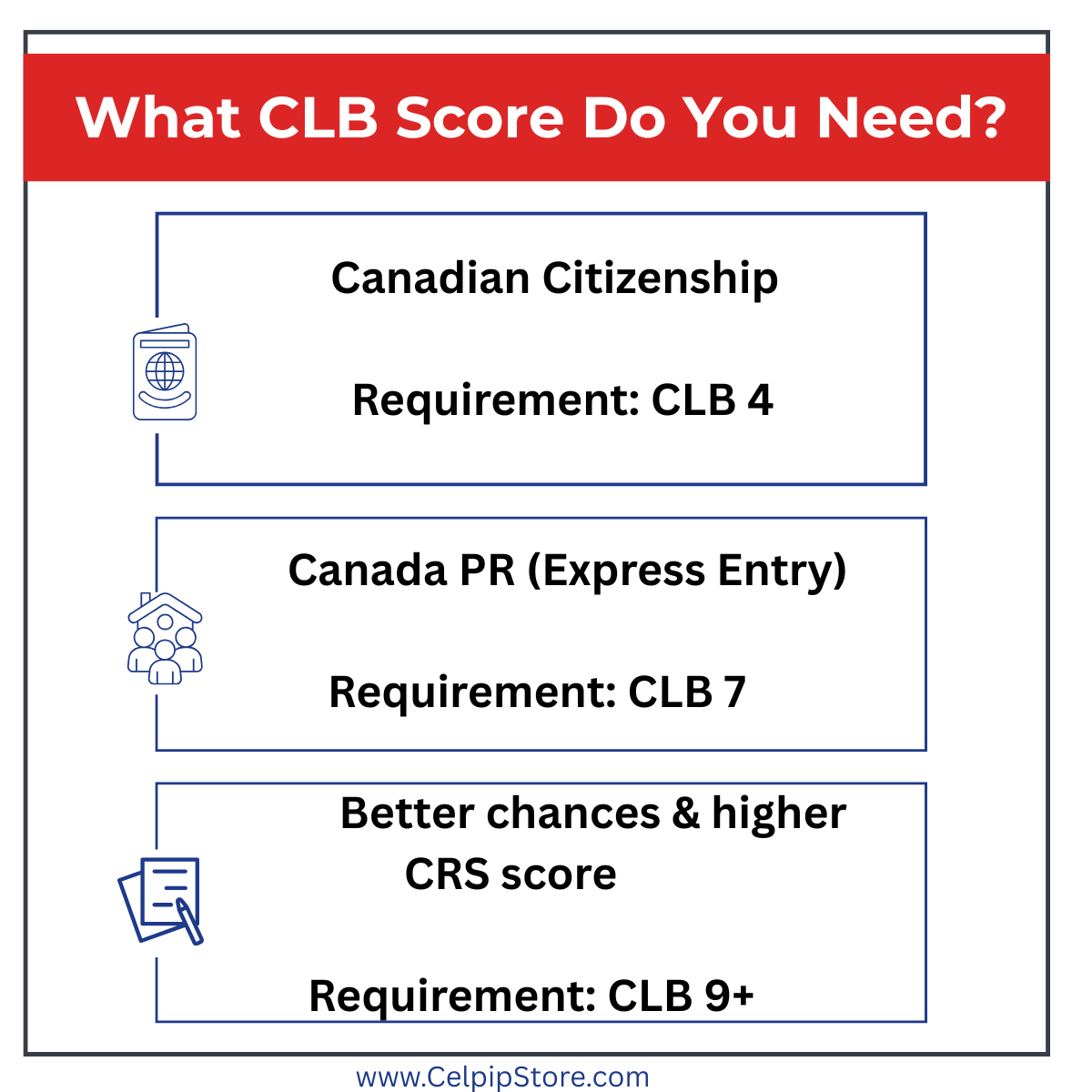
- CLB 7 may meet the minimum requirement
- CLB 9 can significantly increase your CRS score
Even a small improvement in CELPIP can have a big impact on your CLB level and overall application. While CLB explains your language level, immigration decisions depend on whether you meet the minimum passing score for CELPIP.
How CLB Affects Your Immigration Chances
CLB levels play a critical role in your success, especially in competitive programs like Express Entry.
General Understanding:
- CLB 4–5: Basic eligibility for some programs
- CLB 7: Minimum requirement for many PR pathways
- CLB 9+: Strong profile with higher chances
- CLB 10+: Maximum language points
Important: Requirements can change, so always verify from official Canadian immigration sources.
Real Student Examples
Example 1: Raj
Raj scored CELPIP Level 7 (CLB 7) in all sections.
He met the minimum eligibility for Express Entry but did not receive an invitation because his CRS score was low. For example, many programs require at least CLB 7, but the exact requirement depends on the CELPIP passing score criteria for your chosen pathway.
Lesson: Minimum qualification does not guarantee success.
Example 2: Mehak
Mehak improved her score from Level 7 to Level 9.
This increased her CLB level and significantly boosted her CRS score.
Result: She received an Invitation to Apply (ITA)
Common Confusions About CELPIP vs CLB
Many students misunderstand how these systems work. Here are some common mistakes:
- Thinking CELPIP and CLB are different systems (they are directly connected)
- Believing overall score matters more than individual sections
- Ignoring CLB requirements for each skill
- Assuming Level 7 is always enough
Understanding these points can save you time, money, and multiple test attempts.
Myth vs Fact
Myth: CELPIP score alone decides your application
Fact: CLB level is what immigration authorities use
Myth: Level 7 is a high score
Fact: It is a good score but may not be competitive
Myth: You only need one attempt
Fact: Many students improve their score over multiple attempts
How to Improve Your CLB Level
If your goal is to move from CLB 7 to CLB 9, you need a focused strategy.
Key Improvement Tips:
- Improve grammar accuracy in writing and speaking
- Use a wider range of vocabulary
- Avoid repeating the same words
- Practice speaking fluently without long pauses
- Structure your writing clearly with proper paragraphs
- Take timed mock tests regularly
Consistency and smart practice are the keys to improvement.

Quick Facts
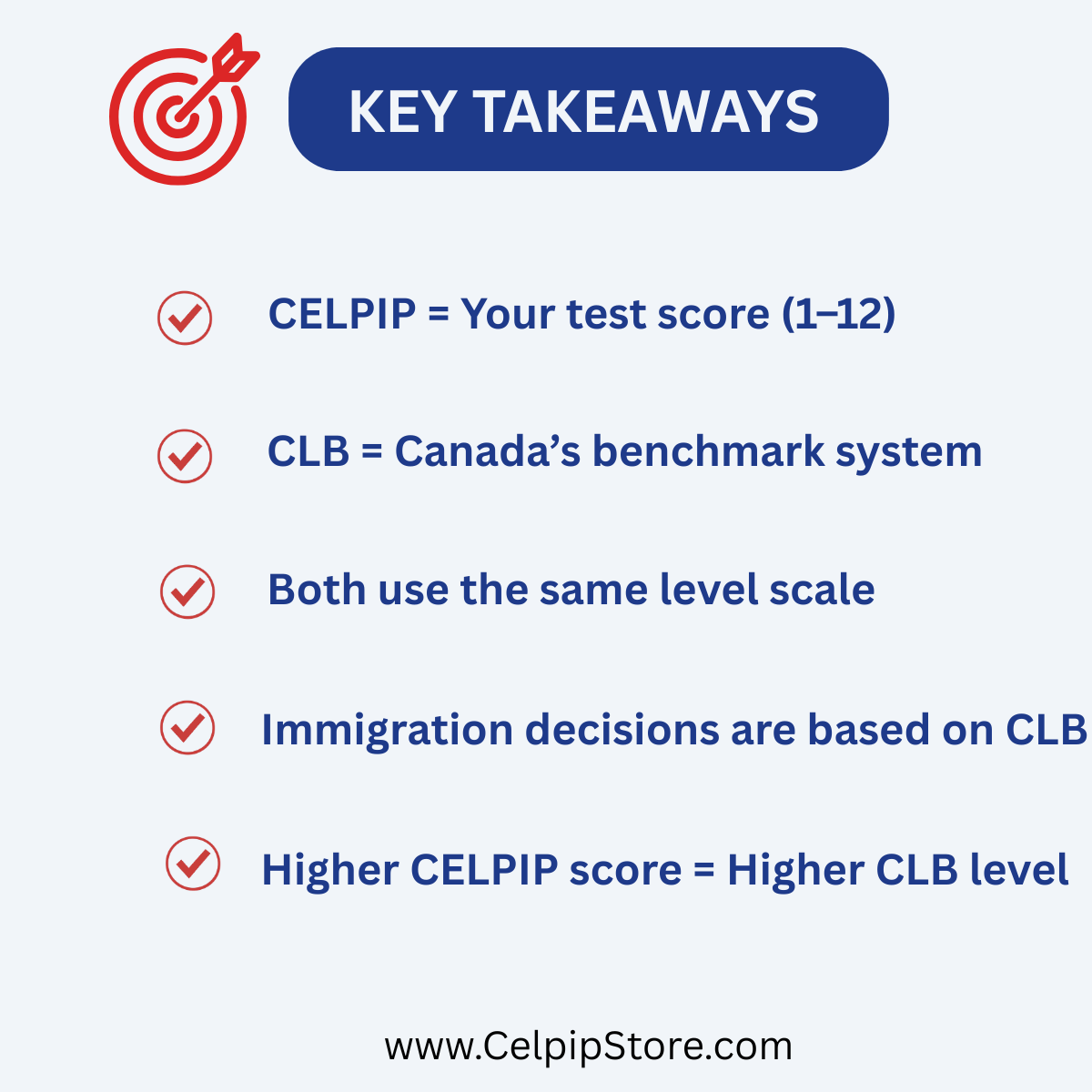
- CELPIP scores range from Level 1 to 12
- CLB levels are used for immigration decisions
- Each CELPIP level equals the same CLB level
- CLB 9 is often considered a “target score”
- Small improvements can lead to big results
Conclusion
Understanding CELPIP score vs CLB is one of the most important steps in your preparation journey.
While CELPIP gives you a score, it is the CLB level that determines your opportunities in Canada.
If your goal is immigration, always focus on:
- Your target CLB level
- Your overall profile
- Continuous improvement
Next Steps
Now that you understand the difference between CELPIP and CLB:
- Check your current level
- Compare it with your target requirements
- Create a clear study plan
For a deeper understanding of score requirements, make sure to read:
What Is the Passing Score for CELPIP?
Call to Action
Want to boost your CLB level faster?
Explore our expert-designed practice tests, strategies, and mock exams to improve your CELPIP performance and achieve your target score. Still confused about required scores? Read the full guide on what is the passing score for the CELPIP test.
FAQs
1. What is the difference between CELPIP and CLB?
CELPIP is a language test, while CLB is the standard used by Canada to measure language ability. Your CELPIP score is converted into a CLB level for immigration purposes.
2. Is CELPIP Level 7 equal to CLB 7?
Yes, CELPIP Level 7 directly corresponds to CLB 7.
3. Why does Canada use CLB instead of CELPIP?
CLB provides a unified standard across multiple language tests like CELPIP and IELTS.
4. Which is more important: CELPIP or CLB?
CLB is more important for immigration decisions.
5. Can I apply for PR with CLB 7?
Yes, but higher CLB levels improve your chances significantly.
6. What CLB level is considered good?
CLB 9 or higher is considered strong.
7. Does each section need the same CLB level?
Yes, many programs require minimum CLB in each skill.
8. How do I convert CELPIP to CLB?
Use the official conversion chart where each CELPIP level matches a CLB level.
9. Is CLB used for citizenship?
Yes, but requirements are usually lower.
10. Can CLB change over time?
The system remains stable, but program requirements may change.
11. What is CLB 9 advantage?
Higher CRS points and better PR chances.
12. Is CLB 10 necessary?
Not always, but it gives maximum points.
13. How can I improve CLB quickly?
Focused practice, feedback, and mock tests.
14. Do employers use CLB?
Some do, especially in regulated professions.
15. Is CLB the same as IELTS band?
No, but both can be converted into CLB levels.