
CELPIP Speaking Task 7: Expressing Opinions
Master CELPIP Speaking Task 7
After learning how to handle difficult situations in Task 6, you now move to a task that tests one of the most important communication skills expressing your opinion clearly and confidently. This task is very common in real life, whether you are discussing ideas, making decisions, or sharing your views.
Many students struggle in this task because they either don’t have enough ideas or cannot organize their thoughts clearly. Some speak without structure, while others hesitate too much. The good news is that Task 7 becomes easy when you follow a simple and repeatable framework. Task 7 is one of the eight speaking tasks in the CELPIP Speaking test. To understand all eight tasks, their strategies, and how they work together, read our Ultimate CELPIP Speaking Guide.
What Is CELPIP Speaking Task 7?
In this task, you are asked to express your opinion on a topic and support it with reasons. There is no right or wrong answer. The goal is to show how clearly and logically you can present your ideas.
Task Requirements:
- Give your opinion clearly
- Support it with 2–3 reasons
- Explain your ideas
- Speak smoothly and confidently
Time Structure:
- Preparation Time: 30 seconds
- Speaking Time: 60 seconds
Task 6 vs Task 7 (Critical Difference)
Understanding this transition helps you adjust your approach quickly.
Key Shift:
- Task 6 - Solve a problem politely
- Task 7 - Express and support an opinion
You are moving from problem-solving - idea sharing. Understanding the difference between individual speaking tasks is important, but you should also understand the complete Speaking section. Learn about all eight tasks in our complete CELPIP Speaking guide.
_vs_TASK_7_(EXPRESS_OPINIONS).png "TASK_6_(DEAL_WITH_SITUATION)_vs_TASK_7_(EXPRESS_OPINIONS).png")
What Examiners Want
Examiners are not testing your knowledge of the topic. They are evaluating how clearly you express your opinion and support it. These skills are important throughout the CELPIP Speaking test, not only in Task 7. Learn how to approach each task in our Ultimate CELPIP Speaking Guide.
A High-Scoring Response Includes:
- Clear opinion (early in your answer)
- Logical reasons
- Smooth flow of ideas
- Simple and correct language
- Confidence and fluency
Why Candidates Lose Marks
Many candidates lose marks because they focus too much on ideas and forget about structure.
Common Issues:
- No clear opinion
- Too many ideas without explanation
- Repetition
- Hesitation and pauses
- Lack of structure
Remember: Clarity is more important than complexity
The Biggest Mistake
The most common mistake is not stating your opinion clearly at the beginning.
Example:
“There are many advantages and disadvantages…”
No clear opinion
Better Approach:
“I believe that online learning is better than traditional classrooms.”
Clear and direct
Learning Objectives
By the end of this lesson, you will be able to:
- Express your opinion clearly and confidently
- Support your ideas with strong reasons
- Use a structured approach
- Speak for the full 60 seconds
- Avoid common mistakes in Task 7
Why Task 7 Is a High-Scoring Opportunity
Task 7 is one of the easiest tasks to score high if you use the right strategy.
Key Advantage:
- You can use simple ideas
- You can follow a clear structure
- You can control your response
You don’t need expert knowledge just clear thinking and organization
Common Mistakes in Task 7
Understanding these mistakes will help you improve quickly.
Mistake 1: No Clear Opinion
- Speaking without taking a position
Mistake 2: Too Many Ideas
- Giving 4–5 ideas without explaining any
Mistake 3: Weak Reasons
- Saying ideas without support
Mistake 4: Repetition
- Repeating the same idea in different words
Mistake 5: Poor Structure
- Jumping between ideas
Mistake 6: Speaking Too Little
- Not using full 60 seconds
Avoiding these mistakes can improve your Task 7 performance, but a strong CELPIP Speaking score requires preparation across all eight tasks. Explore our complete CELPIP Speaking guide for task-by-task strategies.
Quick Thinking Strategy
If you don’t have ideas, use this simple trick:
Choose one side quickly
Think of:
- Personal experience
- Practical benefit
- Common example
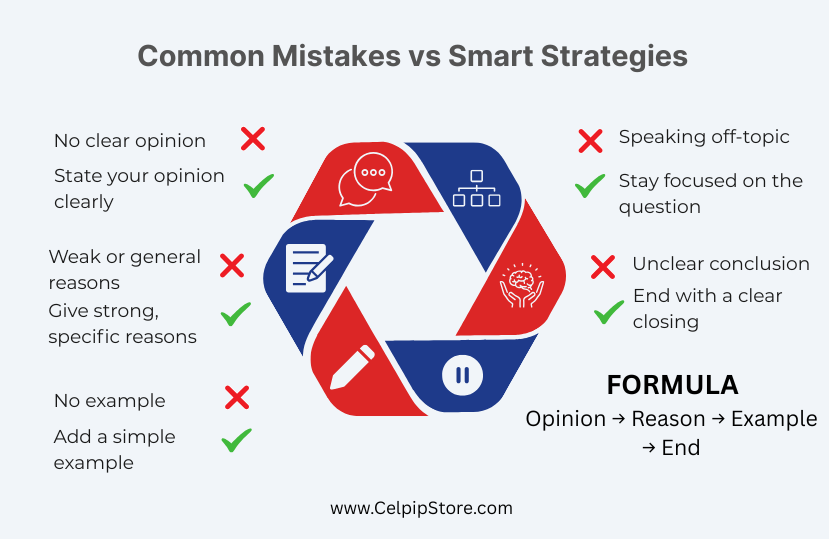
The CELPIPStore Opinion Framework
Now that you understand Task 7, the next step is learning how to organize your ideas clearly. Many students struggle because they speak randomly without structure. A strong response follows a simple and repeatable framework that helps you stay focused and confident.
The 4-Step Opinion Structure
A high-scoring answer follows a clear flow: state your opinion, give reasons, explain them, and conclude.
Step 1: State Your Opinion Clearly
Start your answer with a direct and clear opinion. Do not delay or give a general introduction.
Example:
“I believe that working from home is better than working in an office.”
Step 2: Give Reason 1
Provide your first strong reason to support your opinion.
Example:
“First, it saves a lot of time because people do not need to travel.”
Step 3: Explain + Add Example
Expand your idea with explanation or a simple example.
Example:
“For example, many people spend hours commuting every day, so working from home helps them use that time more productively.”
Step 4: Give Reason 2 + Conclusion
Add another reason and finish your response confidently.
Example:
“In addition, it reduces stress and improves work-life balance. For these reasons, I strongly believe that working from home is a better option.”
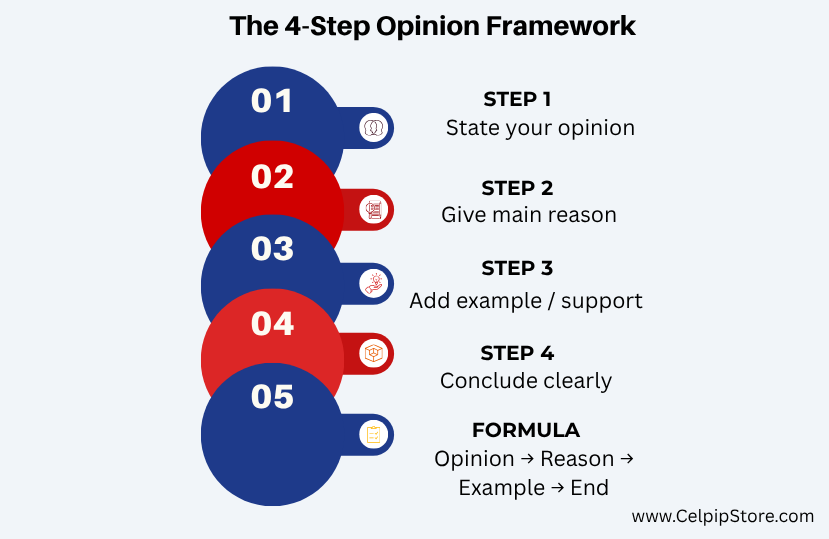
Simple Speaking Template
Use this flexible template to organize your response easily.
Template:
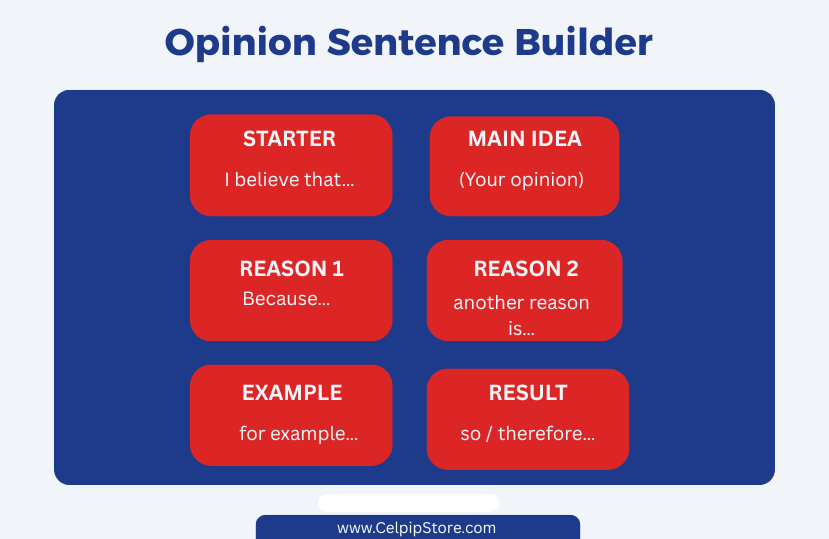
- I believe that…
- First, … because …
- For example, …
- In addition, …
- For these reasons, I believe that…
This structure helps you speak smoothly and logically.
High-Scoring Example Answer
Let’s apply the framework to a real topic.
Example Question
Do you think students should study alone or in groups?
Sample Answer
“I believe that studying in groups is more effective than studying alone. First, group study allows students to share ideas and learn from each other. For example, if one student does not understand a topic, another student can explain it in a simple way. In addition, studying in groups keeps students motivated and focused. For these reasons, I strongly believe that group study is the better option.”
Why This Answer Works
This answer is effective because it is clear, structured, and easy to follow.
Strengths:
- Clear opinion at the beginning
- Logical reasons
- Simple explanation
- Strong conclusion
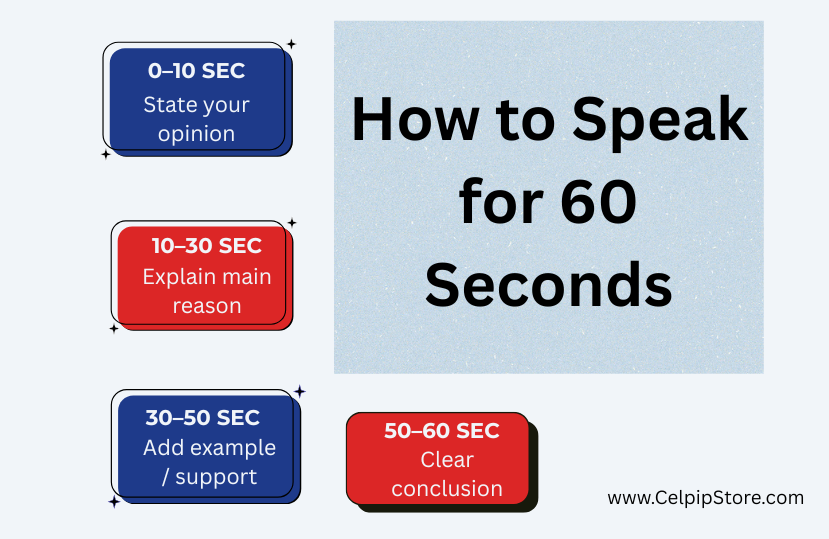
Strategy to Speak for 60 Seconds
To reach 60 seconds, you need to expand your ideas naturally.
Practical Strategy
- State your opinion
- Give reason 1
- Add explanation
- Give example
- Add reason 2
- Conclude confidently
Useful Linking Words
- first
- for example
- in addition
- also
- for this reason
These help improve fluency and flow.
Pro Tip: Keep It Simple
Many students try to use complex ideas and get stuck. Instead, focus on:
- Simple ideas
- Clear structure
- Smooth delivery
Simple answers with strong structure score higher than complex but unclear answers.
Thinking Strategy for Ideas
If you don’t know what to say, use these idea sources:
Personal Experience
- “In my experience…”
Practical Benefits
- Time-saving
- Cost-effective
- Convenient
Common Situations
- Students, workers, daily life
These ideas help you respond quickly.
Advanced Tips to Achieve a High Score
Once you understand the structure of Task 7, the next step is to improve how you present your ideas. High-scoring candidates do not just give opinions—they sound confident, clear, and natural. Your delivery matters as much as your content.
To score high, focus on clarity, fluency, and logical development, rather than trying to sound overly complex. These techniques can help you improve Task 7, but mastering the complete Speaking section requires a strategy for every task. Read our Ultimate CELPIP Speaking Guide for a complete task-by-task roadmap.
Key Advanced Strategies
These strategies will help you sound more natural and organized.
1. Be Direct and Confident
Start your response without hesitation. Avoid weak or unclear openings.
Use:
- I believe that…
- In my opinion…
- I strongly think that…
Example:
“I strongly believe that online education is more effective.”
2. Develop Your Ideas Fully
Do not just mention reasons—explain them clearly.
Weak:
- “It is good because it saves time.”
Strong:
- “It is good because it saves time, which allows people to focus on more important tasks.”
3. Use Simple but Effective Language
You do not need advanced vocabulary. Focus on clear communication.
Tip:
- Short sentences
- Clear ideas
- Logical flow
4. Avoid Repetition
Repeating the same idea lowers your score.
Instead:
- Add examples
- Add explanations
- Add another reason
5. Maintain Fluency
Fluency is key in Task 7.
Tips:
- Speak at a steady pace
- Avoid long pauses
- Use connectors to continue speaking
6. Balance Your Time
Do not spend too much time on one idea.
Ideal Structure:
- Opinion (5–7 seconds)
- Reason 1 + explanation (20 seconds)
- Reason 2 + explanation (20 seconds)
- Conclusion (10–15 seconds)
Examiner Insights: What Really Matters
Understanding how your response is evaluated helps you focus on the right things.
What Examiners Evaluate
1. Content
- Did you give a clear opinion?
- Did you support it with reasons?
2. Coherence
- Are your ideas organized logically?
- Is your response easy to follow?
3. Vocabulary
- Are your words clear and appropriate?
- Do you use linking words effectively?
4. Grammar
- Are your sentences mostly correct?
- Do you avoid major errors?
5. Fluency
- Do you speak smoothly for 60 seconds?
- Do you avoid hesitation?
What Examiners Do NOT Care About
Many students focus on the wrong areas.
Examiners do NOT expect:
- Complex ideas
- Advanced vocabulary
- Perfect grammar
They want clear, organized, and confident communication.
High-Impact Vocabulary for Opinions
Using the right language improves clarity and confidence.
Opinion Expressions
- I believe that
- In my opinion
- I strongly think that
- I prefer
Reasoning Language
- because
- this is important because
- the main reason is
Adding Ideas
- first
- in addition
- also
- another reason is
Giving Examples
- for example
- for instance
- such as
Conclusion Phrases
- for these reasons
- therefore
- that’s why I believe
Example Combination
“I believe that public transport is better because it is more affordable. For example, many people can save money by using buses instead of driving cars.”
From Average to High-Scoring Answer
Let’s compare two responses.
Average Answer
“I think it is good. It helps people. It is better.”
Problems:
- No explanation
- Weak vocabulary
- No structure
High-Scoring Answer
“I believe that exercise is very important because it improves both physical and mental health. For example, regular exercise helps reduce stress and keeps the body active. In addition, it increases energy levels. For these reasons, I strongly believe exercise is essential.”
Strengths:
- Clear opinion
- Strong reasons
- Good examples
- Logical flow
Practice Questions
Practice regularly to improve your confidence.
Practice Question 1
Do you think online shopping is better than in-store shopping?
Practice Question 2
Should students have part-time jobs while studying?
Practice Question 3
Is it better to live in a city or a small town?
Practice Challenge
Now apply the framework.
Task:
- State your opinion
- Give 2 reasons
- Add explanations
- Conclude clearly
- Speak for 60 seconds
Pro Tip
Record your answer and check:
- Did I give a clear opinion?
- Did I explain my reasons?
- Did I avoid repetition?
- Did I speak for 60 seconds?
Self-evaluation helps you improve faster.
Summary
CELPIP Speaking Task 7 tests your ability to express your opinion clearly and support it with logical reasons. A high-scoring response is simple, structured, and easy to follow. By stating your opinion early, giving 2–3 strong reasons, and explaining them clearly, you can deliver a confident and effective answer within 60 seconds. This task is not about complex ideas it is about clarity, organization, and fluency.
Task 7 Quick Checklist
Use this checklist during your exam to stay focused and organized.
During Preparation Time:
- Decide your opinion quickly
- Think of 2 strong reasons
- Plan a simple example
During Speaking:
- Start with a clear opinion
- Give reason 1 + explanation
- Add example
- Give reason 2
- Conclude confidently
- Speak for full 60 seconds
Language Focus:
- Use opinion phrases (I believe, in my opinion)
- Use connectors (first, in addition, for example)
- Use simple and clear sentences
- Avoid repeating the same idea
Frequently Asked Questions (FAQs)
1. What is CELPIP Speaking Task 7?
It is a task where you express your opinion on a topic and support it with reasons.
2. How many reasons should I give?
You should give 2–3 strong reasons.
3. Should I talk about both sides?
No, you should clearly choose one side and support it.
4. How long should I speak?
You should speak for the full 60 seconds.
5. What language should I use?
Use simple, clear, and structured language.
6. What are common mistakes?
Common mistakes include no clear opinion, weak reasons, and poor structure.
7. Can I use simple ideas?
Yes, simple ideas with clear explanation are better than complex ideas.
8. How can I improve quickly?
Practice regularly, follow a structure, and record your responses.
7-Day Practice Plan
Consistent practice will help you improve fluency and confidence.
Day 1–2:
- Understand the task format
- Practise giving opinions quickly
Day 3–4:
- Use the opinion framework
- Focus on giving strong reasons
Day 5:
- Practise speaking for full 60 seconds
- Record and review answers
Day 6:
- Improve vocabulary for opinions
- Practise using connectors
Day 7:
- Take a full speaking practice test
- Evaluate your performance
Final Tips for Success
To succeed in Task 7, focus on being clear, confident, and structured. Do not overthink your ideas. Choose a simple opinion, support it with strong reasons, and explain clearly. Maintain a natural speaking pace and use connectors to keep your answer smooth. Confidence and clarity are more important than perfection. With regular practice, you can turn this task into one of your strongest scoring areas.
Conclusion
CELPIP Speaking Task 7 is a powerful opportunity to show your ability to communicate ideas clearly and logically. By using a simple framework and practising regularly, you can improve your fluency and confidence. This skill is valuable not only for the exam but also for real-life communication in Canada.