1.png)
CELPIP Speaking Task 2
Many candidates become nervous when they see a Personal Experience question because they think they need to tell an exciting or unforgettable story.
The good news is that the examiner is not judging how interesting your life is.
Instead, they want to see whether you can:
- Organize your ideas
- Speak naturally
- Include relevant details
- And communicate clearly
Even an ordinary experience like visiting a park, learning to ride a bicycle, or helping a friend can become a high-scoring answer if it is well structured. CELPIP Speaking includes 8 different tasks, each testing a different communication skill. To understand all tasks and how the speaking test is scored, read our Ultimate CELPIP Speaking Guide.
In this guide, you'll learn exactly how to organize your story, avoid common mistakes, and build confidence for CELPIP Speaking Task 2. These mistakes are common across multiple speaking tasks. Learn how to avoid them in our complete CELPIP speaking guide.
What Is CELPIP Speaking Task 2?
In Task 2, you'll be asked to describe a real or believable personal experience.
Typical topics include:
- A memorable trip
- A celebration
- Your first day at work
- A challenging situation
- A favourite teacher
- A hobby
- An achievement
- A family event
- A time you helped someone
The examiner is looking at how you tell the story, not whether the event actually happened. Task 2 is just one part of the CELPIP speaking test. You can explore all 8 tasks and their strategies in our complete CELPIP speaking guide.
If you can't remember a real experience, it's perfectly acceptable to tell a believable story.
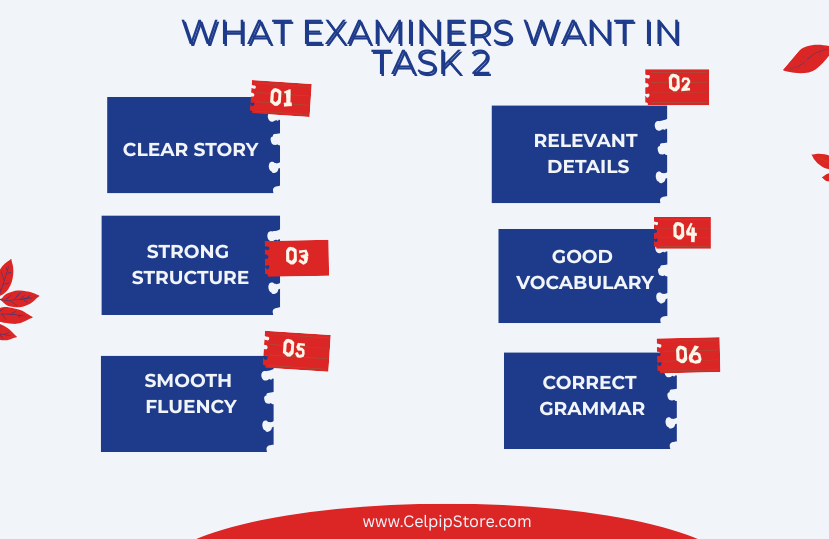
What Examiners Are Looking For
A strong Task 2 response usually includes:
- A clear beginning
- A logical sequence of events
- Relevant details
- Smooth transitions
- Natural speaking
- A satisfying ending
Your goal is to make the listener feel like they're following a story rather than listening to disconnected sentences.
Why Candidates Lose Marks
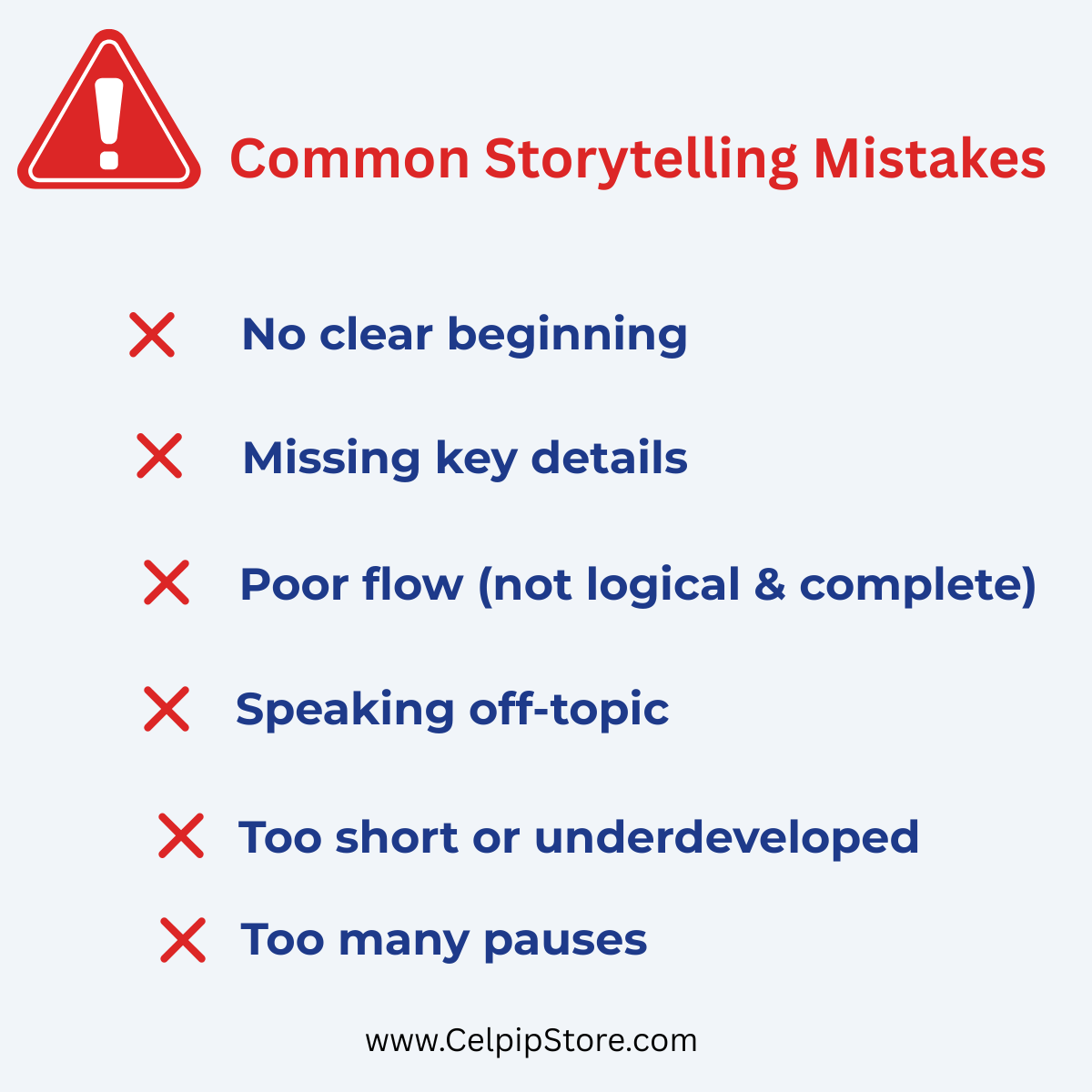
Many candidates:
- Jump randomly between ideas
- Forget important details
- Finish too early
- Or spend too much time introducing the topic
Without a clear structure, even good English can sound confusing.
That's why successful candidates use a simple storytelling framework.
Learning Objectives
By the end of this guide, you'll know how to:
- Organize any personal story
- Sound confident and natural
- Include enough details
- Manage your speaking time
- And answer almost any Task 2 question effectively
Quick Tip
Don't worry about telling a perfect or dramatic story.
A simple, well-organized experience will almost always score better than a complicated story that's difficult to follow.
The Best Storytelling Framework for CELPIP Speaking Task 2
Many candidates think they need an extraordinary story to impress the examiner.
That's not true.
Examiners are far more interested in how you organize your story than how exciting it is.
A simple experience with a clear beginning, middle, and end will almost always score higher than an interesting story that's confusing or disorganized.
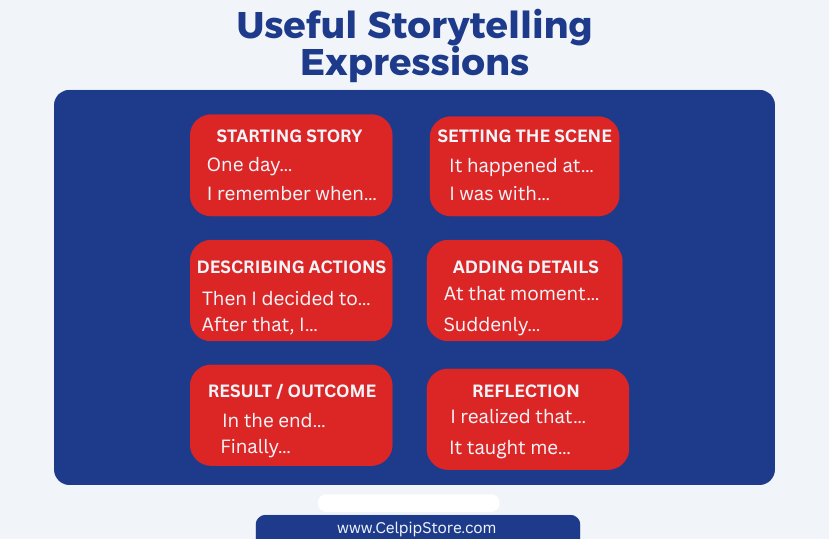
The 5-Step Story Framework
Whenever you receive a Personal Experience question, organize your answer using this simple structure:
- Situation
- What Happened
- Details
- Result
- Reflection
Let's look at each step.
Step 1 – Introduce the Situation
Start by explaining when, where, and what the situation was.
You don't need many details just enough to help the listener understand the context.
Example
"Last summer, I went on a family trip to the mountains during my vacation."
or
"A few years ago, I started my first part-time job while I was still in college."
Keep this introduction brief.
Step 2 – Explain What Happened
Now describe the main event.
Tell the story in the order it happened.
Avoid jumping back and forth between different moments.
Example
"When we arrived, it suddenly started raining, and we couldn't continue our hike."
or
"On my first day at work, I accidentally sent an email to the wrong customer."
Chronological storytelling is easier for the examiner to follow.
Step 3 – Add Interesting Details
This is where many candidates lose marks.
Don't simply say what happened.
Explain:
- How you felt
- What you saw
- What people said
- Or what you learned
These details make your story sound natural and engaging.
Example
"At first, I felt embarrassed because everyone noticed my mistake, but my manager remained calm and helped me fix it."
One or two meaningful details are enough.
Step 4 – Describe the Result
Explain how the story ended.
Did you solve the problem?
Did something funny happen?
Did you achieve your goal?
Example
"In the end, everything worked out well, and the customer appreciated our quick response."
Every story should have a clear conclusion. Similar structured approaches are used across all speaking tasks. Learn the complete framework in our CELPIP speaking strategies guide.
Step 5 – Finish with Reflection
Finish by explaining what you learned or why the experience was memorable.
This creates a strong ending.
Example
"Since then, I've always double-checked my emails before sending them."
or
"It became one of my favourite family memories."
Reflection makes your answer sound complete.
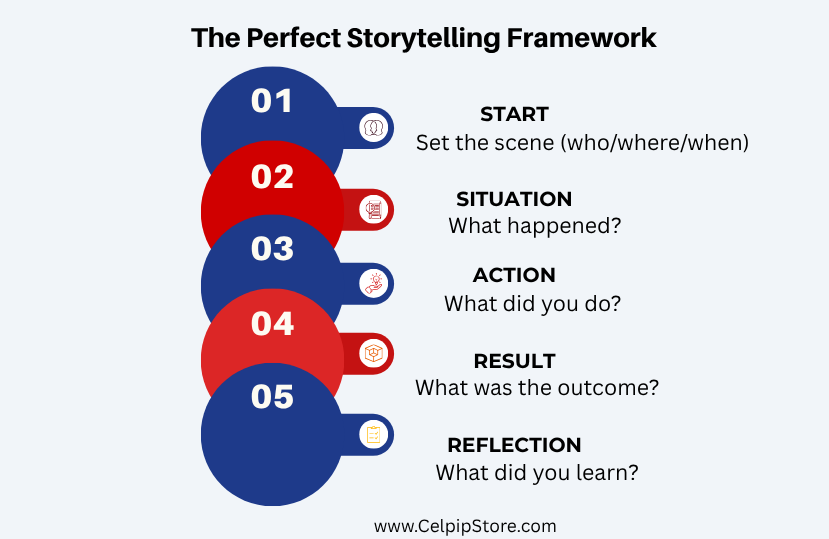
Useful Transition Words
Transitions help your ideas flow smoothly.
Beginning
- One day...
- A few years ago...
- Last weekend...
- During my vacation...
- When I was younger...
Middle
- First...
- Then...
- After that...
- Meanwhile...
- Suddenly...
Ending
- Finally...
- In the end...
- Eventually...
- Fortunately...
- Looking back...
Using transitions makes your story easier to follow and demonstrates strong organization.
What If You Don't Have a Real Story?
Many candidates panic because they can't remember a suitable personal experience.
Remember:
The CELPIP test does not require every story to be true.
You may tell a believable story based on:
- Something that happened to a friend
- A family member
- A colleague
- Or even an imagined situation
As long as your story is realistic and consistent, the examiner is evaluating your English not your biography.
Timing Your Response
A balanced answer might look like this:
- Situation: 10–15 seconds
- What Happened: 20–25 seconds
- Details: 25–30 seconds
- Result: 10–15 seconds
- Reflection: 10–15 seconds
This helps you use your speaking time effectively without rushing or finishing too early.
Quick Practice Exercise
Imagine this question:
"Talk about a memorable birthday celebration."
Before speaking, quickly think about:
- Where was it?
- Who was there?
- What happened?
- How did it end?
- Why do you still remember it?
If you can answer these five questions, you've already built a complete story.
Expert Tip
Don't try to include every detail you remember.
Choose one clear story, keep it in chronological order, and speak naturally. A simple, well-organized experience is much easier to understand—and much more likely to earn a strong CELPIP Speaking score.
High-Scoring Sample Answers & Examiner Analysis
Now that you've learned the storytelling framework, it's time to see how it works in a real CELPIP response.
Reading strong sample answers helps you understand:
- How ideas connect
- How much detail is enough
- And what separates an average response from a high-scoring one
Remember:
There isn't only one "correct" answer.
The examiner evaluates how effectively you communicate your story, not whether your experience is extraordinary.
Practice Question
Describe a memorable trip you took. Explain where you went, what happened, and why the experience was memorable.
Sample Response (Estimated Level 5–6)
"Last year I went to Manali with my family during the summer holidays. We travelled by car and stayed there for three days. We visited some beautiful places and took many pictures. My favourite part was seeing snow because it was my first time. I really enjoyed the trip and I hope I can visit again someday."
Examiner Analysis
Strengths
- Easy to understand
- Logical order
- Clear beginning and ending
Weaknesses
- Limited details
- Very simple vocabulary
- Little emotional description
- Few transitions
- Story develops quickly without much explanation
Sample Response (Estimated Level 8–9)
"One of the most memorable trips I've ever taken was a family vacation to Manali two years ago. It was during the summer holidays, and my parents wanted all of us to spend some quality time together.
We travelled overnight by car, and although the journey was long, the beautiful mountain views made it worthwhile. On our second day, we visited a popular hill where I saw snow for the first time in my life. I was so excited that I immediately started taking photos and even had a small snowball fight with my younger cousin.
What made the trip even more special was that everyone in my family was relaxed and happy. We laughed a lot, shared meals together, and created memories that we still talk about today. Looking back, that vacation reminded me how important it is to spend time with the people you love. I would definitely love to visit Manali again in the future."
Examiner Breakdown
Content
Excellent.
The candidate fully answers every part of the question.
Organization
The story follows a natural sequence:
- Situation
- Journey
- Main event
- Conclusion
- Reflection
- Very easy to follow
Vocabulary
Good variety.
Examples:
- Memorable
- Worthwhile
- Quality time
- Relaxed
- Created memories
- Looking back
Grammar
Good sentence variety.
Mostly accurate throughout.
Fluency
Natural conversational pace.
Ideas connect smoothly.
Communication
The response sounds genuine and engaging.
The listener can easily imagine the experience.
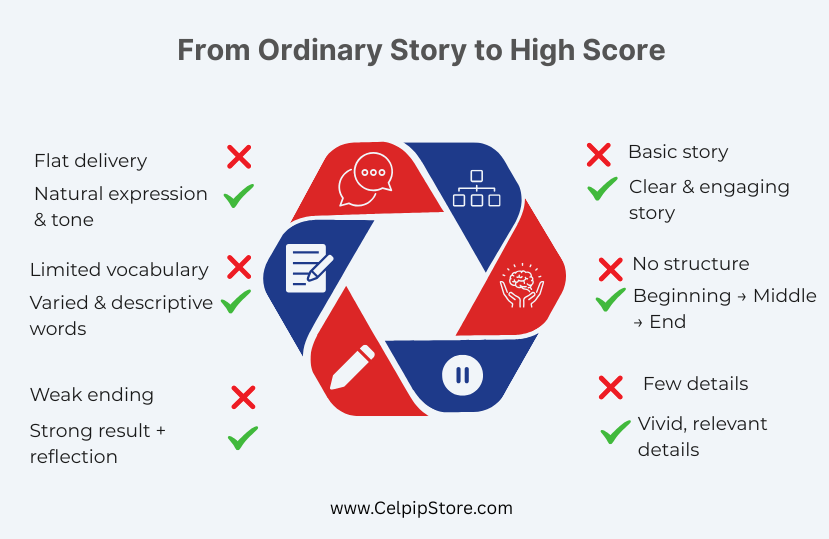
Why Does the Second Answer Score Higher?
Notice that the second story isn't dramatically more exciting.
The difference is how the experience is described.
The candidate:
- Adds emotions
- Explains why the trip mattered
- Includes meaningful details
- Uses transitions
- And finishes with reflection
These elements create a much stronger response.
Expert Storytelling Techniques
Technique 1 – Show Feelings
Instead of saying:
"I was happy."
Say:
"I was so excited that I couldn't stop smiling."
This sounds more natural.
Technique 2 – Use Your Senses
Describe:
- What you saw
- Heard
- Smelled
- Or felt
Example:
"The fresh mountain air and beautiful scenery made the entire trip unforgettable."
Small sensory details make your story more vivid.
Technique 3 – Focus on One Story
Don't combine multiple experiences.
Choose one event and develop it well.
One detailed story is stronger than three short ones.
Technique 4 – Use Natural Transitions
Good storytellers guide the listener through the story.
Examples:
- At first...
- A little later...
- After that...
- Finally...
- Looking back...
Transitions improve organization and fluency.
Technique 5 – Finish with Reflection
Don't simply stop after the story ends.
Explain:
- What you learned
- Why the experience mattered
- Or how it changed you
Reflection creates a memorable ending.
Common Vocabulary for Personal Experiences
Instead of repeating simple words, try these alternatives.
|
Basic Word |
Better Alternative |
|
nice |
enjoyable, memorable, wonderful |
|
happy |
excited, delighted, thrilled |
|
sad |
disappointed, upset |
|
trip |
journey, vacation, visit |
|
good |
rewarding, worthwhile |
|
bad |
challenging, stressful |
|
fun |
entertaining, enjoyable |
Use words that feel natural to you.
Accuracy is more important than complexity.
Practice Challenge 1
Question:
Describe a time when you learned something new.
Think about:
- Where were you?
- What happened?
- What did you learn?
- Why was it important?
Record yourself using the five-step storytelling framework.
Practice Challenge 2
Question:
Talk about a celebration you will always remember. To improve your overall speaking score, you should practise all 8 tasks, not just Task 2. Read our Ultimate CELPIP Speaking Guide for a complete roadmap.
Try to include:
- The people involved
- Your emotions
- One memorable moment
- And a reflection at the end
Self-Evaluation Checklist
After each practice recording, ask yourself:
- Did I introduce the situation clearly?
- Did I tell the story in order?
- Did I include meaningful details?
- Did I explain the result?
- Did I finish with reflection?
- Did I sound natural?
Listening to your own recordings is one of the fastest ways to improve your storytelling skills.
Your Complete Task 2 Success Plan
Congratulations!
You've now learned:
- What CELPIP Speaking Task 2 measures
- How to organize personal stories
- A simple storytelling framework
- High-scoring sample answers
- Examiner expectations
- Vocabulary and transition techniques
Now let's put everything together into a practical preparation plan.
Your 7-Day Task 2 Practice Plan
One of the easiest ways to improve your storytelling skills is through consistent practice.
Here's a simple one-week plan.
Day 1 – Learn the Framework
Objective:
Become familiar with the storytelling structure.
Practice:
Choose five Task 2 questions.
For each question, quickly write:
- Situation
- What Happened
- Details
- Result
- Reflection
Don't speak yet.
Simply organize your ideas.
Day 2 – Tell Simple Stories
Objective:
Speak without stopping.
Choose three easy topics such as:
- Your favourite holiday
- A birthday celebration
- A memorable meal
Focus on telling the story from beginning to end.
Don't worry about mistakes.
Day 3 – Improve Details
Objective:
Make your stories more interesting.
For every story, include:
- One emotion
- One description
- One memorable moment
Instead of saying:
"The trip was nice."
Try:
"The cool mountain air and beautiful scenery made the trip unforgettable."
Day 4 – Use Better Transitions
Objective:
Improve organization.
Practice using transitions like:
- At first...
- Then...
- After that...
- Meanwhile...
- Finally...
- Looking back...
Good transitions make your stories much easier to follow.
Day 5 – Practice Under Exam Conditions
Choose five different Task 2 questions.
Answer each one using official timing.
No restarting.
No editing.
Treat every response like the real exam.
Day 6 – Review Your Recordings
Listen carefully.
Ask yourself:
- Did my story have a clear beginning?
- Did I follow the correct order?
- Did I include enough details?
- Did I finish with reflection?
- Did I sound natural?
Write one improvement for every recording.
Day 7 – Retell Your Best Story
Choose your favourite recording.
Tell the same story again.
Try to improve:
- Vocabulary
- Fluency
- Transitions
- Confidence
You'll notice significant improvement.
Daily Storytelling Practice
Good storytellers practice every day.
You don't need special materials.
Simply describe experiences like:
- What you did yesterday
- Your favourite restaurant
- Your last vacation
- Your first day at school
- A recent celebration
Every real-life conversation improves your speaking skills.
Exam-Day Checklist
Before speaking, ask yourself:
- What experience will I describe?
- What happened first?
- What happened next?
- How did it end?
- What did I learn?
If you can answer these five questions, your story is already organized.
Last-Minute Tips
Keep It Simple
A simple story told well is better than a complicated story told poorly.
Don't Memorize Stories
Memorized stories often sound unnatural.
Instead, memorize the structure, not the content.
Stay Chronological
Avoid jumping between different time periods.
Tell the story in the order it happened.
Include Reflection
Reflection often separates average responses from stronger ones.
Always explain:
- Why the experience mattered
- Or what you learned
Keep Speaking
If you forget a word
Describe it another way
Never stop speaking because of one missing word
Frequently Asked Questions
Does my story have to be true?
No.
You may create a realistic story if you cannot remember a real experience.
The examiner evaluates your communication skills.
What if I forget some details?
That's perfectly normal.
Create believable details and continue speaking confidently.
Can I exaggerate?
Yes, slightly.
As long as your story remains realistic and internally consistent.
Is one experience enough?
Yes,
One well-developed story is much stronger than several short stories.
How many details should I include?
Enough to make the story interesting.
Don't overload your answer with unnecessary information.
Quick Story Formula
Whenever you practice Task 2, remember:
- Situation
- What Happened
- Details
- Result
- Reflection
This simple framework works for almost every Personal Experience question.
Your Task 2 Success Roadmap
Choose One Story
- Introduce the Situation
- Describe Events Clearly
- Add Interesting Details
- Explain the Result
- Finish with Reflection
- Review Your Recording
- Practice Again
Every story you tell builds confidence for the next one.
Continue Your CELPIP Speaking Journey
You've now mastered:
- Task 1 – Giving Advice
- Task 2 – Talking About a Personal Experience
Next, we'll move to one of the most visual tasks in the Speaking Test:
CELPIP Speaking Task 3 – Describing a Scene
You'll learn:
- How to observe images quickly
- What details to mention first
- How to organize descriptions naturally
- High-scoring sample responses
- Examiner analysis
- Practice exercises
- Common mistakes to avoid
Final Thoughts
Many candidates worry that they don't have interesting stories to tell.
Fortunately, that's not what CELPIP examiners are looking for.
A high-scoring Task 2 response is built on:
- Clear organization
- Logical storytelling
- Relevant details
- Natural communication
- Thoughtful reflection
Whether your story is about a family dinner, a school project, a holiday, or a memorable conversation, you can earn a strong score by presenting it clearly and confidently. Want to master all CELPIP speaking tasks? Start with our Ultimate CELPIP Speaking Guide.
The storytelling techniques you learned here will also help you in future speaking tasks and in everyday conversations after moving to Canada.