1.png)
CELPIP Writing Task 2 Ideas & Argument Development System
Introduction
Many students struggle with CELPIP Writing Task 2 not because of English, but because of ideas.
They sit in the exam thinking:
- “What should I write?”
- “I don’t have enough points.”
- “My ideas feel too simple.”
This is where most scores drop.
The truth is:
You don’t need “perfect ideas”
You need a clear system to generate and develop ideas quickly
This lesson will teach you a repeatable idea generation and argument development system that works for almost every CELPIP Task 2 question. While strong idea generation and argument development are essential for achieving a high score in CELPIP Writing Task 2, they must be used within a complete understanding of the Writing section, including Task 1, Task 2, scoring criteria, and overall exam strategy. To understand the full system, you should also read our Ultimate CELPIP Writing Guide.
Learning Objectives
By the end of this lesson, you will be able to:
- Generate ideas quickly in the exam
- Develop strong arguments using a clear method
- Avoid weak or repetitive ideas
- Write more convincing and structured essays
- Improve Task 2 score consistency
Overview: Why Students Struggle with Ideas
Most students make one critical mistake:
They try to think of “perfect ideas”
But CELPIP does NOT require perfect ideas.
It requires:
- Clear opinion
- Logical reasoning
- Simple but well-explained points
What Examiners Look For
- Is your idea clear?
- Is your reasoning logical?
- Did you explain your idea properly?
What They DON’T Care About
- Unique or creative ideas
- Advanced knowledge
- Complex arguments
Idea generation is only one part of the Writing process. To apply these ideas effectively in the exam, you must understand task structure and scoring requirements. Learn the complete system in our CELPIP Writing Guide.
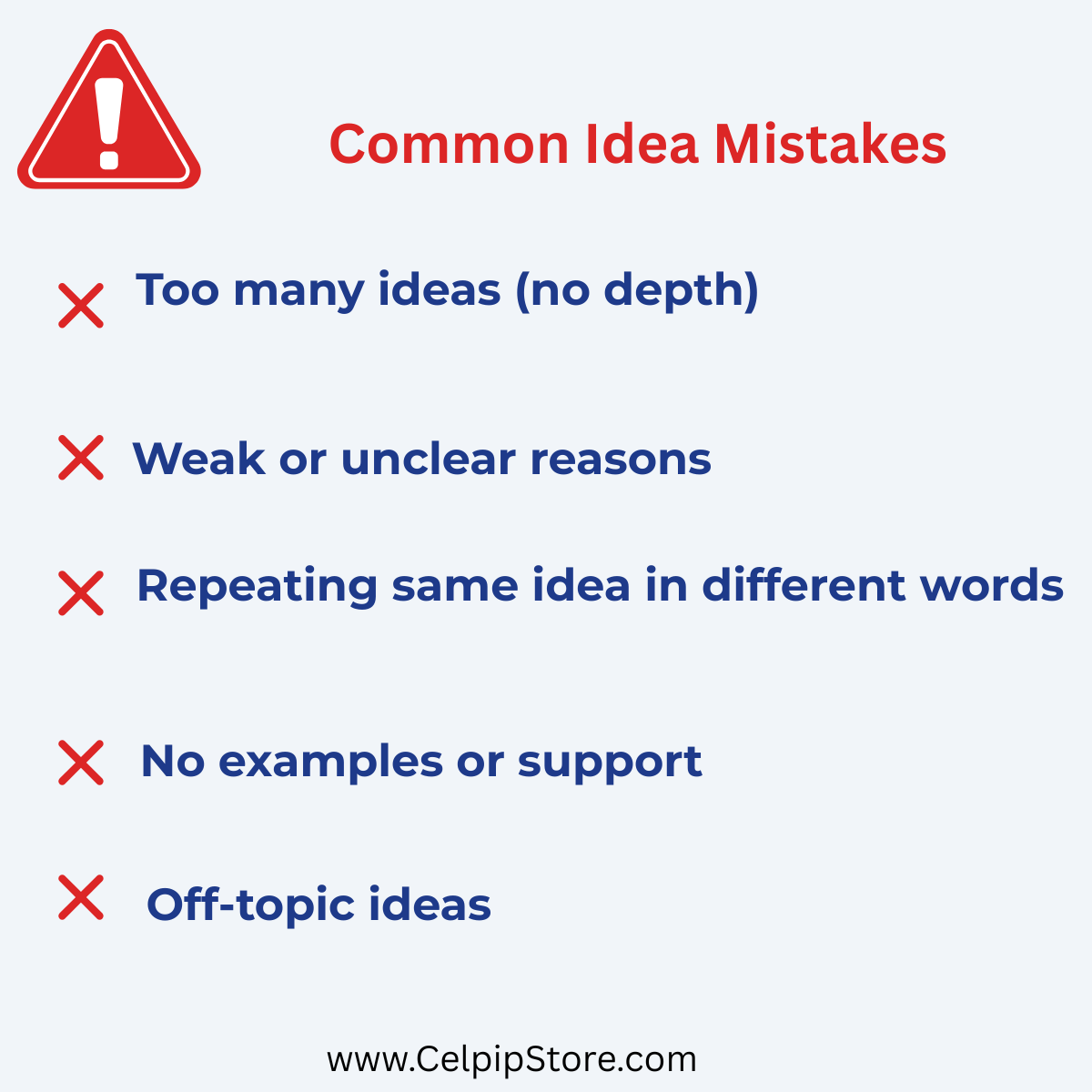
Common Mistakes in Task 2 Ideas
1. No clear opinion
Students try to write both sides.
Result: weak argument
2. Too many ideas
Students include 3–4 weak points instead of 2 strong ones.
3. No explanation
Ideas are mentioned but not developed.
4. Repetition
Same idea written in different words.
5. Going off-topic
Ideas don’t match the question clearly.
Core System: Idea Generation Formula (Works for ANY Topic)
Stop waiting for “perfect ideas.”
Use this simple and powerful system:
The 5 Idea Categories (Universal Thinking Tool)
For almost every CELPIP Task 2 question, you can generate ideas using these categories:
- Cost / Money
- Time / Convenience
- Productivity / Efficiency
- Environment / Society
- Health / Lifestyle
Example Topic:
“Should public transport be free?”
Generate ideas:
- Cost -> saves money for citizens
- Environment -> reduces pollution
- Time -> reduces traffic congestion
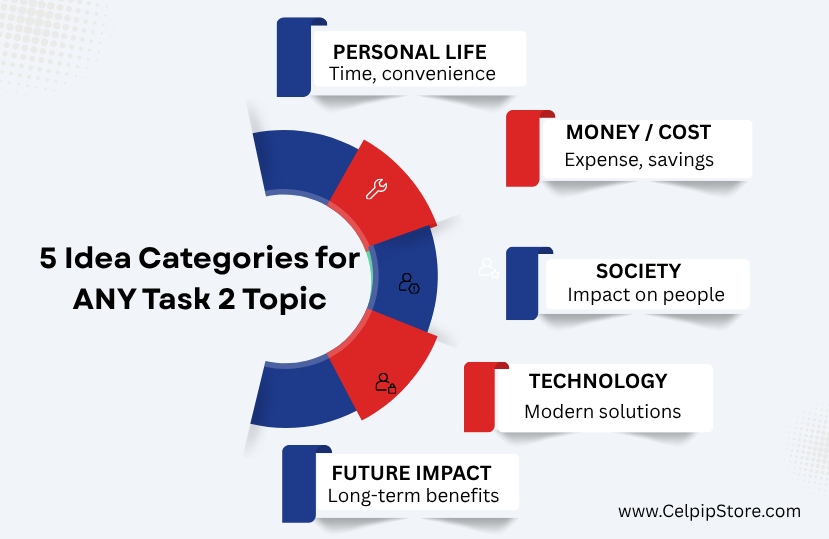
You only need 2 strong ideas, not all.
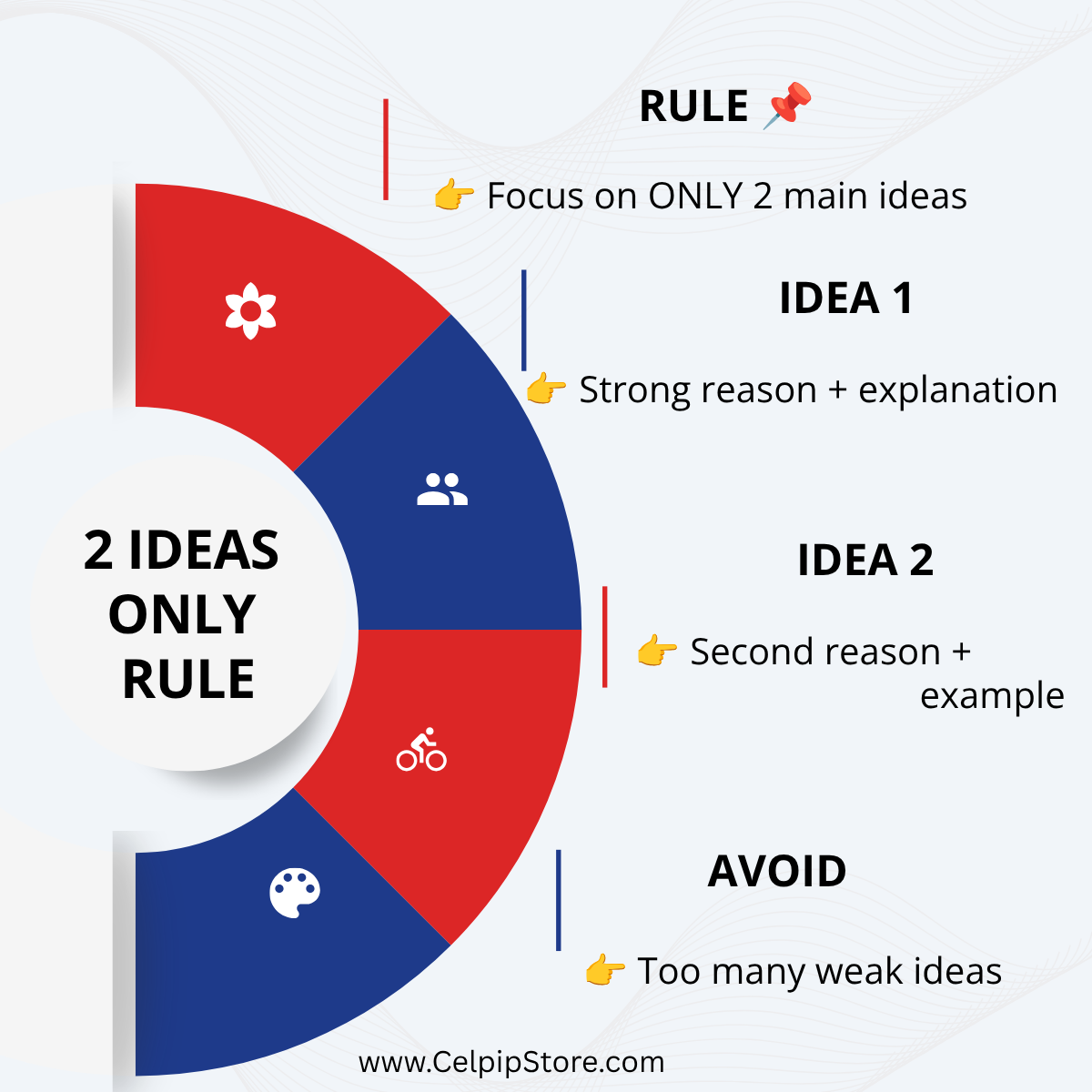
Rule for High Score
Choose 2 ideas only
Develop them fully
Argument Development System (Band 9 Formula)
Use this structure for every idea:
Point -> Explain -> Result (PER System)
1. Point (Your Idea)
Clearly state your reason.
Example:
Public transport should be free because it reduces financial burden.
2. Explain (Why?)
Explain your idea in simple terms.
Example:
Many people spend a large portion of their income on daily travel.
3. Result (Impact)
Show the effect or outcome.
Example:
As a result, free transportation can improve financial stability and quality of life.
Full Example (Band 8–9 Style)
Public transportation should be free because it significantly reduces financial pressure on individuals. Many people rely on buses and trains for daily commuting, which can be expensive over time. As a result, free access would allow people to save money and manage their expenses more effectively.
3. How to Generate Ideas in 30 Seconds (Exam Strategy)
Follow this process:
Step 1: Choose your opinion
Agree or disagree quickly
Step 2: Pick 2 categories
Example: cost + environment
Step 3: Apply PER system
Develop both ideas clearly
Done. No overthinking.
To score high in CELPIP Writing, strong ideas alone are not enough you must also understand task requirements, structure, and evaluation criteria. Read our Ultimate CELPIP Writing Guide for complete strategies.
Common Mistakes in Idea Development
Writing only “Point”
- No explanation = low score
Weak explanation
- Too short or unclear
No result
- Missing impact reduces clarity
Too many ideas
- Less depth, more confusion
Many candidates lose marks because they focus only on ideas but ignore overall Writing strategy and task requirements. Avoid this mistake by understanding the full Writing system.
Golden Rule
“Depth beats quantity”
2 strong ideas = higher score
4 weak ideas = lower score
4. Ready-to-Use Idea Bank (Quick Support)
Use these general ideas for most topics:
Cost Ideas
- Saves money
- Reduces expenses
Time Ideas
- Saves time
- Improves convenience
Productivity Ideas
- Increases efficiency
- Better performance
Environment Ideas
- Reduces pollution
- Promotes sustainability
Health Ideas
- Reduces stress
- Improves well-being
Advanced Idea Development (Band 8–10 Level)
At this stage, your goal is not just to “have ideas,” but to build strong arguments that feel logical and convincing.
Examiners are looking for:
- Clear reasoning
- Deep explanation (not just surface ideas)
- Logical connection between sentences
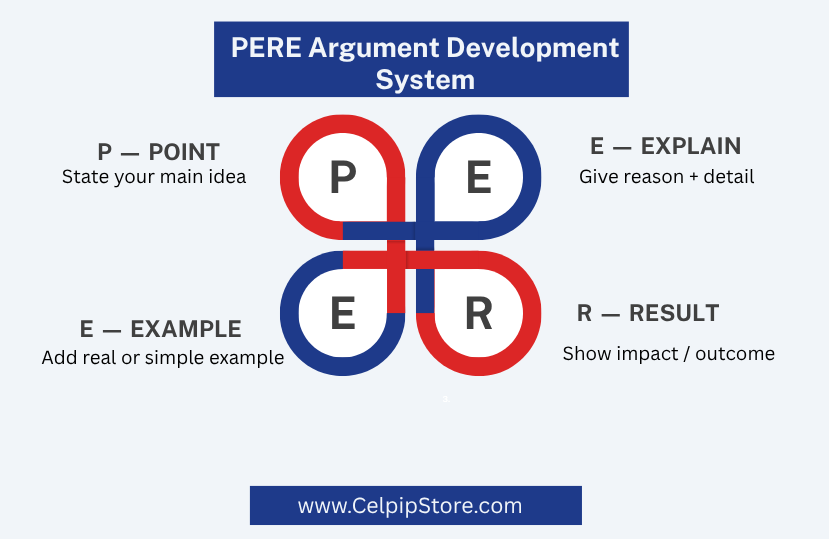
1. Advanced PER System (Upgraded Version)
We now upgrade the basic system:
Point -> Explain -> Result -> Example (PERE System)
Point
State your idea clearly.
Explain
Explain why it is true.
Result
Show the impact.
Example (optional but powerful)
Add a real-life or simple example.
Full Example (High Score Response)
Public transportation should be free because it significantly reduces financial stress for individuals. Many people, especially students and low-income workers, spend a large portion of their income on daily commuting. As a result, free transportation would improve financial stability and reduce economic pressure. For example, students could save money and use it for education-related expenses.
2. Examiner Insight (What Gets Band 9)
Examiners do NOT reward:
- Fancy vocabulary
- Long essays
- Rare ideas
They reward:
- Clear opinion
- Logical structure
- Fully developed ideas
- Easy-to-understand English
What Low Scores Look Like
Weak Writing Pattern
- Idea stated
- No explanation
- No result
This = Band 5–6 level
Over-Complex Writing
- Too many big words
- Confusing structure
- Unclear message
This also reduces score
3. How Band 9 Writers Think
They don’t ask:
“What unique idea can I write?”
They ask:
“How can I explain this idea clearly?”
4. High-Scoring Idea Expansion Techniques
Technique 1: “Why Method”
Ask: Why is this true?
Technique 2: “So What Method”
Ask: What is the result?
Technique 3: “Who is affected?”
Ask: Who benefits or suffers?
.png "Idea_Expansion_Checklist_(PERE).png")
Example Application
Topic: Should students wear uniforms?
Idea:
Uniforms reduce social pressure.
Why:
Students do not need to compete with expensive clothing.
So what:
This creates a more equal and focused learning environment.
Who:
Students from low-income families benefit the most.
5. Idea Quality Checklist
Before writing, check:
- Is my idea clear?
- Did I explain WHY?
- Did I show RESULT?
- Did I avoid repetition?
Golden Rule
“A simple idea with strong explanation beats a complex idea with weak explanation.”
Final Summary: CELPIP Task 2 Idea System
The biggest mistake students make in CELPIP Task 2 is trying to think of “perfect ideas.”
In reality, high scores come from:
Simple ideas + strong explanation + clear structure
Not creativity. Not complexity.
Core System Recap
Idea Generation
Use the 5 Universal Categories:
- Cost
- Time
- Productivity
- Environment
- Health
Idea Development
Use the PERE System:
- Point
- Explain
- Result
- Example
Writing Goal
- 2 strong ideas only
- Fully developed paragraphs
- Clear logical flow
Final Idea Framework (Exam Blueprint)
STEP 1: Choose Opinion
- Agree / Disagree / Preference
STEP 2: Select 2 Ideas
- Cost / Time / Health / Environment / Productivity
STEP 3: Apply PERE System
For each idea:
- Point
- Explain
- Result
- Example
STEP 4: Conclude Clearly
- Restate opinion
- Summarize ideas
CELPIP TASK 2 FINAL CHECKLIST
Idea Quality
- I used only 2 ideas
- Both ideas are clear and relevant
- No off-topic content
Development Quality
- I explained WHY each idea is true
- I included RESULT or impact
- I used simple examples (if possible)
Structure Quality
- Introduction is clear
- 2 body paragraphs are balanced
- Conclusion restates opinion
Language Quality
- Clear and simple English
- No unnecessary complexity
- Logical flow maintained
FAQs: CELPIP Task 2 Ideas
Q1: Do I need advanced ideas for high score?
No. You need clear and well-explained ideas, not advanced topics.
Q2: How many ideas should I write?
Exactly 2 strong ideas are enough.
Q3: What if I don’t understand the topic?
Use universal categories:
Cost, Time, Health, Environment, Productivity
Q4: Can I use personal examples?
Yes, simple real-life examples are very effective.
7-Day Practice Plan (Idea Development Mastery)
Day 1–2: Idea Generation Practice
- 5 topics -> generate 2 ideas each
Day 3–4: PERE Practice
- Expand each idea into full paragraph
Day 5: Full Essay Writing
- 1 Task 2 essay daily
Day 6: Timed Practice
- 40 minutes per essay
Day 7: Mock Test
- Full writing simulation
Final Strategy Insight
Ideas are NOT the problem
Development is the real score booster
If you explain clearly, even simple ideas become Band 8–9 level.
Final Takeaway
To master CELPIP Task 2:
- Think simple
- Use categories
- Develop deeply
- Stay structured
To master CELPIP Writing, you must combine strong idea development with proper task strategy, structure, and scoring understanding. For complete preparation, start with our Ultimate CELPIP Writing Guide.