CELPIP Speaking Fluency Mastery: Speak Fast, Clear & Confident for CLB 9 Score
Introduction
In CELPIP Speaking, most students think the biggest problem is vocabulary or grammar. In reality, the real score killer is fluency breakdown pauses, hesitation, and loss of flow.
You may know English well, but if you stop frequently while thinking, your score drops significantly. This is because CELPIP evaluates how smoothly you can communicate under time pressure.
CLB 9 speakers are not perfect speakers. They are continuous speakers. They may make small mistakes, but they do not lose flow.
This lesson focuses on building that exact ability: speaking continuously while thinking in real time.
Learning Objectives
By the end of this lesson, you will be able to:
- Understand what fluency really means in CELPIP speaking
- Reduce hesitation and unnatural pauses
- Think and speak at the same time
- Maintain continuous speech under pressure
- Improve real-time sentence formation
- Build confidence in spontaneous speaking
Overview: What Fluency Really Means in CELPIP
Fluency is not about speaking fast.
Fluency means:
- You do not stop frequently
- Your ideas flow naturally
- You can continue even if sentences are simple
- You do not lose direction while speaking
Many students misunderstand fluency and try to speak faster. This actually increases mistakes and confusion.
CLB 9 fluency is about controlled speed, not maximum speed.
The Real Problem: Why Students Keep Pausing
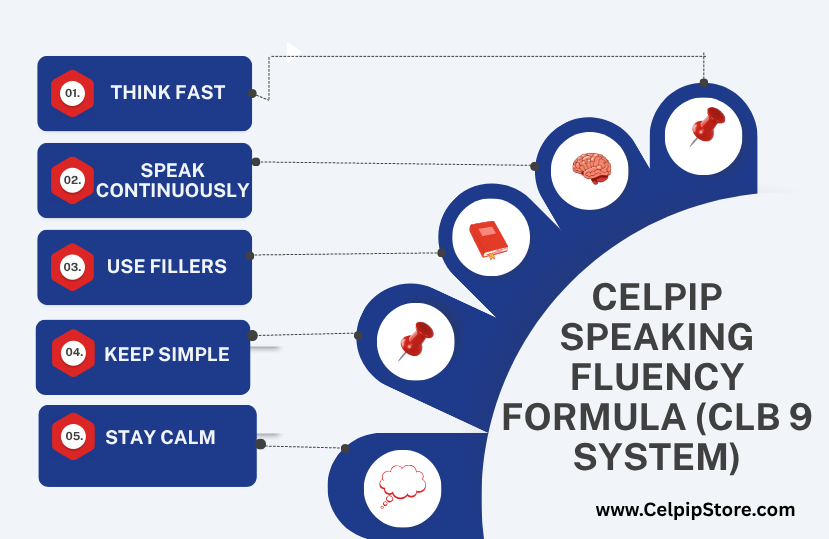
Most fluency problems happen because students try to:
- Translate ideas in their head before speaking
- Find “perfect vocabulary” before continuing
- Build full sentences mentally before starting
- Stop when they make small mistakes
- Overthink grammar during speaking
This creates a gap between thinking and speaking, which leads to hesitation.
What CLB 9 Fluency Actually Looks Like
A CLB 9 speaker:
- Starts speaking immediately
- Uses simple sentence structures naturally
- Thinks while speaking, not before speaking
- Continues even if minor errors happen
- Does not restart answers
- Keeps ideas flowing logically
They prioritize communication over perfection.
Common Mistakes Students Make in CELPIP Speaking Fluency
- Translating sentences from their native language before speaking, which causes long delays
- Trying to form perfect grammar in the mind before starting to speak
- Pausing too often to “think of the next sentence” instead of continuing naturally
- Stopping completely after making small mistakes instead of moving forward
- Overthinking vocabulary choices during speaking, which breaks natural flow
The Core Idea: Fluency Is Real-Time Thinking, Not Pre-Thinking
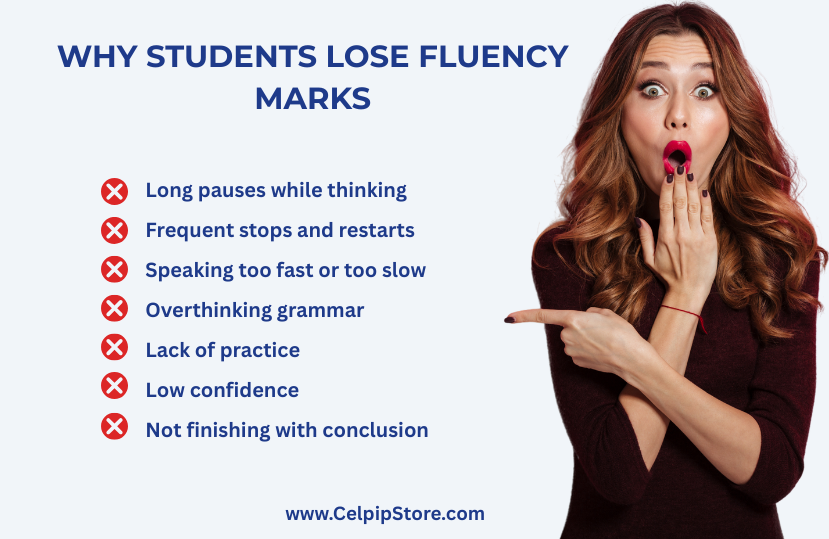
Most students fail fluency because they try to complete the sentence in their mind before speaking. This creates silence, hesitation, and broken flow.
CLB 9 speakers do the opposite. They start speaking immediately and think while speaking.
This is the most important shift in CELPIP Speaking performance.
You are not preparing sentences. You are building sentences in motion.
CLB 9 Real-Time Speaking Framework
This system helps you speak continuously without stopping to “think first.”
1. Start Immediately (No Thinking Delay Rule)
As soon as the question appears, start speaking.
Do NOT:
- Wait for perfect idea
- Plan full sentence
- Translate in your head
Instead, use automatic starters:
- “I think…”
- “In my opinion…”
- “I would like to say that…”
- “One important point is…”
This removes silence at the beginning.
2. Keyword Thinking (Not Sentence Thinking)
Instead of thinking full sentences, think in keywords only.
Example:
Question: “Should students work part-time jobs?”
Keywords:
- money
- experience
- time management
Then expand while speaking.
This reduces mental load and increases speed.
3. Build While Speaking (Sentence Expansion Method)
Start simple and expand naturally.
Example:
- “Students should work part-time jobs…”
- “because it gives them money…”
- “and also helps them gain experience…”
- “which is useful for future careers…”
You are building the sentence step by step.
4. No Stop Rule (Keep Flow Alive)
Even if you make mistakes, do NOT stop speaking.
Instead:
- Continue sentence
- Correct naturally
- Move forward
Example:
Stop -> restart
Continue -> adjust mid-sentence
This is critical for CLB 9 fluency.
5. Bridge Phrases (Keep Speech Connected)
Use linking words to avoid silence:
- “Also…”
- “Another point is…”
- “In addition…”
- “For example…”
- “That’s why…”
These phrases buy thinking time without stopping flow.
6. Safe Ending Strategy
Do not struggle at the end of answers.
Use simple closures:
- “That is why I believe this is correct.”
- “Overall, I think this is the best option.”
- “So, I agree with this idea.”
Ending smoothly is part of fluency scoring.
Why This System Works
This system works because it removes the biggest fluency blocker: pre-planning sentences.
Instead of building full sentences before speaking, you:
- Start fast
- Think in keywords
- Expand naturally
- Stay continuous
This makes speech feel smooth and natural.
Fluency Under Pressure: What Changes at CLB 9 Level
At higher levels of CELPIP Speaking, fluency is not judged by how fast you speak, but by how smoothly you maintain communication under pressure.
Many students assume that speaking faster improves fluency. In reality, uncontrolled speed increases mistakes and hesitation.
CLB 9 speakers control three things at the same time:
- Flow
- Clarity
- Stability
This balance is what creates high scores.
What Examiners Actually Look For in Fluency
Examiners are not counting words or measuring speed. They observe how easily your ideas move forward.
They evaluate:
1. Continuity of Speech
Do you keep speaking without long unnatural pauses?
Strong candidates may pause briefly, but they never lose direction.
2. Recovery Ability
If you make a small mistake, do you continue smoothly or stop completely?
CLB 9 speakers recover instantly without breaking flow.
3. Natural Rhythm
Does your speech sound like natural communication or forced sentence building?
Natural rhythm improves fluency perception significantly.
4. Idea Flow
Do your ideas connect logically without sudden stops or jumps?
Clear progression of ideas is essential.
Speed Control Strategy (Very Important)
Fluency is directly connected to controlled speaking speed.
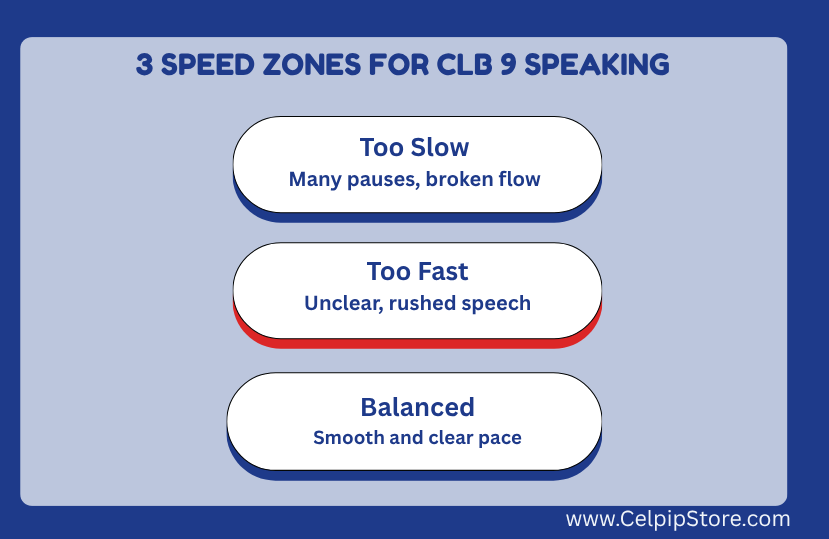
There are three speed zones:
Slow Speed (Thinking Mode)
Used at the beginning of answers
Helps organize ideas quickly
Normal Speed (Main Speaking Mode)
Used for explanation and examples
This is your default speaking speed
Fast Flow (Confidence Mode)
Used when ideas are clear
Shows confidence and control
CLB 9 speakers naturally switch between these speeds without breaking flow.
Advanced Technique: The “No Mental Pause” Rule
The biggest fluency killer is mental silence before speaking.
Instead of stopping to think, CLB 9 speakers:
- Keep speaking
- Think in background
- Adjust mid-sentence
Example:
“(pause)… I think… maybe… um…”
“I think this is a good idea because it helps students improve their skills…”
The difference is continuous flow.
High-Level Fluency Pattern (CLB 9 Model Response Flow)
Strong speakers naturally follow this pattern:
Start -> Expand -> Support -> Example -> Link -> Close
This creates a natural speaking rhythm without forced structure breaks.
Sample Fluent Response (CLB 9 Style)
“I think students should take part-time jobs because it helps them gain practical experience. For example, many students who work part-time learn time management skills, which is very useful in real life.
Also, it helps them become more independent financially. That’s why I believe part-time work is a good option for students overall.”
Notice:
- No long pauses
- Simple language
- Continuous flow
- Clear structure without stopping
Complete Summary of Fluency Mastery
CELPIP Speaking fluency is not about speaking fast or using advanced vocabulary. It is about maintaining continuous, controlled communication without breaking flow.
Throughout this system, you learned how CLB 9 speakers think and speak in real time instead of preparing perfect sentences in advance.
The goal is simple: reduce hesitation and keep speaking moving forward at all times.
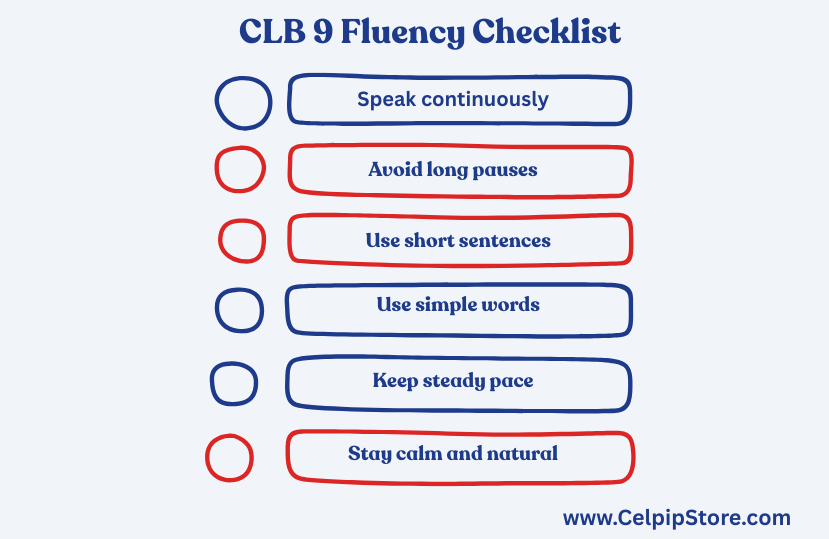
Final CLB 9 Fluency Checklist (Before Exam)
Before every speaking task, quickly check:
Flow Control
- I will start speaking immediately
- I will not wait for perfect ideas
- I will keep my speech continuous
Thinking Control
- I will think in keywords, not full sentences
- I will build sentences while speaking
- I will avoid mental silence
Speed Control
- I will speak at a natural pace
- I will not rush or slow down too much
- I will adjust speed based on confidence
Recovery Control
- I will not stop after small mistakes
- I will continue speaking smoothly
- I will correct naturally if needed
Exam-Day Fluency Strategy
During the CELPIP Speaking test, your main goal is not perfection. Your goal is continuous communication under pressure.
Start each response immediately using a simple phrase like:
- “I think…”
- “In my opinion…”
- “One important point is…”
Then continue building ideas step by step without stopping.
Even if you make mistakes, keep going. Fluency is more important than accuracy.
Common Mistakes (Final Recap)
Across all speaking tasks, avoid:
- Translating sentences before speaking
- Trying to form perfect grammar in your head
- Stopping after small mistakes
- Overthinking vocabulary choices
- Pausing too long before starting
- Restarting sentences repeatedly
- Losing flow when ideas are unclear
- Speaking in short disconnected phrases
These habits directly reduce fluency scores.
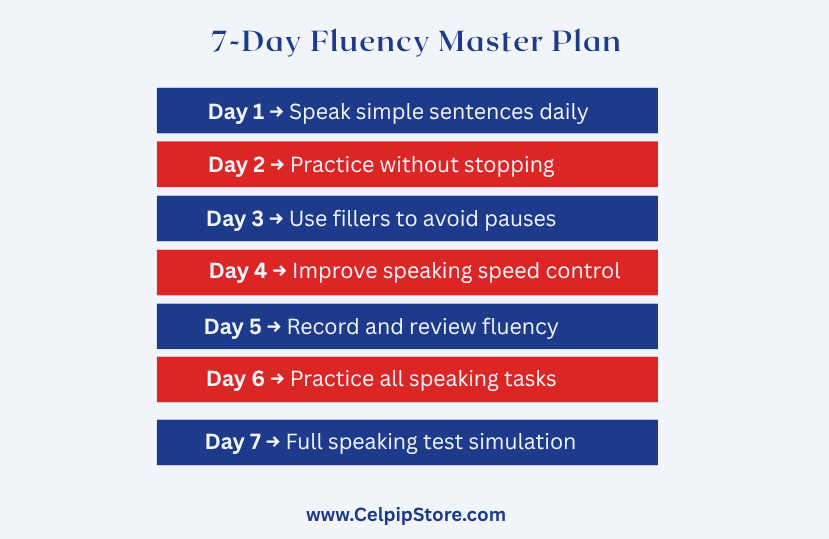
7-Day Fluency Improvement Plan
To master CELPIP speaking fluency, follow this structured plan:
Day 1–2: Keyword Thinking Practice
Train yourself to think in keywords instead of full sentences.
Day 3–4: Continuous Speaking Drills
Speak on any topic for 60–90 seconds without stopping.
Day 5–6: Timed Speaking Simulation
Practice CELPIP tasks under real exam timing conditions.
Day 7: Full Mock Speaking Test
Simulate full speaking test flow with no pauses or restarts.
Final Master Insight
Fluency is not a language skill problem. It is a thinking-speed and flow-control skill.
Once you:
- Remove mental pauses
- Think in keywords
- Build sentences while speaking
- Keep flow continuous
Your speaking automatically reaches CLB 9 level performance.