CELPIP Mock Test Strategy: Error Analysis System to Improve Reading Score CLB 9–12
Introduction
Most CELPIP candidates take mock tests, check their score, and move on without understanding what went wrong.
This is the biggest reason scores stay stuck at the same level.
Mock tests are NOT the final step of preparation. They are diagnostic tools, designed to reveal:
- weak question types
- time management issues
- vocabulary gaps
- decision-making errors
The real improvement happens AFTER the test not during it.
This lesson focuses on turning every mock test into a structured improvement system.
Learning Objectives
By the end of this lesson, you will be able to:
- Use mock tests as a learning system, not just practice
- Identify and classify CELPIP Reading mistakes
- Track recurring error patterns
- Convert mistakes into improvement actions
- Improve score through structured analysis
- Build a performance feedback loop
Overview of Mock Test & Error Analysis System
CELPIP Reading improvement works in two stages:
Stage 1: Mock Test Execution
- Simulate real exam conditions
- Use full timing rules
- Do not pause or guess randomly
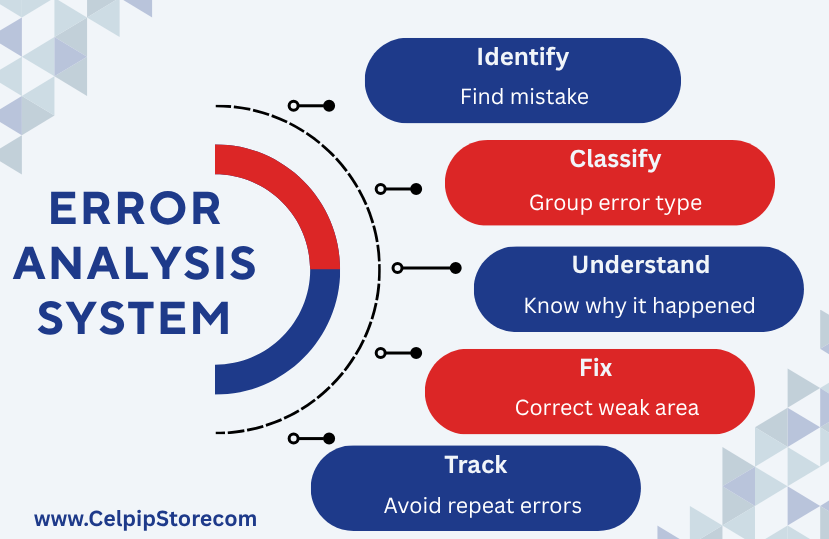
Stage 2: Error Analysis System
This is the most important part:
- Why was the answer wrong?
- Was it a timing issue or understanding issue?
- Was it vocabulary, scanning, or logic?
Improvement happens when you understand why you made mistakes.
Common Mistakes
Most students fail to improve even after multiple mock tests.
Mistake 1: Taking Mock Tests Without Analysis
Students focus only on score, not mistakes.
Fix: Every test must be reviewed in detail.
Mistake 2: Ignoring Repeated Errors
Students repeat the same mistake in every test.
Fix: Track error patterns (not just individual mistakes).
Mistake 3: Treating All Mistakes the Same
Students do not categorize errors.
Fix: Separate:
- time errors
- vocabulary errors
- logic errors
- scanning errors
Mistake 4: No Improvement Plan After Test
Students finish test and move on.
Fix: Every test must end with correction practice.
Mistake 5: Focusing Only on Score
Students chase numbers instead of skill improvement.
Fix: Focus on process, not result.
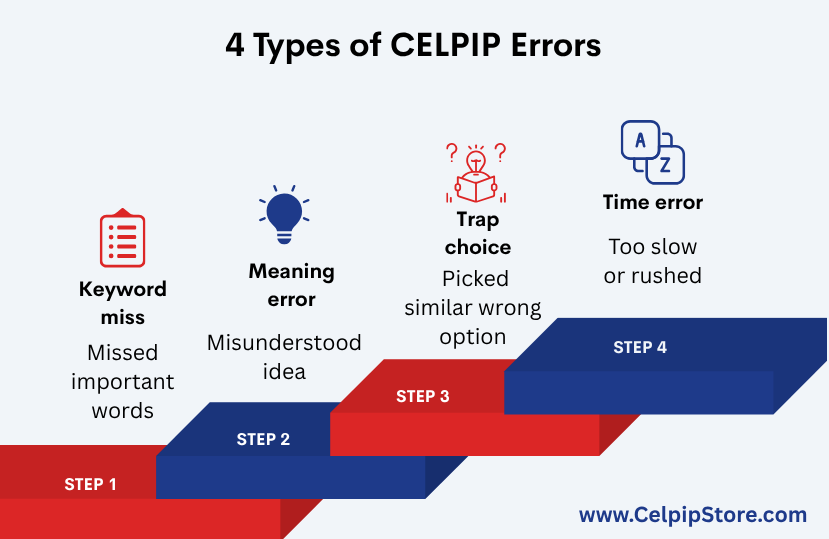
1. Error Classification System (CORE DIAGNOSTIC MODEL)
In CELPIP Reading, every mistake is NOT the same. If you treat all errors equally, your score will stay stuck.
You must classify every mistake into 4 clear categories:
Type 1: Understanding Error (Meaning Failure)
You did not understand the passage or sentence correctly.
Common causes:
- weak vocabulary understanding
- misunderstanding sentence meaning
- confusion due to complex structure
Example: You misread “increase” as “decrease”
Type 2: Scanning Error (Location Failure)
You failed to find the correct information in the passage.
Common causes:
- wrong keyword search
- slow scanning
- missed synonyms
Example: Answer was in paragraph 2, but you searched paragraph 4
Type 3: Logic Error (Decision Failure)
You found the information but chose the wrong option.
Common causes:
- confusion between similar answers
- ignoring context
- selecting partially correct option
Example: Two options seem correct, but you choose the weaker one
Type 4: Time Error (Pressure Failure)
You knew the answer but ran out of time.
Common causes:
- spending too long on one question
- no prioritization system
- panic at end of section
Example: Last 5 questions guessed randomly
2. Analysis Framework (STEP-BY-STEP REVIEW SYSTEM)
After every mock test, you must follow this structured review process:
Step 1: Mark All Wrong Answers
Do NOT ignore any incorrect question.
- mark it clearly
- revisit without time pressure
Step 2: Identify Error Type
For each mistake, ask:
- Did I misunderstand meaning? (Understanding Error)
- Did I fail to locate answer? (Scanning Error)
- Did I choose wrong option? (Logic Error)
- Did I run out of time? (Time Error)
Step 3: Find Root Cause
Do not stop at classification.
Ask:
- Why did this happen?
- Was it vocabulary, speed, or strategy?
Step 4: Write Correction Note
For each mistake, write:
- correct answer
- why it is correct
- what you did wrong
- what you will do next time
This is where real improvement begins.
3. Improvement Cycle Strategy (PERFORMANCE LOOP SYSTEM)
CELPIP improvement is not linear. It is a loop system:
Cycle Step 1: Mock Test
Simulate real exam conditions:
- strict timing
- no pauses
- full section attempt
Cycle Step 2: Error Breakdown
Classify all mistakes into 4 types:
- understanding
- scanning
- logic
- time
Cycle Step 3: Targeted Practice
Fix ONLY weak areas:
- scanning drills
- vocabulary practice
- inference training
- timing exercises
Cycle Step 4: Re-Test
Take another mock test to measure improvement.
Then repeat cycle again.
1. Advanced Performance Optimization (CLB 9–12 SYSTEM UPGRADE)
At this level, improvement is not about “doing more tests.” It is about fixing precision inside your thinking process.
You upgrade from practice mode -> performance mode.
Technique 1: Error Frequency Mapping
Instead of looking at random mistakes, you track patterns.
Ask:
- Which error happens most often?
- Understanding, scanning, logic, or time?
- Is it repeating in every test?
Your weakest error type becomes your priority training zone.
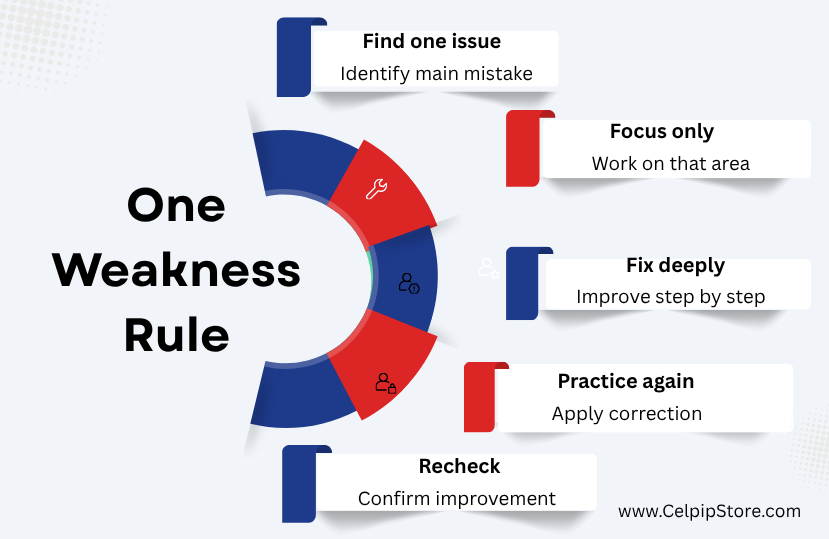
Technique 2: One-Weakness Fix Rule
After each mock test, you only fix ONE main problem area.
Examples:
- If scanning is weak -> only practice scanning
- If time management fails -> only practice timing drills
- If logic errors occur -> focus on elimination practice
This prevents confusion and builds fast improvement.
Technique 3: Accuracy Before Speed Reset
Many students try to increase speed too early.
Correct order:
- accuracy first
- consistency second
- speed last
Speed without accuracy creates repeated mistakes.
2. Examiner Insights (What CELPIP REALLY Measures)
CELPIP Reading is not just testing comprehension.
It is testing:
- decision speed under pressure
- ability to ignore distractions
- consistency across question types
- recovery from mistakes
Key Examiner Strategy
Examiners deliberately design:
- similar answer choices
- paraphrased traps
- time-consuming passages
- mixed difficulty levels
The goal is to test your control, not your memory
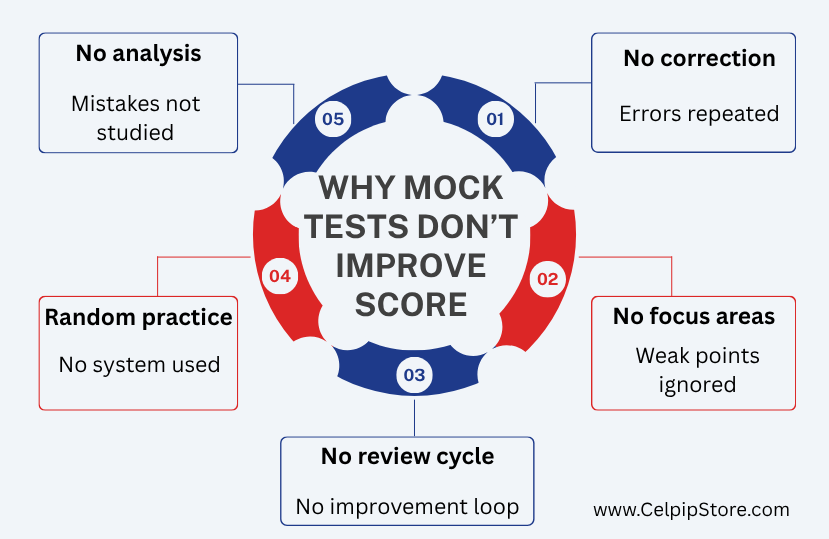
3. Common Mistakes (WHY STUDENTS DON’T IMPROVE AFTER MOCK TESTS)
Mistake 1: Repeating Tests Without Fixing Errors
Students take multiple tests but never analyze deeply.
Fix: Every test must have correction phase.
Mistake 2: Ignoring Error Categories
Students treat all mistakes as random.
Fix: Classify every mistake into 4 types.
Mistake 3: Practicing Weak Areas Too Late
Students avoid difficult question types.
Fix: Attack weakest area immediately after test.
Mistake 4: Focusing Only on Score Improvement
Students chase numbers instead of skill growth.
Fix: Focus on error reduction, not score jumps.
Mistake 5: No Feedback Loop
Students do not track progress over time.
Fix: Maintain error log for every test.
4. Score Breakthrough System (FINAL PERFORMANCE MODEL)
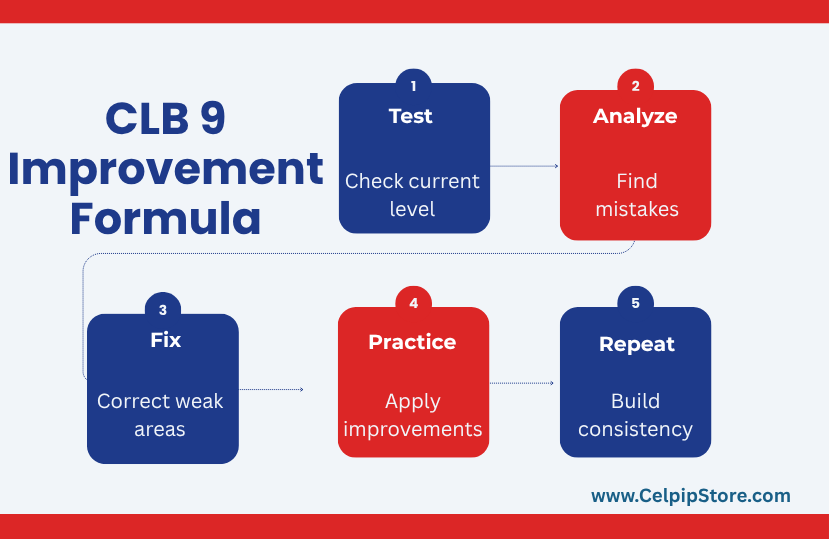
To move from CLB 7 -> CLB 9+, you must use this system:
Step 1: Diagnose
- Take full mock test
- Identify all errors
Step 2: Categorize
- understanding
- scanning
- logic
- time
Step 3: Fix One Weak Area
- targeted drills only
- no mixed practice
Step 4: Retest
- apply improvements under exam conditions
Step 5: Repeat Cycle
- continue until error rate drops consistently
Summary
Mock tests alone do not improve CELPIP Reading scores. Improvement happens only when every test is followed by a structured error analysis system.
The key is not how many tests you take, but how deeply you understand your mistakes.
Real progress comes from:
- identifying error types
- fixing root causes
- repeating improvement cycles
Final Checklist
After every mock test, make sure you:
- Review every wrong answer carefully
- Classify mistakes into 4 types:
- understanding
- scanning
- logic
- time
- Identify the root cause of each error
- Write correction notes for learning
- Focus on ONE weak area at a time
- Retake test after improvement
FAQs
Q1: How many mock tests should I take?
Not many focus on fewer tests with deep analysis.
Q2: Why is my score not improving even after practice?
Because you are not analyzing errors systematically.
Q3: What is the most important part of mock tests?
Error analysis, not the score itself.
Q4: How do I break CLB 9 barrier?
Fix repeated mistakes and improve one weak area at a time.
Practice Plan (7-Day Score Improvement System)
Day 1–2: Mock Test + Error Classification
- Take full reading test
- Categorize all mistakes
Day 3–4: Targeted Weakness Fix
- Focus only on weakest error type
- Practice related question types
Day 5–6: Re-Test Simulation
- Take another full mock test
- Apply corrections
Day 7: Final Review
- Compare errors from both tests
- Check improvement patterns
- Identify remaining gaps
5. Conclusion
CELPIP Reading improvement is not about repetition it is about structured correction and intelligent feedback loops.
Once you understand your mistakes and fix them systematically, your score naturally moves toward CLB 9–12.
This is how top scorers think:
Not more practice but smarter practice.