_Complete_Strategy_for_High_Band_Scores1.png)
CELPIP Speaking Mastery: Complete Strategy for High Band Scores
Introduction
CELPIP Speaking is not just a test of English it is a test of structured thinking under pressure.
Many candidates can speak English comfortably in daily life, but still score low in CELPIP Speaking because the exam demands:
- Fast idea generation
- Clear structure
- Task-specific responses
- Time-controlled speaking
The difference between a CLB 5–6 candidate and a CLB 9–12 candidate is not grammar it is organization and strategy.
This guide will help you master all 8 speaking tasks using a professional exam framework designed for high scores. The CELPIP Speaking test includes multiple tasks that require different strategies and structured responses. One of the most important tasks is giving advice clearly and confidently.
You can learn this in detail in CELPIP Speaking Task 1: Giving Advice (CLB 9–12 Strategy System).
The CELPIP Speaking test includes multiple tasks that assess different communication skills. One key task focuses on describing personal experiences clearly and fluently. You can master this in CELPIP Speaking Task 2: Personal Experience Strategy (CLB 9–12 Guide).
The CELPIP Speaking test includes multiple tasks, and one of the most important is describing images clearly and accurately under time pressure.
You can learn this in CELPIP Speaking Task 3 Mastery: Describe Images & Respond Clearly (CLB 9–12 Strategy).
Task 4 focuses on giving clear opinions with strong reasoning and structured explanation. Many students lose marks because their answers are unclear or not well-supported. A complete method is explained in CELPIP Speaking Task 4 Opinion Strategy Guide.
The CELPIP Speaking test includes multiple tasks, and one of the most important is maintaining fluency while integrating ideas smoothly. This task directly tests your natural speaking flow. You can master this in CELPIP Speaking Task 5 Mastery: Fluency Integration System (CLB 9–12 Strategy).
The CELPIP Speaking test includes multiple tasks, and one of the most important is problem-solving speaking where you must explain solutions clearly and logically. This task tests your reasoning and clarity. You can master this in CELPIP Speaking Task 6 Mastery: Problem-Solution Speaking (Solve Problems Clearly).
The CELPIP Speaking test includes multiple tasks, and one of the most important is decision-making speaking where you must choose between options and justify your choice clearly. This tests your reasoning and clarity. You can master this in CELPIP Speaking Task 7 Mastery: Decision-Making Speaking Strategy.
Learning Objectives
By the end of this lesson, you will be able to:
- Understand all 8 CELPIP Speaking tasks clearly
- Use structured response frameworks (PREP method)
- Manage time effectively in every task
- Avoid common mistakes that reduce scores
- Build confident, fluent, and task-focused answers
- Improve vocabulary for higher band performance
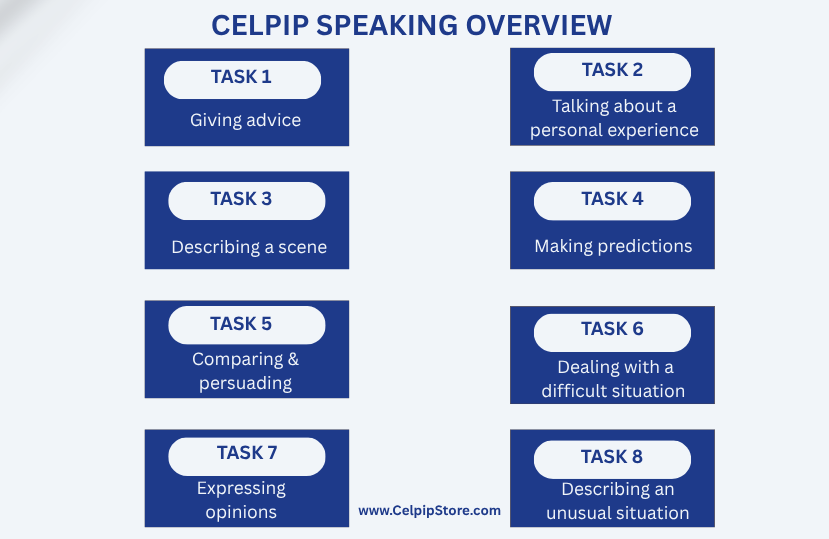
Overview of CELPIP Speaking Test
The CELPIP Speaking section includes 8 tasks, each testing a different communication skill:
- Giving Advice
- Talking About a Personal Experience
- Describing a Scene
- Making Predictions
- Comparing & Choosing
- Dealing with Difficult Situations
- Expressing Opinions
- Describing Unusual Situations
Each task is designed to test:
- Fluency
- Clarity
- Relevance
- Vocabulary usage
- Logical thinking
Task 1 focuses on your ability to give practical advice in a clear and logical way under time pressure. Many students struggle because they lack a structured response method. A complete step-by-step system is explained in CELPIP Speaking Task 1 Master Guide (Giving Advice Strategy).
Task 2 requires you to describe a past experience in a structured and engaging way within a limited time. Many students struggle with organization and idea development. A complete method is explained in CELPIP Speaking Task 2 Mastery (Personal Experience Strategy System.
Task 3 focuses on describing visual information in a structured and logical way while maintaining fluency. Many students lose marks due to lack of organization. A complete method is explained in CELPIP Speaking Task 3 Describe Images Master Guide.
The CELPIP Speaking test includes multiple tasks, and one of the most important is expressing strong opinions clearly and confidently. This task directly tests your ability to justify ideas. You can master this in CELPIP Speaking Task 4 Mastery: Give Strong Opinions (CLB 9–12 Strategy).
Task 5 focuses on speaking fluently without pauses while connecting ideas in a natural and structured way. Many students lose marks due to hesitation and lack of flow. A complete method is explained in CELPIP Speaking Task 5 Fluency Integration Strategy Guide.
Task 6 focuses on identifying a problem and providing clear, structured solutions within a limited time. Many students struggle because their answers are not well-organized. A complete method is explained in CELPIP Speaking Task 6 Problem-Solution Strategy Guide.
Task 7 focuses on making clear decisions, comparing options, and explaining your choice with strong reasoning under time pressure. Many students struggle with structured justification. A complete method is explained in CELPIP Speaking Task 7 Decision-Making Strategy Guide.
Common Mistakes Students Make
Most candidates lose marks due to predictable errors:
1. Speaking Without Structure
- Random ideas
- No clear beginning or ending
This reduces coherence score
2. Overthinking Grammar
- Students pause too much
- Trying to be perfect
Fluency gets affected
3. Memorized Answers
- Answers sound unnatural
- Do not match task situation
Examiner detects repetition
4. Not Completing the Response
- Running out of time
- Leaving ideas incomplete
Major score loss in content development
5. Weak Vocabulary Usage
- Repeating basic words like good, bad, nice
Limits band score potential
Many students lose marks in Speaking because they give unclear or generic advice without proper structure. This reduces both coherence and task achievement scores. Learn how to avoid this in CELPIP Speaking Task 1: Giving Advice Master Guide.
Many candidates lose marks in Task 2 because they give unclear or unstructured responses without proper storytelling techniques. This affects clarity and coherence. Avoid these mistakes with CELPIP Speaking Task 2 Master Guide (Personal Experience).
Many candidates lose marks in Task 3 because they either miss key details or describe images without a clear structure. This reduces both fluency and coherence scores. Avoid these mistakes with CELPIP Speaking Task 3 Master Guide (Describe Images Strategy).
Task 4 focuses on giving clear opinions with strong reasoning and structured explanation. Many students lose marks because their answers are unclear or not well-supported. A complete method is explained in CELPIP Speaking Task 4 Opinion Strategy Guide.
Many candidates lose marks in Task 5 because they pause too often or struggle to connect ideas smoothly, which affects their fluency score.
Avoid these mistakes with CELPIP Speaking Task 5 Master Guide (Fluency Integration).
Many candidates lose marks in Task 6 because they either do not clearly explain the problem or fail to give structured, practical solutions. This affects coherence scores. Avoid these mistakes with CELPIP Speaking Task 6 Master Guide (Problem-Solution Strategy).
Many candidates lose marks in Task 7 because they fail to clearly justify their decision or do not compare options properly, which affects coherence.
Avoid these mistakes with CELPIP Speaking Task 7 Master Guide (Decision-Making Strategy).
.png "Common_CELPIP_Speaking_Mistakes_(1).png")
The Core Framework: PREP Method (High-Score Structure)
To consistently score CLB 9–12, you must avoid random speaking and use a controlled response system.
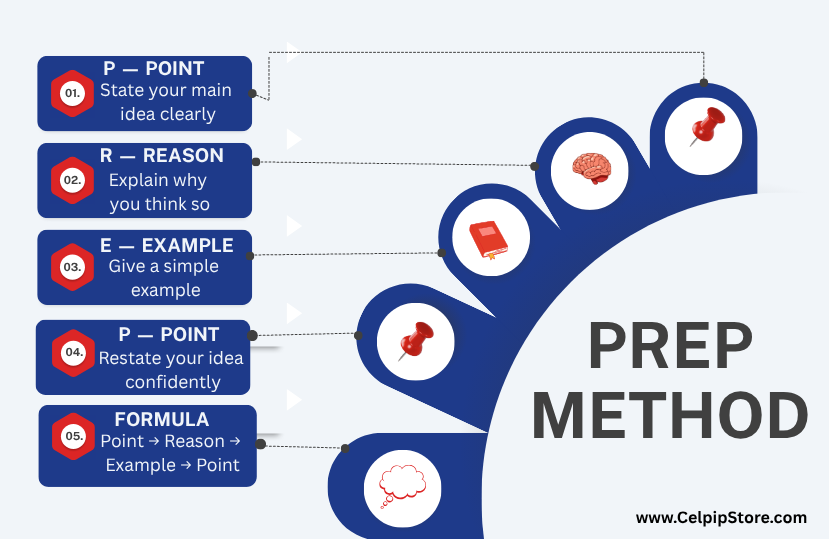
PREP Structure
- P – Point -> Give your direct answer immediately
- R – Reason -> Explain why
- E – Example -> Give a real-life or logical example
- P – Point Restatement -> Repeat your main idea clearly
Why PREP Works
CELPIP examiners reward:
- Clear organization
- Logical development
- Complete responses
PREP ensures you:
- Stay structured
- Avoid silence gaps
- Cover all scoring criteria
To score high in CELPIP Speaking, you must follow a structured framework for each task instead of speaking randomly. This is especially important in advice-based responses. You can apply this using the CELPIP Speaking Task 1 CLB 9+ Strategy System.
Universal Speaking Strategy (Works for All 8 Tasks)
No matter the question, follow this mental flow:
Step 1: Understand the task in 5 seconds
Ask yourself:
- What is being asked?
- What type of response is needed? (advice, opinion, description, etc.)
Step 2: Choose your position quickly
- Agree / disagree
- Choose option A / B
- Describe / explain / predict
Do NOT stay confused decisions must be fast.
Step 3: Build 2 supporting ideas
Every high-scoring answer includes:
- 1 main reason
- 1 supporting example
Step 4: Speak in structured flow
Avoid jumping between ideas.
Use:
- First…
- Also…
- For example…
- That is why…
To score high in speaking, you need a clear structure for storytelling and idea flow, especially in experience-based responses. Random speaking leads to low coherence. You can apply a proven system from CELPIP Speaking Task 2 CLB 9+ Strategy Guide.
To score high in Task 3, you must follow a clear structure for describing images instead of randomly explaining details. This improves clarity and coherence.
You can apply this system from CELPIP Speaking Task 3 CLB 9+ Strategy Guide.
To score high in Task 4, you must present your opinion clearly, support it with reasons, and maintain a logical flow throughout your response.
You can apply this system from CELPIP Speaking Task 4 CLB 9+ Opinion Strategy System.
To score high in Task 5, you must maintain continuous speech flow while organizing your ideas clearly and logically. This improves both fluency and coherence scores. You can apply this system from CELPIP Speaking Task 5 CLB 9+ Fluency Strategy System.
To score high in Task 6, you must clearly define the problem, explain solutions logically, and maintain a structured speaking flow throughout your response.
You can apply this system from CELPIP Speaking Task 6 CLB 9+ Problem-Solving Strategy System.
To score high in Task 7, you must compare options logically, clearly state your decision, and support it with strong reasons in a structured way.
You can apply this system from CELPIP Speaking Task 7 CLB 9+ Decision Strategy System.
Task-Wise Strategy Overview (Simplified Version)
Task 1 – Giving Advice
Focus: Help someone solve a problem
- Start with clear suggestion
- Give reason
- Add practical example
Task 2 – Personal Experience
Focus: Storytelling clarity
- Set time + place
- Explain sequence
- Share result or lesson
Task 3 – Describing a Scene
Focus: Observation skills
- Start general
- Move to details
- Mention actions
Task 4 – Predictions
Focus: Logical guessing
- Use: might, could, probably
- Support with reason
Task 5 – Compare & Choose
Focus: Decision making
- Compare both options
- Clearly choose one
- Explain 2 reasons
Task 6 – Problem Situations
Focus: Solution thinking
- Identify problem
- Suggest solution
- Stay polite and calm
Task 7 – Opinions
Focus: Argument clarity
- State opinion early
- Give 2 reasons
- Add example
Task 8 – Unusual Situation
Focus: Creativity + clarity
- Describe situation
- Explain reaction
- Conclude naturally
Examiner Insight (What Gets High Scores)
Examiners are not looking for:
- Complex vocabulary
- Perfect grammar
- Native accent
They are looking for:
- Clear communication
- Logical structure
- Task completion
- Smooth delivery
Advanced Speaking Tips (CLB 9–12 Level)
Once you understand structure, the next step is improving delivery quality and control under pressure.
1. Think in “Idea Blocks”, Not Sentences
High scorers do NOT think word-by-word.
They think in:
- Idea 1 (main point)
- Idea 2 (supporting reason)
- Example (real-life situation)
This prevents hesitation and pauses.
2. Use Controlled Fluency (Not Fast Speech)
Many students think speed = high score. This is false.
Instead:
- Speak naturally
- Pause between ideas
- Emphasize keywords
Avoid rushing or robotic speed
3. Fillers Must Sound Natural
Use professional fillers:
- “Let me explain…”
- “What I mean is…”
- “In this situation…”
- “From my experience…”
Avoid overusing “umm… uhh…”
4. Time Protection Technique
If you feel time pressure:
- Repeat or restate your point
- Add extra example
- Summarize slightly
This keeps you within time without panic. Improving your speaking score requires focused practice on each task type with the right techniques and templates. Task 1 plays a key role in building confidence and fluency. You can master this in CELPIP Speaking Task 1 High Band Strategy (CLB 9–12).
Vocabulary Upgrade System (High Score Booster)
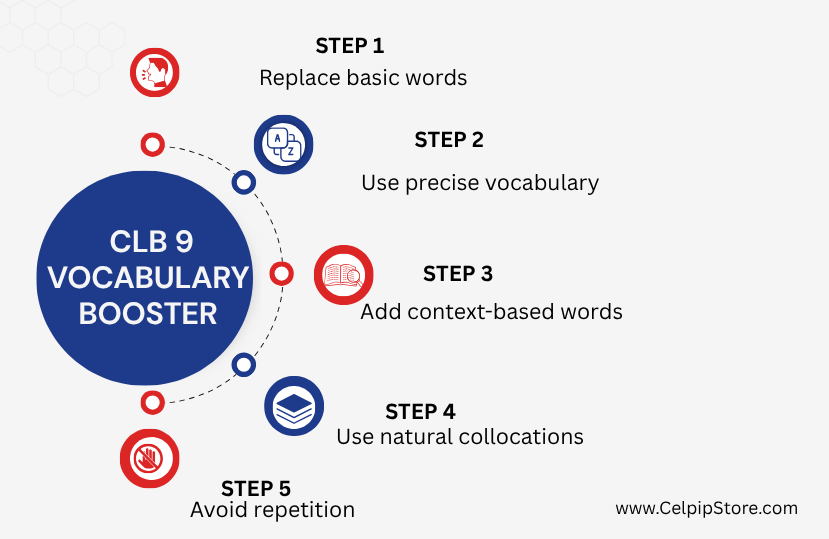
To reach CLB 9–12, replace basic words with precise expressions:
Basic -> Advanced
- good -> beneficial / effective / valuable
- bad -> problematic / challenging / inconvenient
- important -> crucial / essential / significant
- help -> support / assist / improve
- think -> believe / consider / feel
Smart Rule:
Use simple grammar + upgraded vocabulary
NOT complex grammar + confusing words
Examiner Insights (What They Actually Notice)
CELPIP examiners evaluate:
1. Coherence
- Do your ideas connect logically?
2. Task Completion
- Did you fully answer the question?
3. Fluency
- Is your speech smooth without long pauses?
4. Vocabulary Range
- Are you repeating basic words?
Important Insight:
Examiners prefer simple clear answers with structure over complex but unclear responses. Fluency in Task 2 comes from organizing your ideas logically and maintaining a natural flow while speaking. This is essential for achieving higher band scores. Learn this in CELPIP Speaking Task 2 Personal Experience High Score Strategy.
Practice Examples (Model Thinking)
Task Example: Giving Advice
- Weak:
“I think you should study more.”
- Strong:
“I would suggest creating a daily study schedule because it helps you stay consistent. For example, when I prepared for exams, I studied one hour daily and improved quickly.”
Task Example: Opinion
- Weak:
“I agree with this idea.”
- Strong:
“I agree with this idea because it improves efficiency. For example, online learning allows students to study anytime, which saves a lot of time.”
Common Killers
Avoid these mistakes:
- Long silent pauses
- Changing topic mid-answer
- Overthinking grammar
- Using memorized scripts
- Speaking without structure
In Task 4, fluency depends on how smoothly you express and support your opinion without hesitation or repetition. Coherence is equally important for scoring. You can improve this in CELPIP Speaking Task 4 High Score Strategy Guide.
In Task 5, fluency is not just speaking fast it is about speaking smoothly without unnatural pauses or repetition while maintaining clear meaning.
You can improve this in CELPIP Speaking Task 5 High Score Fluency Guide.
Mini Practice Challenge
Try answering:
“Describe a situation where you helped someone.”
Use PREP:
- Point
- Reason
- Example
- Restatement
Final Summary
CELPIP Speaking success is not about perfect English it is about controlled communication under pressure.
To achieve CLB 9–12, you must combine:
- Structured thinking (PREP method)
- Task-specific strategies
- Controlled fluency
- Smart vocabulary usage
- Clear idea development
If you speak clearly, logically, and fully answer the task, high scores naturally follow. The complete speaking mastery system becomes more effective when you practice each task with a clear method and strategy. Consistent practice leads to higher band scores. Start with CELPIP Speaking Task 1 Giving Advice Complete Guide to build a strong foundation.
A complete speaking strategy becomes effective when you master each task individually with the right techniques. Task 2 plays a major role in building confidence and fluency. Start with CELPIP Speaking Task 2 Personal Experience Complete Guide.
In Task 3, fluency depends on how smoothly you describe visual details without hesitation or confusion. Accuracy also plays a key role in scoring.
You can master this in CELPIP Speaking Task 3 Image Description High Score Strategy.
Mastering Task 4 is essential for building confidence in opinion-based speaking, but overall success depends on performance across all speaking tasks.
Start with CELPIP Speaking Mastery Complete Strategy for High Band Scores.
Final Master Checklist (Before Exam)
Use this checklist before your test:
Structure
- I can use PREP in all answers
- I can organize ideas quickly
Fluency
- I can speak without long pauses
- I can continue even if I make mistakes
Vocabulary
- I avoid repeating basic words
- I can use simple upgraded vocabulary
Task Handling
- I understand all 8 speaking tasks
- I know what each task requires
Time Management
- I can complete answers within time
- I can summarize quickly if needed
FAQs (High-Search CELPIP Questions)
1. What is a good score in CELPIP Speaking?
A CLB 9 or above is considered a high score for immigration and professional purposes.
2. How can I improve CELPIP Speaking quickly?
Use structured frameworks like PREP, practice daily speaking tasks, and focus on fluency rather than grammar perfection.
3. Is vocabulary important in CELPIP Speaking?
Yes, but clarity is more important. Use simple but precise vocabulary instead of complex words.
4. How can I avoid hesitation in speaking?
Think in idea blocks, not full sentences, and practice timed responses daily.
5. Can I prepare for CELPIP Speaking in 2 weeks?
Yes, if you practice structured speaking daily and focus on task-wise strategies.
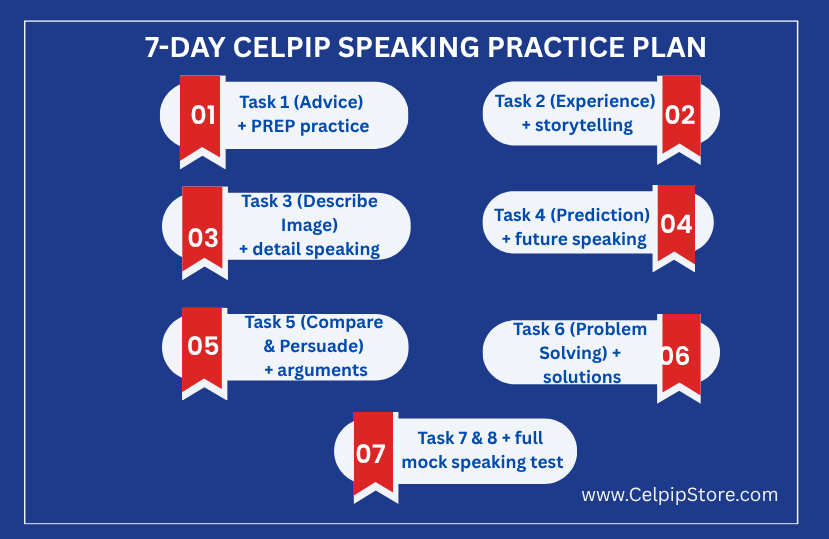
7-Day Practice Plan (Recommended)
Day 1–2
- Learn PREP method
- Practice Task 1 & 2
Day 3–4
- Practice Task 3 & 4
- Focus on fluency
Day 5
- Practice Task 5 & 6
Day 6
- Practice Task 7 & 8
Day 7
- Full mock speaking test
- Self-review and correction
Mastering Task 3 is essential for building confidence in visual description and structured speaking. However, overall success depends on performance across all speaking tasks. Start with CELPIP Speaking Mastery Complete Strategy for High Band Scores.