CELPIP Speaking Task 5 Mastery Fluency Integration System: Connect All Speaking Tasks for CLB 9 to 12
Introduction
CELPIP Speaking Task 5 is not just another speaking question. It is the integration stage of your speaking performance, where your fluency, structure, and confidence are tested together.
At this level, the examiner is no longer only evaluating individual answers. Instead, they are observing how naturally you can maintain consistency, flow, and confidence across different speaking situations. Fluency integration in Task 5 is only one part of the CELPIP Speaking test, but your final score depends on how well you perform across all speaking tasks. A complete system ensures smooth and consistent performance.
You can understand this full system in CELPIP Speaking Mastery: Complete Strategy for High Band Scores.
Most students fail here not because of grammar, but because they treat each speaking task separately instead of connecting them into one system.
Learning Objectives
By the end of this lesson, you will be able to:
- Understand how Task 5 connects all speaking skills
- Maintain consistent fluency across responses
- Apply structured speaking frameworks automatically
- Reduce hesitation during unexpected questions
- Improve overall speaking confidence and natural flow
Overview of Task 5
CELPIP Speaking Task 5 focuses on your ability to integrate speaking strategies from previous tasks into a smooth, natural response style.
In simple terms, it checks:
- Can you stay fluent under pressure?
- Can you organize ideas quickly?
- Can you connect thoughts logically without pauses?
What this task evaluates:
- Speaking fluency and rhythm
- Logical idea development
- Confidence under time pressure
- Consistency across speaking tasks
To perform well in Task 5, you need to maintain a structured flow of ideas, but this structure is part of a larger speaking framework used across all CELPIP tasks. This complete framework is explained in CELPIP Speaking Mastery Complete Strategy Guide.
Common Mistakes Students Make
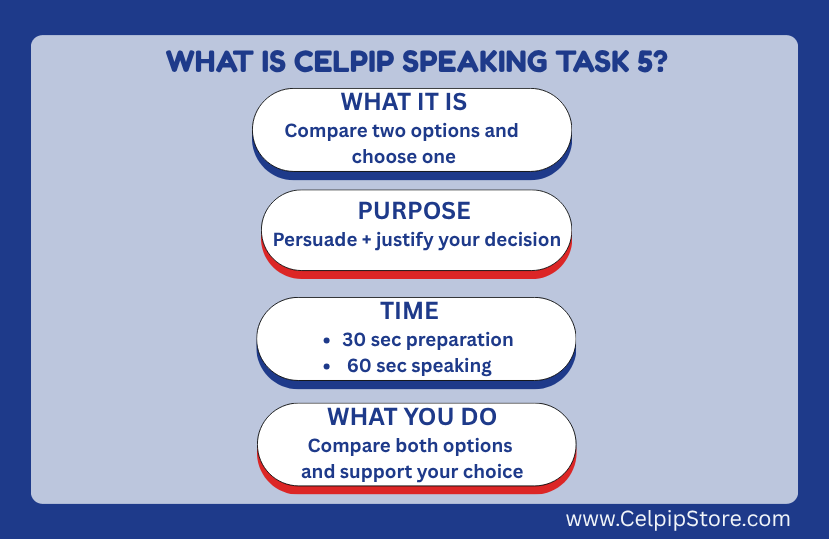
Many learners lose marks due to avoidable issues:
Treating each task separately
- Students forget previous strategies
- No connection between answers
Overthinking responses
- Long pauses due to vocabulary pressure
- Searching for “perfect words” instead of clear ideas
No speaking flow
- Answers sound broken and disconnected
- Ideas do not follow logical progression
Memorizing answers
- Responses sound unnatural
- Examiner detects lack of spontaneity
Many candidates lose marks in Task 5 because they do not understand how CELPIP Speaking is evaluated as a complete system, which affects their fluency and structure. To fix this, refer to CELPIP Speaking Mastery Complete Scoring Strategy.
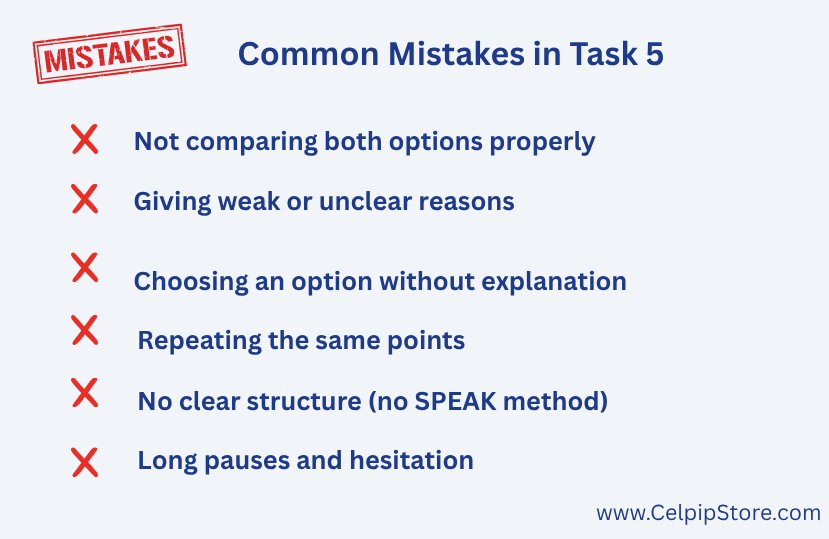
Core Teaching Concept: FLUENCY INTEGRATION SYSTEM
CELPIP Speaking Task 5 is not a “new skill” task. It is a fluency integration test where you combine everything you learned in Tasks 1–4 into one natural speaking flow.
Instead of switching frameworks, you must blend them automatically while speaking.
Think of it like this:
You are no longer “thinking about structure” you are speaking with structure naturally.
How All Tasks Connect (Integration Map)
To perform well in Task 5, you must mentally connect:
- Task 1 -> Advice / Suggestion style thinking
- Task 2 -> Storytelling / sequence logic
- Task 3 -> Description / visual clarity
- Task 4 -> Opinion + reasoning clarity
Key idea:
All speaking tasks become ONE system:
- Clear ideas
- Logical flow
- Natural fluency
- No mental switching pressure
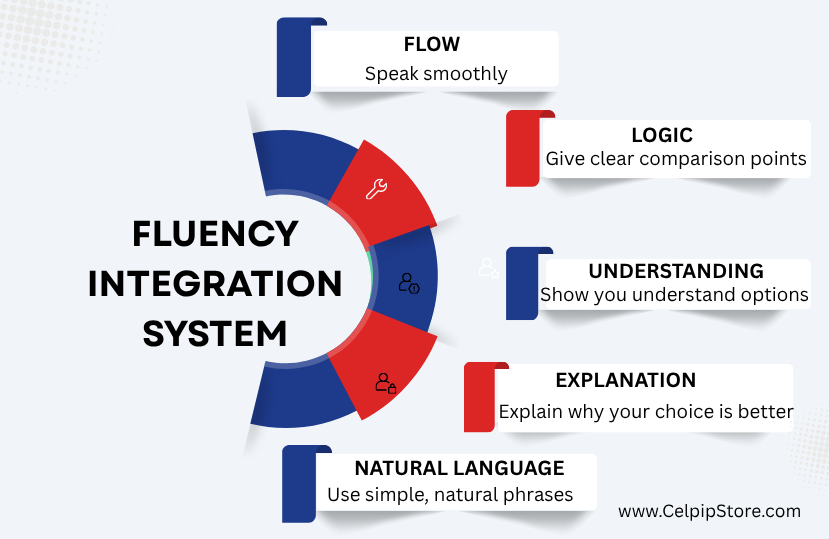
FLUENCY FRAMEWORK: S.P.E.A.K System
To manage Task 5 effectively, use this integrated speaking model:
S — Start Naturally
Begin without hesitation or overthinking.
- Simple opening sentence
- Direct response style
- No long pauses
P — Point Clearly
State your main idea early.
- One central idea only
- Avoid multiple directions
E — Explain Smoothly
Develop your idea using simple supporting details.
- Use examples from daily life
- Keep sentences short and natural
A — Add Flow
Connect ideas using natural linking words:
- “Also…”
- “For example…”
- “That’s why…”
K — Keep Moving
Do not stop to perfect sentences.
- Maintain fluency
- Focus on communication, not perfection
.png "S_P_E_A_K_Method_(Fluency_Framework).png")
EXAMPLE RESPONSE (Integrated Speaking Style)
Question: Do you think teamwork is important in daily life?
“Yes, I believe teamwork is very important in daily life. It helps people complete tasks more efficiently. For example, when I worked on a group project, we divided tasks and finished faster. That’s why I think teamwork improves productivity and makes work easier.”
STRATEGY INSIGHTS (HIGH-SCORE BEHAVIOUR)
To score CLB 9–12, focus on:
- Speaking continuously without long pauses
- Using simple but connected ideas
- Avoiding memorized answers
- Keeping one clear direction per response
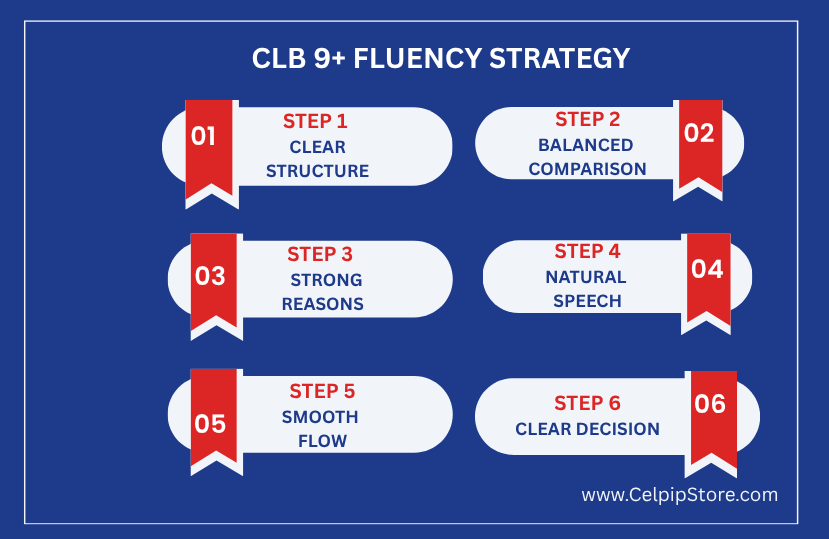
WHAT EXAMINERS REALLY LOOK FOR
Examiners are not checking perfection. They are checking:
- Natural fluency under pressure
- Logical idea connection
- Confidence in speaking
- Smooth transitions between ideas
FINAL KEY INSIGHT
Task 5 does NOT test new English skills.
It tests:
How naturally your speaking system works under real exam pressure
If your foundation (Tasks 1–4) is strong, Task 5 becomes effortless.
Advanced Fluency Techniques (CLB 9–12 Level)
To perform well in Task 5, you must stop “thinking sentence by sentence” and start speaking in idea flow units.
1. Think in “Idea Chains”
Instead of separate sentences, connect ideas naturally:
- Idea -> Example -> Reason -> Result
Example:
“I prefer studying in groups because it helps me understand better, and when I worked with friends, we solved problems faster.”
2. Use “Pause Control Strategy”
Good speakers do NOT avoid pauses completely. They control them.
- Short pause = thinking (OK)
- Long silence = score drop (avoid)
Use fillers naturally:
- “Well…”
- “Let me think…”
- “In my opinion…”
3. Avoid Over-Structuring in Real Time
Do NOT mentally force OREC or ODAC during speaking.
Instead:
- Speak naturally
- Let structure flow automatically
- Focus on communication, not labels
4. Use Simple Expansion Technique
One idea -> expand slightly:
- Statement
- Reason
- Example
No need for complex development. Practicing fluency is important, but you must also practice all speaking tasks together to develop natural flow, timing, and confidence under exam pressure. Follow the full system in CELPIP Speaking Mastery Complete Preparation Strategy.
Examiner Insights (Task 5 Focus Area)
Examiners evaluate:
- Natural Fluency
Do you sound smooth and continuous?
- Confidence Level
Do you speak without hesitation?
- Idea Flow
Do your thoughts connect logically?
- Communication Control
Can you express ideas without getting stuck?
Important Insight:
Even if your grammar is not perfect, smooth fluency can still score high (CLB 9+). Achieving CLB 9+ in Task 5 requires strong fluency, coherence, and the ability to integrate ideas smoothly across all speaking tasks, not just one section. You can build these skills using CELPIP Speaking Mastery for High Band Scores.
Vocabulary Upgrade (Natural Speaking Style)
Use simple but powerful expressions:
- important -> essential / valuable
- good -> effective / helpful
- bad -> challenging / difficult
- help -> support / improve
- think -> believe / feel / consider
PRACTICE TASKS
Practice 1:
Do you prefer working alone or in a team?
Practice 2:
Is technology helpful in education?
Practice 3:
Do you think people should exercise daily?
Practice Rule:
- Speak for 60–90 seconds
- Do not stop to correct small mistakes
- Focus on flow, not perfection
TIMED CHALLENGE
Speak continuously:
“Describe a situation where you worked with others.”
Focus on:
- Natural flow
- Simple explanation
- One example
- Continuous speaking
Summary
CELPIP Speaking Task 5 is not a separate skill test. It is the final fluency integration stage where all your speaking abilities are evaluated together.
Instead of focusing on new techniques, you must focus on natural, continuous, and confident speaking flow.
The main idea:
You don’t “switch strategies”you SPEAK fluently using everything you already learned.
Final Checklist (Before Task 5 Speaking)
Make sure you can:
- Speak continuously without long pauses
- Connect ideas logically
- Use simple sentences confidently
- Avoid overthinking vocabulary
- Expand one idea smoothly
- Stay calm under pressure
FAQs
1. Is Task 5 harder than other speaking tasks?
No. It feels harder only when you overthink. It tests fluency, not new skills.
2. Do I need special vocabulary for Task 5?
No. Simple, natural vocabulary is enough if fluency is strong.
3. What is the biggest mistake in Task 5?
Long pauses and trying to “plan perfect sentences” in your mind.
4. How long should I speak?
Aim for 60–90 seconds of continuous speaking flow.
7-DAY PRACTICE PLAN
Day 1–2
- Practice speaking without stopping
- Focus only on flow
Day 3–4
- Answer mixed speaking questions
- Avoid structuring mentally
Day 5–6
- Record yourself speaking
- Identify pauses and fix flow
Day 7
- Full speaking simulation (Tasks 1–5 integration practice)
CONCLUSION
Task 5 becomes easy when you stop treating it as a new challenge and start treating it as a fluency performance test.
Use this mindset:
“I don’t think in structures. I speak in flow.” If your foundation is strong, your fluency will naturally carry your score to CLB 9–12. Mastering Task 5 is an important step, but your final score depends on how well you perform across the entire speaking section as a complete system. Start with CELPIP Speaking Mastery Complete Guide for High Scores.
FINAL INTEGRATION GUIDE (IMPORTANT)
Now your CELPIP Speaking system is complete:
- Task 1 -> Advice & response clarity
- Task 2 -> Storytelling & sequencing
- Task 3 -> Description & visual clarity
- Task 4 -> Opinion & reasoning
- Task 5 -> Fluency integration
Together, they form a complete speaking mastery system