CELPIP Reading Mastery System: Full Strategy Integration for CLB 9–12 Score Improvement
Introduction
At this stage of CELPIP Reading preparation, most students already know individual strategies:
- skimming
- scanning
- vocabulary clues
- time management
- mock test practice
But the real challenge is not knowing these skills.
The real challenge is using them together under real exam pressure.
Many learners fail to perform well in the actual test because their strategies are fragmented, not connected.
This lesson focuses on building a complete integrated reading system for CLB 9–12 performance.
Learning Objectives
By the end of this lesson, you will be able to:
- Combine all CELPIP Reading strategies into one system
- Switch between skimming, scanning, and inference smoothly
- Apply time management during real test conditions
- Use vocabulary, context clues, and paraphrasing together
- Reduce mistakes by using system-based thinking
- Perform consistently at CLB 9–12 level
Overview of the Integration System
CELPIP Reading mastery is not one skill it is a combined system of multiple micro-skills.
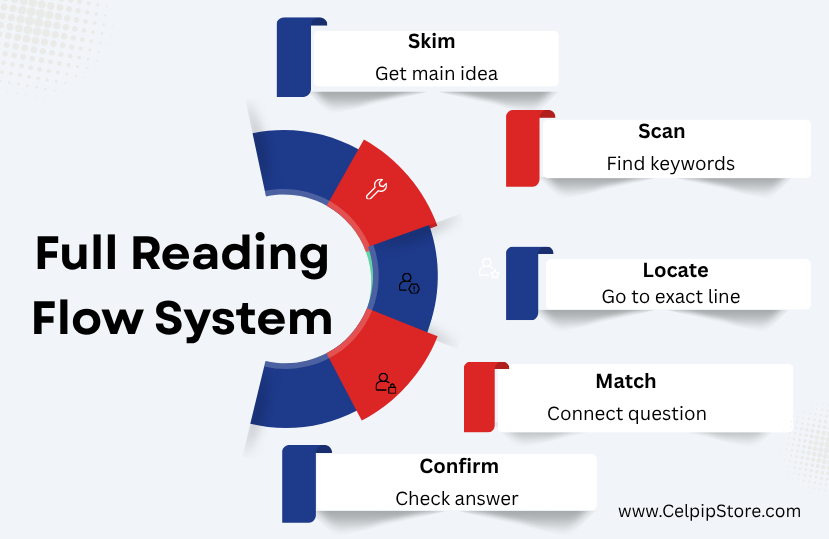
Instead of using strategies separately, you must use them in sequence:
Integrated Flow System
- Skim -> Understand passage structure
- Read Question -> Identify type
- Scan -> Locate information
- Analyze Vocabulary -> Understand meaning
- Apply Logic -> Eliminate wrong answers
- Manage Time -> Move forward strategically
This flow must become automatic, not conscious.
Common Mistakes
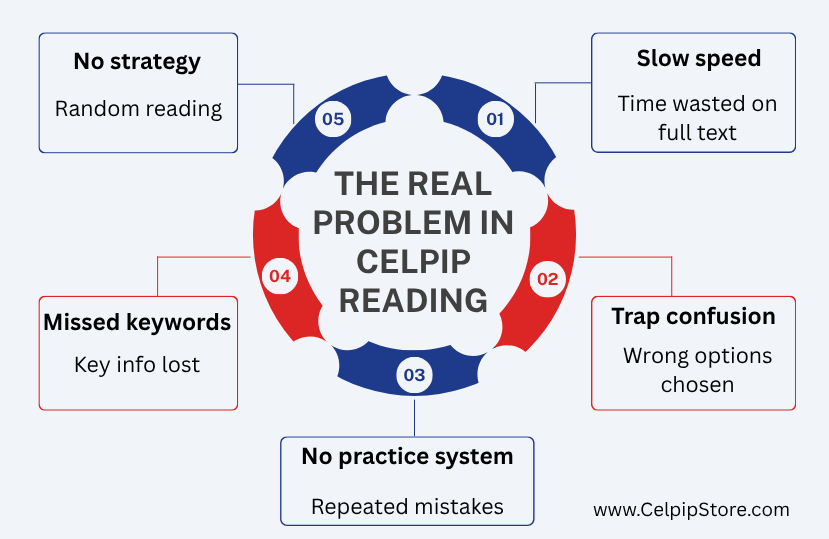
Most students fail at this stage because they cannot connect strategies.
Mistake 1: Using Skills Separately
Students know techniques but don’t combine them.
Fix: Always follow full flow system, not isolated methods.
Mistake 2: Forgetting Strategy Under Pressure
Students revert to slow reading in exam.
Fix: Practice full simulation repeatedly.
Mistake 3: No System Thinking
Students solve questions randomly.
Fix: Always follow structured steps (skim -> scan -> decide).
Mistake 4: Overusing One Skill
Some students only scan or only read carefully.
Fix: Balance all skills based on question type.
Mistake 5: No Real Exam Simulation
Students never practice full integration under time pressure.
Fix: Full mock tests with strict system application.
1. Full Integrated Framework (ONE SYSTEM, NOT MANY SKILLS)
At CLB 9–12 level, CELPIP Reading is not about choosing between skimming, scanning, or vocabulary.
It is about automatically combining all skills in a fixed order.
You are building a single decision system:
READING = Process Flow, not individual techniques
Core Integrated Model
Every question follows this chain:
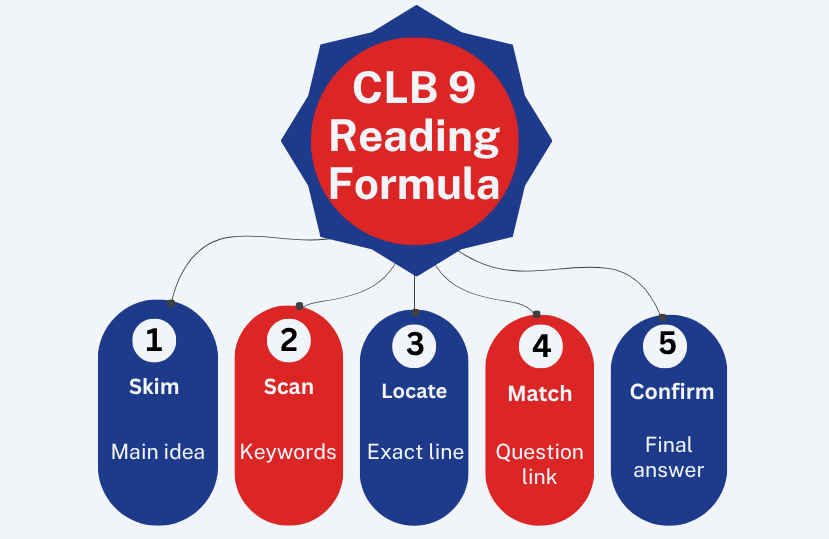
Step 1: Skim (Understand Structure)
-> What is this passage about?
Step 2: Identify Question Type
-> Fact / inference / vocabulary / matching
Step 3: Scan (Locate Information)
-> Find keyword or idea location
Step 4: Decode Meaning (Context + Vocabulary)
-> Understand sentence meaning
Step 5: Apply Logic (Elimination)
-> Remove incorrect options
Step 6: Confirm Answer (Final Check)
-> Does it match passage idea?
This is your automatic exam brain system
2. Step-by-Step Reading Execution Model (REAL EXAM FLOW)
This is exactly how high scorers solve CELPIP Reading under pressure.
STEP 1: 30–40 Second Skim
- Read first lines of each paragraph
- Identify topic + tone
- Understand structure
Do NOT overthink details.
STEP 2: Question Breakdown
Before looking at passage again:
- Identify keyword
- Decide question type
- Predict answer location
STEP 3: Target Scanning
- Move eyes quickly
- Find keywords or synonyms
- Skip unrelated text
You are searching, not reading.
STEP 4: Meaning Check
- Read only relevant sentence
- Use context clues
- Understand idea (not just words)
STEP 5: Elimination
- Remove clearly wrong options
- Compare remaining choices logically
STEP 6: Final Answer Decision
- Confirm meaning match
- Do NOT overthink
- Move to next question quickly
3. Integrated Timing + Strategy Control
This system works ONLY if timing is controlled:
- Skim -> 30–40 sec
- Scan -> 20–60 sec
- Decision -> max 60 sec
No question should break your flow.
4. Examiner Insight (What This System Fixes)
Examiners design CELPIP Reading to break students who:
- switch strategies randomly
- read without direction
- panic under time pressure
- cannot connect skills
This integrated system fixes all of that by:
Forcing structured thinking
Reducing confusion
Increasing decision speed
5. Key Mindset Shift (CLB 9 DIFFERENCE)
Weak learners think:
“I need to use skimming OR scanning OR vocabulary”
Strong learners think:
“I must follow one system that uses all skills together”
1. Advanced Integration Techniques (CLB 9–12 PERFORMANCE LEVEL)
At this stage, CELPIP Reading is no longer about “following steps.” It becomes a fast automatic decision system.
Strong candidates don’t consciously think “skim, scan, analyze.”
They execute everything as one smooth flow.
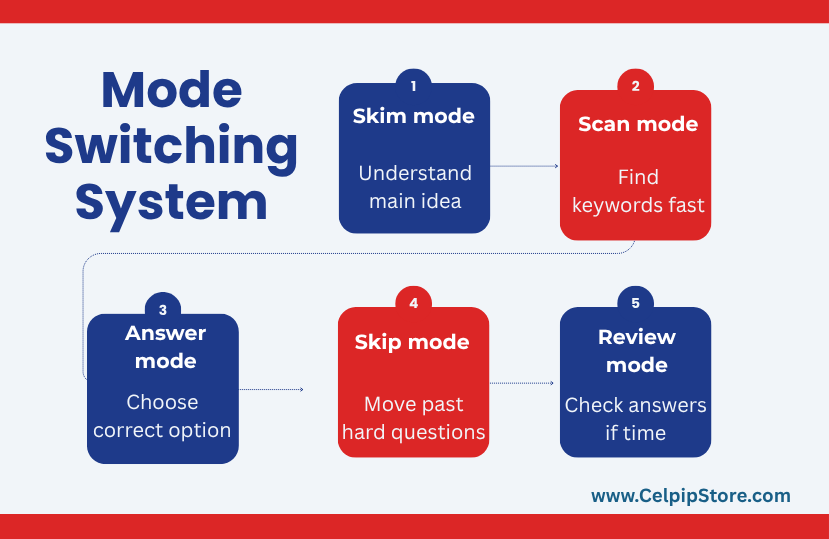
Technique 1: Automatic Mode Switching
Instead of deciding what to do, you react instantly:
- Fact question -> scanning mode
- Vocabulary question -> context mode
- Matching question -> structure mode
- Inference question -> logic mode
Your brain switches modes automatically without hesitation.
Technique 2: Compression Reading (High-Speed Understanding)
You don’t read full sentences deeply.
You:
- extract only key meaning words
- ignore fillers and examples
- focus on idea flow
This reduces reading load by 40–60%.
Technique 3: Answer Prediction Before Scanning
Before looking at passage, you predict:
- What type of word will appear?
- Name, number, reason, or definition?
This makes scanning faster and more accurate.
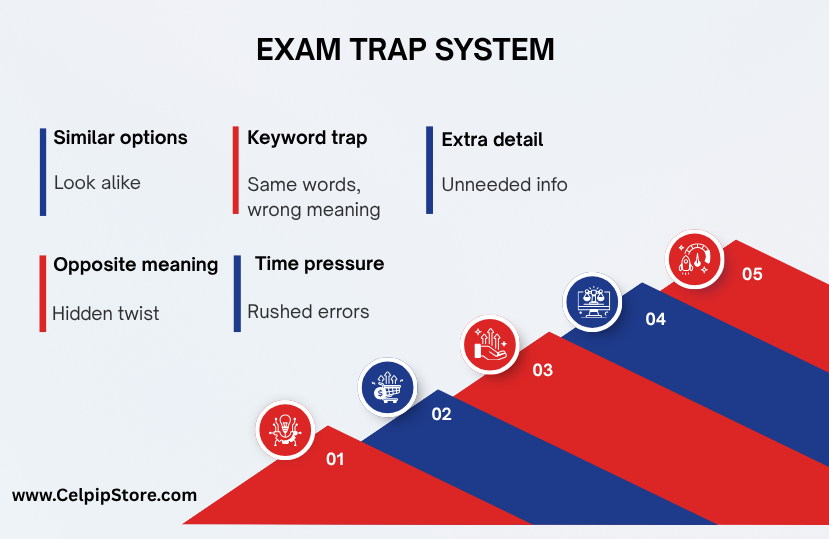
2. Examiner Patterns (HOW CELPIP TESTS YOUR SYSTEM)
CELPIP does NOT test skills separately. It tests how well your system performs under pressure.
Examiners intentionally design:
Pattern 1: Mixed Difficulty Flow
- Easy -> Hard -> Easy -> Hard
To break your rhythm and timing control
Pattern 2: Paraphrase Traps
- Same meaning, different wording
To test understanding vs memorization
Pattern 3: Distractor Similarity
- Options that look correct but slightly wrong
To test decision accuracy
Pattern 4: Time Pressure Distribution
- Easy questions are placed later
To trap students who waste early time
3. Common System Breakdowns (WHY STUDENTS FAIL EVEN AFTER TRAINING)
Breakdown 1: Strategy Confusion Under Pressure
Students forget which method to use.
Fix:
Practice automatic mode switching daily.
Breakdown 2: Skipping System Flow
Students skip steps and jump directly to answers.
Fix:
Always follow full sequence (skim -> scan -> analyze -> decide).
Breakdown 3: Overthinking Logic Questions
Students spend too long on inference questions.
Fix:
Limit time and move on quickly.
Breakdown 4: Partial System Usage
Students use only scanning or only reading.
Fix:
Always use full integration model.
Breakdown 5: No Recovery Strategy
Students lose control after one difficult question.
Fix:
Reset instantly and continue system flow.
4. Optimization Strategy (HOW TO REACH CLB 9–12 CONSISTENTLY)
Phase 1: System Automation
- Practice full flow daily
- No skipping steps
- Build habit consistency
Phase 2: Speed Refinement
- Reduce skimming time
- Improve scanning accuracy
- Train fast decision-making
Phase 3: Pressure Simulation
- Full timed mock tests
- No pauses
- Real exam conditions
Phase 4: Error Optimization
After every test:
- Identify system breakdown point
- Fix only one weakness
- Re-test immediately
1. Final Summary
CELPIP Reading Mastery is not about using multiple strategies separately.
It is about building a single integrated reading system that runs automatically under time pressure.
At CLB 9–12 level, success comes from:
- Fast passage understanding (skimming)
- Accurate information location (scanning)
- Meaning decoding (context + vocabulary)
- Logical elimination (decision-making)
- Strict time control (execution discipline)
When all systems work together, reading becomes predictable and controlled.
2. Master Checklist
Before and during the exam, ensure you consistently:
- Skim each passage in under 40 seconds
- Identify question type before searching
- Scan only for keywords or synonyms
- Use context clues for meaning clarification
- Eliminate clearly wrong options first
- Avoid spending more than 60 seconds per question
- Maintain full system flow without skipping steps
- Recover quickly from difficult questions
3. FAQs
Q1: What is the biggest difference between CLB 7 and CLB 9 in reading?
CLB 7 uses isolated strategies. CLB 9 uses an integrated system under time pressure.
Q2: Do I need to read every word in CELPIP Reading?
No. You should focus on key ideas, not every word.
Q3: What should I do if I feel stuck during the exam?
Immediately reset and return to system flow (skim -> scan -> decide).
Q4: Can I skip questions in CELPIP Reading?
Yes, but strategically. Skip and return later if time allows.
4. Practice Blueprint (7-Day System Integration Plan)
Day 1–2: System Familiarization
- Practice full flow steps slowly
- Focus on accuracy, not speed
Day 3–4: Speed Integration
- Reduce skimming time
- Practice scanning under pressure
Day 5–6: Full Simulation
- Complete full reading tests
- Strict timing enforcement
- No stopping or rethinking
Day 7: System Breakdown Analysis
- Identify where flow broke
- Fix weakest integration point
- Re-test targeted weakness
5. Conclusion
CELPIP Reading mastery is not about individual skills.
It is about building a complete performance system that combines:
- comprehension
- speed
- logic
- decision-making
- time control
Once this system becomes automatic, your performance stabilizes at CLB 9–12 level.