CELPIP Speaking Task 2: Personal Experience (Complete CLB 9 Strategy + Sample Answer)
Introduction
CELPIP Speaking Task 2 (Personal Experience) is where many students suddenly lose fluency, even if they performed well in Task 1. This happens because Task 2 requires you to think in a story format while speaking in real time.
Unlike Task 1, where you give advice, Task 2 asks you to describe something that happened in your life or a personal situation. This sounds easy, but under exam pressure, students often struggle to organize events clearly.
Most candidates do not fail because they lack stories. They fail because their storytelling becomes messy, unstructured, or too detailed in the wrong places. As a result, fluency drops and the answer feels incomplete.
Describing personal experiences in Task 2 is an important part of the CELPIP Speaking test, but your final score depends on how well you perform across all speaking tasks. A complete system ensures consistency. You can understand this full system in CELPIP Speaking Mastery: Complete Strategy for All Tasks.
To reach CLB 9, you do not need dramatic or perfect stories. You need a simple, structured storytelling system that helps you stay clear, logical, and fluent from start to finish.
Learning Objectives
By the end of this lesson, you will be able to:
- Understand how Task 2 Personal Experience works in CELPIP Speaking
- Use a clear storytelling structure for any question
- Organize events in logical order
- Speak fluently without unnecessary pauses
- Control time while speaking naturally
- Build confidence while describing personal experiences
Overview: What Task 2 Really Tests
Task 2 is designed to test how clearly you can describe a real or imagined personal experience in a logical sequence.
You may be asked to talk about:
- A memorable event in your life
- A time you faced a challenge
- A situation where you helped someone
- An experience at school, work, or home
The key challenge is not vocabulary or grammar. The real challenge is story structure under time pressure.
Many students start well but lose direction in the middle of the story. They jump between ideas, repeat points, or forget the sequence of events. This reduces coherence and fluency.
A strong system solves this problem by guiding your story step by step. To perform well in Task 2, you need a clear structure for storytelling, but this structure is part of a larger speaking framework used across all CELPIP tasks. This complete framework is explained in CELPIP Speaking Mastery Complete Strategy Guide.
What CLB 9 Means in Task 2
CLB 9 in Task 2 does NOT mean:
- Emotional or dramatic storytelling
- Complex vocabulary or expressions
- Long and detailed descriptions
CLB 9 actually means:
- Clear sequence of events
- Easy-to-follow story flow
- Balanced detail (not too much, not too little)
- Smooth and continuous speaking
Examiners are not looking for creativity. They are looking for clarity and structure in storytelling. Achieving CLB 9+ in Task 2 requires strong fluency, coherence, and consistent performance across all speaking tasks, not just personal experience responses. You can build these skills using CELPIP Speaking Mastery for High Band Scores.
Common Mistakes Students Make in Task 2 (Personal Experience)
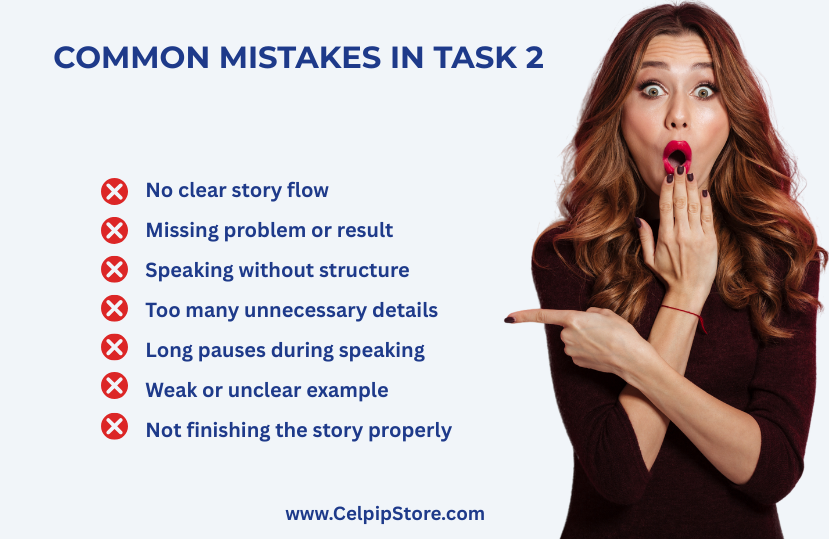
- Starting the story without setting a clear time or situation, which makes the response confusing for the listener
- Jumping between events randomly instead of following a clear chronological order
- Adding too many unnecessary details, which reduces clarity and breaks fluency
- Speaking without a structure, leading to a disorganized and hard-to-follow story
- Pausing frequently while trying to remember exact details instead of focusing on smooth delivery
Many candidates lose marks in Task 2 because they do not understand how CELPIP Speaking is evaluated as a complete system, which affects their overall performance. To fix this, refer to CELPIP Speaking Mastery Complete Scoring Strategy.
The Core Idea: A Story Is Not Memory — It Is Structure
In Task 2, most students think they need to remember a perfect real-life story. This is not true. You are not being tested on memory accuracy. You are being tested on how clearly you can organize and narrate an experience under pressure.
High-scoring candidates do not rely on perfect stories. They rely on a fixed storytelling framework that works for any question. This removes confusion and keeps your response smooth, logical, and fluent.
Once you learn this system, you can turn any question into a clear, structured story in seconds.
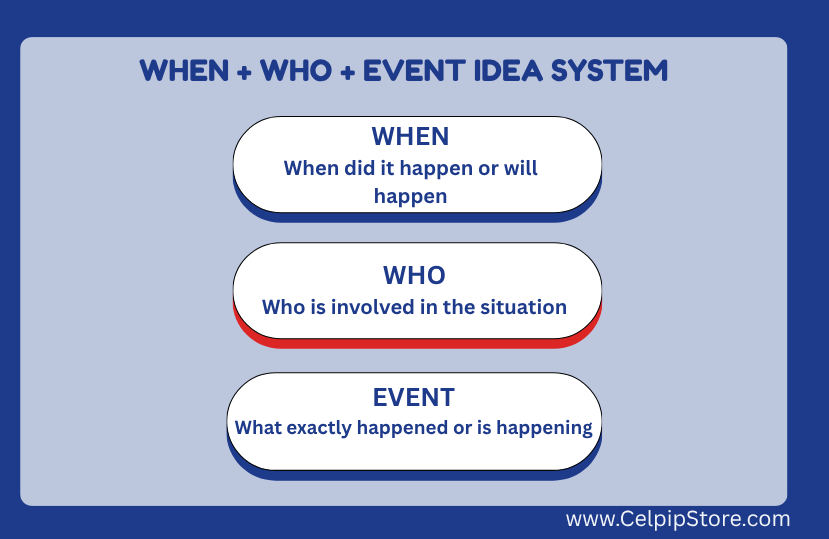
CLB 9 Storytelling Framework (Universal Structure)
Use the same step-by-step method for every Task 2 question.
1. Opening Line (Immediate Start)
Start speaking immediately without hesitation. A simple opening sets the direction of your story and prevents silence.
You can use:
- “I would like to talk about a time when…”
- “One experience I clearly remember is…”
- “There was an occasion when I had to…”
This step is important because it quickly establishes your topic and reduces nervousness.
2. Situation Setup (When & Where)
Next, briefly set the context of your story. This helps the examiner understand the background.
Mention:
- When it happened
- Where it happened
- Who was involved
Keep it short and clear. Do not over-explain at this stage.
3. Main Event (What Happened)
Now describe the main action or event. This is the core of your story.
Focus on:
- What happened step by step
- What you or others did
- The main situation
Keep the sequence logical. This is where structure matters most.
4. Action / Reaction (Your Response)
Explain what you did or how you reacted to the situation. This adds depth to your response.
You can include:
- Your decision
- Your actions
- Your thoughts or feelings during the event
This part shows engagement and makes your story more natural.
5. Outcome (Result of the Situation)
Now explain what happened in the end. This gives closure to your story and improves coherence.
Example ideas:
- The problem was solved
- You learned something
- The situation improved
This step is essential for CLB 9 because it completes the narrative.
6. Closing Line (Natural Ending)
Always end your response clearly. Do not stop suddenly.
You can say:
- “That was a memorable experience for me.”
- “I learned a lot from that situation.”
- “This is an experience I still remember clearly.”
A strong ending improves structure and fluency.
Practicing personal experience speaking is important, but you must also practice all speaking tasks together to improve fluency, timing, and confidence under exam conditions. Follow the full system in CELPIP Speaking Mastery Complete Preparation Strategy.
Why This Framework Works
This system works because it eliminates the biggest problem in Task 2: loss of sequence.
Instead of thinking randomly, your mind follows a clear path:
Opening -> Context -> Event -> Action -> Result -> Closing
This structure keeps your story organized even under pressure.
It also reduces hesitation because you always know what comes next.
Storytelling Fluency: Why Smooth Flow Matters More Than Detail
In Task 2, many students believe that adding more details will improve their score. In reality, excessive detail often reduces clarity and breaks fluency. CLB 9 responses are not long stories they are clear, structured narratives with controlled detail.
Your goal is not to describe everything. Your goal is to guide the listener through a simple, logical sequence of events.
Fluency in storytelling comes from control, not complexity. When you know exactly what comes next in your story, you speak more confidently and with fewer pauses.
Examiner Insight: What Gets High Scores in Task 2
CELPIP examiners focus on how effectively you can communicate a past or imagined experience. They are not testing creativity or emotional depth. They are evaluating clarity, structure, and fluency under time pressure.
There are four key scoring areas:
1. Task Completion
Did you fully respond to the question?
Strong answers stay focused on the main event and do not drift off-topic.
2. Coherence
Is your story easy to follow?
A clear sequence of events (beginning -> middle -> end) is essential for high scores.
3. Fluency
Do you speak smoothly without frequent hesitation?
Short pauses are fine, but repeated stopping reduces performance.
4. Language Use
Is your English natural and accurate?
Simple, correct sentences are preferred over complex but unclear expressions.
Natural Storytelling Language (CLB 9 Pattern)
One of the most important strategies is using simple narrative language instead of complex vocabulary.
Instead of trying to sound advanced, focus on natural expressions:
- “At that time…” instead of “during that particular moment in time…”
- “I decided to…” instead of “I made a conscious decision to…”
- “It was a good experience” instead of “it was an extremely beneficial experience”
- “Everything worked out well” instead of “the situation was resolved successfully”
This keeps your speech smooth and reduces hesitation.
5-Second Idea Generation Method for Task 2
One of the biggest challenges in Task 2 is thinking of a story quickly under pressure. You do not need a real perfect memory. You need a quick story framework idea generator.
Use this method:
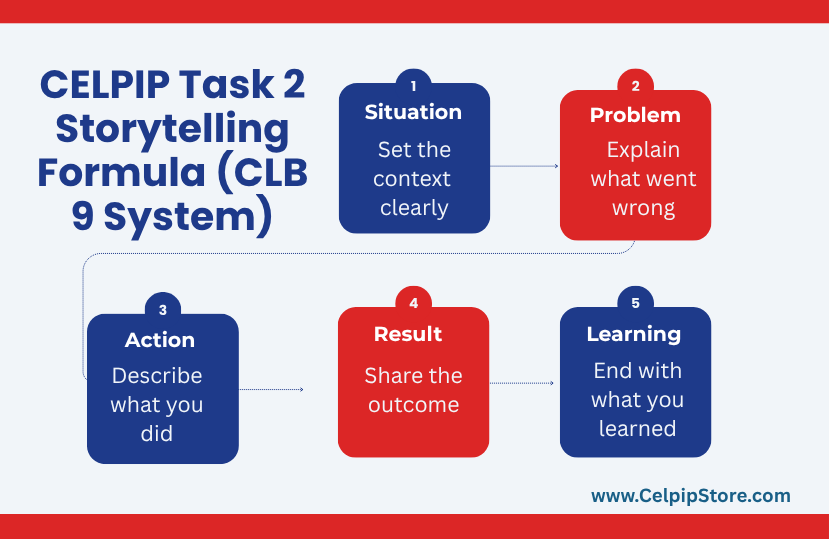
WHEN + WHO + EVENT
Example question: Describe a time you helped someone
- WHEN: Past situation (school, work, home)
- WHO: Friend, family member, colleague
- EVENT: Helped with a problem
Instantly, you can create a story:
- Helped a friend with studies
- Helped a family member with a task
- Helped a colleague at work
Then you build your structured response using the framework.
Sample CLB 9 Response Style
“I would like to talk about a time when I helped one of my friends. It happened a few months ago when she was preparing for an important exam. She was feeling very stressed because she was not able to manage her study schedule properly.
I decided to help her by creating a simple study plan. I explained how she could divide her time between different subjects and focus on the most important topics first. She followed the plan, and gradually she started feeling more confident.
In the end, she performed well in her exam, and she was very thankful for my help. It was a meaningful experience for me because I realized how small guidance can make a big difference.”
Practice Strategy Used by High Scorers
High-performing students do not memorize stories. Instead, they build storytelling control through targeted practice:
- Practicing 10–15 second story outlines
- Repeating the same story with improved fluency
- Practicing speaking without stopping even if mistakes occur
- Focusing on sequence, not perfection
This builds automatic storytelling ability under pressure.
Complete Summary of Task 2 Strategy
CELPIP Speaking Task 2 (Personal Experience) becomes much easier when you stop trying to “remember perfect stories” and instead focus on using a clear storytelling structure.
The real challenge is not creativity or vocabulary. It is maintaining a logical sequence of events while speaking under time pressure.
Once you follow a fixed system, your story becomes predictable, organized, and easy to deliver even in stressful exam conditions.
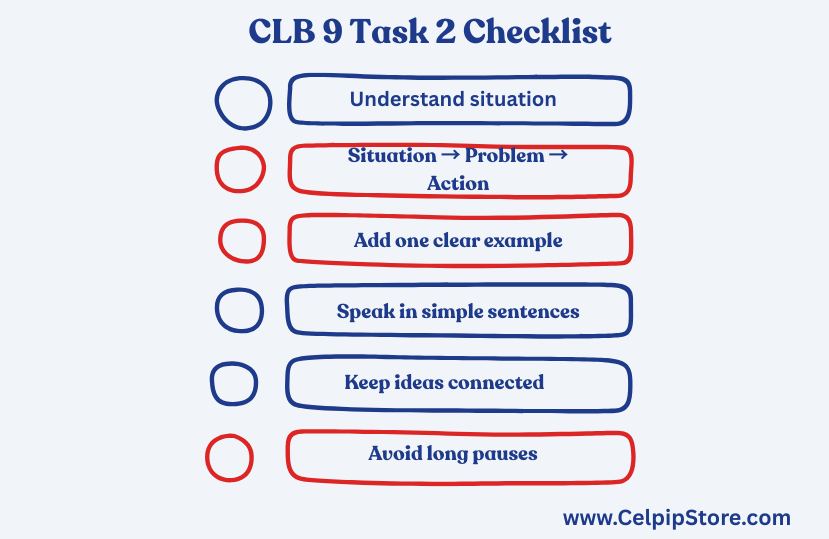
Final CLB 9 Checklist (Before Speaking)
Before you start speaking, quickly guide yourself using this checklist:
Structure
- I will start immediately without silence
- I will set the situation (when and where)
- I will describe events in order
- I will explain my action or reaction
- I will mention the result
- I will end clearly
Fluency
- I will speak at a steady pace
- I will avoid long pauses
- I will continue speaking even if I make small mistakes
Content
- My story follows a clear timeline
- I am staying on topic
- I am not adding unnecessary details
Language
- I will use simple and natural English
- I will focus on clarity instead of complex vocabulary
- I will not overthink grammar while speaking
Exam-Day Strategy (Very Important)
In the real CELPIP exam, your priority should be control, not perfection.
Start speaking immediately with a simple opening sentence. This helps reduce nervousness and builds early momentum.
Once you begin, follow your structure step by step. Do not try to recall exact words or perfect sentences. Keep your focus on moving the story forward.
If you make a small mistake, continue speaking without stopping. Fluency is more important than accuracy in Task 2.
Common Mistakes to Avoid (Final Reminder)
- Trying to memorize fixed stories for every question
- Adding too many unnecessary details
- Losing the order of events
- Pausing frequently to “think of the next sentence”
- Using overly complex vocabulary
- Ending the story without a proper conclusion
These mistakes directly reduce your CLB score, even if your English is strong.
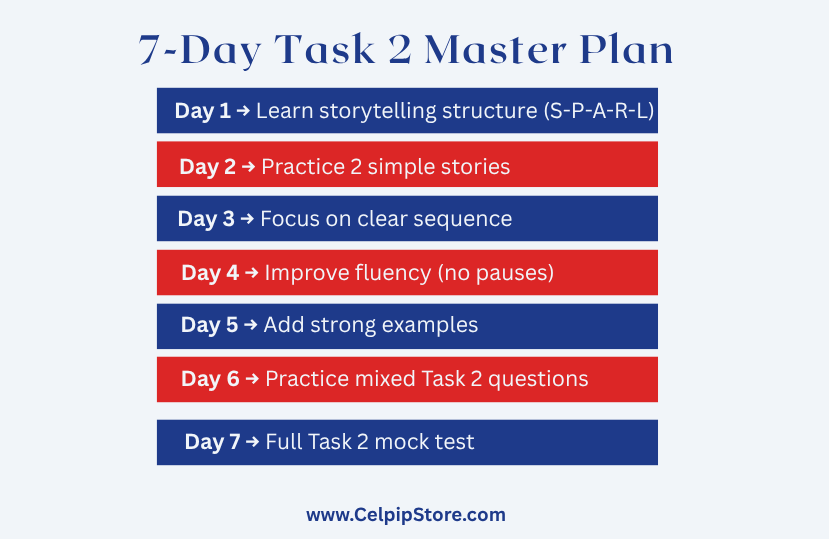
Final Practice Plan (Task 2 Mastery System)
To master Task 2, follow this structured training plan:
Day 1–2: Structure Training
Focus only on learning the storytelling framework:
Opening -> Situation -> Event -> Action -> Result -> Closing
Day 3–4: Guided Story Practice
Practice different story prompts using the same structure. Focus on clarity and sequence, not detail.
Day 5–6: Timed Speaking Practice
Simulate exam conditions. Speak within time limits and avoid stopping mid-story.
Day 7: Full Mock Task
Complete multiple Task 2 questions back-to-back to build confidence and fluency under pressure.
Final Success Insight
Task 2 is not about telling impressive stories. It is about telling clear, structured, and controlled stories under pressure.
Once you master the framework, you will always know:
- How to start your story
- How to continue logically
- How to finish confidently
This consistency is what leads to CLB 9 performance. Mastering Task 2 is a strong step forward, but your final score depends on how well you handle the entire speaking section as a complete system. Start with CELPIP Speaking Mastery Complete Guide for All Tasks.