CELPIP Reading Exam Simulation Strategy: Full Test Execution System for CLB 9–12 Success
Introduction
Most CELPIP candidates “practice reading” but never truly experience the real exam environment.
They solve passages casually, pause when needed, re-read sentences, and take breaks in between. This creates a false sense of confidence.
But the real CELPIP Reading test is different:
- strict timing
- continuous pressure
- no pause control
- rapid decision-making
This lesson focuses on building a full exam simulation system, so your practice feels identical to the real test.
Learning Objectives
By the end of this lesson, you will be able to:
- Simulate real CELPIP Reading exam conditions
- Handle time pressure without panic
- Apply strategies under real-time constraints
- Build mental stamina for full-length tests
- Improve accuracy under stress
- Eliminate comfort-based practice habits
Overview of Exam Simulation System
Exam simulation is not just a “mock test.”
It is a performance training environment that replicates:
- time pressure
- mental fatigue
- decision stress
- continuous focus requirement
Core Idea
If your practice feels easier than the real exam, you are NOT ready.
What Real Simulation Includes
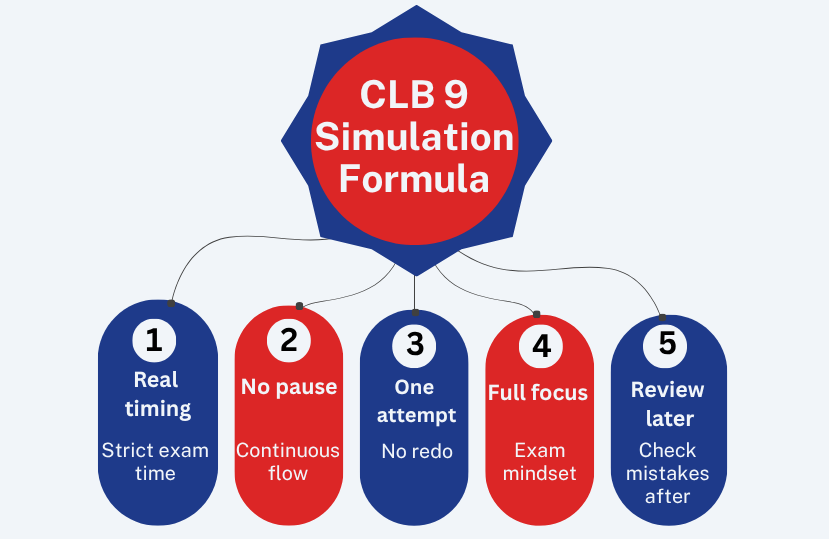
A proper CELPIP Reading simulation must include:
- strict timing (no pause)
- full section completion
- no distractions
- no re-reading outside rules
- no comfort breaks
Common Mistakes
Most students fail to simulate properly.
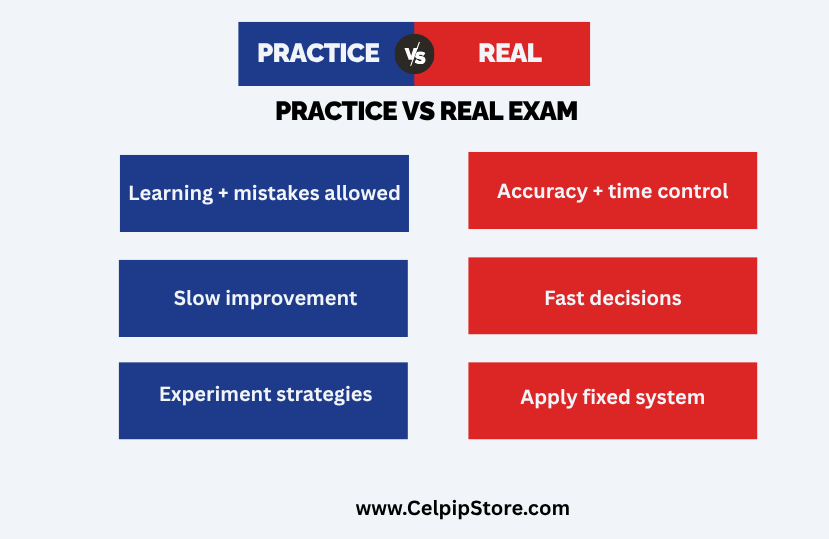
Mistake 1: Practicing in Comfort Mode
Students pause, re-read, and relax during practice.
Fix: Always simulate exam pressure conditions.
Mistake 2: No Time Enforcement
Students loosely track time.
Fix: Strict timer for every section.
Mistake 3: Partial Practice
Students practice only small sections.
Fix: Always attempt full reading section.
Mistake 4: Breaking Flow During Test
Students stop to think too long or check answers repeatedly.
Fix: Maintain continuous flow system.
Mistake 5: Ignoring Mental Pressure Training
Students only train skills, not stress handling.
Fix: Practice under exam-like pressure regularly.
1. Full Exam Simulation Framework (REAL PERFORMANCE SETUP)
A true CELPIP Reading simulation is not just “doing a mock test.”
It is a controlled exam environment reproduction system.
You must recreate:
- time pressure
- mental fatigue
- decision speed
- no-break continuity
- strict question flow discipline
The goal is simple: your practice should feel slightly harder than the real exam
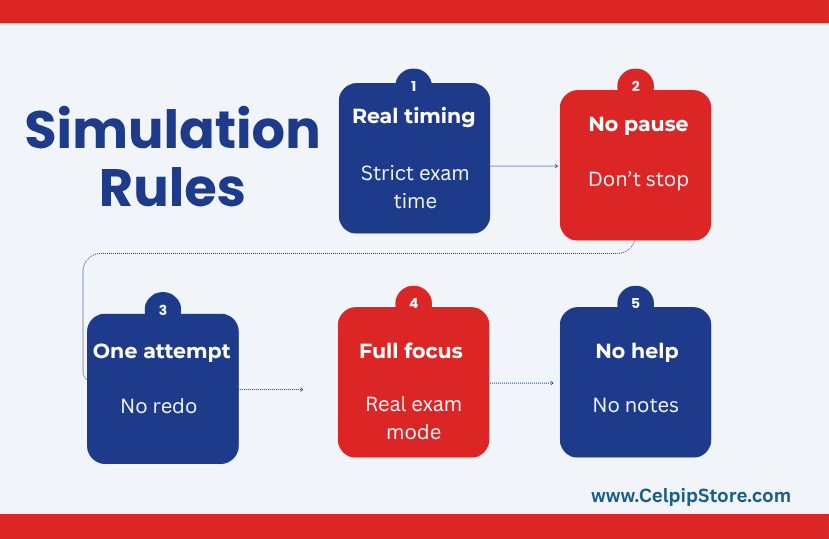
Simulation Rule Set (NON-NEGOTIABLE)
During simulation:
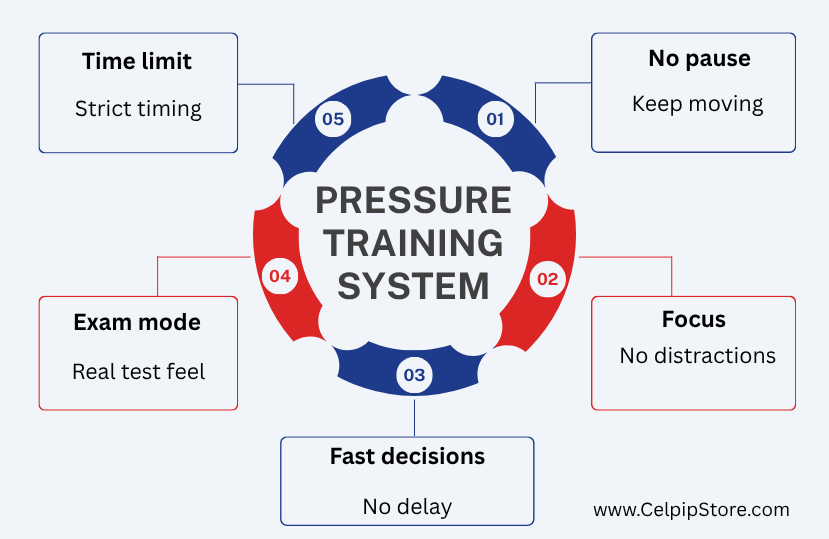
- No pause button
- No checking answers midway
- No dictionary use
- No re-reading entire passages
- No comfort breaks
If you break rules, it is NOT a simulation
2. Pressure Training System (BUILDING EXAM RESILIENCE)
CELPIP Reading is not just testing knowledge it is testing mental control under pressure.
Pressure Factor 1: Time Compression
Reduce comfort time gradually:
- Week 1: normal timing
- Week 2: -10% time
- Week 3: real exam timing
- Week 4: slightly faster than exam
This trains urgency response
Pressure Factor 2: Continuous Flow Training
You must train your brain to:
- never stop reading flow
- never overthink one question
- move forward immediately
Flow interruption = score drop
Pressure Factor 3: Fatigue Simulation
Practice full-length reading when:
- tired
- after study session
- without breaks
This mimics real exam mental fatigue
3. Real Exam Execution Model (FINAL TEST BEHAVIOR SYSTEM)
In the real CELPIP Reading test, follow this exact behavior model:
STEP 1: Immediate Start
- Do NOT overthink instructions
- Start skimming immediately
STEP 2: Controlled Skimming
- 30–40 seconds only
- Identify structure and topic
- Move forward instantly
STEP 3: Question Flow Lock
- Identify question type first
- Follow priority system
- Do NOT jump randomly
STEP 4: Strict Time Discipline
- Easy questions -> fast execution
- Hard questions -> limited attempt
- No question deserves unlimited time
STEP 5: Recovery Mode
If stuck:
- skip immediately
- mark mentally
- return only if time remains
4. Examiner Insight (WHY SIMULATION MATTERS)
Examiners design CELPIP Reading to test:
- reaction under pressure
- consistency across difficulty changes
- emotional control during confusion
- speed under time restriction
Without simulation, students fail under real stress even if they are skilled
5. Key Mindset Shift (CLB 9+ BEHAVIOR)
Weak students think:
“I will practice until I understand everything.”
Strong students think:
“I will train until I can perform under pressure.”
1. Advanced Pressure Techniques (HIGH-PERFORMANCE TRAINING)
At CLB 9–12 level, your biggest enemy is not English ability it is pressure distortion (thinking becomes slow under time stress).
These techniques fix that.
Technique 1: Controlled Panic Training (CPT Method)
You intentionally simulate slight pressure so your brain learns to stay stable.
How:
- Set strict timer
- Do not pause
- Continue even if confused
Goal: train calm decision-making under stress
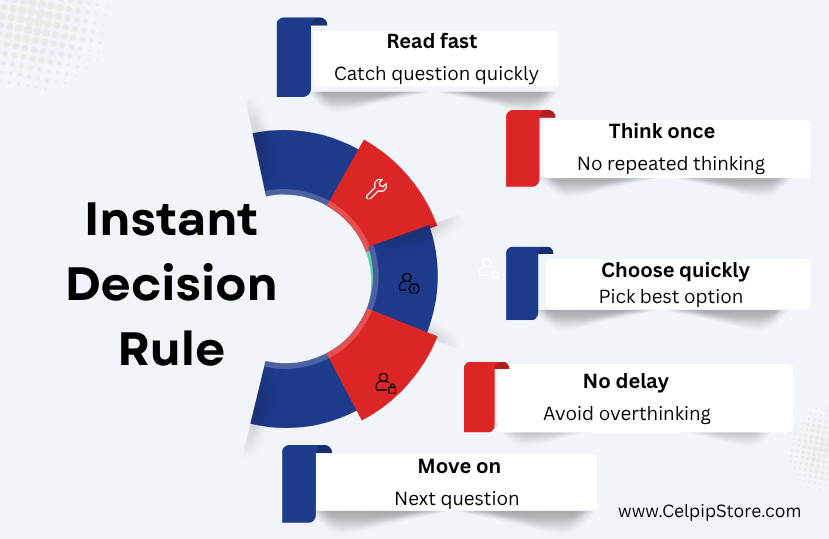
Technique 2: Instant Decision Rule
In CELPIP Reading, hesitation is the biggest score killer.
Rule:
- If answer is 70% sure -> select it
- Do not chase 100?rtainty
Perfect thinking = time loss
Fast thinking = score gain
Technique 3: Recovery Acceleration System
After a difficult question:
- Do NOT mentally reset for long
- Immediately move to next question
- Re-engage flow within 5–10 seconds
Fast recovery = stable performance
2. Examiner Patterns (HOW PRESSURE IS BUILT INTO THE TEST)
CELPIP Reading is carefully designed to break focus patterns.
Pattern 1: Cognitive Load Spikes
Examiners place:
- long passages
- dense information
- multiple ideas
To overload attention and slow decision-making
Pattern 2: Confidence Traps
Some questions feel easy but contain subtle errors in options.
This tests overconfidence under pressure
Pattern 3: Rhythm Disruption
Easy -> hard -> easy -> confusing order
Breaks your mental flow and timing rhythm
Pattern 4: Paraphrase Pressure
Answers are rarely direct copies. They are:
- reworded
- restructured
- partially hidden
Tests mental clarity under stress
3. Simulation Breakdowns (WHY PRACTICE FAILS IN REAL EXAM)
Breakdown 1: Comfort Simulation
Students practice without pressure.
Fix: strict exam rules only
Breakdown 2: Time Drift
Students slightly exceed time limits in practice.
Fix: enforce hard cut-offs (no extra seconds)
Breakdown 3: No Emotional Stress Training
Students never feel exam tension in practice.
Fix: fatigue + timed simulation sessions
Breakdown 4: Overthinking During Test
Students try to “perfect” answers.
Fix: adopt instant decision rule
Breakdown 5: Flow Break Failure
Students stop after difficult questions.
Fix: recovery acceleration system
4. Optimization Strategy (FINAL PERFORMANCE UPGRADE SYSTEM)
To reach CLB 9–12 consistency, you must optimize 4 areas:
Phase 1: Pressure Familiarization
- strict timed mock tests
- no pauses allowed
- simulate exam exactly
Phase 2: Decision Speed Training
- practice instant answer selection
- reduce overthinking
- build confidence in 70?rtainty decisions
Phase 3: Flow Stability Training
- maintain continuous reading flow
- avoid emotional disruption
- skip and return strategy practice
Phase 4: Full Simulation Mastery
- combine pressure + timing + fatigue
- replicate real exam conditions fully
- review only AFTER completion
Summary
CELPIP Reading exam success is not determined by how much you practice, but by how closely your practice matches real exam pressure.
Exam simulation transforms your preparation from:
- casual practice
to - performance training system
At CLB 9–12 level, success depends on:
- speed under pressure
- stable decision-making
- emotional control
- continuous flow execution
The goal is simple: no difference between practice and real exam performance
Master Checklist
Before you consider yourself exam-ready, ensure you can:
- Complete full Reading section without pauses
- Maintain strict timing under pressure
- Apply skimming, scanning, and logic in one flow
- Make fast decisions without overthinking
- Recover quickly from difficult questions
- Avoid breaking system flow during stress
- Perform consistently in multiple full simulations
FAQs
Q1: How many simulations should I do before the exam?
Enough until performance feels stable under pressure (not just once or twice).
Q2: What is the biggest benefit of exam simulation?
It removes fear and builds familiarity with real exam pressure.
Q3: Why do I perform well in practice but not in the exam?
Because practice is usually comfortable, not pressure-based.
Q4: Should I analyze simulation tests immediately?
No. First focus on execution. Analysis comes after full completion.
Practice Blueprint (7-DAY SIMULATION TRAINING SYSTEM)
Day 1–2: Controlled Simulation
- Full reading test
- Strict timing
- No breaks
Day 3–4: Pressure Increase
- Reduce time slightly
- Add fatigue (practice when tired)
- No re-reading allowed
Day 5–6: Full Exam Reality Mode
- Exact exam conditions
- No comfort behaviors
- Full focus execution only
Day 7: Performance Review
- Analyze only after completion
- Identify flow breaks
- Improve weak execution points
Conclusion
CELPIP Reading mastery is not about knowledge alone.
It is about execution under pressure.
When you master:
- simulation control
- time discipline
- decision speed
- mental stability
You stop practicing like a student and start performing like a test-ready candidate.