CELPIP Vocabulary Strategy: Context Clues System to Improve Reading Score CLB 9–12
Introduction
One of the biggest myths in CELPIP Reading is that you need a large vocabulary to get a high score.
In reality, CELPIP is not testing how many words you know. It is testing how well you can understand meaning in context.
Even if you do not know certain words, you can still answer correctly by using:
- surrounding sentences
- tone of the passage
- logic of the idea
- paraphrased expressions
This is called context-based understanding, and it is essential for CLB 9–12.
Learning Objectives
By the end of this lesson, you will be able to:
- Understand unknown words using context clues
- Recognize paraphrased meanings in passages
- Avoid dependency on memorizing vocabulary lists
- Improve accuracy in difficult reading passages
- Decode meaning through sentence logic and structure
Overview of Vocabulary & Context Clues System
In CELPIP Reading, vocabulary is rarely tested directly. Instead, it is tested indirectly through:
- paraphrasing
- sentence context
- meaning substitution
- idea interpretation
You will often see words you do not know, but the passage is designed so that meaning can still be understood without a dictionary.
The skill is not “knowing words”
The skill is “understanding meaning from context”
Common Mistakes
Most students lose marks because they panic when they see unknown words.
Mistake 1: Stopping Reading When a Word is Unknown
Students freeze when they see difficult vocabulary.
Fix: Keep reading meaning is usually in surrounding lines.
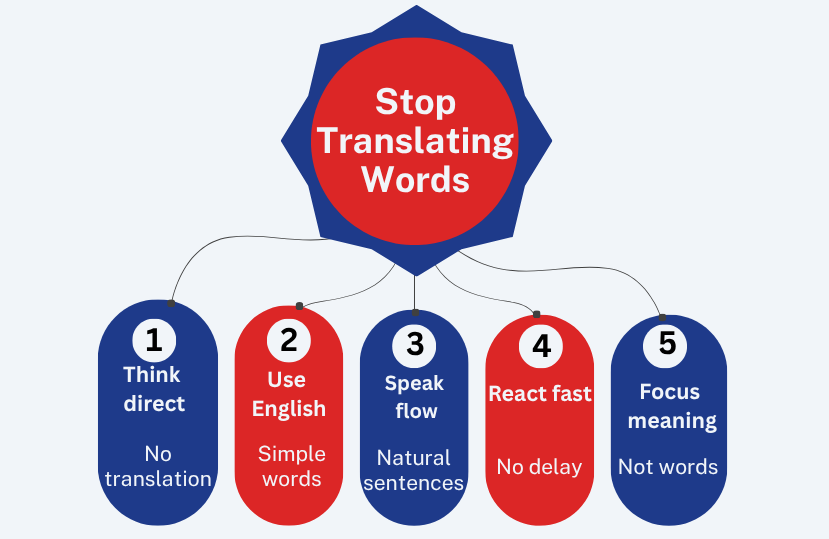
Mistake 2: Trying to Translate Every Word
Students try to understand every single word.
Fix: Focus on sentence meaning, not individual words.
Mistake 3: Relying Only on Memorization
Students think vocabulary lists are enough.
Fix: Focus on context understanding instead of memorization.
Mistake 4: Ignoring Paraphrasing
Students fail to recognize same meaning written differently.
Fix: Learn to identify synonyms and reworded ideas.
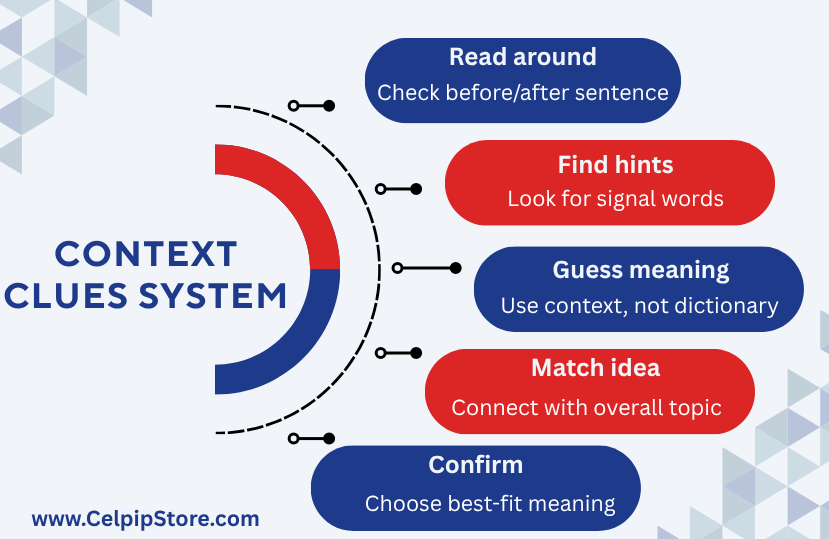
1. Core Teaching Framework (Meaning Decoding System)
In CELPIP Reading, vocabulary is not tested in isolation. It is always embedded inside a meaning system.
This system works in 3 steps:
Step 1: Identify Unknown Word
When you see a difficult word, do not stop reading. Simply mark it mentally as:
- unknown word
- confusing word
- unclear meaning
Do NOT panic or translate immediately.
Step 2: Use Context Clues
Look at surrounding information:
- previous sentence
- next sentence
- overall tone
- situation described
Meaning is usually explained indirectly nearby.
Step 3: Confirm Logical Meaning
Replace the unknown word with a possible meaning and check:
- Does the sentence still make sense?
- Does it match passage idea?
- Does it fit the tone?
2. Context Clues System (HOW YOU GUESS MEANING)
Context clues are hints inside the sentence or passage that help you understand unknown words.
Type 1: Definition Clue
Sometimes the meaning is directly explained.
Example:
“The clinic was closed due to contagious diseases, which are illnesses that spread easily.”
Meaning is given directly in sentence.
Type 2: Synonym Clue
The sentence repeats meaning using simpler words.
Example:
“He was exhausted, completely tired after the journey.”
exhausted = tired
Type 3: Contrast Clue
Meaning is explained through opposite idea.
Example:
“Unlike his energetic brother, he was very lazy.”
lazy = opposite of energetic
Type 4: Example Clue
Examples help explain meaning.
Example:
“She likes citrus fruits such as oranges, lemons, and grapefruits.”
citrus = type of fruit group
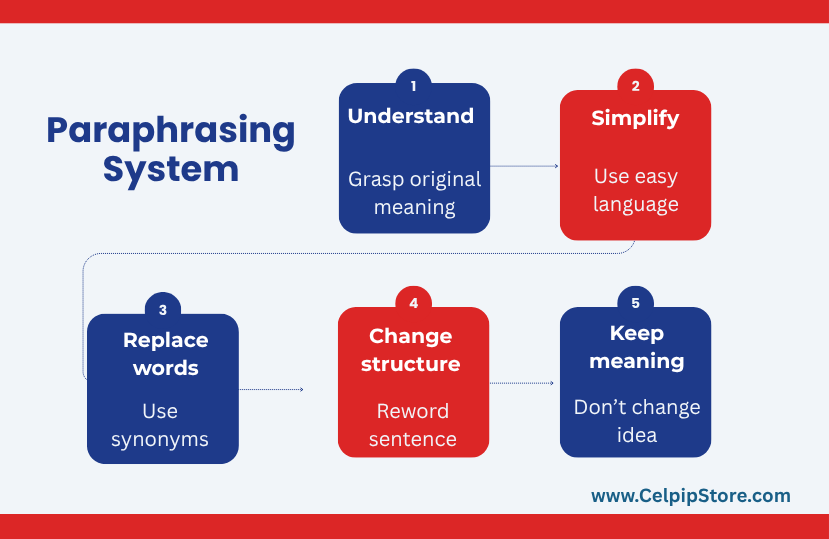
3. Paraphrasing Strategy (CELPIP SECRET SYSTEM)
CELPIP rarely repeats exact words. Instead, it changes form.
You must train your brain to recognize meaning shifts.
Common Paraphrase Patterns
- increase -> rise / grow / go up
- decrease -> fall / drop / reduce
- important -> essential / crucial / significant
- problem -> issue / challenge
- help -> assist / support
Key Rule
If wording is different but meaning is same -> it is correct answer
If wording is same but meaning is different -> it is trap
4. Real Exam Application (How This Works in CELPIP Reading)
In real CELPIP Reading passages:
- You will see unknown words
- You will see paraphrased answers
- You will see misleading options
Step-by-Step Real Exam Flow
Step 1: Read Question First
Understand what meaning is required.
Step 2: Locate Passage Section
Use scanning or skimming depending on question type.
Step 3: Identify Context Clues
Do not stop at unknown word — read nearby sentences.
Step 4: Replace Meaning Mentally
Substitute possible meaning into sentence.
Step 5: Verify Answer
Check if meaning fits logically with passage.
5. High-Score Pattern (CLB 9–12 Learners)
Strong students do NOT translate words.
They:
- understand sentence meaning
- rely on context clues
- identify paraphrased ideas
- focus on logic instead of vocabulary
Weak students:
- stop reading when they see unknown word
- try to translate everything
- lose time and confidence
1. Advanced Vocabulary Strategy (CLB 9–12 Thinking System)
At higher levels, vocabulary is not about knowing more words it is about understanding how meaning changes in context.
Instead of memorizing lists, you must train your brain to recognize meaning patterns.
Technique 1: Meaning Substitution Method
When you see an unknown word, immediately replace it with a simple guess and test the sentence.
For example:
- “The situation was critical”
You test: - important
- serious
- urgent
If the sentence still makes sense, your interpretation is correct.
Technique 2: Sentence Flow Reading
Do not stop at difficult words. Instead:
- read full sentence
- connect with next sentence
- understand overall idea
Meaning is always spread across sentences, not inside one word.
.png "Vocabulary_is_NOT_the_Problem_(1).png")
Technique 3: Idea First, Word Later Rule
Strong students never focus on words first. They focus on:
- situation
- message
- intention
Words are just tools meaning is the real target.
2. Examiner Insights (How CELPIP Tests Vocabulary Without Testing It Directly)
CELPIP does NOT ask:
“What does this word mean?”
Instead, it hides vocabulary inside:
- paraphrased sentences
- context-based meaning traps
- similar-looking options with different meanings
Key Examiner Trick
Examiners often:
- use easy words in wrong answers
- use difficult words in correct answers
- change sentence structure to confuse test-takers
This is designed to test understanding, not memorization
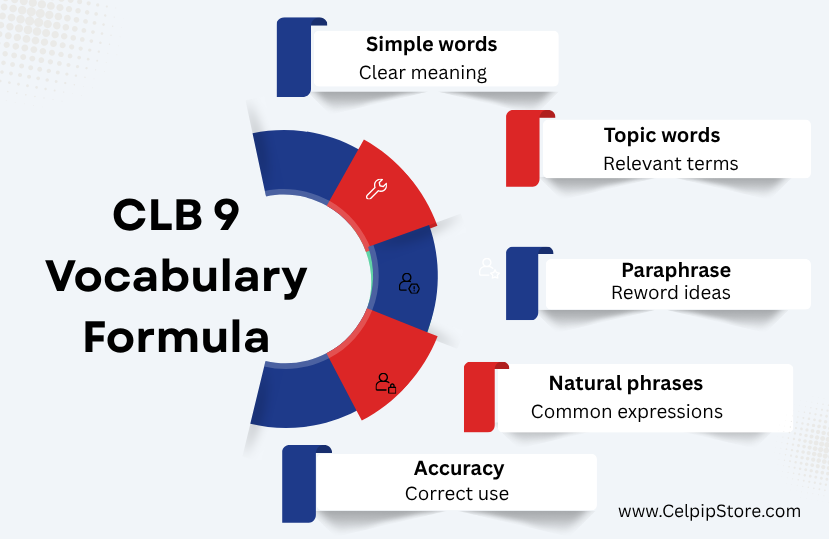
3. Common Errors (Why Students Fail Vocabulary Questions)
Error 1: Translating Every Word
Students try to understand every unknown word.
Fix:
Focus on sentence meaning, not word meaning.
Error 2: Panic Stopping
Students stop reading when they see difficult vocabulary.
Fix:
Continue reading meaning is usually explained later.
Error 3: Over-Reliance on Memory Lists
Students memorize vocabulary lists but fail in real passages.
Fix:
Practice context-based learning, not memorization.
Error 4: Ignoring Surrounding Sentences
Students focus only on one line.
Fix:
Read before and after sentence for full meaning.
Error 5: Literal Thinking
Students interpret everything word-by-word.
Fix:
Think in ideas, not words.
4. Improvement System (How to Build Vocabulary Skill for CELPIP)
Phase 1: Context Practice
- Read short passages
- Identify unknown words
- Guess meaning using surrounding sentences
Phase 2: Paraphrase Training
- Learn common word transformations
- Practice synonym recognition
- Compare sentence variations
Phase 3: Mixed Passage Practice
- Full CELPIP reading passages
- Focus on meaning, not vocabulary
- Identify traps and distractors
Phase 4: Error Review Loop
After every test:
- Did I stop at unknown word?
- Did I understand context?
- Did I miss paraphrased meaning?
- Did I rely on guessing too early?
1. Summary
CELPIP vocabulary is not a memorization test. It is a context understanding system.
You will regularly face unknown words, but the test is designed so that meaning can still be understood through:
- surrounding sentences
- paraphrasing patterns
- logic of the passage
- tone and intention
Success in CELPIP Reading comes from understanding meaning, not words
2. Final Checklist
Before and during the exam, ensure you:
- Do not stop reading when you see unknown words
- Use surrounding sentences for meaning clues
- Focus on sentence meaning, not individual words
- Recognize paraphrased expressions
- Think in ideas, not literal translations
- Confirm meaning logically before choosing answers
3. FAQs
Q1: Do I need advanced vocabulary for CELPIP Reading?
No. You need context understanding, not memorized word lists.
Q2: What should I do if I don’t know a word?
Keep reading and use surrounding sentences to guess meaning.
Q3: Why do I still lose marks even if I understand English?
Because CELPIP tests paraphrasing and context understanding, not just vocabulary.
Q4: How can I improve vocabulary quickly?
Focus on reading passages and learning meanings through context, not memorization.
4. Practice Plan (7-Day Vocabulary Mastery System)
Day 1–2: Context Clue Training
- Read short passages
- Guess meaning of unknown words
- Verify using sentence logic
Day 3–4: Paraphrase Practice
- Learn common word transformations
- Match similar meaning sentences
Day 5–6: Full Passage Practice
- Solve CELPIP reading tests
- Focus on meaning, not vocabulary
Day 7: Error Analysis
- Identify where you stopped due to unknown words
- Check if meaning was available in context
- Correct interpretation mistakes
5. Conclusion
CELPIP Reading does not reward vocabulary memorization. It rewards context intelligence and meaning recognition.
Once you stop translating word-by-word and start understanding ideas, your accuracy and speed will improve significantly.
The real skill is: reading beyond words into meaning.