
CELPIP Speaking Integration Strategy: Master All Tasks (1–8) for CLB 9 Score
Introduction
Most CELPIP candidates prepare for speaking tasks separately. They learn Task 1, then Task 2, then Task 3, but they never connect them into one system.
This is the biggest reason students fail to reach CLB 9 consistently.
In the real exam, your brain does not have time to “switch strategies” between tasks. You need one unified speaking system that works for all situations: advice, storytelling, description, opinion, problem-solving, and decision-making. Integration across all CELPIP Speaking tasks helps improve consistency and fluency, but your final performance also depends on how well you understand each individual speaking task.
You can learn this in CELPIP Speaking Mastery: Complete Strategy for All Tasks.
The CELPIP Speaking Integration System is designed exactly for this purpose to help you speak consistently, fluently, and structurally across all 8 speaking tasks.
Learning Objectives
By the end of this lesson, you will be able to:
- Understand how all CELPIP speaking tasks are connected
- Use one universal speaking structure across different question types
- Improve fluency under exam pressure
- Switch between speaking styles without confusion
- Apply CLB 9 strategies consistently across all tasks
- Reduce hesitation and mental overload during speaking
Overview: What Integration Really Means
Integration does NOT mean memorizing answers for each task.
It means using a common thinking system for every speaking question.
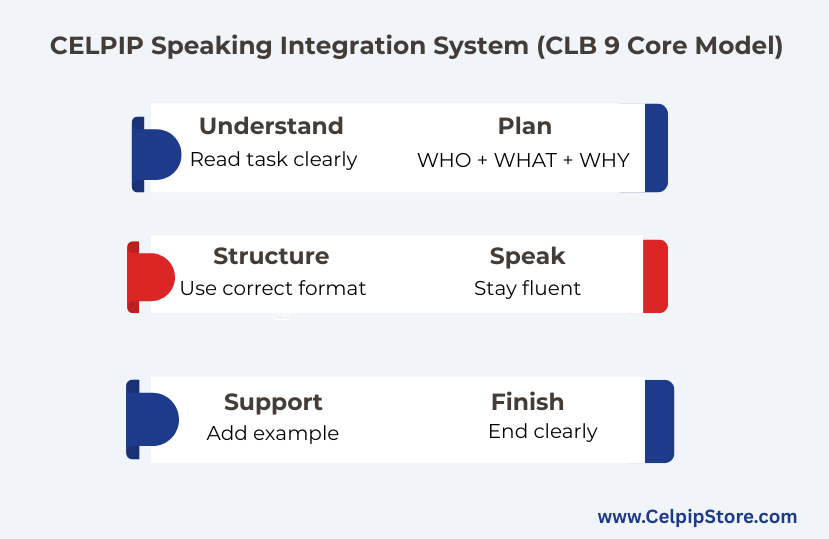
Instead of treating tasks separately, you learn to identify patterns:
- Task 1 -> Advice / Suggestion structure
- Task 2 -> Storytelling structure
- Task 3 -> Description structure
- Task 4 -> Opinion structure
- Task 5–8 -> Mixed communication skills
Even though topics change, the thinking process remains the same. While integrating all speaking tasks is important, it must be built on a strong foundation of task-wise strategies that cover structure, fluency, and response quality. This complete system is explained in CELPIP Speaking Mastery Complete Strategy Guide.
This is what CLB 9 candidates naturally do.
The Core Problem Most Students Face
Students usually fail because they:
- Learn different strategies for each task without connection
- Panic when task type changes suddenly
- Waste time thinking “what structure should I use?”
- Lose fluency due to switching mental systems
- Focus on content instead of structure
This creates inconsistency across tasks.
What CLB 9 Integration Actually Means
CLB 9 is not about perfect answers. It is about controlled speaking performance under pressure.
At CLB 9 level, you should be able to:
- Start speaking immediately in any task
- Automatically choose a structure
- Stay fluent even under pressure
- Maintain logical flow across different question types
- Use simple, natural English consistently
The key skill is automatic structure recognition. To achieve CLB 9+, you need both integration across tasks and strong individual performance in each speaking question type. You can build this balance using CELPIP Speaking Mastery for High Band Scores.
Common Mistakes Students Make in CELPIP Speaking Integration (Tasks 1–8)
- Treating each speaking task as completely separate instead of using one unified speaking system
- Memorizing fixed answers for each task instead of learning a flexible structure framework
- Panicking when the task type changes, which leads to hesitation at the start
- Spending too much time identifying the “task type” instead of starting to speak immediately
- Switching speaking styles incorrectly mid-response, causing loss of coherence
Your speaking performance improves when you combine task-level preparation with a unified strategy that connects all speaking tasks into one system.
This approach is explained in CELPIP Speaking Mastery Complete Performance Strategy.

The Core Idea: One System for All Speaking Tasks
In CELPIP Speaking, most students try to learn separate strategies for each task. This creates confusion during the exam because the brain has to constantly “switch systems.”
CLB 9 candidates do something different. They use one universal speaking framework and adjust only the content, not the structure.
This makes speaking faster, smoother, and more consistent across all 8 tasks.
The Universal Speaking Framework (CLB 9 Core System)
You can use this structure for ANY CELPIP speaking question:
1. Immediate Start (No Delay Rule)
Start speaking instantly with a clear opening sentence.
- No silence
- No thinking delay
- No over-analysis
Example starters:
- “I would like to talk about…”
- “In my opinion…”
- “One situation I remember is…”
- “I think the best option is…”
2. Situation / Position Statement
Quickly define what your response is about.
- Advice -> what you suggest
- Story -> what happened
- Opinion -> your position
- Description -> what you see
This gives direction to your answer.
3. Main Idea (Core Content)
This is the central part of your response.
- Task 1 -> main advice
- Task 2 -> main event
- Task 3 -> main scene focus
- Task 4 -> main argument
Always keep it simple and clear.
4. Supporting Point (Reason / Detail / Example)
Add depth using one strong supporting idea.
You can use:
- Reason
- Example
- Explanation
- Experience
5. Second Support (Optional Expansion)
Add one more point only if time allows.
This increases scoring depth without overcomplicating.
6. Closing Line (Strong Finish)
Always end clearly.
Examples:
- “That is why I believe this is the best option.”
- “This was an important experience for me.”
- “Overall, this is the most suitable choice.”
Many candidates lose marks because they focus only on integration without mastering individual task structures, which weakens overall clarity and fluency.
Avoid this with CELPIP Speaking Mastery Complete Scoring Strategy.
Why This Framework Works Across ALL Tasks
This system works because CELPIP speaking tasks only change the topic, not the communication pattern.
No matter the task, you always:
- Start immediately
- State main idea
- Support it
- Expand slightly
- End clearly
This reduces mental load during the exam.
How Tasks 1–8 Fit Into This System
Instead of separate strategies, each task becomes a variation of the same structure:
- Task 1 (Advice): Suggest -> Reason -> Example -> Close
- Task 2 (Story): Event -> Sequence -> Action -> Result
- Task 3 (Scene): Overview -> Focus -> Details -> Summary
- Task 4 (Opinion): Opinion -> Reason -> Example -> Conclusion
- Task 5–8: Mix of support + explanation + decision
Same system. Different content.
Fluency Across Tasks: The Real CLB 9 Difference
At CLB 9 level, the main difference is not vocabulary or grammar. It is the ability to maintain consistent structure and fluency across all speaking tasks without mental switching stress.
Most candidates perform well in one task but lose control when the task type changes. This happens because they are thinking in separate systems instead of one unified speaking approach.
CLB 9 speakers do not “rebuild their thinking” for each task. They simply reuse the same speaking flow with different content.
Examiner Insight: What Actually Gets High Scores Across All Tasks
Examiners are not testing how different your answers are for each task. They are evaluating your overall speaking performance in four key areas:
1. Task Achievement
Did you fully respond to the question in each task?
Strong candidates stay focused on the requirement without drifting off-topic.
2. Coherence
Is your speaking logically structured across ideas?
Even in different tasks, your response should feel organized and easy to follow.
3. Fluency
Do you speak continuously without breaking flow when tasks change?
Fluency across transitions is a key CLB 9 indicator.
4. Language Control
Do you maintain simple, natural, and accurate English across all tasks?
Consistency is more important than complexity.
The Integration Mindset (Very Important Shift)
Most students think like this:
- Task 1 = Advice thinking
- Task 2 = Story thinking
- Task 3 = Description thinking
- Task 4 = Opinion thinking
This creates mental overload.
CLB 9 candidates think differently:
- “I always follow the same structure. I just change the content.”
This removes hesitation and improves speed.
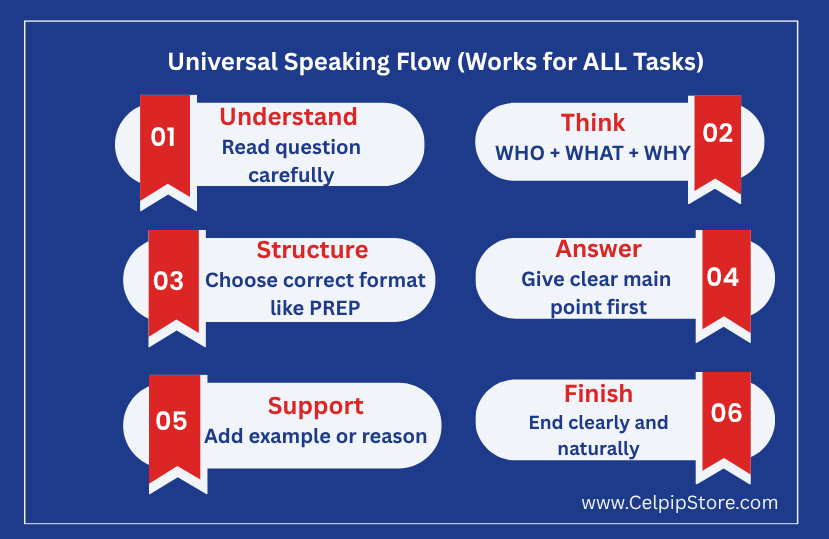
Universal Speaking Flow (Master Pattern)
Across all tasks, high performers naturally use this flow:
Start -> Identify -> Explain -> Support -> Expand -> Close
This pattern remains stable whether you are:
- Giving advice
- Telling a story
- Describing a scene
- Expressing an opinion
- Making a decision
Only the content changes, not the thinking process.
Integrated Speaking Example (CLB 9 Style)
Instead of separate responses, CLB 9 speakers naturally combine structure like this:
“I think the best option is to manage time properly. The main reason is that it helps people stay organized and reduce stress.
For example, when students plan their study schedule, they can complete tasks more efficiently. Another reason is that it improves productivity in both work and daily life.
That is why I believe time management is the most effective approach in this situation.”
This structure can be adapted to almost any CELPIP speaking task.
High-Performance Practice Strategy
To master integration, students should not practice tasks separately only. They must train switching under pressure.
Effective methods include:
- Mixing Task 1–4 randomly in practice sessions
- Practicing timed responses without stopping
- Using the same structure for all answers
- Focusing on flow, not perfection
- Simulating full speaking test sequences
This builds real exam readiness.
Complete Summary of the Integration System
The CELPIP Speaking Integration System is built on one core idea: you do not need separate strategies for each speaking task. Instead, you need one unified speaking framework that works across all 8 tasks.
At CLB 9 level, success depends on your ability to stay consistent in structure, fluent in delivery, and clear in communication regardless of topic changes.
Once this system becomes automatic, speaking becomes predictable, controlled, and significantly less stressful.
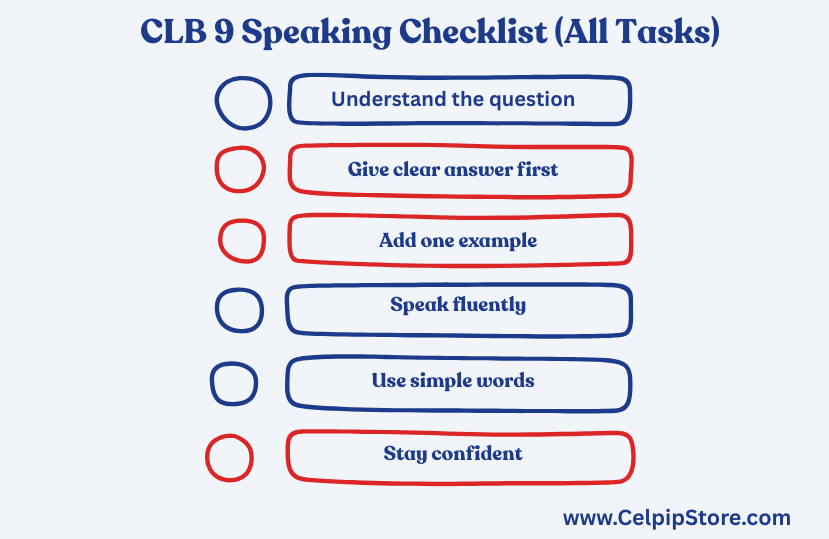
Final CLB 9 Speaking Checklist (Before Exam)
Before starting any speaking task, quickly check:
Structure Control
- I will start speaking immediately
- I will use a clear opening sentence
- I will follow a simple structure flow
- I will support my main idea clearly
- I will end with a strong conclusion
Fluency Control
- I will not pause to think too long
- I will keep speaking even with simple sentences
- I will not restart my answer
- I will maintain steady flow across all tasks
Content Control
- I will stay focused on the question
- I will not switch ideas randomly
- I will not overcomplicate my response
- I will keep my message clear and direct
Language Control
- I will use simple, natural English
- I will avoid unnecessary complex vocabulary
- I will focus on clarity instead of perfection
Exam-Day Strategy (Critical for CLB 9 Performance)
During the actual CELPIP Speaking test:
Do not treat each task as a new challenge. Treat it as a continuation of the same speaking system.
Start immediately without hesitation. The first sentence should always set direction.
Then follow your structure automatically:
Start -> Main Idea -> Support -> Expand -> Close
Do not stop to think about grammar perfection or vocabulary improvement during the test. This breaks fluency and reduces score performance.
Consistency is more important than complexity.
Common Mistakes to Avoid (Full System Reminder)
Across all speaking tasks, avoid:
- Switching speaking strategies for each task
- Pausing too long to “plan perfect ideas”
- Overthinking vocabulary during speaking
- Losing structure when task changes
- Repeating the same point multiple times
- Ending responses without clear conclusion
- Trying to sound too advanced instead of being clear
These mistakes reduce fluency and coherence across the entire speaking test.
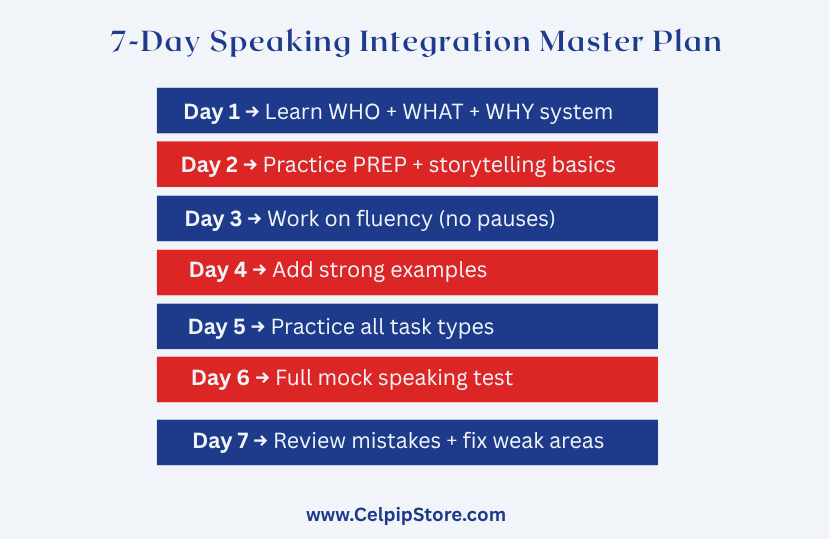
7-Day CELPIP Speaking Integration Practice Plan
To fully master this system, follow this structured plan:
Day 1–2: Structure Familiarization
Practice the universal flow:
Start -> Idea -> Support -> Expand -> Close
Day 3–4: Mixed Task Practice
Randomly practice Tasks 1–4 using the same structure system.
Day 5–6: Timed Speaking Drills
Simulate real exam timing with no pauses allowed.
Day 7: Full Speaking Simulation
Complete all speaking tasks back-to-back to build endurance and fluency control.
Final Success Insight
CLB 9 speaking performance is not about learning more content.
It is about building one reliable speaking system that works under pressure. True speaking mastery comes from balancing individual task skills with a fully integrated speaking system across all CELPIP tasks. Start with CELPIP Speaking Mastery Complete Guide for All Tasks.
Once this system becomes automatic:
- You will never feel lost in any task
- You will always know what to say next
- You will speak with confidence and clarity
- You will maintain fluency across the entire exam