CELPIP Speaking Task 6 Mastery Problem-Solution Speaking Solve Problems
Introduction
CELPIP Speaking Task 6 tests your ability to solve a problem clearly and logically in spoken English. In this task, you are usually given a situation where something is wrong or needs improvement, and you must explain how to fix it.
Most students struggle here because they either give random ideas or speak without structure. However, Task 6 is highly predictable and becomes easy when you use a step-by-step problem-solving approach.
The key idea: You are not just speaking you are solving a problem logically. Problem-solving in Task 6 is only one part of the CELPIP Speaking test, but your final score depends on how well you perform across all speaking tasks. A complete system ensures balanced performance. You can understand this full system in CELPIP Speaking Mastery: Complete Strategy for High Band Scores.
Learning Objectives
By the end of this lesson, you will be able to:
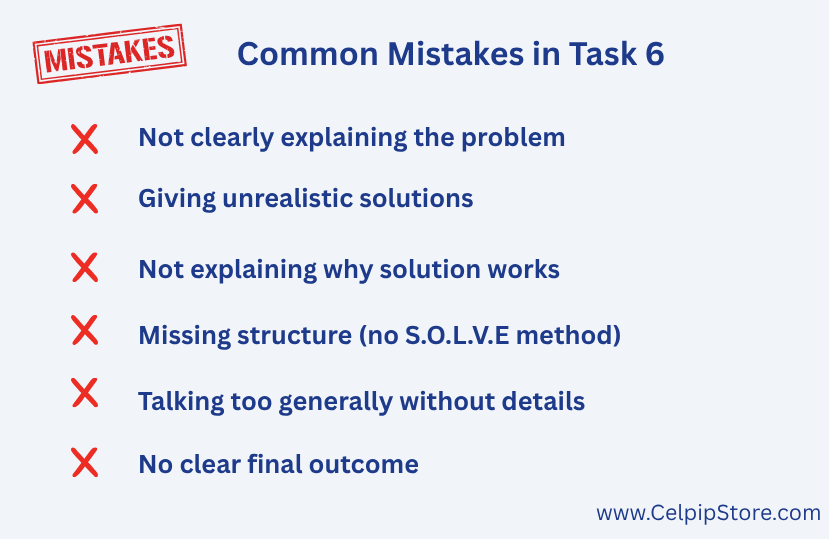
- Understand CELPIP Speaking Task 6 format clearly
- Identify problems quickly in any situation
- Provide structured solutions confidently
- Improve logical speaking flow under time pressure
- Avoid hesitation and confusion while speaking
- Achieve CLB 9–12 using structured response method
Overview of Task 6
In this task, you are presented with a situation where:
- Something is wrong
- A problem needs to be solved
- You must suggest solutions
What you are expected to do:
- Clearly describe the problem
- Suggest practical solutions
- Explain why your solution works
- Keep your answer structured and logical
What Examiners Evaluate
Examiners focus on:
- Clarity of problem identification
- Logical solution development
- Fluency and coherence
- Practical thinking ability
- Structured communication
Common Mistakes Students Make
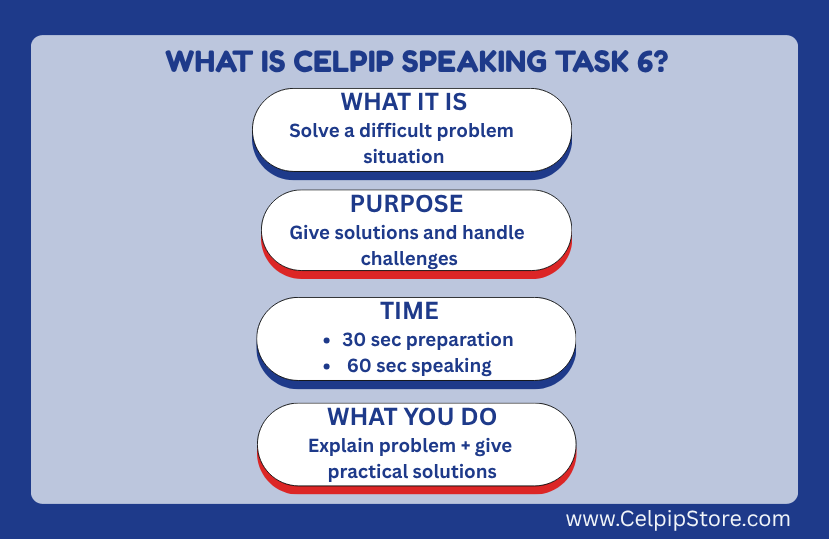
1. Jumping into solutions too fast
Students skip problem explanation and go directly to ideas.
2. Giving unrealistic solutions
Ideas that are not practical reduce score quality.
3. No structure in response
Answer becomes a list of random suggestions.
4. Overthinking vocabulary
Students pause too long searching for complex words.
5. Not explaining “why”
Solutions are given without reasoning or support.
Many candidates lose marks in Task 6 because they do not understand how CELPIP Speaking is evaluated as a complete system, which affects clarity and structure of their answers. To fix this, refer to CELPIP Speaking Mastery Complete Scoring Strategy.
Core Framework: S.O.L.V.E Method
To handle Task 6 effectively, use this structured problem-solving system:
S — Situation
Clearly introduce the problem.
O — Observe
Explain what is wrong or what needs improvement.
L — List Solutions
Give one or two practical solutions.
V — Verify
Explain why your solution will work.
E — End
Give a simple closing statement.
Why This Framework Works
The S.O.L.V.E method helps you:
- Stay organized under pressure
- Avoid random or confused answers
- Improve logical speaking flow
- Increase clarity and confidence
- Meet CELPIP scoring expectations
.png "S_O_L_V_E_Method_(Winning_Framework).png")
Examiners prefer clear reasoning over multiple ideas
Step-by-Step Strategy for Task 6
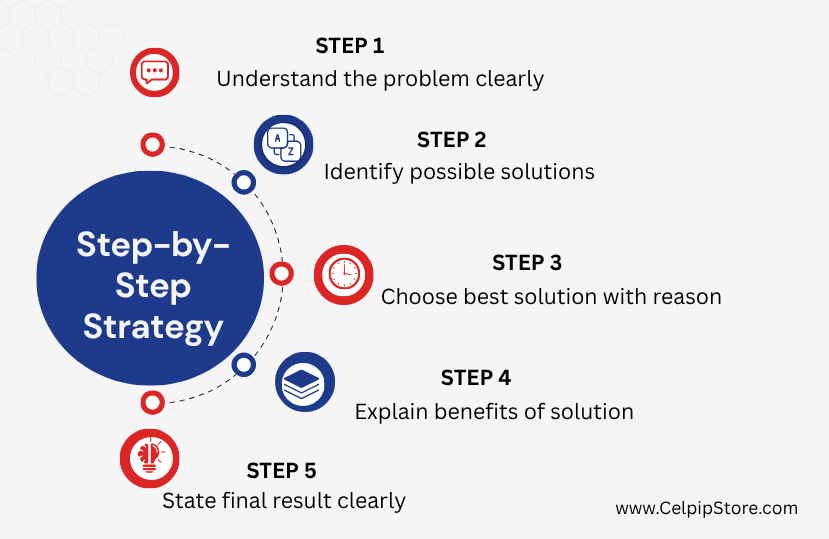
Step 1: Describe the Situation (S)
Start by clearly introducing the problem.
- “There is a problem with…”
- “The situation is…”
- “I noticed an issue with…”
Example:
“There is a problem with the cleanliness in the public park.”
Step 2: Explain the Problem (O)
Give more detail about what is wrong.
- What is happening?
- Why is it a problem?
Example:
“The park is not cleaned regularly, and there is garbage everywhere.”
Step 3: Give Solutions (L)
Suggest one or two practical solutions.
- Simple ideas
- Realistic actions
- Avoid overcomplicating
Example:
“The city should increase cleaning staff and place more trash bins.”
Step 4: Explain Why It Works (V)
Support your solution.
Example:
“This will help keep the park clean and improve the environment for visitors.”
Step 5: End Clearly (E)
Finish with a short conclusion.
Example:
“This way, the park will become cleaner and more enjoyable.”
FULL SAMPLE ANSWER
Question: There is a problem with noise in your neighborhood. What can be done?
“There is a problem with noise in my neighborhood. Many people play loud music late at night, which disturbs others. The local authorities should create strict noise rules and increase monitoring in the area. This will help reduce noise and make the neighborhood more peaceful. That is why I believe this solution will work well.”
HIGH-SCORE STRATEGY TIPS
- Focus on ONE clear problem
- Give simple and realistic solutions
- Always explain “why” your solution works
- Keep speaking smooth and natural
- Avoid listing too many ideas
To perform well in Task 6, you need a clear structure for identifying problems and presenting solutions, but this structure is part of a larger speaking framework used across all CELPIP tasks. This complete framework is explained in CELPIP Speaking Mastery Complete Strategy Guide.
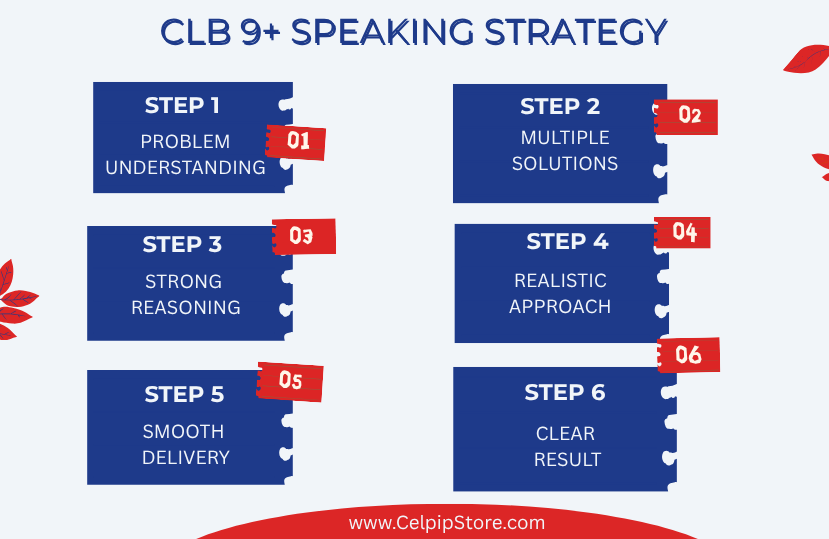
Advanced Tips for Task 6 (High Score Strategy)
To score CLB 9–12 in Task 6, you must show clear thinking under pressure, not complex English.
1. Focus on ONE main problem
Do not try to fix everything at once.
- One problem = one clear solution path
- Too many issues = confusion + lower score
Keep it simple and focused.
2. Think in “Problem -> Fix -> Result”
Instead of random speaking, use a natural chain:
- Problem
- Solution
- Outcome
This creates strong logical flow automatically.
3. Use practical solutions only
Examiners prefer realistic ideas.
Good:
- Hire more staff
- Add rules
- Improve communication
Avoid:
- Unrealistic or extreme solutions
4. Don’t overload vocabulary
Simple English with clarity is enough.
- Clear > Complex
- Natural > Forced
5. Speak continuously
Even if you make small grammar mistakes, keep going.
- Fluency is more important than perfection
- Avoid long silent pauses
Examiner Insights (What They Really Score)
Examiners evaluate:
- Problem clarity
Can you clearly explain the issue?
- Logical solution
Do your ideas make sense?
- Fluency
Are you speaking smoothly?
- Structure
Is your answer organized or random?
Key Insight:
A simple structured answer with clear logic scores higher than a complex but confusing response.
Vocabulary Upgrade (Task 6 Speaking)
Use natural, high-score words:
- problem -> issue / concern / challenge
- fix -> solve / improve / address
- good -> effective / helpful / beneficial
- bad -> serious / negative / harmful
- important -> essential / necessary
PRACTICE TASKS
Practice 1:
There is too much traffic in your city. What can be done?
Practice 2:
Students are not attending classes regularly. Suggest solutions.
Practice 3:
The park in your area is not clean. What should be done?
Practice Rule:
- Speak for 60–90 seconds
- Use S.O.L.V.E structure
- Focus on clarity, not speed
Practicing problem-solving responses is important, but you must also practice all speaking tasks together to develop fluency, timing, and confidence under exam conditions. Follow the full system in CELPIP Speaking Mastery Complete Preparation Strategy.
TIMED CHALLENGE
Speak continuously:
“There is a problem with public transportation in your city. What will you do?”
Focus on:
- Clear problem statement
- One or two solutions
- Simple explanation
- Smooth flow
Summary
CELPIP Speaking Task 6 tests your ability to identify problems and provide logical, practical solutions under time pressure. Success in this task depends on clarity, structure, and simple reasoning, not advanced vocabulary or complex grammar.
When you use the S.O.L.V.E method, your response becomes organized, natural, and easy to follow:
Situation -> Observe -> List solutions -> Verify -> End
Final Checklist (Before Speaking Task 6)
Before answering, make sure you can:
- Clearly state the problem in one sentence
- Explain what is wrong briefly
- Give 1–2 practical solutions
- Explain why your solution works
- Maintain smooth fluency without long pauses
- End your response confidently
FAQs
1. Do I need many solutions in Task 6?
No. One or two strong, realistic solutions are enough.
2. What if I cannot think of ideas quickly?
Stay calm and use simple everyday solutions like rules, communication, or improvements.
3. Is grammar very important?
Grammar matters, but clarity and fluency matter more.
4. Can I repeat ideas?
Yes, but rephrase them naturally instead of repeating word-for-word.
7-DAY PRACTICE PLAN
Day 1–2
- Learn S.O.L.V.E structure
- Practice identifying problems quickly
Day 3–4
- Practice 3 Task 6 questions daily
- Focus on clear problem + solution flow
Day 5–6
- Record responses (60–90 seconds)
- Improve fluency and reduce pauses
Day 7
- Full speaking simulation (Tasks 1–6 integration practice)
CONCLUSION
Task 6 becomes simple when you stop overthinking and start thinking in a clear problem-solving flow.
Remember:
“One problem. One solution. One clear explanation.”
This mindset will help you achieve CLB 9–12 speaking performance with confidence. Mastering Task 6 is an important step, but your final score depends on how well you handle the entire speaking section as a complete system. Start with CELPIP Speaking Mastery Complete Guide for High Scores.
INTEGRATION GUIDE (VERY IMPORTANT)
Now your CELPIP Speaking system includes:
- Task 1 -> Advice clarity
- Task 2 -> Storytelling flow
- Task 3 -> Description clarity
- Task 4 -> Opinion reasoning
- Task 5 -> Fluency integration
- Task 6 -> Problem-solving logic
Together, these create a complete CELPIP Speaking mastery system