CELPIP Writing Mastery (2026): Complete Strategy for Task 1 Email & Task 2 Essay High Band Scores
CELPIP Writing is not a test of “advanced English.” It is a test of clear, structured communication under time pressure. Many students lose marks not because their English is weak, but because their writing is unclear, unorganized, or incomplete.
To score CLB 9 or higher, you must focus on four key areas:
- Clear structure
- Task completion
- Appropriate tone
- Simple but accurate language
Even strong vocabulary cannot fix weak organization. In CELPIP Writing, clarity always wins over complexity. The CELPIP Writing test includes different task types, and one of the most important is writing professional emails with clear structure and tone. This task forms the foundation of Writing Task 1 success. You can master this in CELPIP Writing Task 1 Email Guide (Step-by-Step CLB 9 Strategy).
The CELPIP Writing test includes multiple tasks, and one of the most important is essay writing where you must present clear arguments and structured ideas. This task plays a major role in your final score. You can master this in CELPIP Writing Task 2 Essay Guide (Step-by-Step CLB 9 Strategy).
Understanding writing strategies is important, but real improvement comes from applying them in actual practice tests with model answers. This helps you see how high-scoring responses are structured. You can practice this in CELPIP Writing Practice Test with Model Answers (CLB 9 Guide).
The CELPIP Writing test includes structured tasks, and using templates for Task 1 and Task 2 can significantly improve clarity and speed. Templates help you maintain consistency under exam pressure. You can master this in CELPIP Writing Templates for Task 1 & Task 2 (CLB 9 Guide).
The CELPIP Writing test requires strong time control because both Task 1 and Task 2 must be completed within strict time limits. Without proper time management, even good writers lose marks. You can master this in CELPIP Writing Time Management Strategy (CLB 9 Guide).
The CELPIP Writing test requires strong vocabulary usage to achieve a high band score. Without precise and natural expressions, even good ideas may lose marks. You can master this in CELPIP Writing Vocabulary: High Score Expressions (CLB 9 Guide).
Learning Objectives
By the end of this lesson, you will be able to:
- Understand how CELPIP Writing is evaluated
- Write a well-structured Task 1 email
- Build a clear 4-paragraph Task 2 essay
- Avoid the most common score-reducing mistakes
- Improve coherence, grammar, and idea development
- Manage time effectively in both tasks
Overview of CELPIP Writing Tasks
CELPIP Writing consists of two different tasks that test different skills.
Task 1: Email Writing
You are required to write an email based on a real-life situation. The tone may be formal or semi-formal depending on context.
Typical purposes include:
- Requesting information
- Making complaints
- Giving suggestions
- Asking for permission
The key is not creativity it is clear communication and relevance. Task 1 requires you to write clear, well-structured emails with correct tone, purpose, and organization. Many students lose marks due to unclear formatting and weak response structure. A complete method is explained in CELPIP Writing Task 1 Email Writing Step-by-Step Guide.
A strong writing strategy is not only about structure and grammar, but also about using high-level vocabulary appropriately in both Task 1 and Task 2.
This system is explained in CELPIP Writing High Score Vocabulary Strategy Guide.
Task 2: Essay Writing
In this task, you must write an opinion-based essay. You need to clearly present your viewpoint and support it with reasons and examples.
You are expected to:
- Take a clear position
- Support it with logical reasons
- Use examples for clarity
- Maintain a structured flow
Task 2 requires you to write a well-organized essay with clear opinions, supporting ideas, and logical structure. Many students struggle with idea development and coherence. A complete method is explained in CELPIP Writing Task 2 Essay Writing Step-by-Step Guide.
To achieve a high score in CELPIP Writing, it is not enough to have ideas you must express them clearly using strong and accurate sentences. Sentence quality directly impacts your score. You can master this in CELPIP Writing Sentence Improvement: Advanced Techniques for CLB 9+.
A strong writing strategy is not only about ideas and grammar, but also about managing time effectively so you can plan, write, and review your answers properly. This system is explained in CELPIP Writing Time Management Strategy for High Band Scores.
Key Difference Between Tasks
- Task 1 (Email): Practical communication in real-life situations
- Task 2 (Essay): Opinion + argument development
| Task | Focus | Style | Structure |
|---|---|---|---|
| Task 1 | Communication | Formal/Semi-formal | Flexible but clear |
| Task 2 | Argument | Formal | Fixed structure |
To score high in Task 2, you must follow a clear essay structure including introduction, body paragraphs, and conclusion. This ensures clarity and strong argument development. You can apply this system from CELPIP Writing Task 2 CLB 9 Essay Strategy Guide. Learning writing frameworks alone is not enough you must apply them in exam-style questions to build confidence and accuracy. Practice helps you convert theory into performance. You can do this using CELPIP Writing Practice Test Model Answers for CLB 9+.
Many students understand writing techniques but fail to score high because they use repetitive or basic vocabulary instead of natural, high-scoring expressions. You can improve this using CELPIP Writing Vocabulary Upgrade Guide for CLB 9+.
Common Mistakes That Reduce Scores
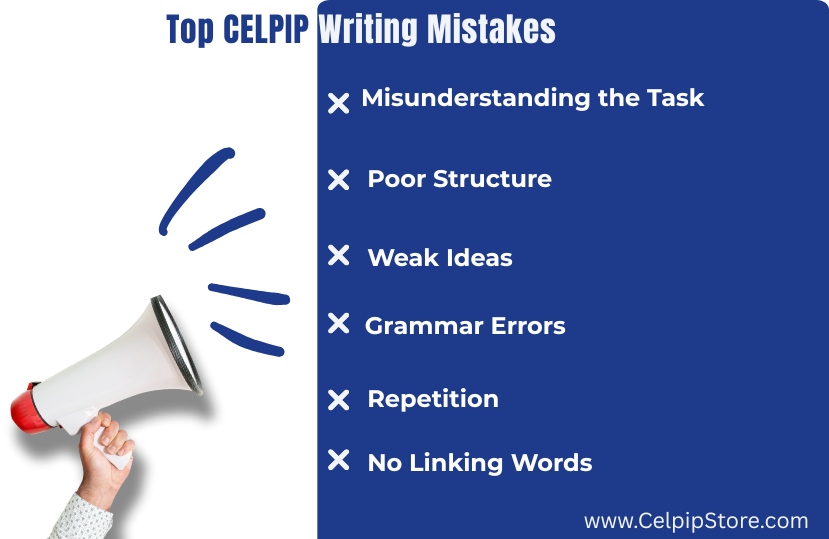
Most candidates lose marks due to predictable errors. The most common ones are:
1. Not fully answering the task
Many students miss one or more required points.
2. Poor structure
Ideas are written in random order without paragraph clarity.
3. Incorrect tone
For example:
- Too casual in emails
- Too informal in essays
4. Overcomplicated language
Students try to use difficult vocabulary and make grammar mistakes.
5. Weak idea development
They mention ideas but do not explain or support them.
6. Grammar mistakes under pressure
Even small errors can reduce your score significantly.
Many candidates lose marks in Task 2 because they write unclear arguments or fail to organize their ideas properly in essay format. This affects both coherence and task achievement. Avoid these mistakes with CELPIP Writing Task 2 Master Guide (Essay Writing Strategy).
Many students understand writing techniques but fail to improve because they don’t practice under real exam conditions. Structured practice with model answers solves this problem. You can follow this system in CELPIP Writing Practice Test & Answer Guide (CLB 9 Level).
Clarity and coherence in writing depend heavily on how well you construct your sentences and connect ideas logically. Weak sentence structure often leads to lower scores. You can improve this in CELPIP Writing Sentence Improvement High Score Guide.
Many candidates lose marks in writing because of simple sentence errors, repetition, and lack of variety. These issues reduce clarity and overall impression.
Avoid these mistakes with CELPIP Writing Sentence Improvement Master Guide.
Many candidates lose marks because they do not use structured templates, which leads to disorganized writing and weak task achievement in both writing tasks. Avoid this with CELPIP Writing Task 1 & Task 2 Template System Guide.
Many candidates lose marks because they mismanage time between Task 1 and Task 2, leading to incomplete responses or weak conclusions. Avoid this with CELPIP Writing Time Management Master Guide (CLB 9 Strategy).
Many candidates lose marks because they either overuse simple words or incorrectly use advanced vocabulary, which reduces clarity and coherence.
Avoid this with CELPIP Writing Vocabulary Master Guide (CLB 9 Strategy).
Teaching Principle (Most Important Rule)
CELPIP Writing follows one core principle:
Clear structure + clear purpose = high score
Examiners do NOT reward complexity. They reward:
- Clarity
- Task relevance
- Logical structure
- Accurate grammar
Framework 1: Task 1 Email Writing Structure
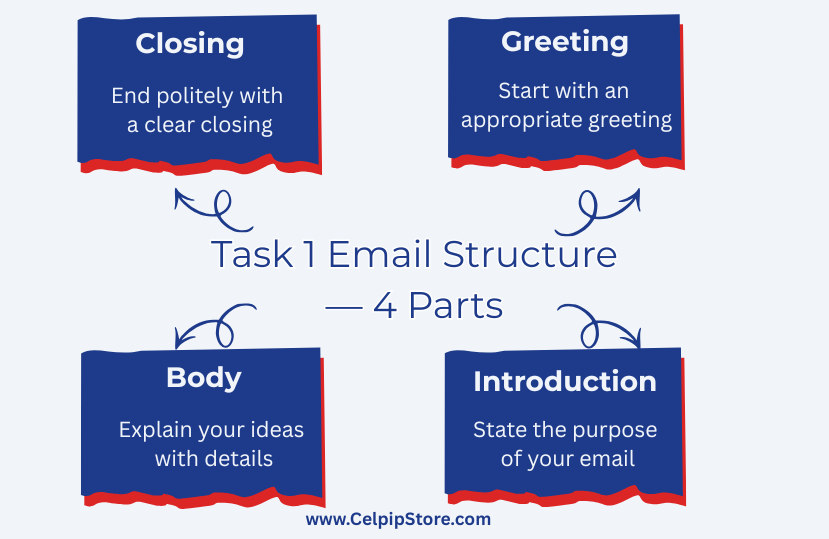
A high-scoring email should follow this simple 4-part structure:
1. Opening (Purpose Statement)
Start by clearly stating why you are writing.
Example phrases:
- “I am writing to request information regarding…”
- “I would like to express my concern about…”
2. Background (Context)
Briefly explain the situation. Keep it short and relevant.
- What happened?
- Why are you writing now?
3. Main Body (Request / Details)
This is the most important part of the email.
You should:
- Ask clear questions
- Make specific requests
- Explain problems
- Provide necessary details
4. Closing
End politely and professionally.
Examples:
- “I look forward to your response.”
- “Thank you for your assistance.”
Task 1 Strategy Rules
To score high, follow these principles:
- Keep one clear purpose
- Include 2–3 strong points only
- Use polite and natural tone
- Write simple, error-free sentences
Avoid:
- Too many ideas
- Unnecessary storytelling
- Informal language like “Hey” or “bro”
To score high in Task 1, you must follow a clear writing structure including introduction, purpose, details, and closing statements. This ensures clarity and coherence in your response. You can apply this system from CELPIP Writing Task 1 CLB 9 Email Strategy Guide.
A strong writing strategy includes not only structure and organization but also the ability to form clear, varied, and grammatically correct sentences. This improves overall readability. You can apply this using CELPIP Writing Advanced Sentence Improvement Techniques (CLB 9 Guide).
A strong writing strategy is not only about ideas and grammar it also includes using proven templates to organize responses quickly and effectively in both writing tasks. This system is explained in CELPIP Writing Task 1 & Task 2 Template Strategy Guide.
Framework 2: Task 2 Essay Structure
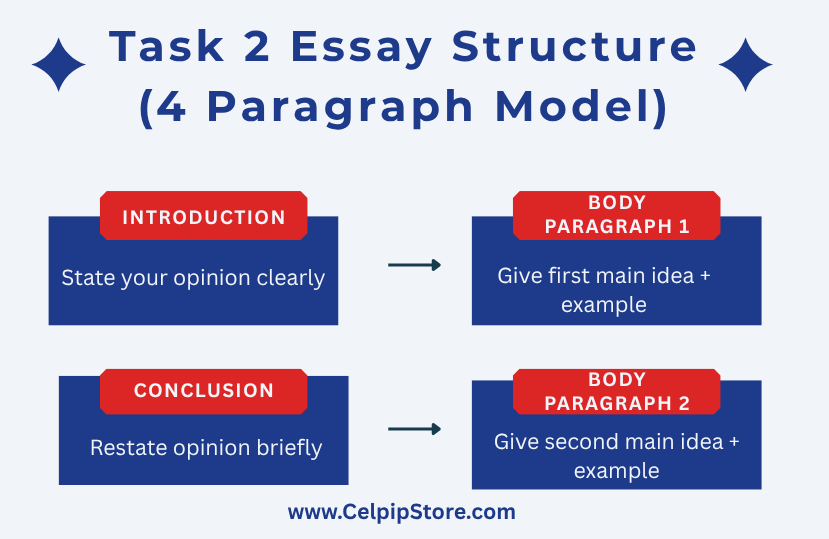
For Task 2, use a strict 4-paragraph structure:
Paragraph 1: Introduction
- Paraphrase the question
- Clearly state your opinion
Paragraph 2: First Reason
- Main idea
- Explanation
- Example
Paragraph 3: Second Reason
- Another strong supporting idea
- Explanation
- Example
Paragraph 4: Conclusion
- Restate your opinion
- Summarize main points
Task 2 Strategy Rules
High scoring essays follow these rules:
- Clear opinion from the beginning
- One idea per paragraph
- Strong and simple examples
- Logical flow between ideas
- Accurate grammar over complex vocabulary
Examiner Insight (Very Important)
CELPIP examiners are trained to reward:
- Clarity over complexity
- Structure over vocabulary
- Relevance over length
- Accuracy over variety
Even simple English can achieve CLB 9 if:
- The response is well structured
- The task is fully completed
- Grammar errors are minimal
- Ideas are clear and connected
Advanced Writing Tips for High Scores
Once you understand structure, the next step is control and precision. High-scoring candidates don’t write more — they write better and cleaner.
A key upgrade is learning how to control your ideas inside time limits. Many students run out of time in Task 2 because they spend too long thinking instead of writing.
To improve this, follow these advanced habits:
- Plan your answer in 2–3 minutes only
- Stick to one idea per paragraph
- Avoid rewriting sentences repeatedly
- Use simple sentence patterns with accuracy
A strong CELPIP response often looks “simple,” but it is actually very well controlled.
Time Management Strategy
Time pressure is one of the biggest challenges in CELPIP Writing.
A practical time plan:
Task 1 (Email — 27 minutes total)
- 3 minutes ? Understand prompt
- 20 minutes ? Writing
- 4 minutes ? Review
Task 2 (Essay — 31 minutes total)
- 4 minutes ? Plan ideas
- 22 minutes ? Writing
- 5 minutes ? Final correction
The goal is not speed the goal is controlled writing without panic. Time management becomes easier when you regularly practice writing tasks under exam conditions. This helps you build speed and accuracy together. You can train this using CELPIP Writing Timed Practice Test with Model Answers.
Examiner Insights (What Gets CLB 9+)
CELPIP examiners focus on communication effectiveness, not “perfect English.”
High band scripts usually have these features:
- Clear paragraph separation
- Direct answers to task requirements
- Natural tone (not memorized or robotic)
- Few grammar errors, not zero errors
- Logical flow of ideas
What surprises many students is this:
You do NOT need advanced vocabulary for CLB 9
You DO need clarity, structure, and consistency
High-Scoring Vocabulary (Safe & Useful)
Instead of complex words, use accurate and natural academic vocabulary.
For Email Writing (Task 1)
- request
- inquire
- concern
- assistance
- clarify
- appreciate
- inconvenience
- resolution
For Essay Writing (Task 2)
- advantage / disadvantage
- significant
- impact
- effective
- benefit
- consequence
- support
- encourage
Important rule:
Use words you can spell and use correctly not “big words.” Improving vocabulary alone is not enough you must also use it correctly within well-structured sentences. Proper grammar and sentence variety are essential for high band scores. You can learn this in CELPIP Writing Sentence Structure & Grammar Improvement Guide (CLB 9+).
Grammar Focus (What Actually Matters)
Grammar in CELPIP is not about perfection. It is about control of basic structures.
Focus on:
- Present tense accuracy
- Past tense clarity
- Simple compound sentences
- Correct subject-verb agreement
- Proper punctuation (especially commas and full stops)
Avoid:
- Long, confusing sentences
- Overuse of passive voice
- Complex structures you are not confident with
Practice Section
Task 1 Practice Prompt (Email)
You recently experienced a problem with a delivery service. Write an email to the company.
Include:
- Explain the problem
- Ask for a solution
- Request compensation or follow-up
Practice Focus:
- Clear complaint tone
- 2–3 focused points
- Polite but firm language
Task 2 Practice Prompt (Essay)
Some people believe students should learn practical skills in school instead of academic subjects. Do you agree or disagree?
Practice Focus:
- Clear opinion (agree/disagree)
- Two strong reasons
- Simple examples
- Logical structure
Consistent practice is the key to mastering CELPIP Writing, especially when you review high-quality sample answers and understand scoring expectations.
You can start this with CELPIP Writing Practice Test Full System (CLB 9 Model Answers).
Practice Writing Strategy
When practicing, do not focus on “perfect essays.” Focus on:
- Writing within time limits
- Improving structure clarity
- Reducing grammar mistakes
- Strengthening idea support
A good practice cycle is:
- Write
- Review
- Identify 2 mistakes
- Rewrite improved version
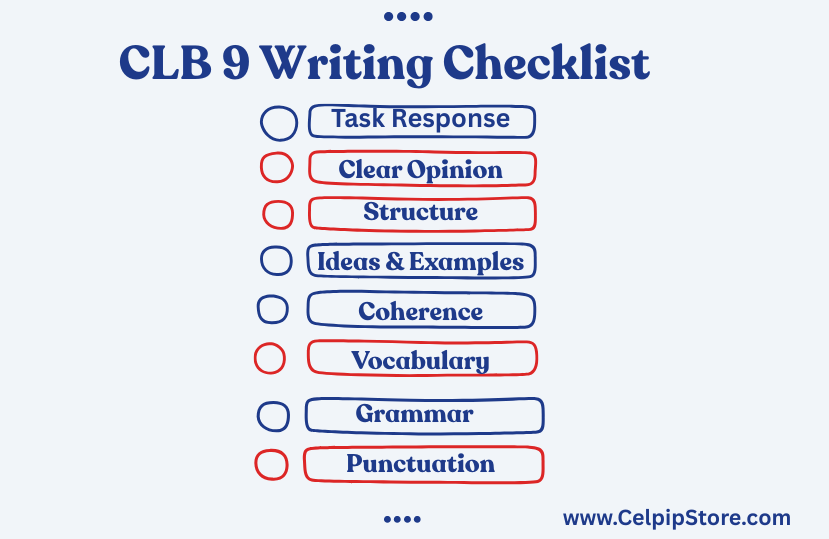
Mini Improvement Checklist
Before submitting any CELPIP Writing response, check:
- Did I answer ALL parts of the question?
- Is my structure clear (paragraphs)?
- Is my tone appropriate?
- Did I keep ideas simple and relevant?
- Are grammar mistakes minimal?
Summary of Key Learning
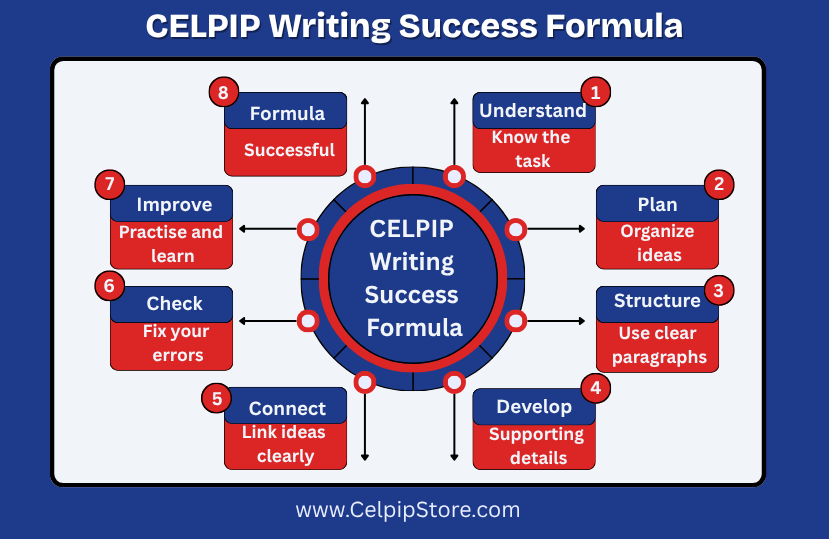
In this lesson, you learned that CELPIP Writing is not about complexity it is about clarity, structure, and task completion.
Both Task 1 and Task 2 follow the same success principle:
Clear structure + relevant ideas + simple accurate language = high score
We also learned that:
- Task 1 (Email) focuses on real-life communication
- Task 2 (Essay) focuses on opinion and argument development
- Structure is more important than vocabulary
- Grammar accuracy matters more than complexity
If you follow the framework properly, CLB 9 becomes achievable even with intermediate English.
Final Writing Checklist (Before Exam)
Use this checklist before submitting any writing task:
Task Completion
- Did I answer ALL parts of the question?
- Did I stay on topic throughout?
Structure
- Is my writing divided into clear paragraphs?
- Is each paragraph focused on ONE idea?
Language
- Are my sentences simple and correct?
- Did I avoid unnecessary complex vocabulary?
Using advanced vocabulary correctly helps improve clarity, tone, and overall writing quality, which directly impacts your CELPIP Writing score. You can learn this in CELPIP Writing High Band Vocabulary Expressions Guide.
Tone
- Is my email polite and appropriate?
- Is my essay formal and neutral?
Grammar & Accuracy
- Are subject-verb agreements correct?
- Are tenses consistent?
- Are punctuation marks used properly?
In Task 1, tone and clarity are extremely important because incorrect tone or unclear messaging can reduce your score significantly. Structured practice helps avoid this issue. You can improve this in CELPIP Writing Task 1 High Score Email Guide. Using templates improves your speed and reduces errors during the exam, especially when you need to organize ideas quickly under time pressure. You can learn this system in CELPIP Writing Template-Based Writing Strategy for High Scores.
Common Exam-Day Reminders
- Do not panic if ideas are simple
- Do not overthink vocabulary
- Do not write long sentences to “impress”
- Focus on clarity and control
- Always finish both tasks
Completion is more important than perfection.
Frequently Asked Questions (FAQs)
1. Can I get CLB 9 with simple English?
Yes. CELPIP rewards clarity, structure, and accuracy more than advanced vocabulary.
2. How long should my essay be?
Around 150–200 words is sufficient if well structured and complete.
3. Do I need complex vocabulary for high score?
No. You need correct and natural vocabulary, not difficult words.
4. What is the biggest mistake in CELPIP Writing?
Not fully answering the task or writing without structure.
5. How can I improve quickly?
Practice timed writing, then review and correct 2–3 key mistakes each time.
Practice Plan (7-Day Improvement System)
To improve writing quickly:
Day 1–2
- Learn Task 1 structure
- Write 2 emails
Day 3–4
- Learn Task 2 structure
- Write 2 essays
Day 5
- Timed practice (both tasks)
Day 6
- Review mistakes and rewrite answers
Day 7
- Full mock test simulation
Consistency matters more than volume.
Conclusion
CELPIP Writing is a skill that improves with structure training, not memorization.
If you consistently apply:
- Clear paragraph structure
- Controlled ideas
- Simple grammar
- Task-focused writing
You will see a strong improvement in your score.
Remember:
“Good writing is not complex writing. It is clear writing.” Mastering Task 1 is essential for building a strong foundation in CELPIP Writing, but overall success depends on performance in both writing tasks together.Start with CELPIP Writing Mastery Complete Strategy for High Band Scores.
Mastering Task 2 is essential for achieving a high writing score, but overall success depends on strong performance across both writing tasks.
Start with CELPIP Writing Task 2 Complete Essay Strategy Guide.
The writing mastery system becomes truly effective when combined with regular practice and performance analysis. This ensures steady improvement in your writing score. Start with CELPIP Writing Practice Test Model Answers Complete Guide.
The writing mastery system becomes more effective when combined with strong sentence control and clear expression of ideas. This ensures better performance in both tasks. Start with CELPIP Writing Sentence Improvement Complete Guide (CLB 9 Level). The writing mastery system becomes more effective when combined with structured templates that guide your writing in both tasks and improve consistency. Start with CELPIP Writing Templates Complete Guide for Task 1 & Task 2.
The writing mastery system becomes more effective when combined with strong time management skills that help you perform consistently in both tasks.
Start with CELPIP Writing Time Management Complete Guide for High Scores