CELPIP Reading Mastery: Complete Strategy to Achieve CLB 9–12
Introduction
CELPIP Reading is not a test of how fast you read English. It is a test of how accurately you process information under time pressure.
Most test-takers believe reading more English will automatically improve their score. This is not true. High scores (CLB 9–12) come from system-based reading skills, not general reading ability.
In the CELPIP Reading test, success depends on:
- Identifying keywords quickly
- Understanding meaning in context
- Eliminating distractors
- Managing time across multiple question types
If you rely only on “reading everything carefully,” you will run out of time and lose marks.
Learning Objectives
By the end of this CELPIP Reading Mastery lesson, you will be able to:
- Understand all CELPIP Reading question types clearly
- Apply skimming and scanning techniques correctly
- Identify keywords and paraphrased information
- Manage time efficiently across sections
- Avoid common traps and distractors
- Improve accuracy without reading every word
- Build a CLB 9–12 scoring strategy
Overview of CELPIP Reading
The CELPIP Reading section evaluates your ability to:
- Understand written information in real-life contexts
- Identify main ideas and supporting details
- Interpret meaning from emails, notices, and passages
- Compare and analyze information
- Select correct answers under time pressure
Key Challenge:
You do NOT have enough time to read everything slowly.
You must switch between:
- Fast reading (skimming)
- Targeted reading (scanning)
- Meaning interpretation
Common Mistakes (Why Most Students Lose Marks)
1. Reading Every Word Slowly
Students try to understand every sentence in detail.
This wastes time and causes incomplete sections.
2. Ignoring Keywords
Many answers are hidden in:
- synonyms
- paraphrased ideas
- keyword variations
Students miss them because they search for exact words only.
3. Not Understanding Question Types
Each question type requires a different approach:
- Matching questions ? detail questions
- Opinion questions ? fact questions
Treating all questions the same leads to confusion.
4. Falling for Distractors
CELPIP includes answer choices that:
- look similar
- use same vocabulary
- change meaning slightly
Students choose based on familiarity, not meaning.
5. Poor Time Management
Spending too long on one passage causes:
- unanswered questions
- guessing at the end
- score drop even with good English
6. Lack of Strategy (No System)
Most learners practice randomly without:
- structure
- technique
- progression system
This leads to slow improvement.
7. Over-Reliance on Vocabulary Alone
Knowing words is not enough.
You must understand:
- context
- tone
- intention
- logic flow
1. The CELPIP Reading Framework (CORE SYSTEM)
To score CLB 9–12, you must stop “reading” and start processing information strategically.
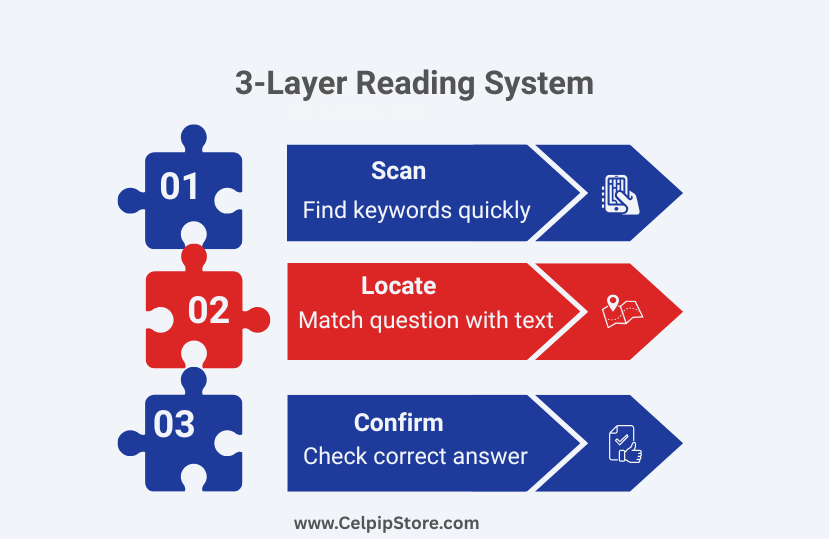
CELPIP Reading works on a 3-layer system:
Layer 1: Orientation (What is this text about?)
- Read title + first 2–3 lines quickly
- Identify topic (email, notice, article, conversation)
- Understand purpose (inform, request, explain, compare)
Goal: Build a mental map in 5–10 seconds
Layer 2: Navigation (Where is the answer?)
- Do NOT read line by line
- Scan for:
- names
- numbers
- dates
- keywords from questions
- synonyms
Goal: Locate information fast
Layer 3: Precision (What is the correct meaning?)
- Compare options carefully
- Match meaning, not words
- Eliminate distractors
Goal: Choose correct answer based on logic
2. Skimming System (FAST UNDERSTANDING)
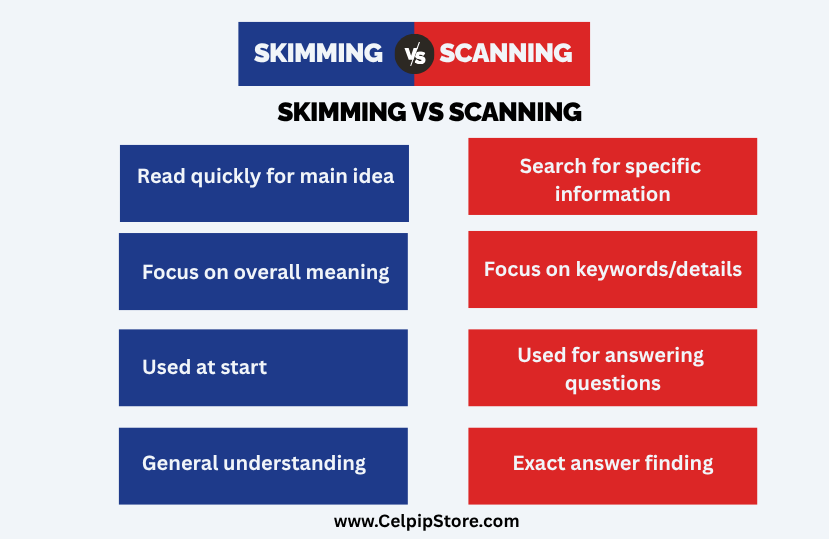
Skimming = understanding general idea quickly
How to skim in CELPIP:
- Read first sentence of each paragraph
- Focus on:
- topic shifts
- main idea words
- tone (formal/informal)
What skimming gives you:
- Overall meaning
- Passage direction
- Expected question type
Common mistake:
Students read everything in detail
Instead: read only for structure + meaning
3. Scanning System (ANSWER HUNTING TECHNIQUE)
Scanning = searching for exact information
How to scan:
- Look for keywords from questions
- Scan vertically, not line by line
- Focus on:
- numbers
- names
- locations
- verbs in question
Example:
If question says:
“What time does the meeting start?”
You scan for:
- “meeting”
- “start”
- time expressions (10 AM, morning, etc.)
Scanning Rule:
You DO NOT read the passage fully
You only search for signals
4. Question Type Breakdown System
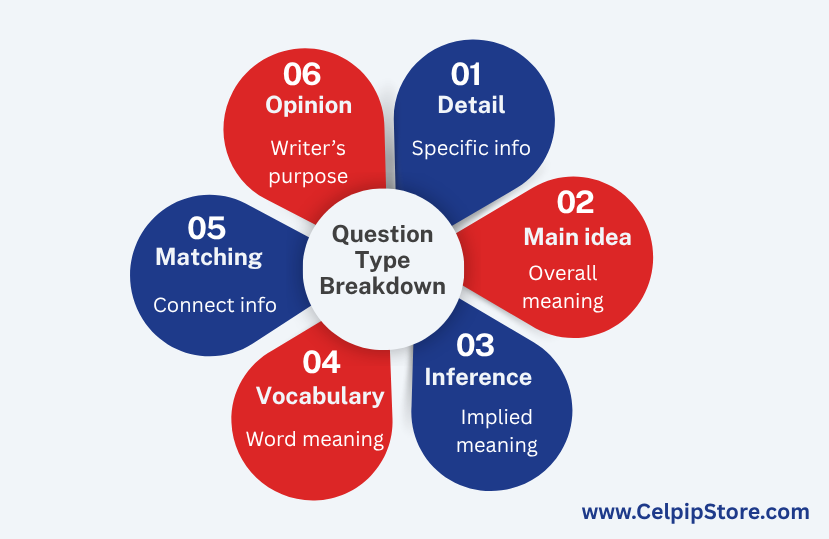
CELPIP Reading is NOT one skill it is multiple micro-skills.
Type 1: Information Questions
Find specific detail
Strategy:
- Scan for keyword
- Match exact meaning
Type 2: Inference Questions
Meaning is NOT directly written
Strategy:
- Read sentence before + after keyword
- Understand hidden meaning
Type 3: Matching Questions
Match statements to paragraphs
Strategy:
- Identify paragraph theme first
- Then match ideas, not words
Type 4: Opinion / Purpose Questions
Why something is written
Strategy:
- Look for intention words:
- suggest
- request
- complain
- inform
Type 5: Vocabulary-in-Context
Meaning of word in passage
Strategy:
- Ignore dictionary meaning
- Use sentence context only
5. High-Score Strategy System (CLB 9–12)
To reach high score, combine 3 actions:
Step 1: Read Question First
- Never read passage first blindly
- Identify what you are looking for
Step 2: Scan Immediately
- Find keyword location
- Do not read unrelated text
Step 3: Verify Meaning
- Check 2 options carefully
- Choose based on logic, not similarity
6. Time-Saving Strategy
CELPIP Reading is time pressure heavy.
Golden Rule:
- 20% reading -> 80% answering
Time Allocation Idea:
- Quick passage understanding: 30–40 seconds
- Each question: controlled scanning (not full reading)
- Move on if stuck > 45 seconds
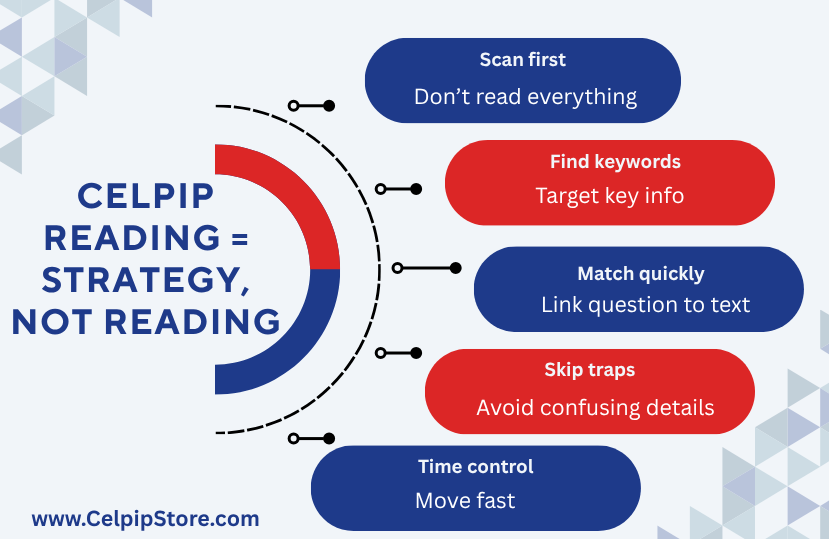
7. Core Mental Shift (MOST IMPORTANT)
Old thinking:
“I must understand every word”
New thinking:
“I must find answers efficiently”
1. Advanced Reading Techniques (CLB 9–12 Level)
At this stage, reading is no longer about finding answers it is about eliminating wrong thinking quickly.
Technique 1: Paraphrase Detection System
CELPIP rarely repeats exact words.
You must identify:
- same meaning
- different wording
Example:
- “reduce expenses”
= “cut costs”
= “lower spending”
If you don’t recognize paraphrasing, you will lose easy marks.
Technique 2: Logic Flow Tracking
Every passage has a hidden structure:
- Problem -> Solution
- Situation -> Response
- Question -> Answer
- Opinion -> Support
Track logic, not sentences.
Technique 3: Keyword Transformation Awareness
CELPIP uses:
- synonyms
- negative forms
- indirect meaning
Example:
- “not allowed” -> “prohibited / restricted”
- “very busy” -> “overwhelmed / fully booked”
2. Examiner Insight (How CELPIP Tests You)
CELPIP Reading is designed to test:
1. Decision Speed
Can you choose correctly under time pressure?
2. Misleading Similarity Handling
Can you avoid answers that LOOK correct?
3. Meaning Interpretation
Can you understand intent, not just words?
4. Information Filtering
Can you ignore irrelevant information?
Exam Trick Insight:
Wrong answers are often partially correct
They:
- repeat keywords
- sound logical
- but change meaning slightly
3. Vocabulary Strategy (HIGH SCORE SYSTEM)
You do NOT need advanced vocabulary.
You need context vocabulary intelligence.
Level 1: Core Academic Words
- increase / decrease
- benefit / disadvantage
- support / oppose
- require / need
Level 2: Paraphrase Words
- important -> essential / crucial
- problem -> issue / challenge
- improve -> enhance / boost
- show -> demonstrate / indicate
Level 3: Functional Words
- however -> contrast
- therefore -> result
- although -> contradiction
- because -> reason
Key Rule:
Vocabulary is not memorization
Vocabulary is recognition in context
4. Common Mistake Correction System
Mistake 1: Overthinking Questions
Students spend too long analyzing options.
Fix:
- eliminate 2 wrong answers first
- then choose between 2
Mistake 2: Word Matching Trap
Students pick answers because words look same.
Fix:
- always check MEANING
- not keyword matching
Mistake 3: Ignoring Context
Students read sentence only.
Fix:
- read surrounding sentence for meaning
Mistake 4: Skipping Difficult Questions
Students leave questions too early or too late.
Fix:
- 45-second rule
- move on strategically
5. Practice System (CELPIP TRAINING MODEL)
To improve fast, follow this structure:
Phase 1: Skill Isolation
- Skimming practice only
- Scanning practice only
- Vocabulary in context practice
Phase 2: Mixed Questions
- Combine question types
- Focus on accuracy
Phase 3: Timed Practice
- Full section under time pressure
- No pauses
Phase 4: Error Analysis
After every test:
- Why was answer wrong?
- Keyword missed?
- Misinterpretation?
- Distractor trap?
6. Improvement Loop (MOST IMPORTANT)
Every mistake must follow this loop:
- Identify error type
- Understand why it happened
- Fix strategy (not just answer)
- Repeat similar question
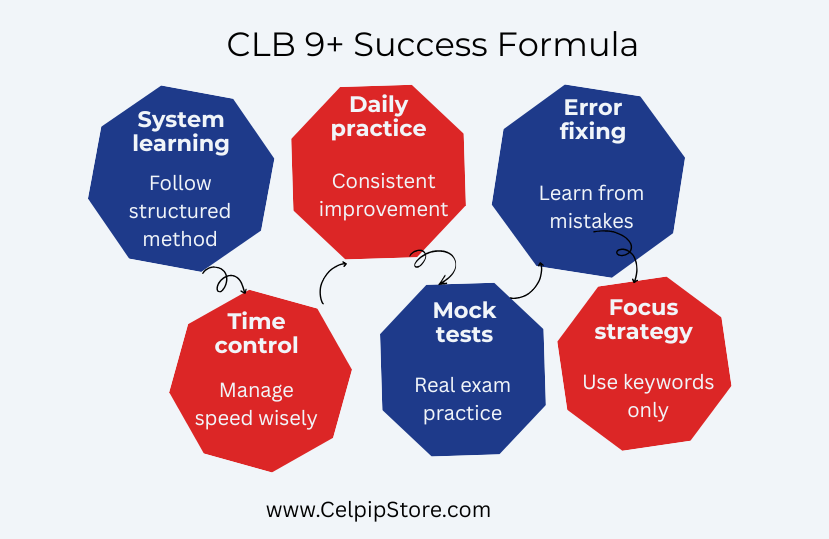
1. Summary of CELPIP Reading Mastery System
CELPIP Reading is not about reading more English.
It is about processing information strategically under time pressure.
To achieve CLB 9–12, you must master:
- Skimming -> Understand structure quickly
- Scanning -> Find answers efficiently
- Paraphrase recognition -> Identify meaning changes
- Question-type awareness -> Apply correct strategy
- Time control -> Avoid over-reading and panic
High scores come from system + speed + accuracy balance
2. Final Checklist (Before Exam Day)
Reading Strategy Checklist
- I read questions before passage
- I use skimming for general idea
- I use scanning for keyword search
- I identify paraphrased meaning
- I avoid word-matching traps
- I eliminate wrong options first
- I manage time strictly per question
Mindset Checklist
- I do NOT read every word
- I focus on meaning, not vocabulary
- I trust logic over familiarity
- I move on if stuck too long
3. Common Exam Day Errors to Avoid
- Spending too long on one question
- Overthinking easy questions
- Trying to understand every sentence
- Ignoring time pressure
- Choosing answers based on keywords only
4. Frequently Asked Questions (FAQs)
Q1: Can I get CLB 9 in CELPIP Reading without advanced vocabulary?
Yes. You need context understanding and paraphrase recognition, not advanced vocabulary.
Q2: What is the biggest reason students lose marks?
They read everything instead of scanning for answers.
Q3: Should I read the passage first or questions first?
Always questions first. This gives direction and saves time.
Q4: How can I improve speed in Reading?
Practice scanning and avoid full reading. Focus on keywords and meaning.
Q5: Are mock tests enough for improvement?
No. Mock tests + error analysis system is required.
5. Practice Plan (7-Day Reading Improvement System)
Day 1–2: Skimming & Structure
- Identify main idea quickly
- Practice paragraph meaning
Day 3–4: Scanning Practice
- Keyword hunting drills
- Time-based exercises
Day 5: Question Type Training
- Practice each question type separately
Day 6: Timed Mock Test
- Full Reading section simulation
Day 7: Error Analysis Day
- Review mistakes
- Identify patterns
- Fix weak areas
6. Conclusion
CELPIP Reading is a skill system, not a language test alone.
If you apply:
- Skimming system
- Scanning system
- Paraphrase recognition
- Time management discipline
You can achieve CLB 9–12 consistently