
CELPIP Reading Time Management Strategy: Master Speed and Accuracy for CLB 9–12
Introduction
One of the biggest reasons students lose marks in CELPIP Reading is not difficulty it is poor time management.
Many test-takers understand the passages but fail to complete all questions. This leads to random guessing at the end, even when they know the correct strategies.
CELPIP Reading is designed with time pressure built into the test structure. You are not only tested on accuracy, but also on how well you manage reading speed, question order, and decision-making under time limits.
In simple terms:
If you run out of time, even good English will not save your score.
Learning Objectives
By the end of this lesson, you will be able to:
- Manage time effectively in CELPIP Reading
- Balance speed and accuracy under pressure
- Allocate time per question type
- Avoid getting stuck on difficult questions
- Complete the reading section within time limits
- Improve decision-making speed during the exam
Overview of Time Management System
CELPIP Reading is not just about understanding text it is about controlling your time across multiple tasks.
The test requires you to:
- read passages
- understand questions
- scan for answers
- select correct options
All within a strict time limit.
The key is not reading faster it is using time strategically.
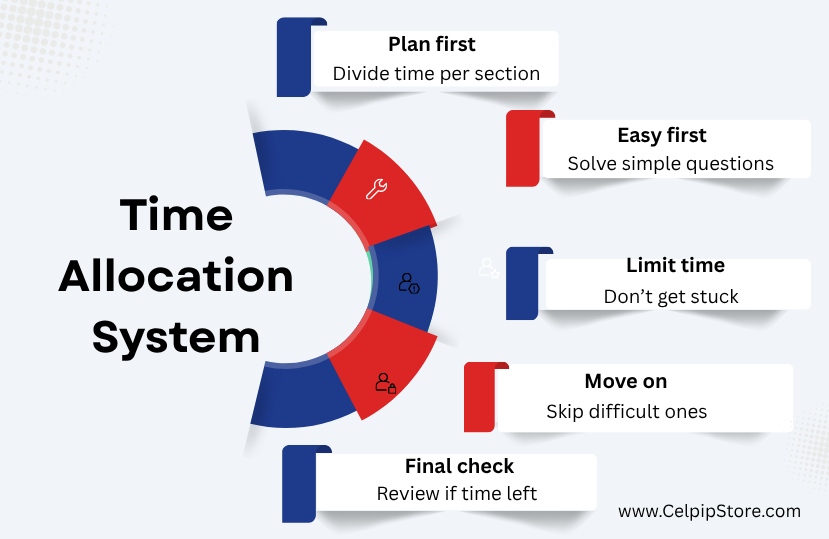
Core Idea of Time Management System
You must always balance:
- Speed (fast processing)
- Accuracy (correct answers)
- Control (not wasting time on one question)
Common Mistakes
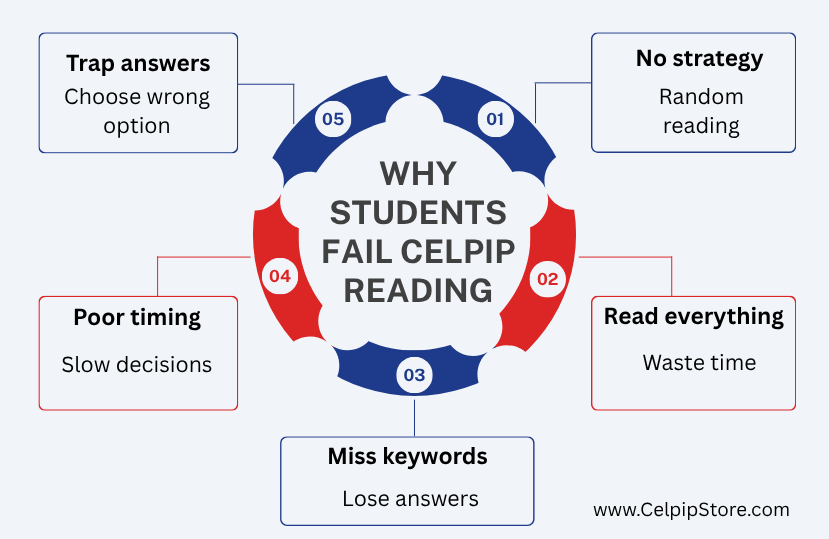
Most students fail due to predictable timing errors.
Mistake 1: Spending Too Much Time on One Question
Students get stuck trying to perfect one answer.
Fix: Move on if a question takes too long.
Mistake 2: Reading Everything Slowly
Students try to fully understand every sentence.
Fix: Use skimming and scanning instead of full reading.
Mistake 3: No Time Awareness
Students do not track how much time is left.
Fix: Check progress regularly during the test.
Mistake 4: Panic at the End
When time runs low, students guess randomly.
Fix: Maintain steady pacing from the beginning.
Mistake 5: Ignoring Question Difficulty
Students spend equal time on easy and hard questions.
Fix: Solve easy questions quickly and save time for harder ones.
1. Time Allocation Framework (Core Exam Control System)
CELPIP Reading is not just a test of understanding it is a test of how well you distribute time across tasks.
You cannot treat every question equally. Instead, you must use a controlled time system.
Basic Time Rule (Golden Rule)
You should NEVER spend unlimited time on any single question.
Instead, follow this structure:
- Easy questions -> solve fast (build speed bank)
- Medium questions -> controlled time
- Hard questions -> limited attempt + move on
Recommended Timing Strategy (CLB 9+ Approach)
- Skimming passage: 30–40 seconds
- Easy questions: 30–45 seconds each
- Medium questions: 60 seconds max
- Difficult questions: 45–60 seconds -> then move on
If you exceed time limit, you are losing marks elsewhere.
2. Question Prioritization System (SMART ORDER METHOD)
Not all questions are equal. High scorers NEVER solve in random order.
They use priority-based solving.
Priority Level 1: Direct Information Questions
- easiest to locate
- based on scanning
- high accuracy potential
Solve these FIRST to build confidence and save time.
Priority Level 2: Vocabulary / Context Questions
- medium difficulty
- requires sentence understanding
- quick if context is clear
Priority Level 3: Matching Questions
- moderate time consumption
- requires comparison
- should not be rushed
Priority Level 4: Inference Questions
- highest difficulty
- takes more thinking time
- should be attempted after easy marks are secured
3. Real Exam Timing Strategy (FULL FLOW SYSTEM)
This is how CLB 9–12 candidates actually manage the test:
Step 1: Quick Passage Overview (30–40 seconds)
- skim passage
- identify topic
- understand structure
No deep reading here.
Step 2: Scan for First Answer
- immediately locate easiest question
- build momentum
Step 3: Solve in Priority Order
- easy -> medium -> hard
- do NOT follow question order blindly
Step 4: Strict Time Control
- if stuck for more than 60 seconds -> move on
- return later only if time remains
Step 5: Final Review (if time allows)
- check unanswered questions
- eliminate obvious wrong options
- make logical guesses (not random)
4. Key Strategy Insight (CLB 9 Mindset Shift)
Weak students think:
“I must solve every question perfectly.”
Strong students think:
“I must maximize total score within time limit.”
5. Golden Rule of CELPIP Reading Time Management
You are NOT trying to get every question right
You are trying to get the maximum number of correct answers within time.
1. Advanced Timing Techniques (CLB 9–12 Level Control)
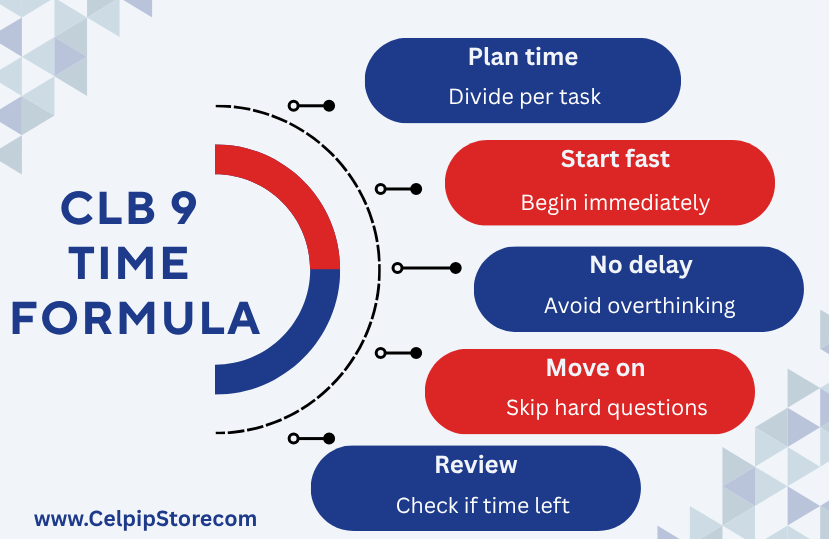
At a higher level, time management is not just about “being fast.” It is about controlling your decision speed under pressure.
Strong candidates don’t rush they allocate attention strategically.
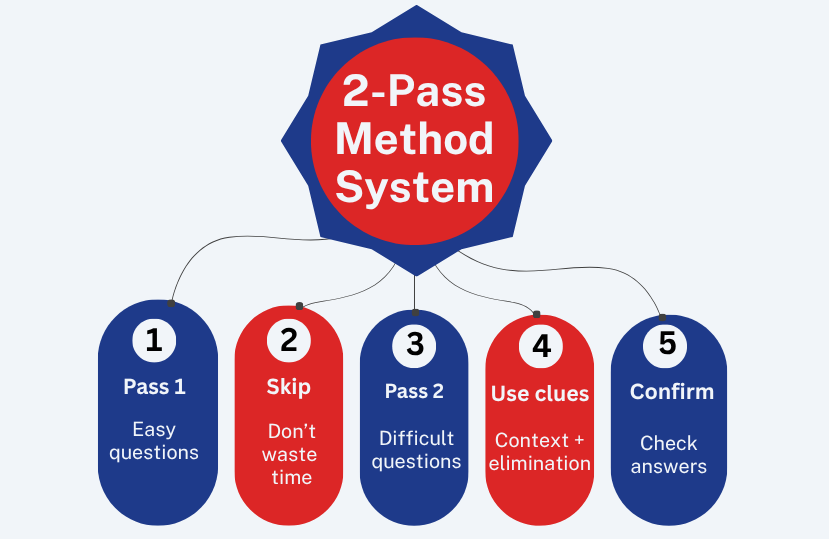
Technique 1: 2-Pass Method (High Score System)
Instead of solving in one go, you use two passes:
Pass 1 (Fast Wins):
- Solve easy information questions first
- Use scanning only
- Build confidence + save time
Pass 2 (Deep Thinking):
- Return to inference + difficult questions
- Use full reasoning
This prevents time loss on hard questions early.
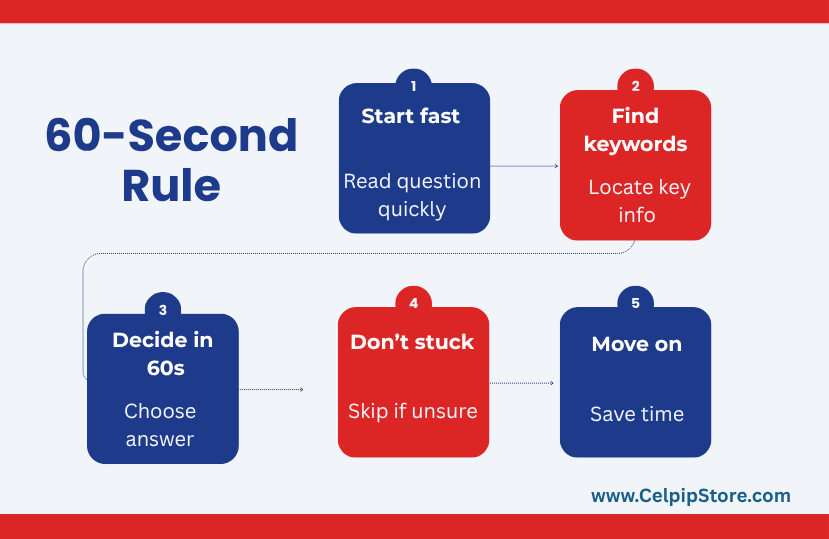
Technique 2: 60-Second Rule
If you cannot solve a question within 60 seconds, you must:
- mark it
- move forward
- return later (if time allows)
This is how high scorers avoid time traps.
Technique 3: Time Banking Strategy
When you solve easy questions quickly, you “save time” for hard ones later.
- Easy question solved in 30 seconds = +30 sec saved
- Hard question can use that saved time later
This creates a “time buffer system.”
2. Examiner Insights (How CELPIP Controls Time Pressure)
CELPIP Reading is designed to test more than comprehension. It tests decision discipline under time limits.
Examiners intentionally:
- mix easy and hard questions
- hide simple answers in long passages
- place traps that waste time
- use similar-looking options to slow you down
Key Insight
The test is not about who is smartest
It is about who manages time most efficiently
3. Common Time Errors (Why Students Lose Marks Even With Good English)
Error 1: Overthinking Easy Questions
Students spend too much time on simple fact questions.
Fix: Solve easy questions in under 45 seconds.
Error 2: Getting Stuck on One Hard Question
Students refuse to move on until they solve it.
Fix: Apply 60-second rule strictly.
Error 3: Ignoring Question Order Strategy
Students follow questions in sequence instead of priority.
Fix: Always start with easiest questions first.
Error 4: No Time Awareness
Students do not track remaining time.
Fix: Check progress at regular intervals.
Error 5: Panic at End
Students rush randomly when time is almost over.
Fix: Maintain steady pacing throughout exam.
4. Improvement System (How to Build Time Control Skill)
Phase 1: Speed Awareness Training
- Practice solving questions with strict timers
- Focus on finishing within limits
- Track average time per question
Phase 2: Priority Practice
- Practice easy -> medium -> hard order
- Train brain to identify question difficulty quickly
Phase 3: Full Timed Simulation
- Complete full reading sections under real exam conditions
- No pausing or re-reading allowed
Phase 4: Error + Timing Analysis
After each test, analyze:
- Where did I waste time?
- Which question took too long?
- Did I follow priority system correctly?
- Did I panic at any point?
1. Summary
CELPIP Reading time management is not about reading faster it is about controlling your decisions under pressure.
To succeed, you must balance:
- speed (how fast you process questions)
- accuracy (how correct your answers are)
- control (how you handle difficult questions)
High scorers don’t try to solve everything perfectly. They focus on maximizing total score within limited time.
2. Final Checklist
Before and during the exam, make sure you:
- Solve easy questions first
- Use skimming for quick understanding
- Use scanning for fast answer location
- Apply 60-second rule for difficult questions
- Do not get stuck on one question
- Track time regularly
- Leave time for final review
3. FAQs
Q1: What if I cannot finish CELPIP Reading on time?
You are spending too much time on difficult questions. Use prioritization and move faster on easy ones.
Q2: Should I follow question order in CELPIP Reading?
No. Always solve easy questions first, not in sequence.
Q3: How much time should I spend per question?
Ideally:
- Easy: 30–45 seconds
- Medium: up to 60 seconds
- Hard: 60 seconds max
Q4: What is the biggest time mistake?
Getting stuck on one difficult question for too long.
4. Practice Plan (7-Day Time Control System)
Day 1–2: Speed Awareness
- Practice reading questions with timer
- Track time per question
Day 3–4: Priority Training
- Solve easy questions first
- Train fast decision-making
Day 5–6: Full Timed Tests
- Complete full reading sections
- Strict time limits only
Day 7: Error Analysis
- Identify where time was wasted
- Check if priority system was followed
- Fix weak timing patterns
5. Conclusion
Time management is the hidden scoring system of CELPIP Reading.
Even strong English learners lose marks because they fail to control time.
When you master:
- prioritization
- controlled speed
- question skipping strategy
You automatically move into CLB 9–12 performance level.