CELPIP Skimming and Scanning Strategy: Master Speed Reading for CLB 9–12
Introduction
Most CELPIP Reading candidates struggle not because they cannot understand English, but because they read at the wrong speed for the wrong purpose.
They try to read every word carefully, which creates two problems:
- They run out of time
- They lose focus on key information
CELPIP Reading is designed to test how quickly you can extract meaning, not how slowly you can understand everything.
This is where Skimming and Scanning become essential.
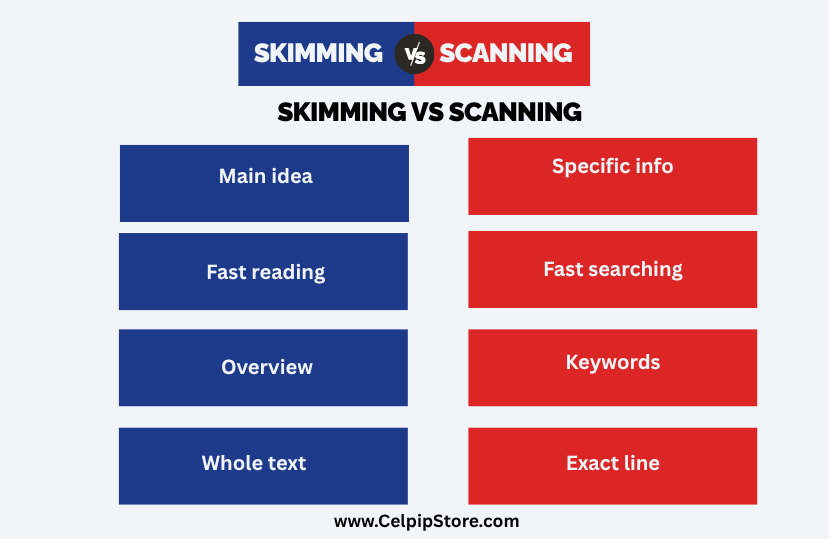
Skimming helps you understand the big picture
Scanning helps you find exact answers
Together, they form the foundation of a high score (CLB 9–12) reading strategy.
Learning Objectives
By the end of this lesson, you will be able to:
- Understand the difference between skimming and scanning
- Use skimming to identify main ideas quickly
- Use scanning to locate keywords and answers fast
- Improve reading speed without losing accuracy
- Apply both techniques in real CELPIP exam conditions
Overview of Skimming & Scanning System
CELPIP Reading does not require full detailed reading.
Instead, it requires a two-speed system:
Skimming (Fast Understanding Mode)
Used to understand:
- Topic of passage
- Main idea of each paragraph
- Overall direction of text
You are NOT reading everything only key lines.
Scanning (Target Finding Mode)
Used to:
- Find specific answers
- Locate keywords
- Identify numbers, names, dates
You ignore meaning until you find the relevant part.
High scorers constantly switch between these two modes.
Common Mistakes
Most students lose marks because they misuse reading speed.
Mistake 1: Reading Everything Slowly
Students believe careful reading means better accuracy.
In reality, it causes time loss and confusion.
Mistake 2: Not Switching Between Skimming and Scanning
They either:
- read too deeply (no time left), or
- scan too blindly (miss meaning)
Mistake 3: Searching Without Direction
Students scan without knowing what they are looking for.
Mistake 4: Ignoring Main Idea First
Without skimming, scanning becomes random and inefficient.
Mistake 5: Panic Reading Under Time Pressure
When time runs out, students start reading everything quickly, which reduces accuracy further.
1. Core Teaching Framework (Speed Reading System)
CELPIP Reading speed is not about reading faster it is about choosing the correct reading mode at the correct time.
Every question follows a 3-step system:
Step 1: Identify Purpose
Before reading, decide:
- Do I need main idea? -> Skimming
- Do I need exact information? -> Scanning
- Do I need meaning? -> Combination
This step controls your reading speed automatically.
Step 2: Apply Reading Mode
You do NOT read everything the same way. You switch mode based on task:
- Skimming for overview
- Scanning for answers
- Target reading for confirmation
Step 3: Confirm Answer
After locating information:
- Check meaning
- Match with options
- Eliminate distractors
2. Skimming System (MAIN IDEA EXTRACTION)
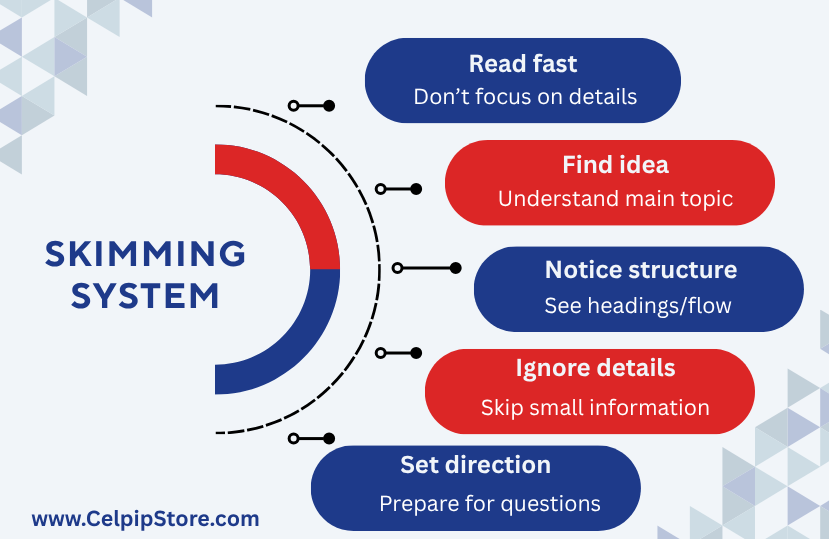
Skimming is used when you need to understand what the passage is about quickly.
How to Skim Correctly
Instead of reading line by line, you:
- Read first sentence of each paragraph
- Look for topic words
- Identify tone (positive / negative / neutral)
- Skip examples and details
What Skimming Gives You
Skimming helps you understand:
- Overall topic
- Writer’s intention
- Structure of passage
- Where answers might be located
Common Skimming Mistake
Students try to understand every sentence
Correct method: only extract main idea, not details
3. Scanning System (ANSWER LOCATION STRATEGY)
Scanning is used when you already know what you are searching for.
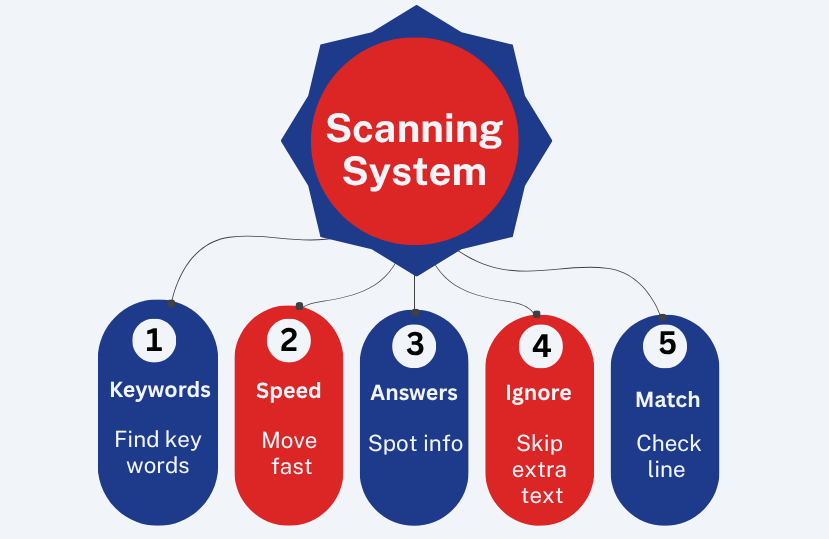
How to Scan Effectively
- Take keyword from question
- Move eyes quickly across text
- Look for:
- names
- numbers
- dates
- synonyms
Important Rule
You do NOT read while scanning
You only SEARCH.
Example Scanning Use
If question says:
“When did the event happen?”
You scan for:
- dates
- time expressions
- words like “on”, “in”, “at”
4. Real Exam Application (How Both Work Together)
In real CELPIP Reading, you NEVER use only one technique.
You combine both:
Step-by-Step Real Exam Flow
Step 1: Skim passage (10–20 seconds)
- Understand topic
- Identify paragraph meaning
Step 2: Read question
- Identify keyword
- Understand what is needed
Step 3: Scan passage
- Find keyword or synonym
- Locate exact line
Step 4: Confirm meaning
- Check surrounding sentence
- Compare options
5. High-Score Pattern (CLB 9–12 Students)
Strong students always:
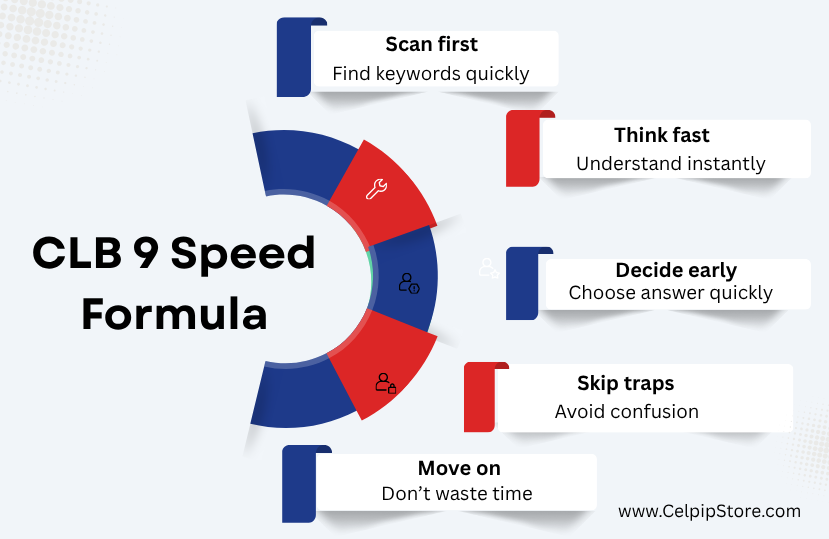
- Skim first (fast understanding)
- Scan second (fast locating)
- Decide third (logical answer)
Weak students:
- Read everything
- Get confused
- Run out of time
1. Advanced Speed Techniques (CLB 9–12 Level Control System)
At higher levels, skimming and scanning are not separate skills they become a single fast decision system.
You are not just reading faster; you are controlling attention.
Technique 1: Keyword Anticipation System
Before you scan, you predict what type of word will appear.
For example:
- “When” -> date / time
- “Where” -> place / location
- “Who” -> person / organization
- “Why” -> reason / explanation
This reduces search time dramatically.
Technique 2: First-Line Compression
Instead of reading full paragraphs, you:
- read only first sentence
- identify topic instantly
- skip supporting details unless needed
80% of meaning comes from first lines in CELPIP passages.
Technique 3: Visual Scanning (Eye Movement Control)
Strong candidates do NOT read left-to-right slowly.
They:
- move eyes in jumps
- search for patterns
- ignore filler words
This is what creates “fast reading ability”.
2. Examiner Insights (What CELPIP Actually Tests)
CELPIP Reading is not testing reading speed alone. It tests:
- Can you find relevant information quickly?
- Can you ignore irrelevant text?
- Can you avoid distractors under time pressure?
Key Examiner Trick
CELPIP often places:
- similar words in wrong answers
- partial truth options
- paraphrased sentences
The goal is to test your decision accuracy, not memory.
3. Common Errors (Why Students Lose Time & Marks)
Error 1: Over-Skimming
Students read too fast and miss key meaning.
Fix:
- always confirm topic in first 1–2 lines
Error 2: Blind Scanning
Students scan without understanding what they are looking for.
Fix:
- always read question before scanning
Error 3: Mixing Skimming & Scanning
Students switch randomly between both methods.
Fix:
- skim first -> then scan -> then confirm
Error 4: Getting Stuck on One Line
Students stop when they see difficult words.
Fix:
- skip unknown words and continue searching
Error 5: Reading Everything Under Stress
Students panic and switch to full reading mode.
Fix:
- return to scanning system immediately
4. Improvement System (How to Build Speed Consistency)
Phase 1: Skimming Training
- Read passages in 30 seconds
- Only extract main idea
- Ignore details completely
Phase 2: Scanning Training
- Practice keyword hunting
- Focus on numbers, names, dates
- Time limit per question
Phase 3: Combined Practice
- Full CELPIP passages
- Switch between skimming + scanning
Phase 4: Error Correction Loop
After every test:
- Did I skim correctly?
- Did I scan correct keyword?
- Did I lose time anywhere?
- Did I overread any section?
1. Summary
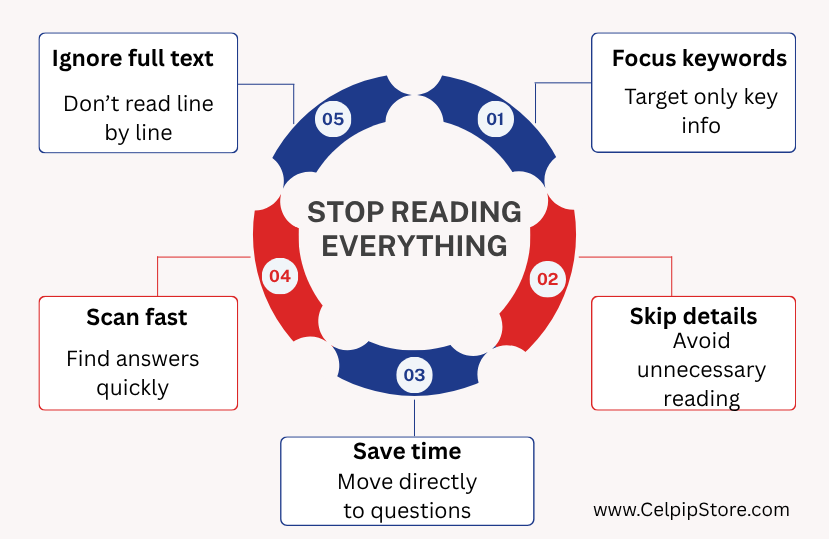
Skimming and scanning are the foundation of CELPIP Reading success. Skimming helps you quickly understand the main idea of a passage, while scanning helps you locate exact answers without reading everything.
When used correctly, these two techniques remove the need for slow reading and allow you to process information efficiently under time pressure.
CLB 9–12 success depends on switching between skimming and scanning at the right time.
2. Final Checklist
Before and during the exam, make sure you:
- Skim the passage to understand the main idea first
- Read the question before searching for answers
- Use scanning for keywords, names, numbers, and dates
- Avoid reading every word in detail
- Confirm answers by checking meaning, not just words
- Switch between skimming and scanning based on question type
3. FAQs
Q1: Should I always skim first in CELPIP Reading?
Yes. Skimming gives you direction before you start scanning for answers.
Q2: Can I get CLB 9 without reading everything carefully?
Yes. CLB 9 requires strategy, not full detailed reading.
Q3: What is the biggest mistake in reading speed?
Mixing skimming and scanning or using them at the wrong time.
Q4: How can I improve scanning speed?
Practice keyword identification and focus on numbers, names, and keywords under time limits.
4. Practice Plan (7-Day Speed Reading System)
Day 1–2: Skimming Practice
- Read passages in 30–40 seconds
- Identify only main ideas
Day 3–4: Scanning Practice
- Search for keywords only
- Focus on accuracy over speed
Day 5–6: Combined Practice
- Use both skimming and scanning together
- Simulate real CELPIP timing
Day 7: Full Test + Review
- Take a full reading test
- Analyze errors and timing issues
- Identify weak areas
5. Conclusion
Skimming and scanning are not optional techniques they are essential survival skills for CELPIP Reading.
When you use them correctly, you stop reading blindly and start reading strategically.
This is what separates average learners from CLB 9–12 achievers.