
CELPIP Speaking Task 4: Opinion Questions (Complete CLB 9 Strategy + High-Score Framework)
Introduction
CELPIP Speaking Task 4 (Opinion Questions) is one of the most important speaking tasks because it directly tests your ability to express, justify, and support an opinion under pressure.
Unlike earlier tasks where you describe or narrate, Task 4 requires you to think more critically. You must clearly take a position, support it with reasons, and communicate your ideas in a logical flow.
Many students struggle here not because they lack opinions, but because they cannot organize their thoughts quickly and clearly during speaking. This leads to hesitation, repetition, and weak arguments.
To achieve CLB 9, you do not need complex ideas. You need a clear opinion structure that works for any topic. Expressing opinions in Task 4 is an important part of the CELPIP Speaking test, but your final score depends on how well you perform across all speaking tasks together. A complete system ensures consistency and confidence. You can understand this full system in CELPIP Speaking Mastery: Complete Strategy for All Tasks.
Learning Objectives
By the end of this lesson, you will be able to:
- Understand how CELPIP Task 4 opinion questions work
- Take a clear position quickly (agree/disagree)
- Build logical speaking arguments
- Use structured support ideas (reasons + examples)
- Speak fluently without hesitation
- Handle abstract topics confidently
Overview: What Task 4 Really Tests
Task 4 gives you an opinion-based question where you must explain your viewpoint clearly.
Topics may include:
- Education policies
- Technology use
- Work-life balance
- Social behavior
- Daily life opinions
The key challenge is not English ability. It is quick thinking and argument organization. To perform well in Task 4, you need a clear structure for presenting opinions, but this structure is part of a larger speaking framework used across all CELPIP tasks. This complete framework is explained in CELPIP Speaking Mastery Complete Strategy Guide.
Most students fail because they:
- Cannot decide their opinion quickly
- Give unclear or mixed arguments
- Repeat ideas instead of developing them
- Speak without structure
A strong system solves all of these issues.
What CLB 9 Means in Task 4
CLB 9 in opinion speaking does NOT mean:
- Advanced academic arguments
- Complex vocabulary
- Deep philosophical reasoning
CLB 9 actually means:
- Clear opinion stated early
- Logical supporting reasons
- Simple but strong examples
- Smooth and organized speaking
- Confidence and consistency
Examiners want clarity, not complexity. Achieving CLB 9+ in Task 4 requires strong reasoning, fluency, and consistent performance across all speaking tasks, not just opinion-based responses. You can build these skills using CELPIP Speaking Mastery for High Band Scores.
Common Mistakes Students Make in Task 4 (Opinion Questions)
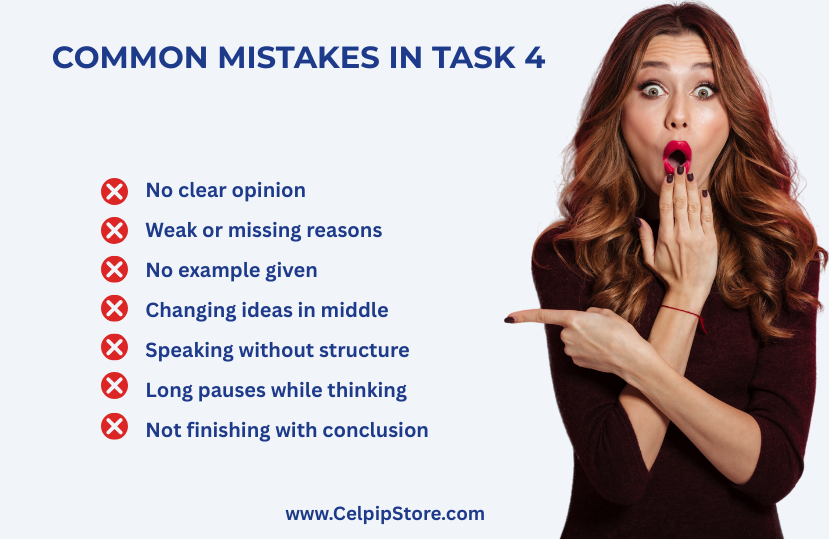
- Not stating a clear opinion at the beginning, which makes the response sound confused or uncertain
- Taking too long to decide “agree or disagree,” leading to hesitation at the start
- Giving mixed or contradictory views instead of sticking to one clear position
- Jumping between ideas without logical connection, which reduces coherence
- Repeating the same reason in different words instead of adding new supporting points
The Core Idea: Opinion Is Not Creativity — It Is Structure
In Task 4, many students believe they must find “perfect ideas” or “smart arguments” before speaking. This is not true. The exam is not testing your intelligence. It is testing your ability to express a clear opinion with logical support under time pressure.
CLB 9 candidates do not search for ideas during the exam. They use a fixed opinion framework that works for any topic, even unfamiliar ones.
Once you follow a structure, your mind becomes calm, and your speaking becomes automatic.
CLB 9 Opinion Framework (Universal Structure)
Use this system for every Task 4 question.
1. Opening Opinion (Clear Position)
Start by clearly stating your opinion immediately. Do not delay or give both sides.
You can use:
- “I strongly believe that…”
- “In my opinion, I agree that…”
- “I do not agree with this statement because…”
This step is critical because it sets direction for your entire response.
2. Main Reason (Primary Argument)
Next, give your strongest reason for your opinion.
Focus on:
- One clear idea
- Simple explanation
- Direct relevance to the question
Example:
- “The main reason is that this approach helps people save time and improve efficiency.”
3. Example (Support Your Idea)
Now support your reason with a simple example.
You can use:
- Personal experience
- Common real-life situations
- Hypothetical examples
Example:
- “For example, many students who follow a study schedule perform better in exams.”
4. Second Reason (Add Depth)
Add another supporting point to strengthen your opinion.
Example:
- “Another important reason is that it reduces stress and improves planning.”
This step improves coherence and scoring depth.
5. Opposite View (Brief Contrast)
Briefly acknowledge the opposite opinion, but do not support it.
Example:
- “Some people may think this is unnecessary, but I believe…”
This shows balance and critical thinking.
6. Closing Statement (Strong Conclusion)
End your response clearly and confidently.
You can say:
- “That is why I strongly support this idea.”
- “Overall, I believe this is the best approach.”
- “This is why I agree with this statement.”
A strong ending improves structure and fluency.
Why This Framework Works
This system works because it removes the biggest problem in Task 4: idea confusion under pressure.
Instead of thinking randomly, your mind follows a fixed flow:
Opinion -> Reason -> Example -> Reason -> Contrast -> Conclusion
This keeps your answer organized and easy to deliver.
.png "CELPIP_Task_4_Opinion_Formula_(CLB_9_System).png")
Fluency in Opinion Speaking: Why Structure Reduces Pressure
In Task 4, students often struggle because they try to “think of strong arguments” while speaking. This creates hesitation, repetition, and loss of fluency.
CLB 9 candidates do something different. They don’t search for ideas in real time. They rely on a pre-built argument structure and simply plug ideas into it.
This is why fluency in opinion speaking is not about speed or intelligence. It is about predictability of structure.
Examiner Insight: What Actually Gets High Scores
In CELPIP Task 4, examiners focus on how clearly you can express and support an opinion under time pressure. They are not evaluating whether your opinion is “correct” or “advanced.”
There are four scoring areas:
1. Task Completion
Did you clearly state and support your opinion?
Strong responses stay focused on one position throughout.
2. Coherence
Are your ideas logically connected?
A clear flow (opinion -> reasons -> example -> conclusion) is essential.
3. Fluency
Do you speak continuously without long pauses?
Short natural pauses are fine, but frequent stopping reduces score.
4. Language Use
Is your language simple, natural, and accurate?
Clear communication is more valuable than complex vocabulary.
Natural Opinion Language (CLB 9 Pattern)
One key mistake students make is trying to sound “academic.” In reality, simple and natural language performs better.
Instead of complex phrasing, use:
- “I believe that…” instead of “it is my strong conviction that…”
- “I agree because…” instead of “I am in agreement due to the fact that…”
- “This is important because…” instead of “this holds significance due to…”
- “For example…” instead of “as an illustration of this point…”
This improves fluency and reduces hesitation.
5-Second Idea Strategy (OPINION FILTER METHOD)
The hardest part of Task 4 is not speaking it is choosing ideas quickly. You need a fast mental filter.
Use this method:
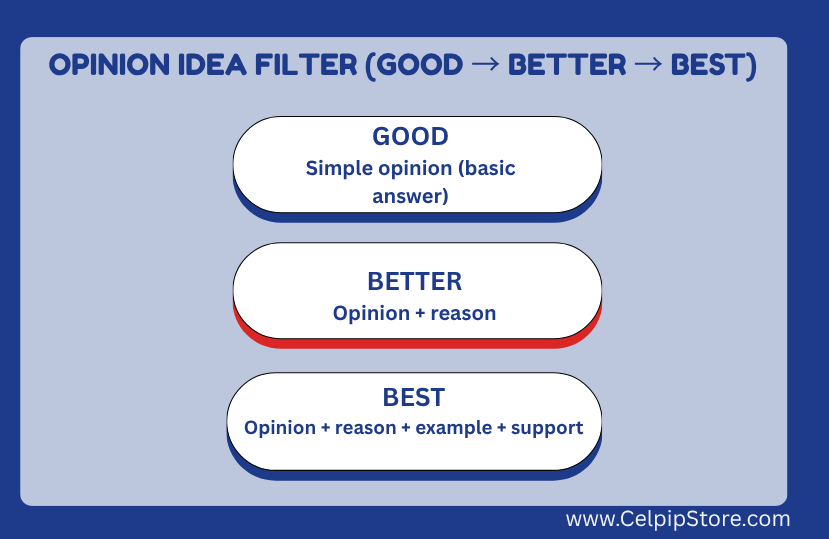
FILTER = Good / Better / Best
When you see a question, instantly think:
- Good idea: basic reason
- Better idea: practical reason
- Best idea: real-life impact
Example question: Should students use mobile phones in class?
- Good: It helps communication
- Better: It can support learning apps
- Best: It may improve access to information quickly
Now you simply choose 2–3 and speak.
Sample CLB 9 Response Style
“I strongly believe that students should not use mobile phones in class. The main reason is that phones can easily distract students from learning. For example, many students may start using social media instead of focusing on lessons.
Another reason is that it can reduce classroom discipline and concentration. Some students may disturb others by using phones during lectures.
Although some people think phones are useful for learning, I believe they should be used only under teacher supervision. That is why I think restricting phone use in class is a better approach.”
Practice Strategy Used by High Scorers
High-performing students do not memorize answers. Instead, they train argument flexibility:
- Practicing 1 opinion in multiple ways
- Speaking with timer-based responses
- Building 2–3 reasons for any topic
- Practicing “no pause” speaking drills
This builds natural confidence under pressure.
Complete Summary of Task 4 Strategy
CELPIP Speaking Task 4 (Opinion Questions) becomes manageable when you stop trying to generate “perfect arguments” and instead follow a fixed opinion structure.
The real challenge is not intelligence or vocabulary. It is your ability to stay clear, logical, and consistent under time pressure.
Once you apply a structured system, any opinion question becomes predictable and easy to answer.
Final CLB 9 Checklist (Before Speaking)
Before you start speaking, quickly check:
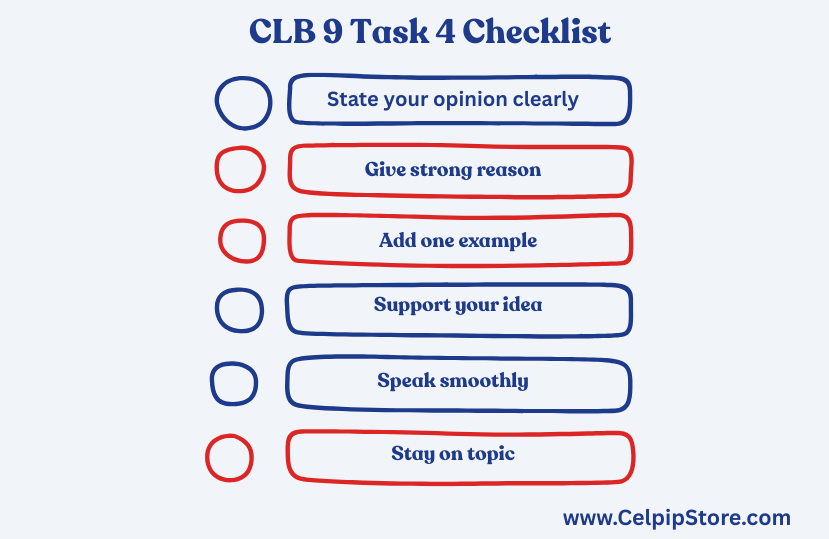
Structure
- I will state my opinion clearly at the start
- I will give one main reason
- I will support it with an example
- I will add a second reason
- I will briefly mention the opposite view
- I will end with a strong conclusion
Fluency
- I will not pause to search for “perfect ideas”
- I will keep speaking even if sentences are simple
- I will maintain a steady speaking flow
Content
- I will stick to one clear opinion
- I will not contradict myself
- I will stay focused on the question
Language
- I will use simple, natural English
- I will avoid overcomplicated vocabulary
- I will focus on clarity over complexity
Exam-Day Strategy (Very Important)
In the actual CELPIP exam, your goal is not to “win an argument.” Your goal is to deliver a clear, structured opinion within time limits.
Start immediately with a clear opinion statement. This reduces hesitation and sets direction.
Then follow your structure step by step without stopping to overthink ideas. Even simple arguments are enough if they are well organized.
Do not change your opinion mid-answer. Consistency is more important than complexity.
Common Mistakes to Avoid (Final Reminder)
- Not stating opinion clearly at the beginning
- Changing opinion halfway through speaking
- Giving random or unconnected ideas
- Repeating the same reason in different words
- Overthinking vocabulary instead of speaking naturally
- Pausing too often while “planning” sentences
- Ending without a clear conclusion
These mistakes reduce clarity and directly affect CLB scoring. Many candidates lose marks in Task 4 because they do not understand how CELPIP Speaking is evaluated as a complete system, which affects their overall performance. To fix this, refer to CELPIP Speaking Mastery Complete Scoring Strategy.
Final Practice Plan (Task 4 Mastery System)
To master Task 4, follow this structured approach:
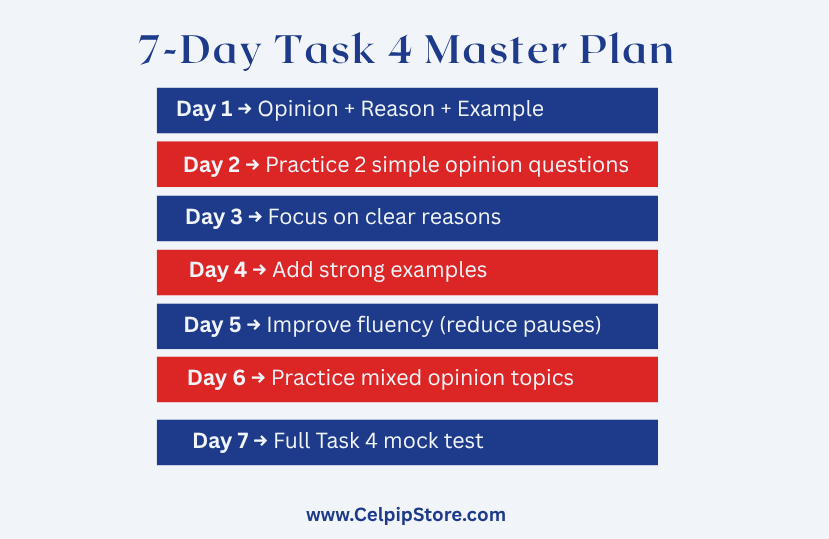
Day 1–2: Structure Training
Focus only on memorizing the opinion framework:
Opinion -> Reason -> Example -> Reason -> Contrast -> Conclusion
Day 3–4: Idea Building Practice
Practice forming 2–3 reasons for random topics quickly.
Day 5–6: Timed Speaking Practice
Answer opinion questions within strict time limits without stopping.
Day 7: Full Mock Test
Practice multiple opinion questions back-to-back to build speed and flexibility.
Practicing opinion questions is important, but you must also practice all speaking tasks together to improve fluency, structure, and confidence under exam conditions. Follow the full system in CELPIP Speaking Mastery Complete Preparation Strategy.
Final Success Insight
Task 4 is not about being “right.” It is about being clear, structured, and confident under pressure.
Once this system becomes automatic, you will always know:
- what your opinion is
- how to support it
- how to finish strongly
This consistency is what leads to CLB 9 performance. Mastering Task 4 is a strong step forward, but your final score depends on how well you handle the entire speaking section as a complete system. Start with CELPIP Speaking Mastery Complete Guide for All Tasks.