CELPIP Writing Task 1 Email Guide (2026): Step-by-Step Strategy to Score CLB 9+
Introduction
CELPIP Writing Task 1 looks simple, but it is one of the most misunderstood parts of the exam. Many students think they just need to “write an email.” However, the test is actually measuring your ability to:
- Communicate clearly
- Use the correct tone
- Organize ideas logically
- Complete the task fully
Even strong English speakers lose marks because their emails are unclear or poorly structured. To score CLB 9+, you must learn how to write focused, structured, and purpose-driven emails. Writing Task 1 (Email Writing) is only one part of the CELPIP Writing test, but your overall score depends on how well you apply complete writing strategies across both tasks. A strong foundation is essential for success. You can understand this full system in CELPIP Writing Mastery: Complete Strategy for High Band Scores.
Learning Objectives
By the end of this lesson, you will be able to:
- Understand the exact requirements of Task 1
- Use a clear 4-part email structure
- Write emails with correct tone (formal/semi-formal)
- Address all task points effectively
- Avoid common mistakes that reduce scores
- Improve clarity and coherence in writing
Overview of Task 1
In Task 1, you are given a situation and asked to write an email.
This situation usually includes:
- A purpose (complaint, request, suggestion, etc.)
- A target reader (manager, company, friend, neighbour, etc.)
- Specific points you must include
Common Email Types
You may be asked to write:
- A complaint email
- A request email
- A suggestion email
- An apology email
- An information request email
Each type requires a slightly different tone, but the structure remains the same.
What the Examiner Checks
Your email is evaluated based on:
- Task completion (Did you answer all points?)
- Coherence (Is it logically organized?)
- Vocabulary (Is it appropriate and natural?)
- Readability (Is it easy to understand?)
Important:
Examiners do NOT expect perfect English.
They expect clear and effective communication.
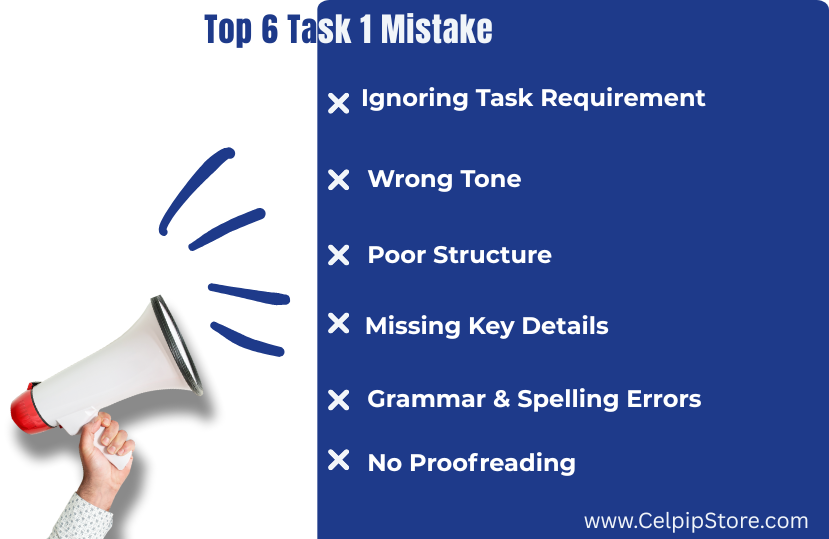
Common Mistakes in Task 1
Many candidates lose marks due to simple but critical mistakes.
1. Missing Task Points
Students ignore one or more bullet points from the question.
2. Unclear Purpose
The email does not clearly explain why it is written.
3. Wrong Tone
Examples:
- Too informal: “Hey, I want to tell you…”
- Too aggressive in complaints
4. Poor Organization
Ideas are mixed together without paragraph structure.
5. Overwriting
Students write long, unnecessary explanations instead of focusing on the task.
6. Grammar Errors
Frequent mistakes reduce clarity and lower the score. Many candidates lose marks in Task 1 because they focus only on email writing without understanding how the CELPIP Writing test is evaluated as a complete system. To fix this, refer to CELPIP Writing Mastery Complete Scoring Strategy.
Key Principle for Task 1
“One clear purpose + clear structure + polite tone = high score”
If your email is:
- Easy to read
- Well organized
- Task-focused
You can achieve a high band even with simple English. To perform well in email writing, you need a clear structure and tone, but this is only one part of a larger writing framework used in the CELPIP Writing test. This complete framework is explained in CELPIP Writing Mastery Complete Strategy Guide.
Teaching: Core Strategy for Task 1
CELPIP Task 1 is not about writing a “long email.” It is about writing a clear, structured, and purpose-driven email.
Every high-scoring response follows this rule:
Say exactly what is needed clearly, politely, and completely
To achieve this, you must follow a fixed structure + controlled idea development.
Step-by-Step Email Writing Framework
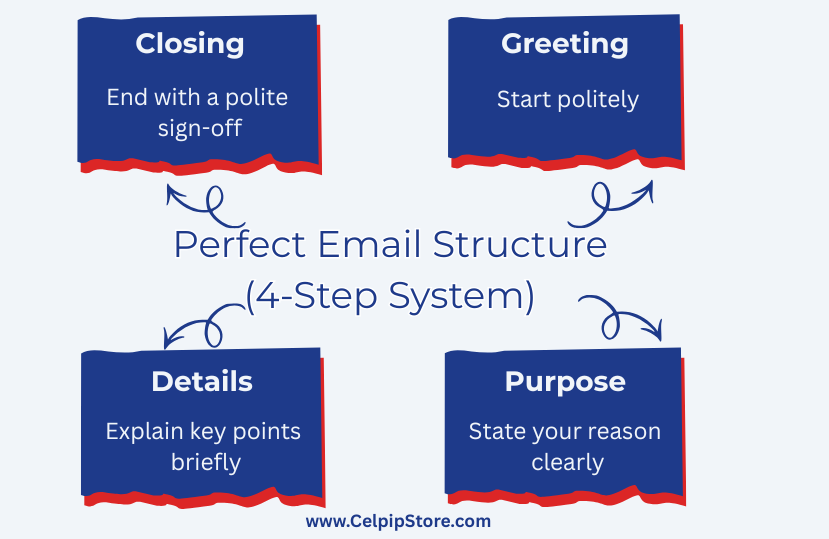
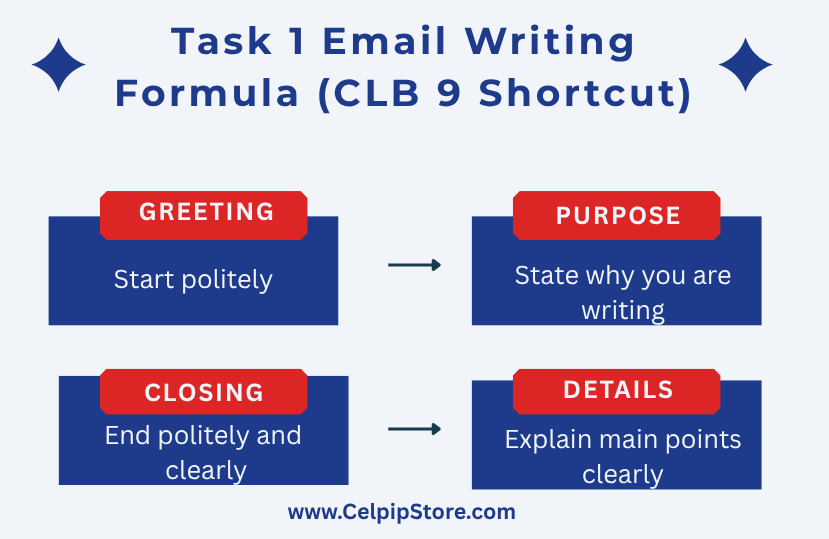
A strong CELPIP email always follows a 4-part structure:
1. Opening (Purpose Statement)
Start your email by clearly stating why you are writing.
This is the most important sentence because it sets direction for the entire email.
Use clear phrases such as:
- “I am writing to request information regarding…”
- “I would like to express my concern about…”
- “I am writing to inquire about…”
Keep it direct and professional
Avoid unnecessary storytelling
2. Background / Context
After your opening, briefly explain the situation.
This section should answer:
- What happened?
- Why are you writing now?
Keep it short 2 to 3 sentences only.
Example:
- “I recently purchased a product from your store, but it arrived damaged.”
Only include relevant information
Do not write long stories
3. Main Request / Details
This is the core of your email and carries most marks.
Here, you must:
- Address all bullet points from the question
- Ask clear questions or make specific requests
- Provide necessary details
Example actions:
- Request a refund
- Ask for clarification
- Suggest a solution
Write in clear, separate sentences
Cover all required points
4. Closing
End your email politely and professionally.
Common closing lines:
- “I look forward to your response.”
- “Thank you for your time and assistance.”
Keep tone respectful
Do not introduce new ideas here
Full Email Structure Overview
A high-scoring email should look like this:
- Paragraph 1 - Purpose
- Paragraph 2 - Background
- Paragraph 3 - Main details / request
- Paragraph 4 - Closing
Achieving CLB 9+ in Task 1 requires strong control of structure, tone, and clarity, along with consistent performance in all writing tasks. You can build these skills using CELPIP Writing Mastery for High Band Scores.
Clear paragraphs = better readability = higher score
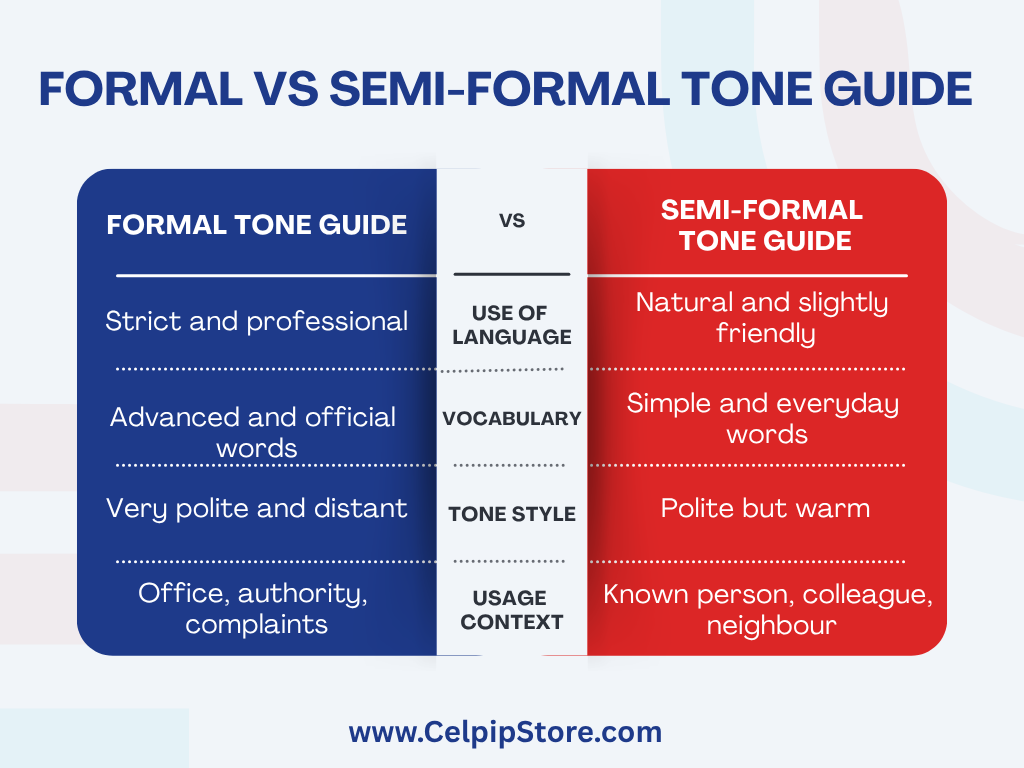
Tone Strategy (Very Important)
Tone can make or break your score.
You must match your tone based on the situation:
Formal Tone (Most Common)
Used for:
- Companies
- Managers
- Officials
Language style:
- Polite
- Professional
- Respectful
Semi-Formal Tone
Used for:
- Neighbours
- Teachers
- Known contacts
Language style:
- Friendly but respectful
Tone Rules to Follow
Use polite phrases:
- “Could you please…”
- “I would appreciate…”
Stay respectful even in complaints
Avoid:
- Slang (“Hey”, “What’s up”)
- Aggressive tone (“This is unacceptable!”)
Mini Example (Model Email)
Situation: You received a damaged product.
Email:
I am writing to express my concern regarding a product I recently purchased from your store.
The item was delivered yesterday; however, it was damaged upon arrival. The packaging appeared to be broken, which may have caused the issue.
I would like to request a replacement or a full refund. Additionally, I would appreciate it if you could investigate this matter to prevent similar issues in the future.
Thank you for your time and assistance. I look forward to your response.
Why This Works
This email scores high because:
- Clear purpose in first sentence
- Short and relevant background
- Direct request
- Polite closing
- No unnecessary complexity
Advanced Tips for High Scores
Once you understand the basic structure, the next step is to improve control, precision, and clarity.
High-scoring candidates do not write longer emails they write focused and efficient emails.
To upgrade your performance, follow these advanced habits:
- Plan before writing (2–3 minutes max)
- Stick strictly to task points
- Avoid repeating the same idea
- Keep sentences short and clear
A strong email is not “impressive” it is easy to read and easy to understand.
Time Management Strategy
Many students lose marks because they run out of time or rush at the end.
Use this simple plan:
Task 1 Time Breakdown (27 Minutes)
- 3 minutes -> Read and understand the question
- 20 minutes -> Write the email
- 4 minutes -> Review and correct mistakes
How to Use Planning Time Effectively
Before writing, quickly note:
- Purpose of email
- 2–3 key points
- Type of tone (formal/semi-formal)
This saves time and improves structure
Examiner Insights (What Gets CLB 9+)
Examiners are trained to reward communication quality, not complexity.
High-scoring emails usually have:
- A clear purpose in the first sentence
- All task points covered
- Logical paragraph structure
- Consistent and appropriate tone
- Minimal grammar errors
Important Reality
You do NOT need perfect grammar
You DO need clear and effective communication
Even simple English can score CLB 9 if:
- The message is clear
- The structure is strong
- The tone is correct
High-Scoring Vocabulary for Emails
Use safe and natural words instead of complex vocabulary.
Useful Email Vocabulary
- request
- inquire
- assistance
- concern
- appreciate
- inconvenience
- clarify
- respond
Polite Sentence Starters
- “I would like to…”
- “Could you please…”
- “I would appreciate if…”
- “I am writing to…”
These phrases improve tone immediately
Grammar Focus (What Matters Most)
You do not need advanced grammar. Focus on accuracy in simple structures.
Important Areas
- Correct verb tense
- Subject-verb agreement
- Clear sentence formation
- Proper punctuation
Avoid These Errors
- Very long sentences
- Mixing tenses
- Overuse of complex structures
- Missing full stops
Simple and correct is always better than complex and wrong
Practice Section
Practice Prompt 1
You recently faced an issue with your internet service. Write an email to the provider.
Include:
- Describe the problem
- Explain how it affected you
- Request a solution
Practice Focus
- Clear complaint tone
- Logical structure
- Polite language
- Strong request
Practice Prompt 2
You want to request leave from your manager.
Include:
- Reason for leave
- Duration
- Work arrangement
Practice Focus
- Formal tone
- Clear explanation
- Professional closing
Practicing email writing is important, but you must also practice both writing tasks together to improve overall coherence, timing, and writing control.
Follow the full system in CELPIP Writing Mastery Complete Preparation Strategy.
Practice Strategy
To improve quickly, follow this method:
- Write 1 email daily
- Check if all task points are covered
- Identify 2 mistakes
- Rewrite improved version
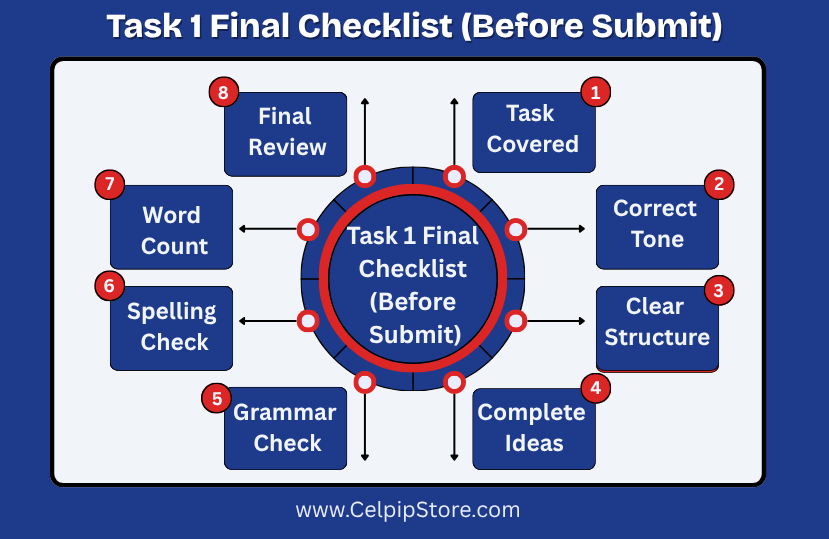
Mini Self-Check Before Submission
Before submitting your email, ask:
- Did I clearly state my purpose?
- Did I include all task points?
- Is my tone polite and appropriate?
- Are my sentences clear and correct?
- Is my email properly structured?
Summary of Key Learning
In this lesson, you learned that CELPIP Task 1 is not about writing long emails it is about writing clear, structured, and purpose-driven communication.
To achieve a high score, your email must:
- Clearly state the purpose in the beginning
- Address all task points
- Follow a logical structure
- Maintain a polite and appropriate tone
- Use simple and accurate language
The most important takeaway is:
Clarity + Structure + Tone + Task Completion = CLB 9
Final Task 1 Checklist (Exam Ready)
Before submitting your email, quickly check:
Task Completion
- Did I cover ALL bullet points from the question?
- Did I stay focused on the main purpose?
Structure
- Do I have 4 clear parts (Opening, Background, Details, Closing)?
- Are my paragraphs logically organized?
Tone
- Is my email polite and respectful?
- Did I match formal or semi-formal tone correctly?
Language
- Are my sentences clear and easy to understand?
- Did I avoid unnecessary complex vocabulary?
Grammar
- Are verb tenses correct?
- Are sentences complete and properly punctuated?
Common Exam-Day Reminders
- Do not panic if your vocabulary is simple
- Do not write long, complicated sentences
- Focus on completing all task points
- Keep your writing clear and direct
- Always leave time to review
A complete and clear email scores higher than a complex but confusing one.
Frequently Asked Questions (FAQs)
1. How many words should I write in Task 1?
You should aim for around 150–200 words, but quality is more important than length.
2. Can I use a template for email writing?
Yes, you can follow a structure, but avoid memorized or robotic sentences. Keep your response natural.
3. Is formal tone required in every email?
No. Some situations require semi-formal tone. Always adjust based on the receiver.
4. What is the biggest mistake in Task 1?
Missing task points or not clearly stating the purpose.
5. Can I still get CLB 9 with grammar mistakes?
Yes, if your message is clear and errors do not affect understanding.
7-Day Practice Plan (Task 1 Focus)
To improve your email writing quickly, follow this structured plan:
Day 1–2
- Learn email structure
- Write 2 basic emails
Day 3–4
- Practice different email types (complaint, request, suggestion)
- Focus on tone
Day 5
- Timed practice (2 emails under exam conditions)
Day 6
- Review mistakes and rewrite improved versions
Day 7
- Full Writing Test Simulation (Task 1 + Task 2)
Consistent practice leads to fast improvement
Conclusion
CELPIP Task 1 is one of the easiest sections to improve if you follow a system.
You do not need advanced English. You need:
- Clear structure
- Strong task focus
- Polite communication
- Controlled grammar
If you apply these principles consistently, your score will improve significantly. Mastering Task 1 is an important step, but your final writing score depends on your performance across the entire CELPIP Writing section. Start with CELPIP Writing Mastery Complete Guide for High Scores.