
CELPIP Test Format: All 4 Sections | CELPIP Store
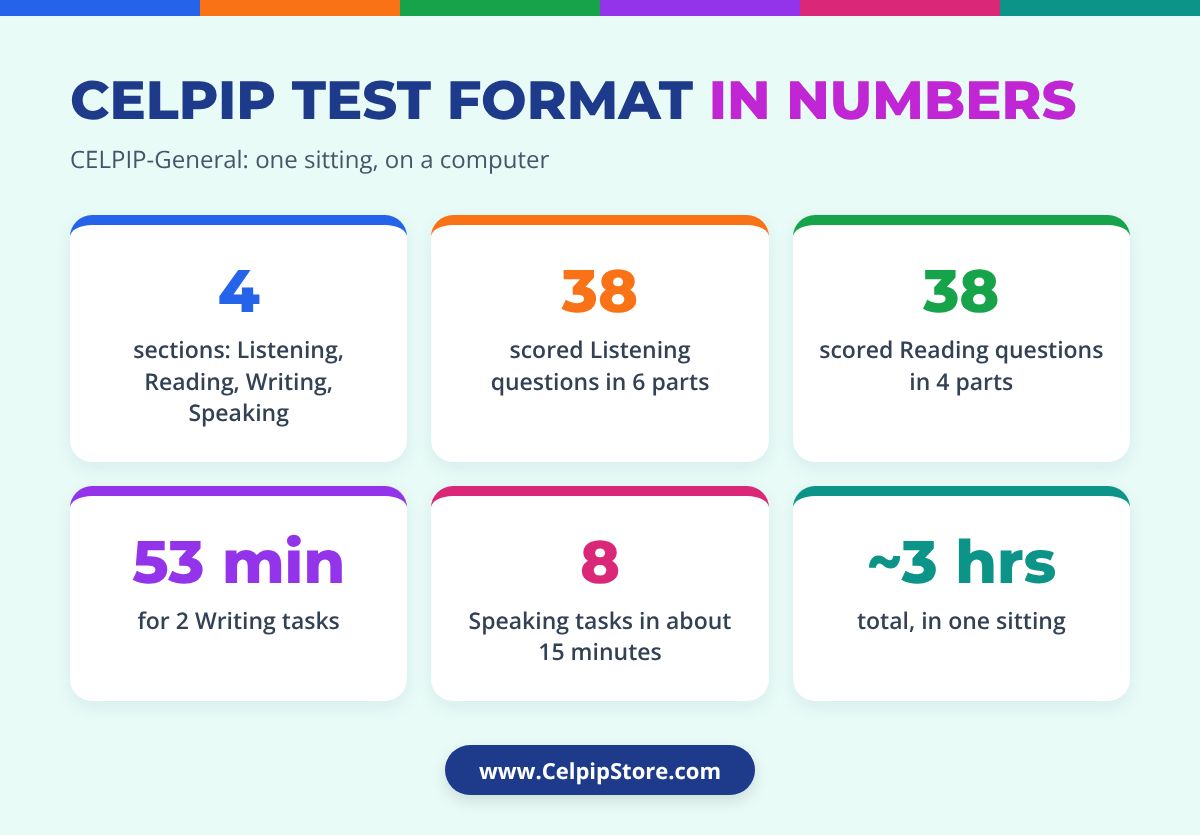
The CELPIP-General test has four sections taken in one sitting on a computer: Listening (6 parts, 38 questions), Reading (4 parts, 38 questions), Writing (2 tasks) and Speaking (8 tasks). The whole test takes about three hours, and the sections always come in the same order: Listening, Reading, Writing, then Speaking.
This guide walks through the format section by section. For each part you will see what appears on the screen, how many questions there are, how much time you get and how your answers are given. You will also find the official preparation and speaking times for every Speaking task, a worked time plan for test day, a practice routine built around the format, and answers to the questions test takers ask most. Every number comes from official CELPIP (Paragon Testing Enterprises) material, listed at the end.
CELPIP test format at a glance
Before looking at each part in detail, it helps to see the whole test on one page. The table below uses the timings and question counts published by CELPIP for the CELPIP-General test.
| Section | Parts or tasks | Scored questions | Official time |
|---|---|---|---|
| Listening | 6 parts | 38 | 46 to 55 minutes |
| Reading | 4 parts | 38 | 43 to 56 minutes |
| Writing | 2 tasks | 2 written responses | 53 minutes |
| Speaking | 8 tasks | 8 spoken responses | About 15 minutes |
A few points stand out right away:
- One sitting. All four sections are done on the same day, at the same computer. There is no separate speaking appointment.
- No examiner in the room. Your Speaking answers are recorded by the computer and rated later, so you speak to a microphone, not to a person.
- Ranges, not fixed times. Listening and Reading are shown as ranges because they may include extra, unscored questions. More on that below.
- Same order every time. CELPIP lists the sections as Listening, Reading, Writing and Speaking, and Speaking is the last part of the test.
If you are still deciding whether CELPIP is the right test for you, start with our complete overview of what CELPIP is, then come back here for the details of each section.
How the test is delivered
CELPIP describes the test as completely computer-delivered. You read, listen, type and speak at a computer in a test centre. Understanding how the screen behaves is part of knowing the format, because it affects how you manage your time.
Tools you get on screen
According to the official guidebook for test takers, the test includes a personal timer, a word counter and spell-check. Each section uses these a little differently:
- Listening: you get volume control, and the test centre gives you paper and a pen for notes. Your notes do not affect your score.
- Reading: the passage appears on the left side of the screen and the questions on the right, with a countdown timer. You scroll to move through long texts.
- Writing: background information is on the left and the instructions on the right. You type your answer and can see an automatic word count, basic editing tools and spell-check.
- Speaking: a progress bar shows how much time is left, and a level bar next to the microphone icon shows that your voice is being recorded.
The screen moves on by itself
In Listening, the official overview explains that the test moves forward automatically. You can click "Next" early, but once you do, you cannot go back to the previous screen. Leaving early also does not add the saved time to later parts, so if you finish a set of questions early, use the time to check your answers instead of rushing ahead.
In Speaking, the screen also moves forward automatically when preparation time ends. You hear "Start speaking now" and recording begins on its own. You do not press a button to start or stop.
Why practising on a computer matters
Because every answer is clicked, typed or recorded, comfort with the computer is part of your preparation. Typing speed affects how much you can write and revise in Writing, and speaking to a microphone with a countdown on screen feels different from speaking to a teacher. Practising with a test that copies the real screen is the easiest way to remove these surprises. You can try our free CELPIP practice test to see the format before test day.
Listening: 6 parts, 38 questions
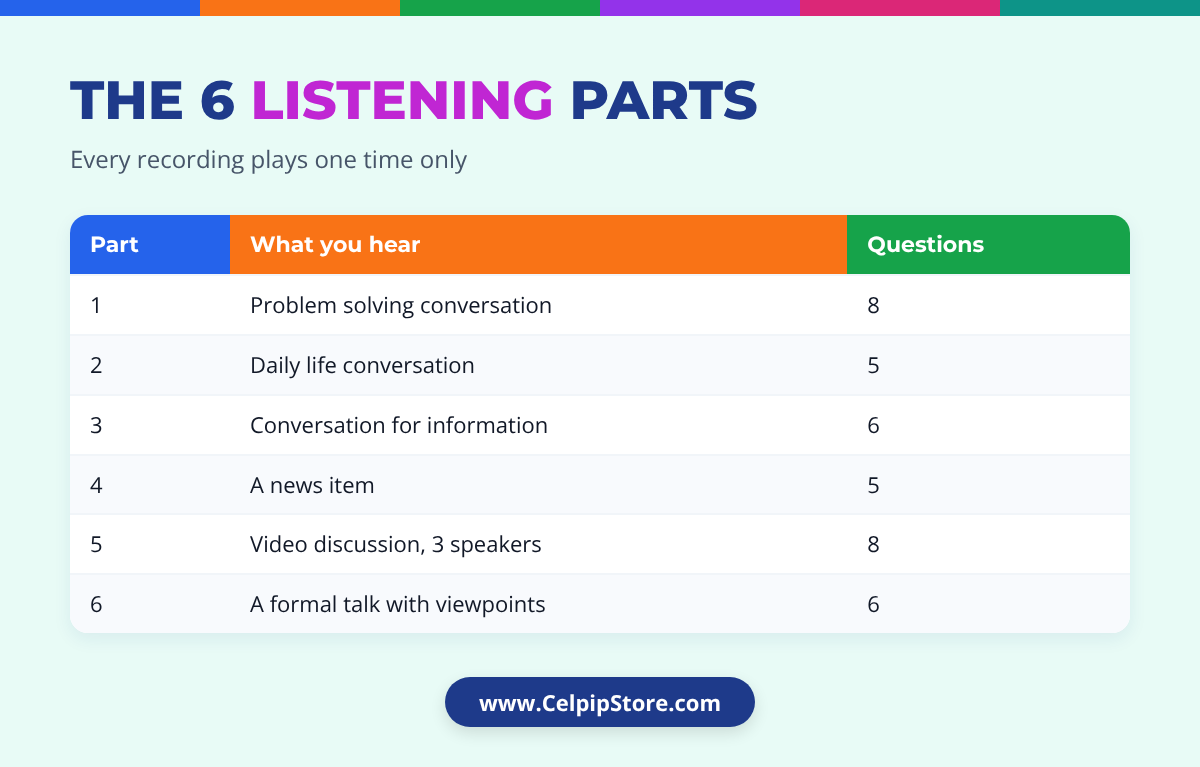
Listening is the first section of the test. CELPIP lists six parts with 38 scored questions in total, and an official time of 46 to 55 minutes. Every recording plays one time only. Clips start automatically and cannot be paused, and the questions come after the audio.
| Part | What you hear | Questions | About how long |
|---|---|---|---|
| Part 1: Listening to Problem Solving | Two people talk about a problem, in three short sections | 8 | 8 minutes |
| Part 2: Listening to a Daily Life Conversation | Two people who know each other talk about everyday plans | 5 | 5 minutes |
| Part 3: Listening for Information | A conversation where one person gets information from another | 6 | 6 minutes |
| Part 4: Listening to a News Item | One speaker gives a short news report | 5 | 5 minutes |
| Part 5: Listening to a Discussion | A video of three people discussing a topic | 8 | 9 minutes |
| Part 6: Listening for Viewpoints | One speaker gives a prepared, formal talk | 6 | 8 minutes |
The approximate times per part come from CELPIP's official Listening Pro study pack. The question counts match the current test-taker guidebook.
What changes from part to part
CELPIP says passages and questions get gradually harder as you move through the section. The early parts are everyday conversations between two people. Part 4 switches to one speaker reading the news. Part 5 is the only part with video: you watch three speakers, so it helps to label your notes by where each person sits on the screen. Part 6 is a more formal talk with several opinions to follow.
A worked example of Part 1
Part 1 is split into three audio sections of about one to one and a half minutes each, with two or three questions after each section. In practice, that means you hear the start of a conversation about a problem, answer a few questions, then hear the next piece. Because you cannot replay anything, the best approach is to set up your notes before the audio starts, for example with two columns for the two speakers, and write short keywords in the order you hear them.
Tips for the Listening format
- Use point form and abbreviations in your notes. Full sentences are too slow.
- Answer every question, even when you are not sure. A blank answer cannot earn a point.
- Do not click "Next" just to save time. The time does not carry over.
- Check the volume during the practice question so you are not adjusting it during a scored part.
Reading: 4 parts, 38 questions
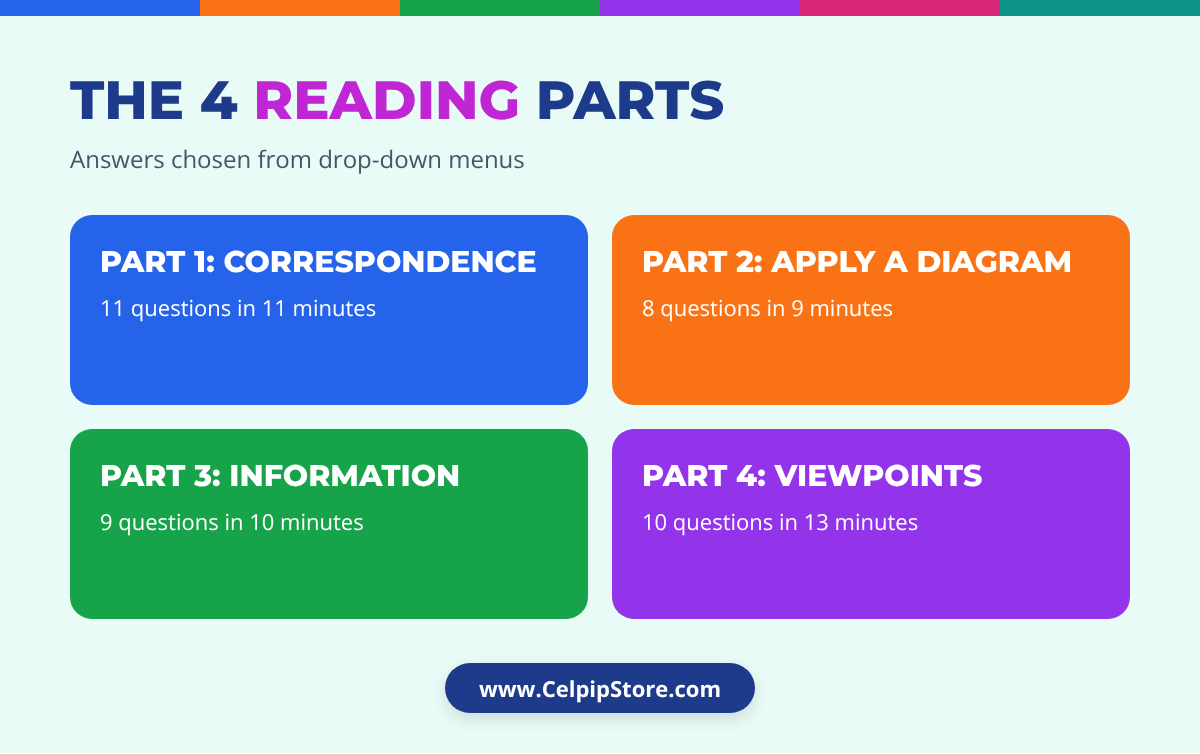
Reading comes second. It has four parts and 38 scored questions, with an official time of 43 to 56 minutes. All the questions for a part appear on the screen at the same time, and you choose your answers from drop-down menus.
- Part 1: Reading Correspondence (11 questions, 11 minutes): an email or letter between two people, then a short reply with blanks.
- Part 2: Reading to Apply a Diagram (8 questions, 9 minutes): a diagram with short text and pictures, then an email about it with blanks.
- Part 3: Reading for Information (9 questions, 10 minutes): a four-paragraph text about a person, place, event or process.
- Part 4: Reading for Viewpoints (10 questions, 13 minutes): an article with two or more opinions, then a reader's comment with blanks.
The four timed parts add up to 43 minutes, which is the bottom of the official range. If your test includes an unscored reading part, the section takes longer.
How the questions work
Parts 1, 2 and 4 come in two sets. In the first set you answer questions about the main text. In the second set you complete a short piece of writing that responds to the main text, such as a reply email or a reader's comment, by choosing the right word or phrase for each blank. Part 3 works differently: you decide which paragraph contains a piece of information, and there is an extra choice, E, for information that is not stated in the text.
A worked example of time planning in Part 2
Part 2 gives you 9 minutes for 8 questions. CELPIP's own study pack suggests spending about 5 minutes on the first set (the diagram questions) and about 2.5 minutes on the second set (the email with blanks). That leaves a little time to check. Practising with a clock helps you feel what 5 minutes looks like on screen.
Tips for the Reading format
- Skim each passage quickly first. The official overview suggests no more than 30 to 40 seconds.
- Look for paraphrase. The right answer often uses different words from the passage.
- In Part 4, note who holds each opinion and why. You will need those notes for the second set.
- Use the scroll bars. Long passages do not fit on one screen.
Writing: 2 tasks in 53 minutes
Writing is the third section. There are two tasks, and you type both answers. The total time is 53 minutes, split between the tasks.
- Task 1: Writing an Email: 27 minutes, 150 to 200 words. An email about an everyday situation, usually covering about three points.
- Task 2: Responding to Survey Questions: 26 minutes, 150 to 200 words. Your choice between two options in an opinion survey, with reasons.
Task 1: Writing an Email
The screen describes a situation and tells you who to write to and what to include. CELPIP advises thinking about the purpose and the reader. The tone should fit the situation: not too formal and not too casual. A message to a neighbour sounds different from a message to a company manager.
Task 2: Responding to Survey Questions
Here you read a short description of an issue and pick one of two options. CELPIP's advice is to state your choice at the beginning and to compare your choice with the other option. This task does not need email format, so there is no greeting or sign-off.
How your writing is rated
CELPIP's official writing study pack lists four rating areas: Content/Coherence, Vocabulary, Readability and Task Fulfillment. Word count is one of the things raters consider under Task Fulfillment, which is why the on-screen word counter is useful. Stay inside the range given in the task.
A worked example of a 27-minute plan
One simple way to use the 27 minutes in Task 1 is: about 3 to 4 minutes to read the task and plan your three points, about 18 minutes to write, and the last 5 minutes to read your email again and fix spelling, grammar and missing points. The exact split is up to you; what matters is that you always leave time to check. For full model answers, see our ultimate CELPIP Writing guide.
Speaking: 8 tasks in about 15 minutes
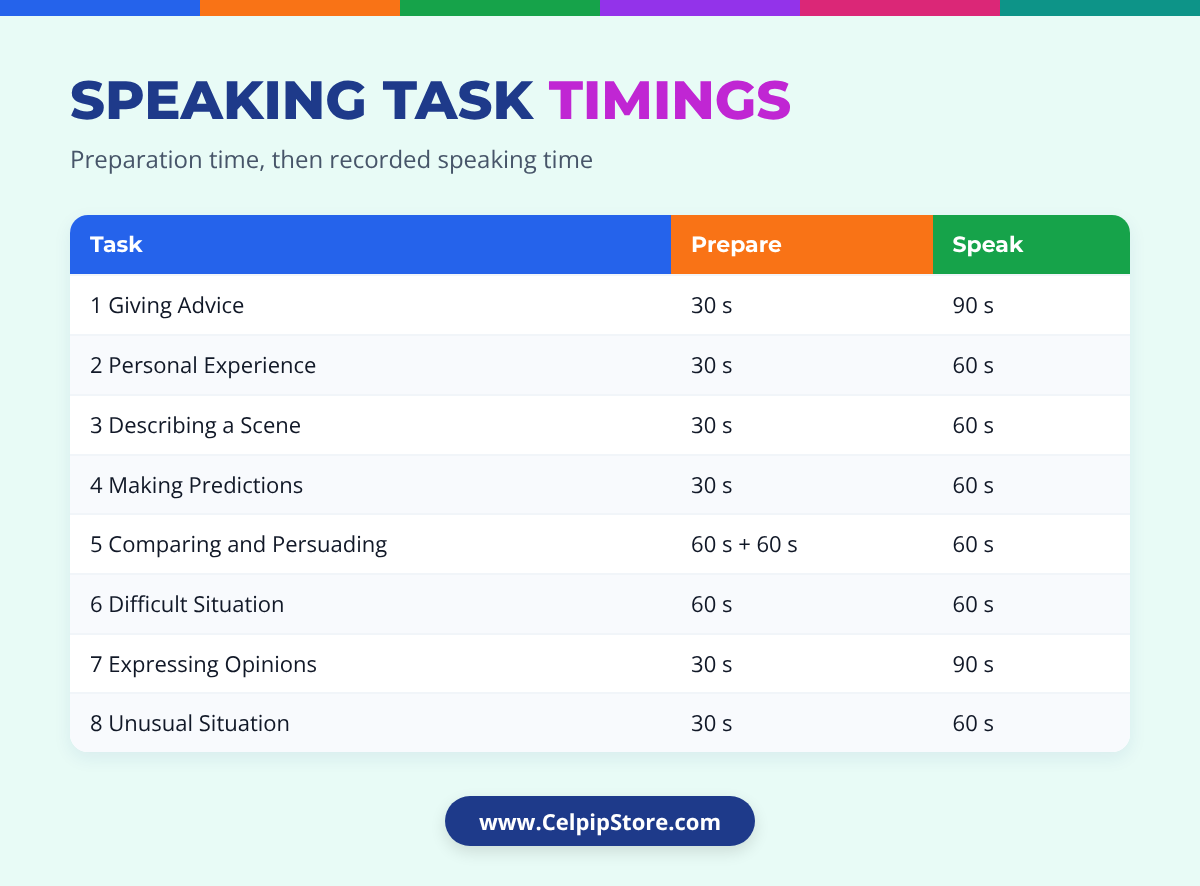
Speaking is the last section. There are eight tasks, plus an optional practice task at the start. Some tasks show only text, and others show text with a picture. Each task has a preparation time and a speaking time, and your answers are recorded and rated later.
| Task | Preparation time | Speaking time |
|---|---|---|
| Practice task (not scored) | 30 seconds | 60 seconds |
| Task 1: Giving Advice | 30 seconds | 90 seconds |
| Task 2: Talking about a Personal Experience | 30 seconds | 60 seconds |
| Task 3: Describing a Scene | 30 seconds | 60 seconds |
| Task 4: Making Predictions | 30 seconds | 60 seconds |
| Task 5: Comparing and Persuading | 60 seconds to choose, then 60 seconds | 60 seconds |
| Task 6: Dealing with a Difficult Situation | 60 seconds | 60 seconds |
| Task 7: Expressing Opinions | 30 seconds | 90 seconds |
| Task 8: Describing an Unusual Situation | 30 seconds | 60 seconds |
How Task 5 works
Task 5 is the only task with two screens. On the first screen you compare options and choose one, with 60 seconds and no speaking. On the second screen you get another 60 seconds to prepare, then 60 seconds to persuade someone that your choice is better.
How speaking is rated
The official Speaking study pack says each response is scored separately in four areas: Content/Coherence, Vocabulary, Listenability and Task Fulfillment. Speak at your normal volume. CELPIP notes that speaking too loudly or too softly can hurt Listenability.
A worked example of using 30 seconds
Thirty seconds is short. A practical approach for Task 1 (Giving Advice) is to note two or three pieces of advice in single words, decide the order, and think of one reason for each. When recording starts, you have 90 seconds to explain them. Many test takers find it helpful to practise with a timer until 30 seconds of planning feels normal.
Practice questions and unscored content
Two features of the format often surprise first-time test takers.
Practice questions
Listening and Speaking begin with a short practice item. In Listening, CELPIP's study pack describes an unscored practice task of one question, about one minute long. In Speaking, the practice task gives 30 seconds to prepare and 60 seconds to speak, and CELPIP says nobody listens to that response. Use these practice items to check your headset volume and microphone, and to settle your nerves.
Unscored content
The official guidebook says the Listening and/or Reading tests may contain unscored content used for test development. It has the same format as the scored questions, and you cannot tell which part it is. That is why CELPIP tells test takers to give their best effort to the whole test. The time spent on unscored content counts toward the total test time, but it does not take time away from your scored tasks. This is also why the official Listening and Reading times are shown as ranges.
How the format connects to your score
Knowing the format also tells you how you are marked. Listening and Reading are made of questions with set answers, so each section is about choosing correctly. Writing and Speaking are rated by trained raters using the four areas listed above for each section.
Your results are reported as CELPIP levels from 0 to 12 for each of the four skills, and CELPIP levels are mapped to Canadian Language Benchmark (CLB) levels. For a full explanation of how each section is marked, read How CELPIP Is Scored.
Because you receive a separate level for each skill, a weak section shows clearly on your score report even when the other three are strong. That is one more reason to know the format of all four sections, not only your favourite.
CELPIP-General LS: the shorter format
CELPIP also offers the CELPIP-General LS test, which tests only Listening and Speaking. According to the official overview, it uses the same six Listening parts and the same eight Speaking tasks, with the same timing as the full test. It has no Reading or Writing.
The two tests are used for different purposes, so check which one your application asks for before you book. Our guide to CELPIP General vs CELPIP General LS explains the difference.
A worked time plan for the full test
Adding the official section times gives a picture of the sitting. Using the top of each range, Listening (up to 55 minutes), Reading (up to 56 minutes), Writing (53 minutes) and Speaking (about 15 minutes) come to just under three hours of test time. CELPIP describes the whole test as about three hours, done in one sitting.
Here is how that feels from the start of the test to the end:
- Listening first. You put on the headset, try the practice question and work through six parts. Your notes are on the paper the centre gives you.
- Reading next. The screen changes to split view: passage on the left, questions on the right. Each part has its own countdown.
- Writing third. You type an email in 27 minutes, then a survey response in 26 minutes, watching the word counter.
- Speaking last. By now you have been testing for well over two hours. You do the optional practice task, then eight recorded responses.
The main lesson from this plan is stamina. Speaking comes at the very end, when you are most tired. Practising full-length tests, not just single parts, trains you for that.
How to practise using the format
Knowing the format is useful only if your practice matches it. Here is a simple routine you can follow.
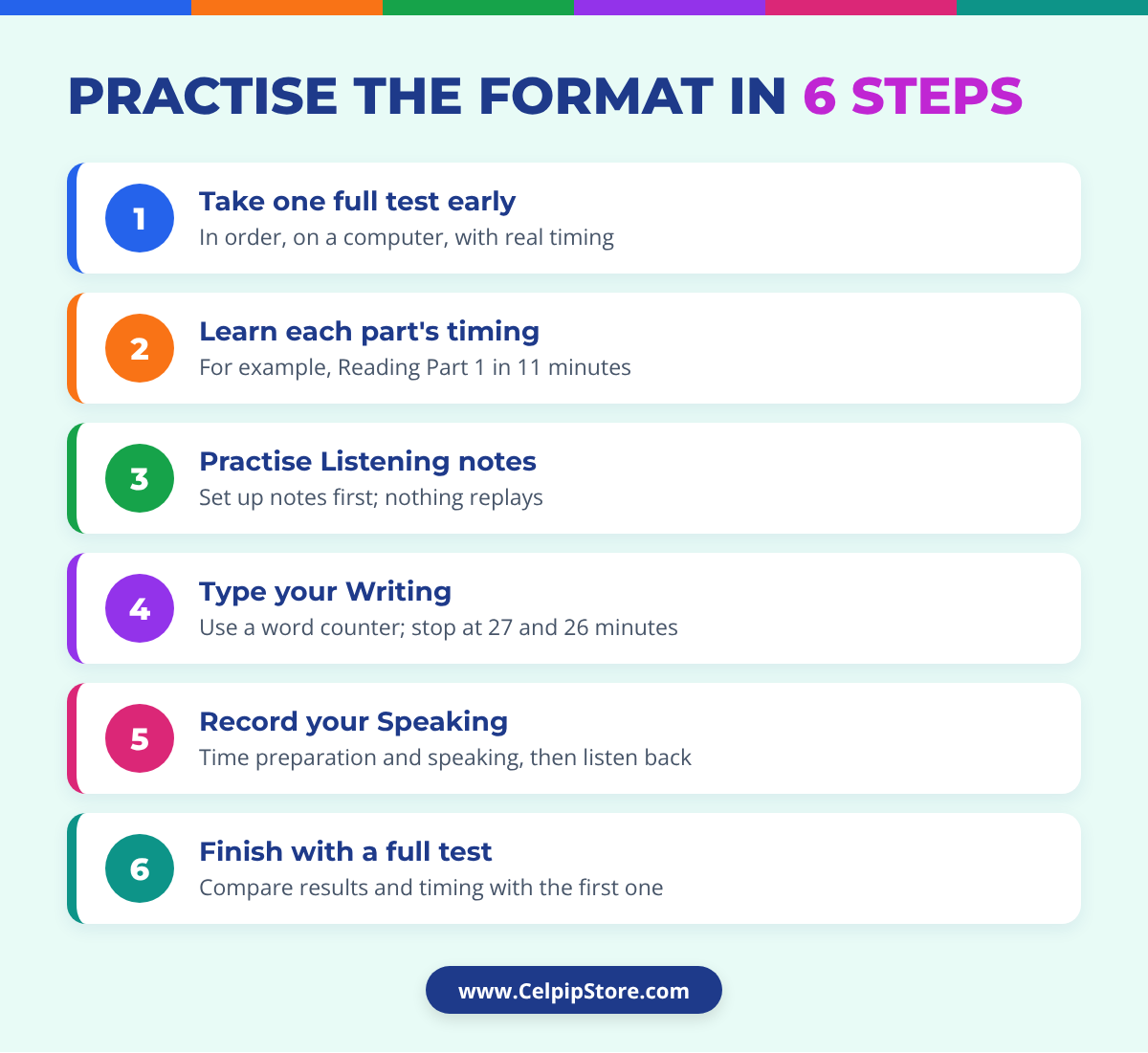
- Take one full test early. Sit a complete practice test in order, on a computer, with no breaks you would not have on test day. Note which section felt longest.
- Learn each part's timing. Practise single parts with the official time. For example, do Reading Part 1 in exactly 11 minutes.
- Practise note-taking for Listening. Set up your notes before each recording and use short forms. Remember that nothing replays.
- Type, do not handwrite, your Writing practice. Use a word counter and stop at 27 and 26 minutes.
- Record your Speaking. Use a phone or computer microphone with a timer for 30 or 60 seconds of preparation and 60 or 90 seconds of speaking. Listen back and check volume and clarity.
- Finish with another full test. Compare your results and your timing with the first one.
CELPIP Store practice tests are built to look and work like the real computer screen. Create a free account to save your progress and try a full test.
Once you know the format, the next step is to practise it under real conditions. Try a free CELPIP practice test on a computer, time every part, and use the results to decide which section needs the most work. If your scores are for an application, also check how long CELPIP scores stay valid so you book your test at the right time.
Common format mistakes to avoid
Most format mistakes come from not knowing how the screen behaves. These are the ones the official material warns about most clearly:
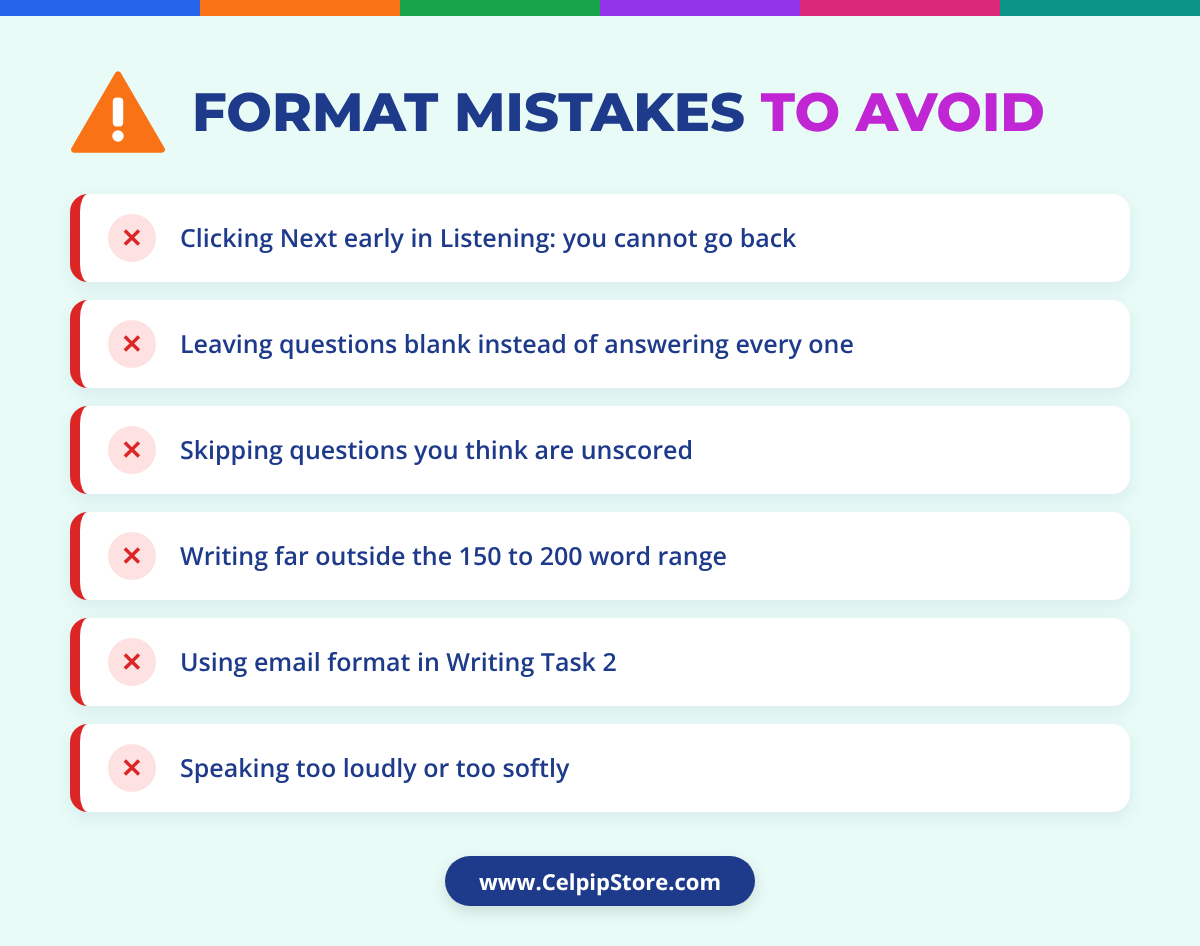
- Clicking "Next" early in Listening. You cannot go back, and the time does not move to later parts.
- Leaving questions blank. CELPIP advises answering every question, even if you are unsure.
- Skipping questions you think are unscored. You cannot tell which content is unscored, so treat every question as real.
- Writing far outside the word range. Word count is part of Task Fulfillment in Writing.
- Using email format in Writing Task 2. The survey response does not need a greeting or sign-off.
- Speaking too loudly or too softly. Volume affects Listenability. Use your normal voice.
- Waiting to be told to start speaking. Recording starts automatically after preparation time ends.
Common questions
How many questions are in the CELPIP test?
The CELPIP-General test has 38 scored Listening questions and 38 scored Reading questions, plus 2 Writing tasks and 8 Speaking tasks. Listening and Reading may also include unscored questions that look the same as scored ones.
Is CELPIP done on paper or on a computer?
CELPIP is completely computer-delivered. You answer Listening and Reading questions by clicking, type your Writing answers and speak into a microphone for Speaking. The only paper is the sheet the test centre gives you for Listening notes.
Is there a speaking interview with an examiner?
No. There is no face-to-face interview. Your Speaking responses are recorded by the computer and rated later.
Can I go back to an earlier question?
In Listening, once you click "Next" you cannot return to the previous screen. In Reading, all the questions for a part appear on the screen together, so you can see the whole set at once while you work. Plan to check each part before you leave it, because the official material advises using any spare time to review your answers.
What order are the sections in?
Listening comes first, then Reading, then Writing, and Speaking is last. The order is the same for every test taker.
How long is each Writing answer?
Both Writing tasks ask for 150 to 200 words. You get 27 minutes for Task 1 (the email) and 26 minutes for Task 2 (the survey response).
Is the format the same for the CELPIP-General LS test?
The Listening and Speaking sections are the same as in the full test. CELPIP-General LS simply has no Reading or Writing section.
Sources
- CELPIP: What is the CELPIP - General?
- CELPIP Guidebook for Test Takers (July 2026)
- CELPIP-General Overview Study Pack (2026)
- CELPIP Listening Pro Study Pack
- CELPIP Reading Pro Study Pack (2026)
- CELPIP Writing Pro Target 9 Study Pack (2026)
- CELPIP Speaking Pro Target 9 Study Pack (2026)
- CELPIP (Paragon) webinar slides on CIC News: test features and score levels
- CELPIP Speaking Pro Target 9 Study Pack (practice task timing)