2.png)
CELPIP Writing Task 1: Writing an Email
Introduction
CELPIP Writing Task 1 is often the first writing task candidates face in the exam, and it plays a crucial role in setting the tone for your overall performance.
Many test-takers believe that writing an email is simple because it is something we do in daily life. However, in the CELPIP test, this task is not just about writing an email it is about demonstrating your ability to:
- Communicate clearly
- Adapt your tone to the situation
- Address specific instructions
- Organize ideas logically
- Use accurate and natural English
This is where many candidates struggle.
They either:
- Miss important points in the question
- Use the wrong tone
- Write without planning
- Or give unclear, underdeveloped responses
The good news is that CELPIP Writing Task 1 is highly structured and predictable. Once you understand the system, you can approach every email question with confidence. CELPIP Writing Task 1 is only one part of the complete Writing section. To understand how both Task 1 (Email Writing) and Task 2 (Survey Response) work together, along with scoring criteria, strategies, and time management techniques, you should also read our Ultimate CELPIP Writing Guide.
Learning Objectives
By the end of this lesson, you will be able to:
- Understand what CELPIP Writing Task 1 requires
- Identify the purpose, reader, and tone of an email
- Break down any Task 1 question correctly
- Plan your response before writing
- Structure your email clearly and logically
- Develop your ideas with relevant details
- Use appropriate vocabulary and tone
- Avoid common mistakes in Task 1
- Write effective emails under exam conditions
What is CELPIP Writing Task 1?
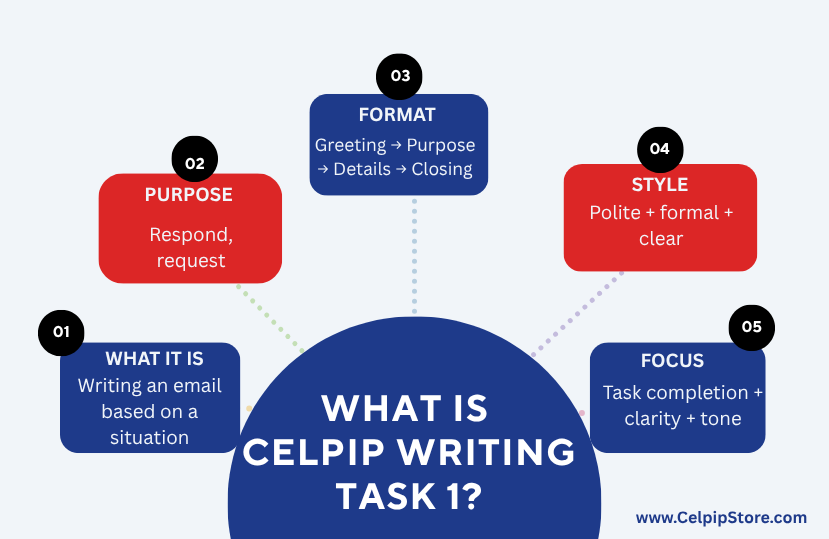
CELPIP Writing Task 1 requires you to write an email based on a real-life situation.
You will be given a prompt that includes:
- A situation
- A purpose for writing
- Specific instructions (usually 2–3 points you must address)
Your task is to write an email that:
- Clearly communicates your message
- Responds to all instructions
- Uses an appropriate tone
- Includes relevant details
- Is well organized
While Task 1 focuses on email writing, the CELPIP Writing test also includes Task 2, which requires opinion-based survey responses. To understand both tasks in detail, read our complete CELPIP Writing Guide.
Quick Definition (Featured Snippet Ready)
CELPIP Writing Task 1 is an email-writing task where candidates respond to a real-life situation by addressing specific instructions using clear, organized, and appropriately toned communication.
Types of Task 1 Emails
Although situations may vary, most CELPIP emails fall into common categories.
Understanding these will help you quickly identify the tone and structure.
1. Complaint Emails
You are reporting a problem.
Examples:
- Incorrect product received
- Poor service
- Noise or inconvenience
2. Request Emails
You are asking for something.
Examples:
- Information
- Permission
- Help
3. Apology Emails
You are explaining a mistake or situation.
Examples:
- Missing an event
- Delayed response
- Miscommunication
4. Invitation Emails
You are inviting someone to an event.
Examples:
- Party
- Meeting
- Gathering
5. Suggestion or Advice Emails
You are recommending or advising.
Examples:
- Helping a friend
- Suggesting improvements
- Giving guidance
.png "TYPES_OF_EMAILS_(TASK_1).png")
Core Concept: Purpose + Reader + Tone
Before writing anything, you must identify three key elements.
1. Purpose
Ask:
Why am I writing this email?
Examples:
- To complain
- To request
- To inform
- To invite
- To suggest
2. Reader
Ask:
Who will read this email?
Examples:
- Friend
- Colleague
- Manager
- Customer service
- Organization
3. Tone
Your tone depends on your reader and purpose.
Friendly Tone
Used for friends or close contacts
Hi John,
Neutral Tone
- Used for acquaintances or colleagues
- Hello Sarah,
Formal Tone
- Used for managers or organizations
- Dear Sir or Madam,
.png "Core_Strategy_(P_R_T_Rule).png")
Why Task 1 is Easier Than You Think
Many students find Writing Task 1 stressful, but in reality, it is one of the most manageable parts of the CELPIP test.
Why?
Because:
- The structure is predictable
- The instructions are clear
- The situations are practical
- You do not need complex ideas
- You can use a repeatable framework
Once you understand how to:
- Identify the purpose
- Address all points
- Use the correct tone
- Organize your ideas
You can confidently handle almost any Task 1 question. Scoring high in CELPIP Writing requires mastering both tasks, not just email writing. Learn the full scoring system and strategies in our Ultimate CELPIP Writing Guide.
The CELPIP Task 1 Approach
At this stage, you do not need a complicated strategy.
Start with this simple process:
- Step 1 — Understand the Question
- Step 2 — Identify Purpose, Reader, Tone
- Step 3 — Plan Your Points
- Step 4 — Organize Your Email
- Step 5 — Write Clearly
- Step 6 — Review
We will build this into a complete framework in Part 2.
Common Mistakes in CELPIP Writing Task 1
Understanding mistakes is one of the fastest ways to improve.
Mistake 1: Ignoring Instructions
Many candidates fail to address all required points.
Example:
If the question asks you to:
- Explain the problem
- Describe the impact
- Request a solution
You must include all three.
Fix:
Highlight or mentally note each instruction before writing.
Mistake 2: Using the Wrong Tone
Writing a formal email to a friend or an informal email to a manager can reduce your score.
Fix:
Identify the reader first, then choose your tone.
Mistake 3: Writing Without Planning
Jumping directly into writing leads to:
- Missing points
- Poor organization
- Repetition
Fix:
Spend 30–60 seconds planning your response.
Mistake 4: Being Too General
Weak:
“The product was bad.”
Better:
“The product I received was damaged and could not be used properly.”
Fix:
Add specific details and explanations.
Mistake 5: No Clear Request or Action
Many emails end without telling the reader what to do.
Fix:
Always include a clear request, suggestion, or next step.
Mistake 6: Overusing Memorized Templates
Memorized answers often:
- Sound unnatural
- Do not fit the situation
- Miss key instructions
Fix:
Use flexible structures, not fixed answers.
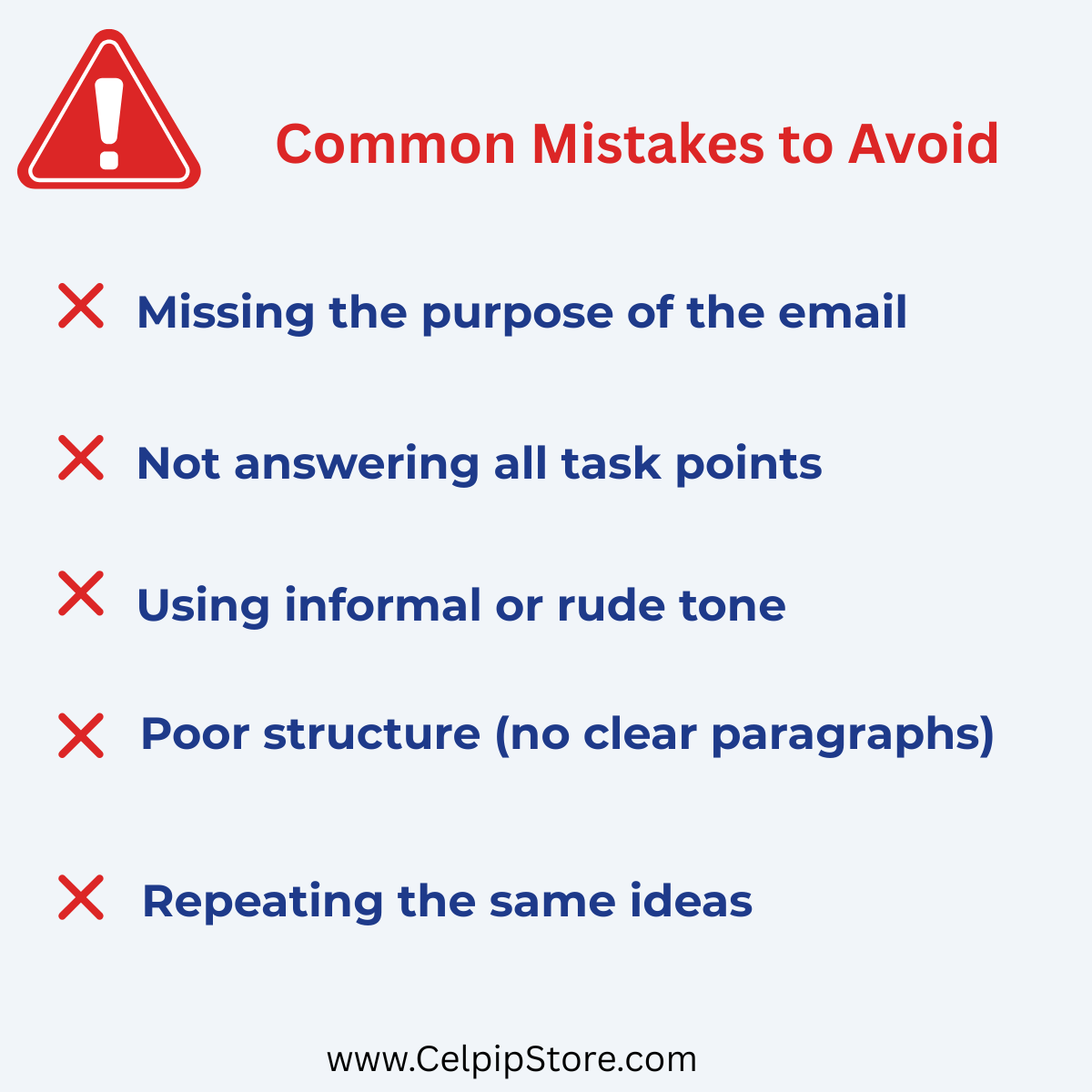
Mistake 7: Poor Organization
Writing everything in one paragraph or jumping between ideas reduces clarity.
Fix:
Use clear paragraphs with a logical flow.
Mistake 8: No Proofreading
Small grammar or spelling errors can reduce clarity.
Fix:
Leave 1–2 minutes to review your email.
Many candidates lose marks not only in Task 1 but across the Writing section due to weak overall strategy. Avoid these mistakes by understanding the complete Writing system in our CELPIP Writing Guide.
The Complete CELPIP Writing Task 1 Framework
To perform well in Task 1, you need a clear and repeatable structure.
Here is the complete framework you should follow:
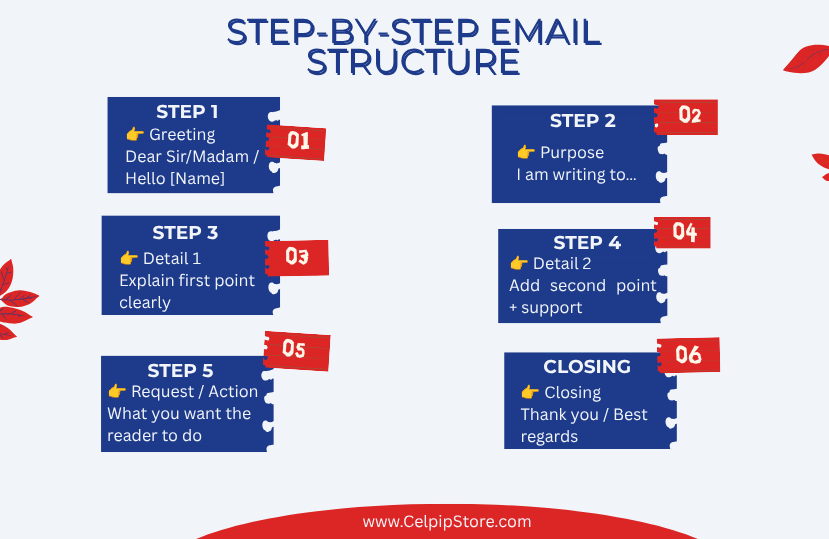
- Greeting
- Purpose
- Main Points
- Details
- Request/Action
- Closing
This structure works for almost every email question in the CELPIP exam.
Let’s break it down step by step.
Step 1 — Greeting
Your greeting must match your reader and tone.
Examples:
Formal
- Dear Sir or Madam,
- Dear Mr. Brown,
Neutral
- Hello Sarah,
Informal
- Hi John,
Key Tip
- Always use a comma after the name.
- Avoid overly casual greetings in formal emails.
Step 2 — Purpose (Opening Sentence)
Your first sentence should clearly explain why you are writing.
This helps the reader understand your message immediately.
Examples:
- I am writing to complain about a recent purchase.
- I am writing to request more information about your services.
- I am writing to invite you to a special event.
Strategy
- Be direct and clear
- Avoid long, confusing introductions
Step 3 — Main Points (Task Completion)
This is the most important part of your email.
You must address every instruction given in the question.
Example Prompt Instructions:
- Describe the problem
- Explain how it affected you
- Request a solution
Your Job:
- Include ALL three points
- Do not skip anything
- Do not combine everything into one sentence
Strategy
Before writing, quickly note:
- Point 1
- Point 2
- Point 3
Step 4 — Develop Your Ideas
Do not just mention a point explain it clearly.
Use this simple formula:
- Point
- Explanation
- Detail / Example
Weak Example:
The product was damaged.
Strong Example:
The product I received was damaged, and the screen was cracked, which made it impossible to use.
Strategy
- Add at least 1–2 sentences for each important point
- Be specific and clear
- Use real-life style examples
Step 5 — Request / Action
This is often the most forgotten part.
You must clearly tell the reader:
What do you want them to do?
Examples:
- I would appreciate it if you could send a replacement.
- Please provide further details about the program.
- I would be grateful if you could approve my request.
Strategy
- Be polite
- Be clear
- Be specific
Step 6 — Closing
End your email in a natural and appropriate way.
Formal Closings
- Sincerely,
- Kind regards,
Neutral Closings
- Best regards,
Informal Closings
- Thanks,
- See you soon,
Final Line Examples:
- I look forward to your response.
- Thank you for your time and consideration.
Paragraph Structure for Task 1
Your email should be divided into clear paragraphs.
Recommended Structure
- Paragraph 1 — Opening + Purpose
- Paragraph 2 — Main Point 1 + Details
- Paragraph 3 — Main Point 2 + Details
- Paragraph 4 — Request + Closing
Key Rule
One paragraph = one main idea
Planning Your Email (30–60 Seconds)
Before you start writing, quickly plan your response.
Example Plan
Purpose: Complaint about product
- Point 1: Wrong item received
- Point 2: Caused inconvenience
- Point 3: Request replacement
Why Planning Matters
- Prevents missing points
- Improves organization
- Saves time while writing
Sample Question
Scenario:
You recently ordered a product online, but it does not match the description on the website.
Write an email to the company:
- Describe the problem
- Explain how it affected you
- Request a solution
Sample Answer (Band 8+ Level)
Dear Sir or Madam,
I am writing to express my dissatisfaction with a product I recently purchased from your website.
I ordered a pair of white sports shoes in size 38; however, I received a brown pair in size 37. As a result, the product is completely unusable for me. This has caused significant inconvenience, as I needed the shoes for an upcoming event.
I would appreciate it if you could arrange a replacement with the correct size and colour as soon as possible. Additionally, I would request that the return process be made convenient.
Thank you for your attention to this matter. I look forward to your prompt response.
Sincerely,
[Your Name]
Why This Answer Works
Clear Purpose
The first sentence clearly explains the issue.
Complete Task Coverage
All instructions are addressed:
- Problem
- Impact
- Request
Strong Development
Each point is explained with detail.
Appropriate Tone
Formal and polite throughout.
Clear Organization
Each paragraph has a purpose.
Useful Sentence Structures
These sentence starters will help you write more naturally.
Opening Sentences
- I am writing to inform you that…
- I am writing to request…
- I would like to bring to your attention…
Explaining a Problem
- Unfortunately, I encountered an issue with…
- The main problem is that…
Describing Impact
- As a result, I was unable to…
- This caused significant inconvenience because…
Making a Request
- I would appreciate it if you could…
- I kindly request that you…
Closing
- I look forward to your response.
- Thank you for your time and consideration.
Key Strategies for Task 1
- Strategy 1: Focus on Task Completion
Always answer all instructions.
- Strategy 2: Keep Your Writing Clear
Avoid:
- Long, confusing sentences
- Unnecessary complexity
- Strategy 3: Use Specific Details
Make your email realistic and clear.
- Strategy 4: Maintain Consistent Tone
Do not mix formal and informal language.
- Strategy 5: Leave Time to Review
Check for:
- Missing points
- Grammar errors
- Spelling mistakes
Advanced Tips to Improve Your CELPIP Writing Task 1 Score
Once you understand the basic structure, the next step is to refine your writing to achieve a higher score.
These advanced strategies will help you move from an average response to a strong, high-scoring one.
Tip 1: Prioritize Clarity Over Complexity
Many learners try to impress the examiner with difficult vocabulary or long sentences.
This often leads to:
- Grammar mistakes
- Unclear meaning
- Awkward phrasing
Better Approach
Use simple, clear, and natural sentences
Example
Complex but weak
I would like to hereby inform you regarding the inconvenience which has been encountered by me.
Clear and strong
I am writing to inform you about an issue I recently experienced.
Key Rule
Clear communication always scores higher than complicated language.
Tip 2: Fully Develop Each Point
High-scoring responses do not just mention ideas they explain them.
Weak
The service was bad.
Strong
The service was disappointing because the staff were unresponsive and did not address my concerns.
Use This Formula
- Point
- Explanation
- Detail
Tip 3: Maintain Consistent Tone
Tone is a key scoring factor in Task 1.
Common Problem
Mixing tones in the same email.
Example:
Hi John,
I would like to formally request your assistance...
Correct Approach
Keep tone consistent from beginning to end
Quick Guide
- Friend: Friendly
- Colleague: Neutral
- Company/Manager: Formal
Tip 4: Use Specific Language
Specific details make your writing:
- More realistic
- Easier to understand
- More convincing
Weak
I had a problem with my order.
Strong
I received the wrong item, and the size was also incorrect.
Tip 5: Write with Purpose
Every sentence should have a clear purpose.
Avoid:
- Repetition
- Unnecessary filler sentences
Ask Yourself
Does this sentence help the reader understand my message better?
Tip 6: Manage Your Time Wisely
You have limited time in the exam.
Suggested Time Strategy
- Planning: 1 minute
- Writing: 6–7 minutes
- Reviewing: 1–2 minutes
Key Reminder
- Always leave time to review your email.
Examiner Insights: How Your Email is Evaluated
To improve your score, you must understand how examiners assess your writing.
1. Task Fulfillment
Do you:
- Answer all parts of the question?
- Provide relevant information?
2. Organization
Is your email:
- Logical
- Well-structured
- Easy to follow
3. Development
Do you:
- Explain your ideas
- Provide details
- Support your points
4. Language
Does your writing show:
- Correct grammar
- Appropriate vocabulary
- Clear sentence structure
5. Tone
Is your tone:
- Appropriate for the reader
- Consistent throughout
Key Insight
Even if your grammar is strong, you can lose marks if you miss instructions or use the wrong tone.
Vocabulary for CELPIP Writing Task 1
Using the right vocabulary can improve your score but only if it is accurate and natural.
Useful Email Vocabulary
Making Requests
- I would appreciate it if you could…
- I kindly request that you…
- Please let me know if…
Explaining Problems
- I encountered an issue with…
- There appears to be a problem with…
- Unfortunately, the product/service did not meet expectations.
Describing Impact
- This caused significant inconvenience.
- As a result, I was unable to…
- This affected my plans because…
Being Polite
- Thank you for your time and consideration.
- I would be grateful for your assistance.
Closing
- I look forward to your response.
- Please respond at your earliest convenience.
Grammar Focus for Task 1
You do not need perfect grammar, but you must avoid frequent errors.
Focus on These Areas
1. Verb Tenses
- Use past tense for completed events
- Use present tense for general situations
2. Subject–Verb Agreement
- Ensure singular/plural forms match
3. Articles (a, an, the)
- Use correctly with countable nouns
4. Sentence Structure
- Avoid fragments
- Avoid overly long sentences
Key Tip
Short, clear sentences are often more effective than long, complex ones.
Practice Section
To improve, you must apply what you have learned.
Practice Question
You borrowed a book from a friend, but you lost it.
Write an email to your friend:
- Apologize for losing the book
- Explain what happened
- Offer a solution
Planning Example
Purpose: Apology
Point 1: Lost the book
Point 2: Explain situation
Point 3: Offer replacement
Sample Response
Hi Sarah,
I hope you are doing well. I am writing to apologize for losing the book you lent me.
Unfortunately, I misplaced it while travelling last week, and despite searching for it, I have not been able to find it. I understand that this book was important to you, and I sincerely regret the inconvenience caused.
I would like to replace the book or compensate you for it. Please let me know which option you prefer.
Thank you for your understanding. I hope to hear from you soon.
Best regards,
[Your Name]
Practice Exercise
Now try this:
Step 1
Choose a Task 1 question
Step 2
Plan your response (30–60 seconds)
Step 3
Write your email
Step 4
Review using this checklist:
- Did I answer all points?
- Is my tone correct?
- Are my ideas clear?
- Did I include a request/action?
- Is my grammar accurate?
Self-Evaluation Checklist (Before You Submit Your Email)
Before finalizing your answer in the exam, quickly review your email using this checklist.
Task Completion Checklist
- Did I respond to all 2–3 instructions in the question?
- Did I clearly explain the purpose of my email?
- Did I include a proper request or action?
Structure Checklist
- Is my email divided into clear paragraphs?
- Does each paragraph focus on one main idea?
- Is the flow logical (introduction ? body ? request ? closing)?
Language Checklist
- Are my sentences clear and easy to understand?
- Did I avoid overly complex or unnatural vocabulary?
- Is my grammar mostly accurate?
Tone Checklist
- Is the tone appropriate (formal / neutral / informal)?
- Did I maintain the same tone throughout the email?
- Did I avoid mixing styles (e.g., “Hi” + “Dear Sir”)?
Accuracy Checklist
- Did I avoid spelling mistakes?
- Did I use correct punctuation?
- Did I keep sentences readable and not too long?
How Examiners Give Your CELPIP Writing Task 1 Score
Understanding scoring helps you focus on what actually matters.
Your email is evaluated in five key areas:
1. Task Achievement (Most Important)
This checks:
- Did you answer everything in the question?
- Did you cover all required points?
High Score Strategy:
Never miss an instruction even one missing point can lower your score.
2. Coherence and Organization
This checks:
- Is your email logically structured?
- Is it easy to follow?
High Score Strategy:
Use clear paragraphs:
- Paragraph 1: Purpose
- Paragraph 2–3: Details
- Paragraph 4: Request + Closing
3. Vocabulary
This checks:
- Are you using appropriate words?
- Are expressions natural and not memorized?
High Score Strategy:
Use simple, correct, and natural vocabulary instead of advanced but incorrect words.
4. Grammar and Accuracy
This checks:
- Sentence structure
- Verb tense accuracy
- Common grammar errors
High Score Strategy:
Short, correct sentences are better than long, error-filled ones.
5. Tone and Formality
This checks:
- Is your tone suitable for the reader?
- Is it consistent?
High Score Strategy:
| Reader | Tone |
|---|---|
| Friend | Informal |
| Colleague | Neutral |
| Company/Official | Formal |
Band Score Improvement Guide (Quick Understanding)
To reach Level 6–7:
- Answer all instructions clearly
- Use simple but correct grammar
- Maintain basic organization
To reach Level 8–9:
- Fully develop all ideas
- Use clear paragraphing
- Maintain consistent tone
- Add specific details and examples
To reach Level 10+:
- Natural English flow
- Strong idea development
- No grammar distraction
- Perfect task completion
Final Expert Tips for CELPIP Writing Task 1
Tip 1: Think Like a Real-Life Email
Do not write like a test answer.
Write like:
- A real complaint
- A real request
- A real apology
Tip 2: Always Stay Relevant
Every sentence must support the purpose of your email.
If a sentence does not help the reader, remove it.
Tip 3: Never Ignore the Action Request
Many students forget to clearly say:
“What do I want the reader to do?”
Always include:
- Request
- Solution
- Next step
Tip 4: Keep Language Natural
Avoid:
- Memorized fancy sentences
- Overly formal structures
- Unnatural phrasing
Use:
- Simple, clear English
- Direct communication
Final Conclusion
CELPIP Writing Task 1 is not a test of complex English it is a test of clear communication under structure.
Once you master:
- Purpose identification
- Task breakdown
- Tone selection
- Structured writing
- Clear requests
You can consistently achieve a high score (Level 8–10+). To master CELPIP Writing completely, it is important to practice both Task 1 and Task 2 with the correct structure, tone, and strategy. Start with our Ultimate CELPIP Writing Guide to build a strong foundation for high scores.
What You Should Do Next (Practice Strategy)
To master this task:
Step 1:
Practice 1 email daily using real CELPIP prompts
Step 2:
Apply this structure every time:
- Greeting
- Purpose
- Details
- Request
- Closing
Step 3:
Self-check using the checklist before finalizing.
Frequently Asked Questions (FAQs)
1. What is CELPIP Writing Task 1?
CELPIP Writing Task 1 is an email-writing task where candidates respond to a real-life situation by addressing specific instructions. You must write a clear, well-organized email using the correct tone and include all required points.
2. How long should my CELPIP Task 1 email be?
Your email should be around 150–200 words. Writing too short may miss key points, while writing too long can lead to mistakes and poor time management.
3. What is the best structure for CELPIP Writing Task 1?
The best structure is:
- Greeting
- Purpose of writing
- Main points (2–3 instructions)
- Details and explanation
- Request or action
- Closing
This structure helps ensure clarity and full task completion.
4. What tone should I use in CELPIP Writing Task 1?
The tone depends on the reader:
- Friend: Informal (Hi John)
- Colleague: Neutral (Hello Sarah)
- Company/Official: Formal (Dear Sir or Madam)
Maintaining consistent tone is very important for scoring well.
5. What are common mistakes in CELPIP Writing Task 1?
Common mistakes include:
- Missing instructions from the question
- Using the wrong tone
- Writing without planning
- Being too general or vague
- Forgetting to include a request or solution
Avoiding these can significantly improve your score.
6. How can I improve my CELPIP Writing Task 1 score?
To improve your score:
- Follow a clear structure
- Address all instructions
- Use simple and natural English
- Add specific details
- Leave time for proofreading
Clarity is more important than complex vocabulary.
7. Do I need advanced vocabulary for CELPIP Writing Task 1?
No. You do not need advanced vocabulary. Examiners prefer clear, simple, and natural English. Overly complex words can lead to mistakes and reduce clarity.
8. How is CELPIP Writing Task 1 scored?
It is scored based on:
- Task achievement
- Organization
- Vocabulary
- Grammar
- Tone and clarity
Missing any instruction or using incorrect tone can lower your score.
9. Can I use templates in CELPIP Writing Task 1?
You can use a structure or framework, but avoid memorized templates. The response must match the question naturally, or it may look unnatural and reduce your score.
10. What is the most important factor in Task 1?
The most important factor is task completion. You must answer all parts of the question clearly. Even strong grammar cannot compensate for missing instructions.